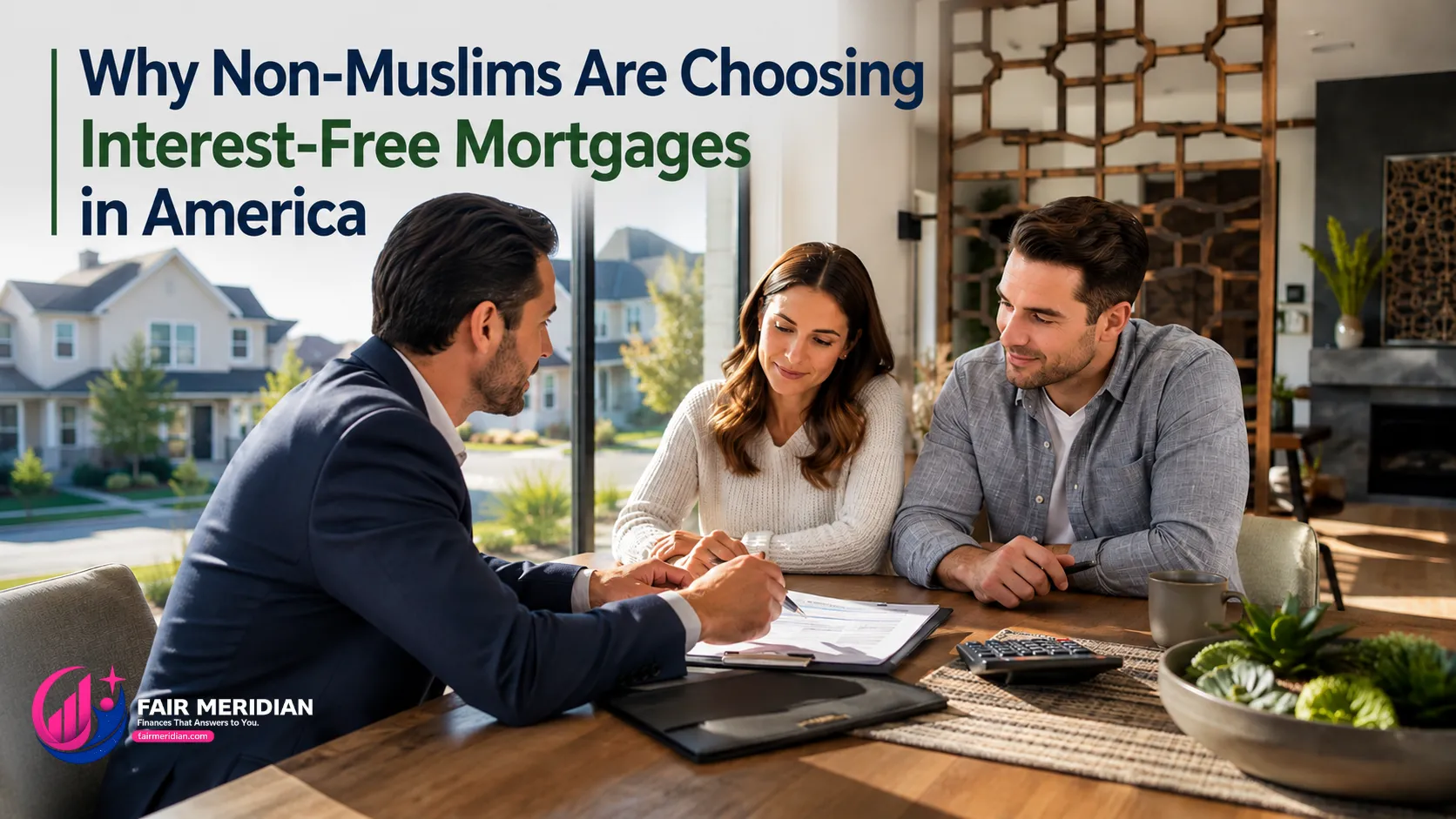
Guidance Residential, the largest Islamic mortgage company in the United States, does not require applicants to be Muslim. There is no religious test, no declaration of faith, no mosque membership required. Any qualifying buyer — Christian, Jewish, Hindu, atheist, agnostic — can apply for their musharakah co-ownership home financing product. And a growing number of non-Muslim Americans are doing exactly that, for reasons that have nothing to do with Islam and everything to do with how the structure works financially, ethically, and psychologically.
This is a story about a banking model that was designed for religious reasons but turns out to make sense for entirely secular ones.
The Structure That Makes Non-Muslims Pay Attention
Most people who encounter halal mortgages for the first time assume it's a conventional loan with Islamic branding — the same math, different vocabulary. It isn't. The musharakah co-ownership structure is genuinely, mechanically different from a conventional amortized mortgage, and that difference has financial consequences that apply to every buyer regardless of religion.
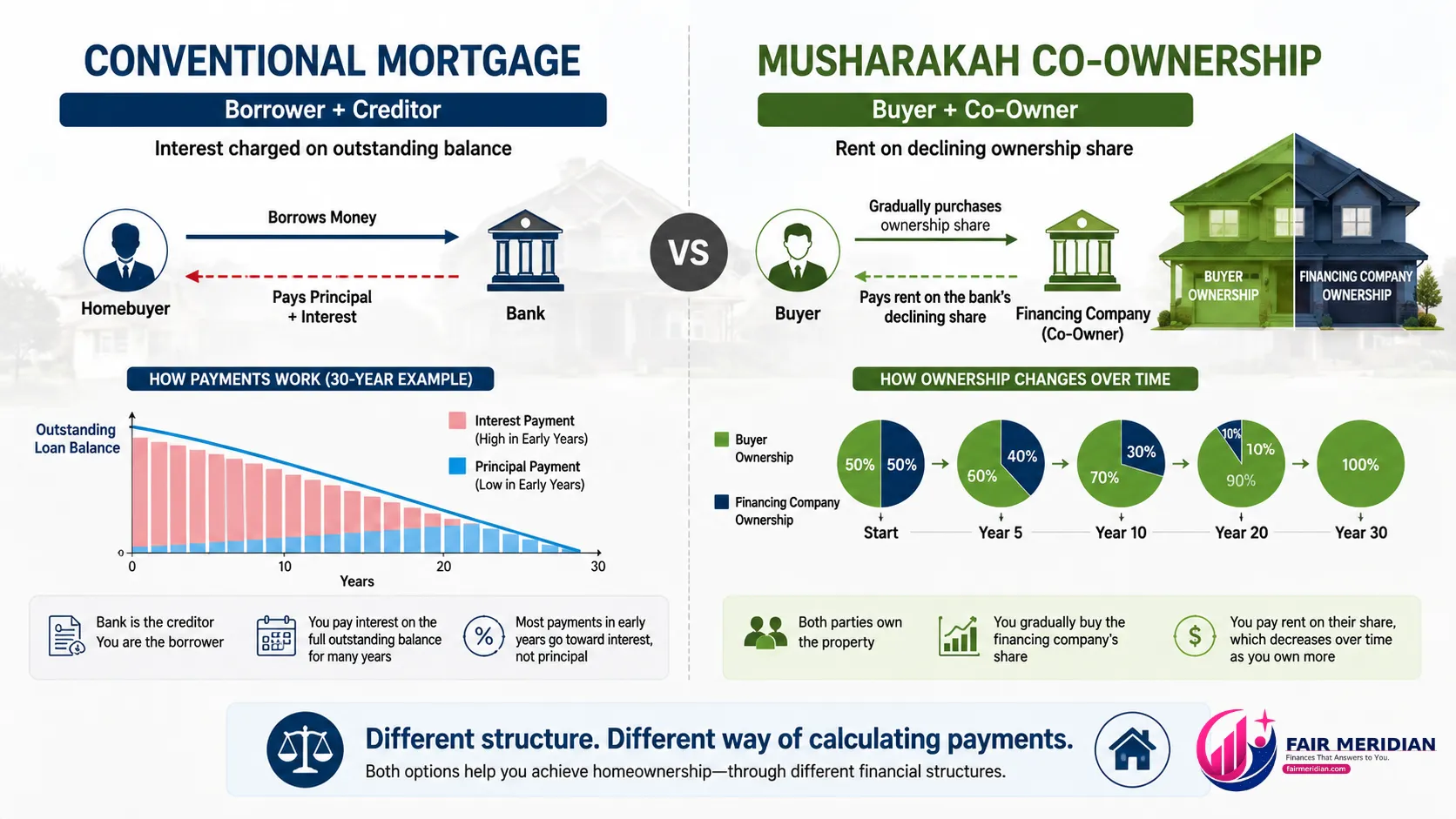
In a conventional mortgage, you borrow money and pay interest on the full outstanding balance throughout the loan term. The amortization schedule is designed so that early payments are almost entirely interest — you pay 25+ years of mostly interest before meaningfully reducing the principal. On a $320,000 loan at 6.87% over 30 years, you pay approximately $437,000 in interest on top of the $320,000 you borrowed. Total out of pocket: $757,000 for a property that cost $400,000.
In the musharakah model, the bank co-owns the property with you. You pay rent on the bank's ownership stake — which decreases each month as you buy it out through fixed monthly acquisition payments. Because the bank's stake shrinks at the same rate every month from day one, the rent you pay on it decreases proportionally throughout the term. You're never paying interest on the full original amount for 30 years. You're paying rent on a declining stake. The math produces a meaningfully lower total cost over the life of the financing — approximately $100,000 less in total payments compared to conventional amortization at the same profit rate.
That $100,000 difference gets the attention of people who would never describe themselves as interested in Islamic finance.
After 2008, Some Americans Changed Their Relationship with Bank Debt
The 2008 financial crisis didn't just wipe out home equity — it changed how a segment of the American public thinks about mortgage debt and banks. A generation of homeowners watched neighbors lose properties because they couldn't service adjustable-rate loans that reset upward while home values collapsed. They watched banks receive bailouts funded by the same taxpayers whose homes were foreclosed. The emotional experience of that period created lasting skepticism about conventional mortgage structures that hasn't fully dissipated.

The co-ownership model appealed to some of these buyers — not because it's Islamic, but because the bank is genuinely a co-owner rather than a creditor. In a default scenario under musharakah, the resolution is proportional: the property is sold and proceeds are divided according to ownership stakes. There's no interest accruing on an unpaid balance. No deficiency judgment for the gap between what the home sells for and what the "outstanding loan" says you owe. The structure shares downside risk between the parties rather than placing all of it on the borrower while protecting the lender entirely.
Some post-2008 buyers found this more honest than what they'd experienced with conventional mortgages. They didn't need a religious framework to reach that conclusion.
The Biblical Usury Connection Most People Don't Know About
Islamic finance is not the only tradition that prohibits interest. The Old Testament contains explicit prohibitions on usury — charging interest on loans to those in need — and these passages appear in Exodus, Leviticus, Deuteronomy, Ezekiel, and the Psalms. The word translated as "usury" in many English Bibles meant, in the original Hebrew context, any addition to the principal — any interest at all, not just excessive interest.
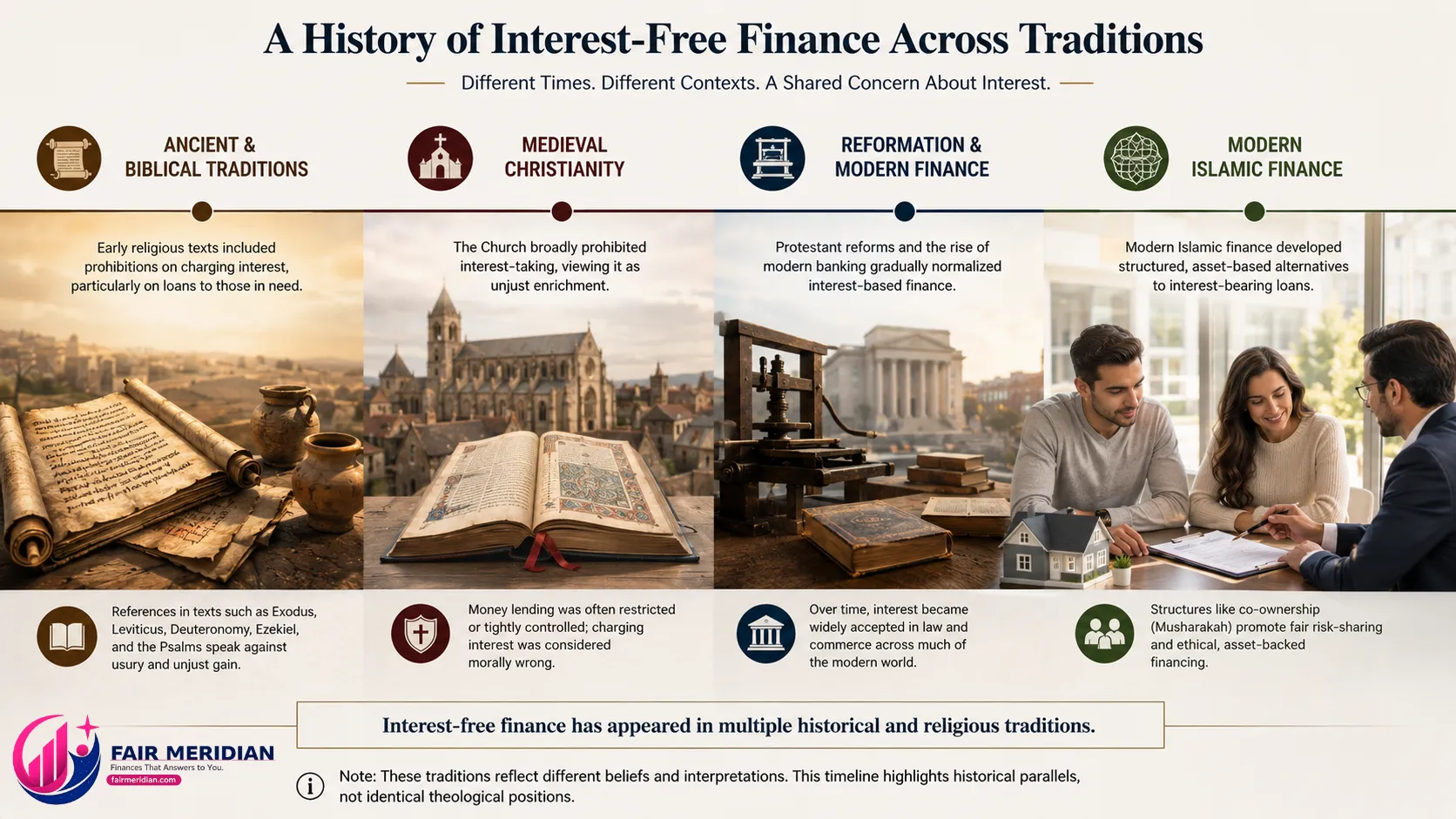
Medieval Christian theology prohibited interest-taking entirely, which is why money lending was historically associated with Jewish communities — the only group exempted from the church's usury prohibition under certain interpretations, and even then only when lending to non-Jews. The Protestant Reformation relaxed these prohibitions significantly, and by the 18th century the Christian world had largely accommodated interest-based finance. But the theological tradition never fully disappeared.
A small but genuine segment of devout Christian homebuyers — particularly in evangelical, Mennonite, and some Catholic communities — have sought interest-free alternatives to conventional mortgages on explicitly biblical grounds. For these buyers, a halal mortgage isn't an Islamic product they're borrowing from another faith — it's a financial structure that happens to align with their own tradition's original position on debt and interest. The fact that it's been preserved and developed by the Islamic finance industry is, to them, a practical detail rather than a theological obstacle.
The ESG Investing Movement's Overlap with Ethical Finance
ESG (Environmental, Social, and Governance) investing has grown dramatically over the past decade — assets in ESG-oriented funds now exceed $35 trillion globally. The movement reflects a broader shift in how a portion of the investing public thinks about capital allocation: not just what returns an investment generates, but what activities it funds and what systems it reinforces.
Interest-based mortgage finance is one of the systems that ESG-aware consumers have begun questioning. A conventional mortgage funds a conventional bank's balance sheet — the same institution that may hold leveraged derivatives, fund payday lending operations, or engage in the kind of financial engineering that ESG-conscious consumers have explicitly said they want to avoid. The halal mortgage co-ownership model is structurally different: the financing institution is a genuine co-owner of the property, with proportional downside risk, not a creditor extracting interest from a transaction in which it bears none of the asset risk.
Some ethical finance advocates have started describing Islamic finance principles as "ahead of their time" — not in a religious sense, but in the sense that the prohibition on interest, the requirement that financing be tied to real assets, and the insistence on risk-sharing between parties map closely onto what post-2008 financial reformers argued the banking system needed. The language is different. The underlying structure is surprisingly similar.
What Non-Muslim Buyers Actually Experience
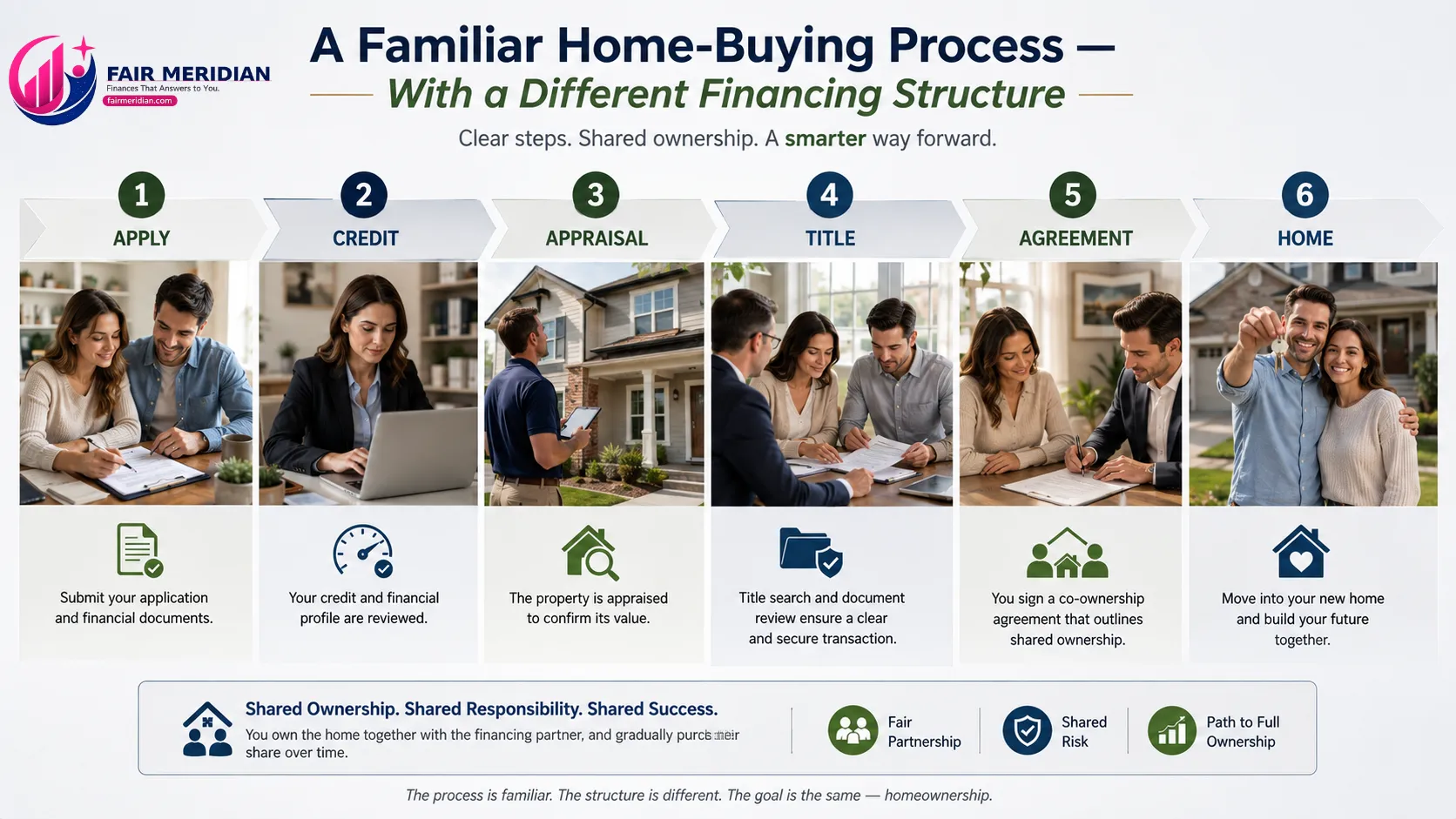
The practical experience of a non-Muslim using Guidance Residential is straightforward. The application process is identical to a conventional mortgage: income documentation, credit check, property appraisal, title search. The contract language is different — you're entering a co-ownership arrangement, not taking out a loan — but the monthly payment feels similar, the closing process is familiar, and the property is yours to live in and eventually own outright.
What's different is the relationship with the lender. Because the financing company co-owns the property, there's a genuine shared-interest dynamic — the lender has incentive for the property to retain value because they're a co-owner, not just a creditor. The late payment structure involves a fixed administrative fee rather than compound penalty interest. And the total cost over 30 years is lower than a comparable conventional mortgage.
None of that requires religious belief to appreciate.
The Honest Limitations for Non-Muslim Buyers
A few things a non-Muslim buyer should know before pursuing this path.
Guidance Residential covers 22 states plus DC. If you're buying in a state they don't serve, you'll need Devon Bank (nationwide, murabaha structure) or Lariba Finance (nationwide, ijara-based) instead. Both are open to non-Muslim buyers as well.
The 5% down option at Guidance is available to any qualifying buyer regardless of religion. This is genuinely important — no conventional lender offers a co-ownership mortgage at 5% down. You're accessing something that doesn't exist anywhere else in the US market.
Closing timelines run 45–60 days rather than the 30–45 days of a conventional mortgage. The co-ownership documentation requires additional processing. If you're in a competitive market where sellers want fast closings, negotiate a 60-day period explicitly in your offer.
Some buyers ask whether it's culturally appropriate for non-Muslims to use a product built for Muslim communities. The answer is yes — Islamic finance scholars and the companies that offer these products generally view broader adoption as positive, not problematic. The financial infrastructure was built to serve a need; it isn't restricted by religion because the need for ethical, interest-free financing is not exclusive to Muslims.
Frequently Asked Questions
Can a non-Muslim get a halal mortgage?
Yes. Halal mortgage lenders in the United States including Guidance Residential, Devon Bank, UIF Corporation, IjaraCDC, and Lariba Finance do not require applicants to be Muslim. There is no religious test, declaration of faith, or mosque membership required. Any qualifying buyer who meets the income, credit, and down payment criteria can apply for and receive Islamic home financing, regardless of their religion or lack of one.
Why would a non-Muslim want an interest-free mortgage?
Several reasons that have nothing to do with religion. The musharakah co-ownership structure generates approximately $100,000 less in total payments over 30 years compared to conventional amortization at the same profit rate. The structure shares downside risk between the buyer and the financing company rather than placing all risk on the buyer. The late payment terms don't compound interest on missed payments. And for ESG-conscious buyers or those with ethical objections to interest-bearing bank finance on non-religious grounds, the structure aligns with their values without requiring any religious framework.
Do you have to be Muslim to use Guidance Residential?
No. Guidance Residential is open to all qualifying buyers regardless of religion. Their musharakah home financing product, minimum 5% down payment, and current rate of 6.74% (720+ FICO, May 2026) are available to any buyer who meets their standard income, credit, and property eligibility criteria. Guidance operates in 22 US states plus DC.
Does the Bible prohibit interest the same way Islam does?
The Old Testament contains multiple explicit prohibitions on interest — passages in Exodus, Leviticus, Deuteronomy, and Ezekiel that use language meaning any addition to the principal, not just excessive rates. Medieval Christianity prohibited interest-taking entirely. The Protestant Reformation relaxed these prohibitions over centuries, and modern Christian practice generally permits conventional mortgages. However, some devout Christian traditions — particularly Mennonite and certain evangelical communities — maintain theological objections to interest and have used Islamic finance structures as a practical alternative that aligns with their own tradition's original position.
Is Islamic finance growing among non-Muslims in the USA?
Yes, gradually. Non-Muslim interest in Islamic finance products in the US is driven primarily by three groups: ESG-focused investors and consumers who find the ethical finance principles compelling on secular grounds; buyers who became debt-averse after 2008 and find the co-ownership model's risk-sharing more honest than conventional lending; and devout Christians or Jews who maintain theological objections to interest and find the Islamic finance infrastructure a practical solution their own religious communities haven't built at scale. This audience is small relative to the Muslim buyer market but is growing as awareness of the product's financial advantages spreads beyond religious communities.
Is a halal mortgage better than a conventional mortgage financially?
On total cost, yes — when comparing the pure musharakah declining-payment model to conventional amortization at the same rate. The musharakah generates approximately $100,000 less in total profit payments over 30 years on a $320,000 financed amount at 6.74%, because profit is calculated on a declining bank ownership stake rather than a compound amortized balance. Additionally, Guidance Residential's current rate (6.74%) is 13 basis points below the conventional 30-year average (6.87%), adding further savings. The closing costs can be $500–$2,000 higher due to co-ownership documentation — a one-time cost that the ongoing rate and structural savings more than offset.
For the complete explanation of how the musharakah payment calculation differs from conventional amortization — with year-by-year payment schedules — read our Musharakah Mortgage Calculator Explained. For current rates from all five US halal mortgage providers, see our Halal Mortgage Rates USA Guide. For the 10 questions every buyer should ask any halal mortgage lender before signing, read our Halal Mortgage Due Diligence Guide.