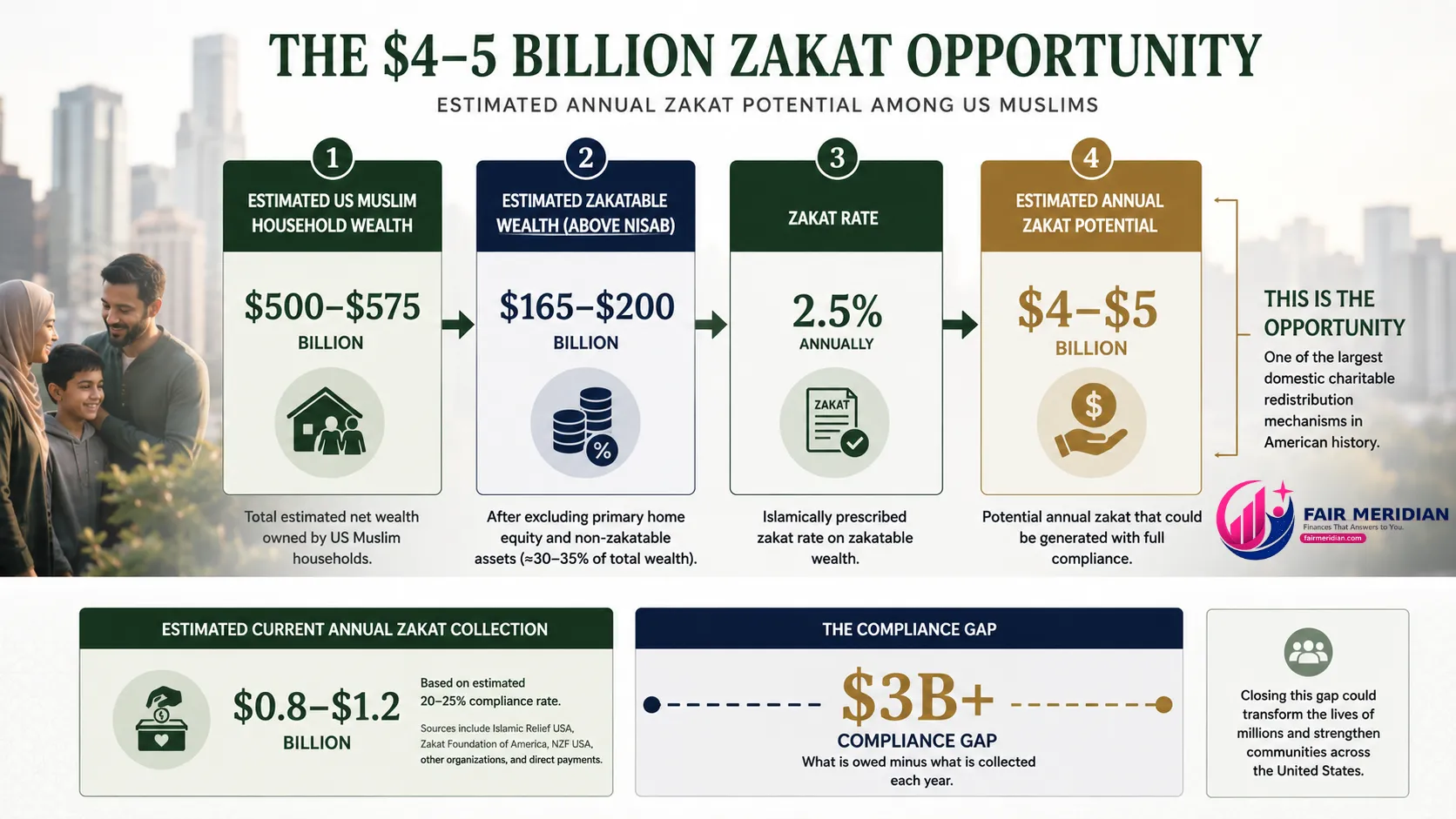
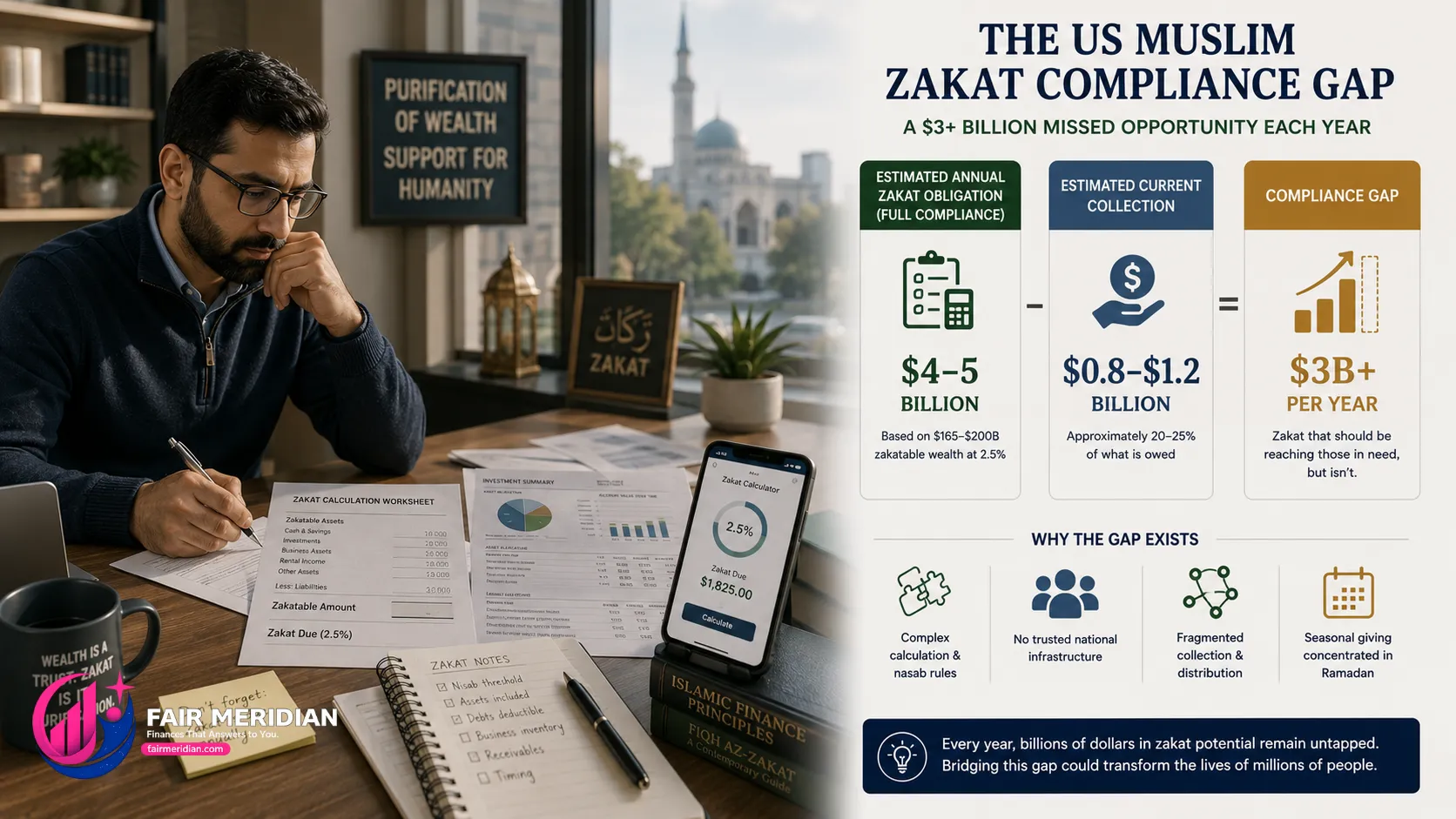
Zakat is a 2.5% annual levy on qualifying wealth above a minimum threshold. In the United States, Muslim Americans likely hold approximately $500–$600 billion in total net wealth. Full zakat compliance on that base would generate approximately $4–5 billion annually — making it, if fully collected and distributed, one of the largest domestic charitable redistribution mechanisms in American history. Actual US Muslim zakat collection is estimated at 20–25% of that figure. The compliance gap is not a spiritual curiosity. It is a $3+ billion annual missed opportunity for the most efficient anti-poverty transfer mechanism in Islamic law — and, it turns out, one of the most efficient in development economics.
This post runs the numbers, compares the model to what the US currently does, maps the Quranic poverty categories against modern American poverty demographics, applies the development economics literature on direct cash transfers, and then asks honestly why the gap between what zakat could do and what it actually does in the US is so large.
The Three Mathematical Scenarios
Before the analysis, the math must be clear. Three scenarios with different assumptions produce three very different numbers.
Scenario A: US Muslim Zakat at Full Compliance
Variable | Estimate | Source / Basis |
|---|---|---|
US Muslim adult population (2026) | ~4.5 million | Pew 2017 (3.45M adults) adjusted for growth |
US Muslim households | ~2.0–2.3 million | Average household size ~2.0 adults |
Estimated average Muslim household net worth | ~$250,000 | Conservative estimate; Muslim Americans are disproportionately college-educated professionals but include substantial working-class immigrant and refugee populations |
Total estimated US Muslim wealth | ~$500–$575 billion | 2.25M households × $250K average |
Estimated zakatable portion (above nisab; excluding primary home equity, personal vehicles, basic household goods) | ~30–35% of net wealth | Typical wealth composition for middle-class households; primary home equity excluded per majority scholarly opinion |
Total zakatable US Muslim wealth | ~$165–$200 billion | $537.5B × 32.5% |
Annual zakat at 2.5% | $4.1–$5.0 billion | $182.5B × 2.5% |
Estimated current actual US zakat collection | ~$0.8–$1.2 billion | Islamic Relief USA (~$80M), Zakat Foundation (~$100–150M), NZF USA, other organizations, direct payments. Estimated 20–25% compliance rate. |
The compliance gap | ~$3+ billion annually | What is owed minus what is collected |
Scenario B: Zakat Applied to All US Wealth (The Thought Experiment)
What if zakat were adopted as a policy framework applied to all US household wealth — regardless of religion? This is not a policy proposal; it is a mathematical demonstration of the system's potential scale.
Variable | Estimate |
|---|---|
Total US household net worth (Q4 2025) | ~$160 trillion (Federal Reserve Z.1) |
Estimated zakatable portion (above nisab ~$612 silver; excluding primary residence equity, retirement accounts up to a threshold, personal use assets) | ~30–35% of total |
Total zakatable US wealth | ~$50–$56 trillion |
Annual zakat at 2.5% | ~$1.25–$1.4 trillion |
Scenario C: The US Poverty Gap — What It Would Need to Cover
Poverty Metric | Figure | Source |
|---|---|---|
Americans below poverty line (2024) | ~37.9 million | US Census Bureau |
US poverty rate | ~11.6% | US Census Bureau 2024 |
Annual "poverty gap" — the total amount needed to bring every person below the poverty line up to the poverty line | ~$175 billion/year | Economic Policy Institute estimate; Congressional Budget Office analysis |
Current US federal anti-poverty spending (means-tested programs) | ~$650–$700 billion/year | OMB budget data; includes SNAP, Medicaid (poverty-related), housing assistance, EITC, TANF — excludes Social Security and Medicare |
Despite this spending, people remaining below poverty line | 37.9 million | The persistence of poverty despite large spending reflects the gap between spending and effective delivery |
Putting the Three Scenarios Together
Scenario | Annual Revenue | vs Poverty Gap ($175B) |
|---|---|---|
US Muslim zakat (full compliance) | ~$4.5 billion | 2.6% of poverty gap — meaningful for Muslim community poverty; insufficient to eliminate national poverty |
Universal US zakat (thought experiment) | ~$1.37 trillion | 7.8× the poverty gap — would fund complete poverty elimination and redirect $1.2 trillion to other community needs |
Current US anti-poverty spending | ~$675 billion | 3.9× the poverty gap — theoretically sufficient but not effectively targeted |
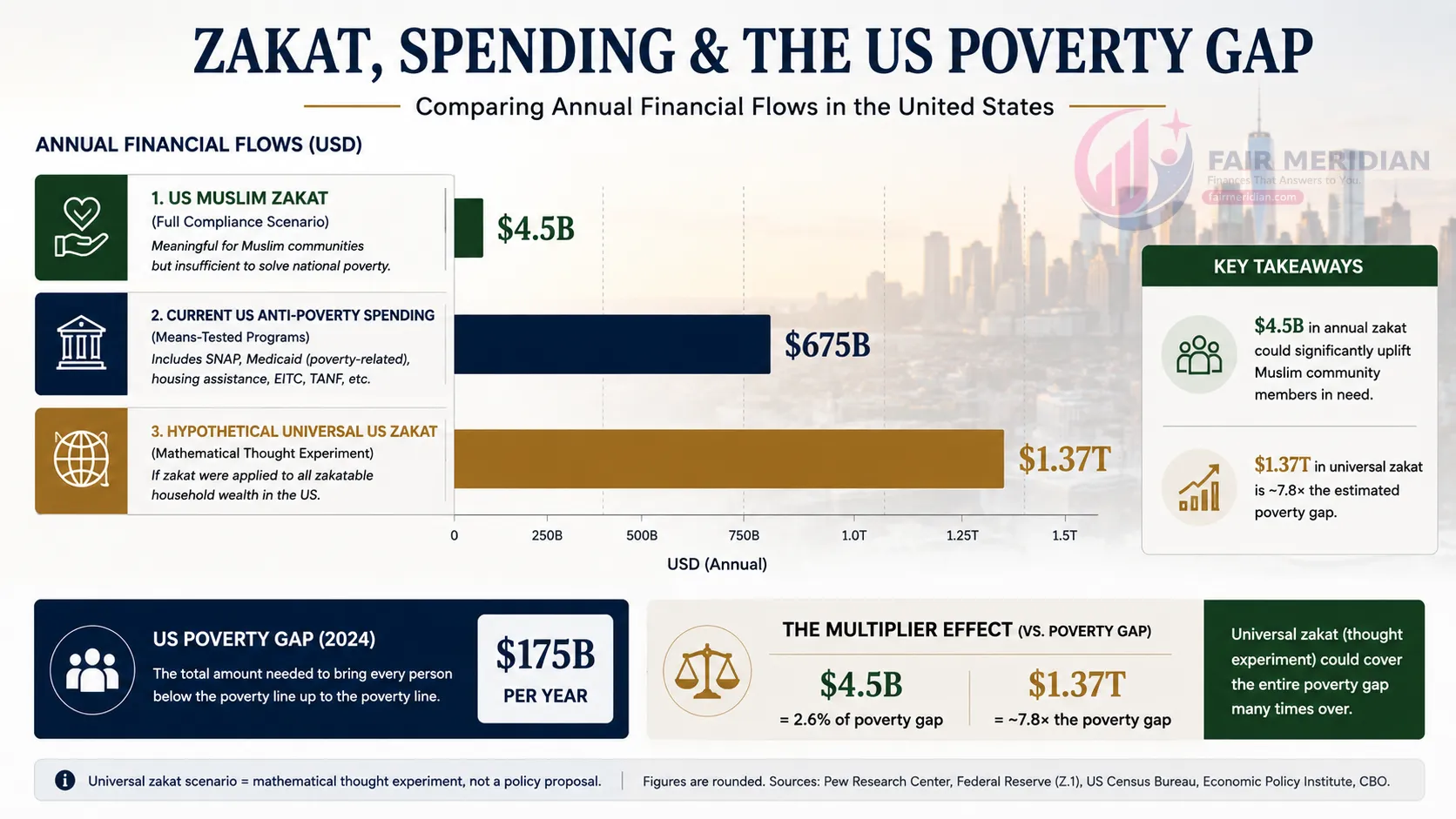
The math reveals something counterintuitive: the US already spends nearly four times the amount needed to close the poverty gap — yet 37.9 million people remain below the poverty line. The problem is not insufficient total spending. The problem is the inefficiency between dollar spent and dollar delivered to people in poverty. This is where the zakat model's design becomes the most interesting economic argument in the post.
The Eight Quranic Categories — Mapped to Modern American Poverty
Quran 9:60 specifies eight categories of zakat recipients. Mapping them to contemporary American poverty demographics reveals both the system's intended comprehensiveness and the scale of the need it was designed to meet.

Quranic Category | Classical Definition | Modern US Equivalent | Estimated US Scale |
|---|---|---|---|
Al-Fuqara (الفقراء) | The poor — those with less than half the nisab or unable to meet basic needs | Americans below 50% of the poverty line — the "deeply poor" | ~18.5 million Americans below 50% of the poverty threshold |
Al-Masakin (المساكين) | The needy — those with some resources but insufficient for basic needs; often considered more destitute than fuqara | The working poor — income above deep poverty but below self-sufficiency; "ALICE" households (Asset Limited, Income Constrained, Employed) | ~40–50 million Americans in this category by United Way ALICE Project estimates |
Al-Amileen (العاملين عليها) | Those who administer the zakat — collectors, distributors, managers | Nonprofit social services infrastructure; zakat administration organizations | Administrative overhead — scholars debate maximum allowable portion (typically 12.5% of fund) |
Al-Muallafat Qulubuhum (المؤلفة قلوبهم) | Those whose hearts are to be reconciled — new Muslims or those positively inclined toward Islam who need support | Support for new Muslim converts; interfaith bridge-building programs | Relatively small US category; meaningful for convert support which is largely unfunded |
Ar-Riqab (الرقاب) | Classically: freeing slaves. Contemporary scholars: liberation from bondage — including severe debt bondage and human trafficking | Debt relief for those in crushing debt burden; anti-trafficking support; those in economic bondage | ~43% of US households carry consumer debt at high interest rates; human trafficking affects estimated hundreds of thousands |
Al-Gharimeen (الغارمين) | The debt-burdened — those overwhelmed by debt incurred for legitimate purposes | Medical debt holders (the largest single US debt crisis); student debt burden; catastrophic financial event recovery | ~100 million Americans carry medical debt; $1.77 trillion in student loan debt nationally |
Fi Sabilillah (في سبيل الله) | In the path of Allah — historically: defense of community. Contemporary scholars: Islamic education, da'wa, community welfare institutions | Islamic schools, mosques, community centers, Islamic charity organizations, education | ~2,769 mosques in the US; hundreds of Islamic schools; significant underfunding relative to community need |
Ibn Al-Sabil (ابن السبيل) | The stranded traveler — someone away from home with insufficient resources | Homeless individuals; stranded migrants; disaster victims away from home resources; refugees | ~653,000 Americans experiencing homelessness (HUD 2023); ~3 million refugees and asylum seekers in various stages of US status |
The Quranic framework covers every major category of American poverty and economic vulnerability — from deep poverty (fuqara) to the working poor (masakin) to debt bondage (riqab, gharimeen) to institutional development (fi sabilillah) to emergency relief (ibn al-sabil). It is a comprehensive poverty coverage framework designed 1,400 years ago that maps directly onto the categories of need that modern welfare economists independently identify.
The Development Economics Case — Why Direct Transfer Outperforms Government Spending
The most compelling secular argument for zakat's economic model is not its scale — it is its delivery mechanism. Zakat to al-fuqara and al-masakin is essentially an unconditional direct cash transfer. And the development economics literature on direct cash transfers is now one of the strongest bodies of evidence in the field.
What the Research Shows
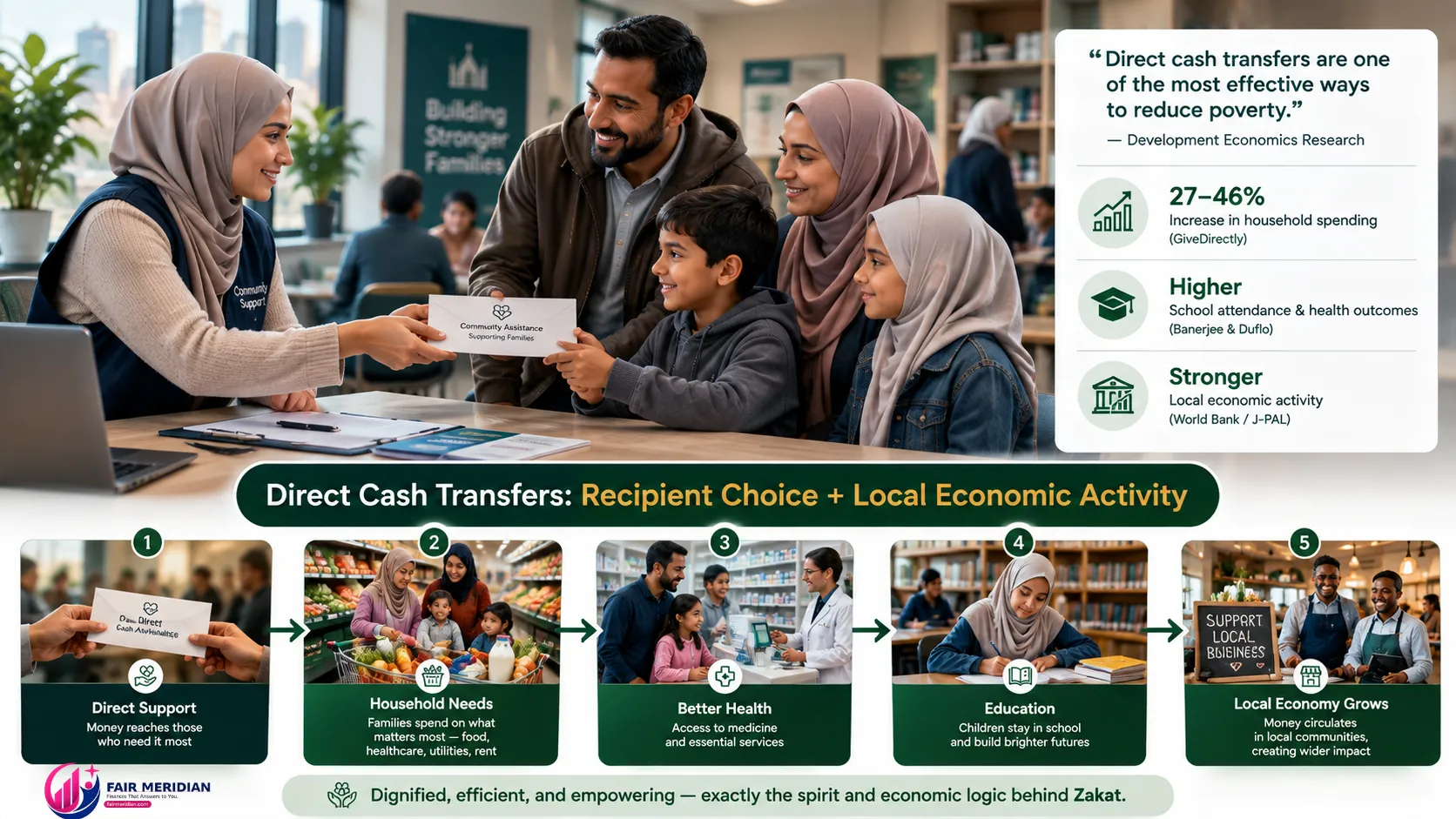
GiveDirectly (Kenya, East Africa): GiveDirectly has conducted the most extensive randomized controlled trials of direct cash transfers in the world, distributing no-strings cash to extremely poor households in Kenya, Rwanda, and elsewhere. Key findings from peer-reviewed studies:
$1,000 in direct cash transfers generates approximately $2.60 in total local economic output through the multiplier effect — each dollar helps the recipient but also stimulates local markets and employment
Recipients spend primarily on food, medicine, housing improvements, and business investment — not on alcohol or non-essential goods, contrary to common assumptions
Children in recipient households show measurably better health and education outcomes years later
MIT/Harvard Randomized Controlled Trials (Banerjee and Duflo, Nobel Laureates 2019): Their extensive work across multiple developing countries found that direct cash transfers to poor households are among the most effective poverty interventions — more effective than most conditional programs that require recipients to behave in specified ways. The poor, it turns out, are effective managers of modest cash resources when given the dignity of choosing how to use them.
Bolsa Família (Brazil): Brazil's conditional cash transfer program — essentially a scaled state implementation of a transfer mechanism analogous to zakat distribution — helped reduce Brazil's poverty rate from 10% to under 4% over a decade. The mechanism: identify those below a poverty threshold; transfer cash; allow recipients to allocate it according to their own understanding of their needs.
Zakat's Efficiency Advantage
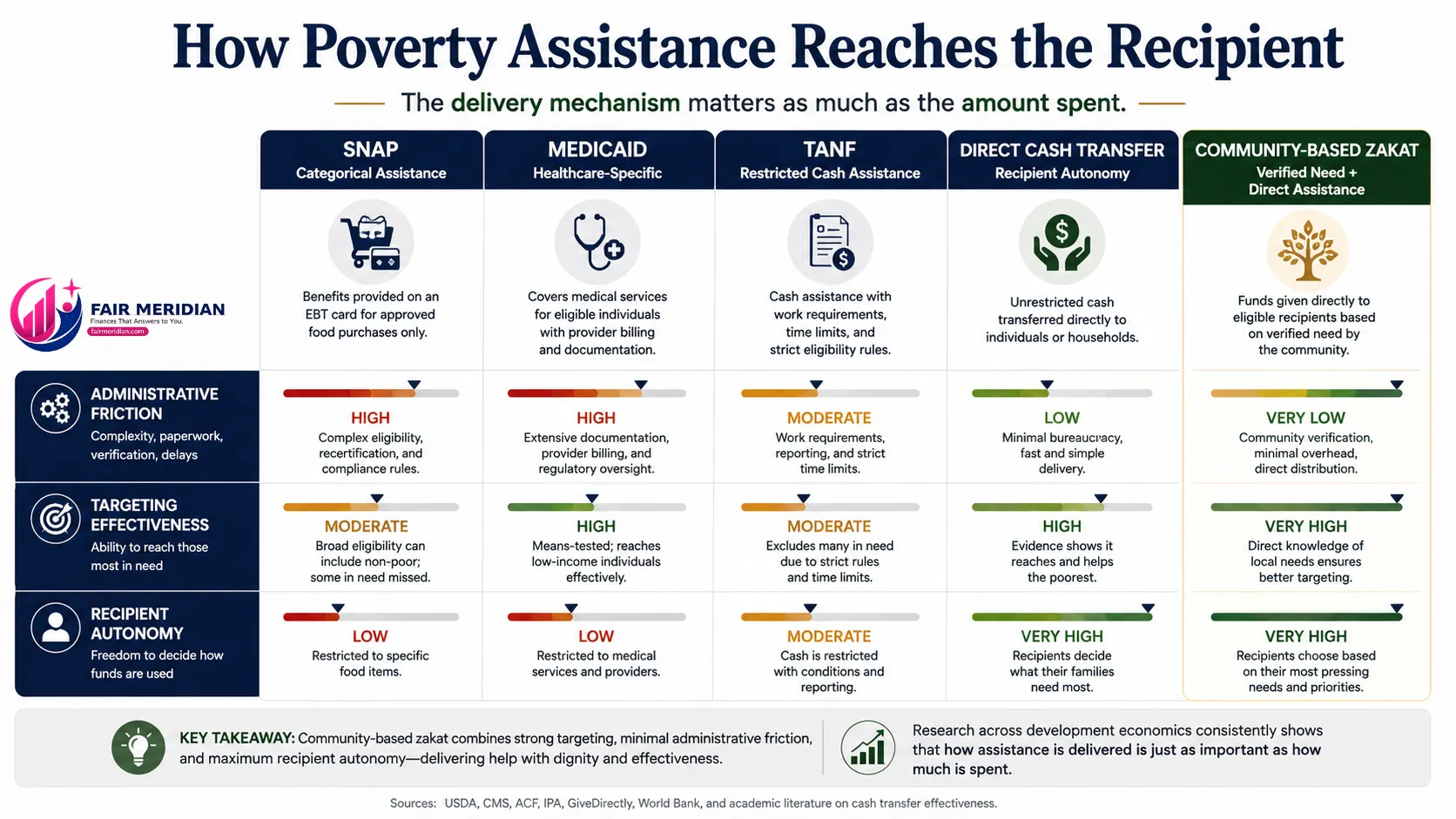
The US government spends approximately $675 billion annually on means-tested anti-poverty programs — roughly 3.9× the amount theoretically needed to close the poverty gap. The gap between spending and impact reflects:
Administrative overhead in bureaucratic distribution systems (SNAP has administrative costs of approximately 6-8%; Medicaid administrative costs run 5-10% depending on state)
Categorical restrictions that prevent recipients from using funds for their highest-priority need
Means-testing friction that excludes people who need help but don't navigate the application process
Political fragmentation across federal, state, and local program silos
Classical zakat distribution — direct payment to verified fuqara and masakin — has theoretically near-zero delivery friction when implemented through community channels. The mosque knows who is poor. The community fund knows who has lost their income. The local Islamic center knows who is facing medical debt or housing crisis. This information advantage that community institutions have over government bureaucracies is the efficiency argument for zakat that economists don't usually frame in Islamic terms but consistently rediscover in their research.
Distribution Mechanism | Administrative Overhead | Targeting Accuracy | Recipient Autonomy |
|---|---|---|---|
Federal SNAP (food stamps) | 6–8% | Moderate — categorical eligibility includes some non-poor; excludes some genuinely poor | Restricted to specific items; cannot use for rent, medicine, clothing |
Medicaid | 5–10% (state-dependent) | Moderate — covers healthcare specifically; poor may have non-healthcare needs unmet | Healthcare only |
TANF (cash assistance) | ~30% of total TANF funding goes to actual cash assistance; rest goes to services | Heavily restricted; only 1 in 4 poor families receives TANF benefits | Some cash freedom but heavily work-conditioned |
GiveDirectly direct transfer | ~11% (for global operations) | High — community-verified poverty targeting | Unconditional — full recipient autonomy |
Ideal zakat distribution (community-based) | ~8–12% (al-amileen category) | High — community-level knowledge of actual need | Full — cash to recipients for their own allocation |
The Compliance Crisis — Why Actual US Zakat Collection Is So Low
Returning to the central finding: US Muslims probably owe $4+ billion in annual zakat and actually collect roughly $1 billion. The $3+ billion compliance gap is not primarily a knowledge problem. Most practicing US Muslims know zakat is obligatory. The gap reflects several specific structural failures.
1. No Trusted National Collection Infrastructure
The US has no national zakat collection institution with the scale, reach, and trust of a national tax authority or even a major charitable organization. The largest US zakat-focused organizations — Zakat Foundation of America (~$150M annual collection), Islamic Relief USA (~$80M), NZF USA (~$15–20M) — together collect approximately $250–300M annually. Compare this to the $4+ billion owed: these organizations, combined, collect roughly 6–7% of the estimated total.
2. Direct Mosque Payment Bypasses National Organizations
A meaningful portion of actual zakat payment happens directly: to family members in need, to individuals at mosques, to community members one knows personally. This direct payment is entirely valid Islamically — and it's untracked. The true compliance rate may be higher than the institutional collection figures suggest, but the direct payment model prevents the aggregation needed for systematic poverty impact.
3. The Calculation Complexity Problem
Calculating zakat correctly for a contemporary American household — with SDIRA investments, a business interest, employer 401k (partially zakatable), home equity (not zakatable), stock portfolio (partially zakatable at the zakatable assets ratio), gold jewelry (madhab-dependent) — is genuinely complex. Most US Muslims have never received clear guidance on how to calculate their specific zakat obligation on a modern financial portfolio. The complexity becomes an avoidance mechanism.
4. Ramadan Concentration and Year-Round Gap
The overwhelming majority of US zakat payment happens in Ramadan — particularly the last 10 nights. While spiritually motivated (the rewards are multiplied in Ramadan), this seasonal concentration creates operational problems: zakat organizations receive massive lump-sum inflows they must deploy efficiently in a short period. The poverty need is year-round. The funding is seasonal.
5. International vs Domestic Allocation Tension
Most US zakat organizations allocate significant portions — sometimes majority portions — of collected zakat to international programs: Gaza, Yemen, Syria, Bangladesh, and other crisis contexts where need is acute and dollars go further. This is entirely valid under Islamic law — the eight Quranic categories have no geographic restriction. But it means that American Muslim poverty — which is real and significant, particularly in refugee communities — receives less zakat funding than the international crisis allocation suggests.
The Waqf Multiplier — Beyond Annual Zakat
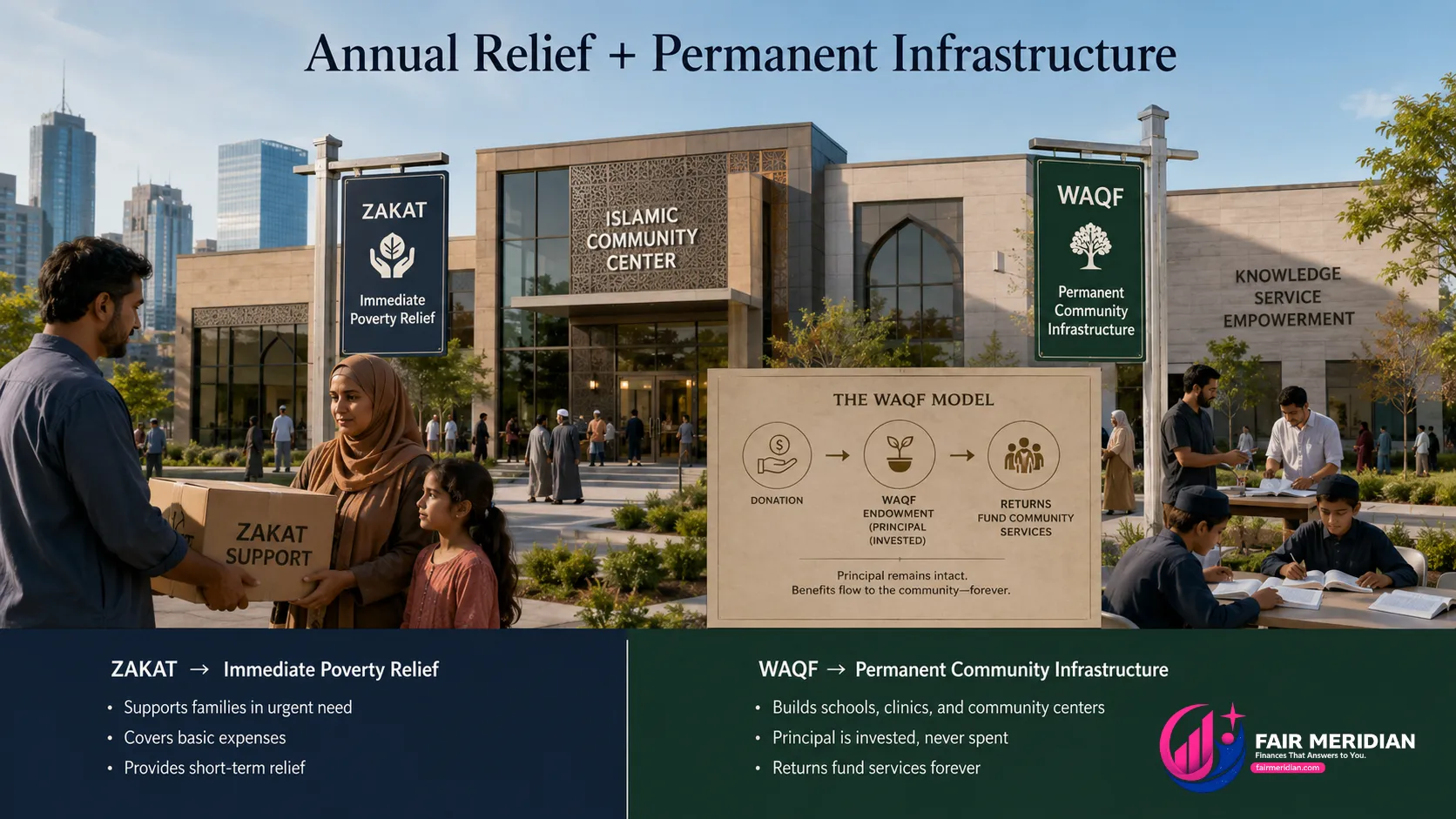
The deeper economic argument goes beyond annual zakat. The classical Islamic anti-poverty system was never just zakat — it was zakat plus waqf (permanent endowment) plus sadaqah, operating in combination to provide both immediate relief and permanent institutional infrastructure.
The waqf's economic power is in compounding: a one-time $1 million waqf contribution generating 5% annual return produces $50,000 per year forever — the original principal never consumed. Harvard's $53 billion endowment distributes approximately $2 billion annually to operations. An equivalent Muslim endowment infrastructure in the US — built over decades from Muslim professional wealth — could produce institutional poverty relief infrastructure that outlasts every living donor.
Waqf Scenario | Endowment Size | Annual Distribution (5% return) | What It Could Fund Permanently |
|---|---|---|---|
Single mosque waqf | $2 million | $100,000/year | 10 families' annual qard hasan loans of $10,000 each; revolving |
Large Islamic center waqf | $20 million | $1 million/year | Emergency fund (100 families × $5,000); halal mortgage assistance; Islamic school scholarship fund |
City Muslim community waqf (10,000 Muslim households) | $200 million | $10 million/year | Community development bank; halal business microfinance; Islamic school full operations; poverty elimination within the community |
National US Muslim waqf federation | $5 billion | $250 million/year | Permanent infrastructure at the scale of medium-sized US foundations; measurable national Muslim poverty impact |
What Would Actually Change — Realistic Impact
The post's title asks whether zakat could solve the US poverty problem. The honest answer is layered.
At current Muslim-only full compliance ($4.5B): No — US Muslim zakat alone could not eliminate American poverty at a national scale. $4.5B against a $175B poverty gap is 2.6%. But this framing misses the right comparison. The right comparison is: what could $4.5B in efficiently delivered direct transfers do for Muslim communities specifically, and for adjacent communities?
Muslim community poverty effectively eliminated: At $4.5B annually targeted at the estimated 800,000–1.2 million Muslim Americans in poverty, the per-capita annual distribution would be $3,750–$5,625 — enough to close the poverty gap for most Muslim families when combined with their existing income. Muslim-community poverty is a solvable problem at current community wealth levels, if collected and targeted effectively.
Medical debt crisis relief: America's 100 million medical debt holders include significant Muslim populations (gharimeen). Dedicated zakat for medical debt relief — a classically valid application — could free thousands of Muslim families from the economic immobility that medical debt causes.
Islamic school infrastructure: Fi sabilillah allocated to Islamic education could fund full-scholarship models at US Islamic schools, removing the economic barrier to Islamic education for working-class Muslim families. Current US Islamic schools charge $5,000–$15,000/year in tuition — prohibitive for low-income families.
Refugee Muslim community support: Clarkston, Georgia. Dearborn, Michigan. Minneapolis's Cedar-Riverside. These communities have large Muslim refugee populations experiencing real poverty that zakat is specifically designed to address. Targeted allocation to these geographies would produce measurable community transformation.
At universal US zakat ($1.37 trillion): Yes — with significant changes to the poverty framework. $1.37 trillion at 2.5% of zakatable wealth would close the $175B poverty gap almost eight times over. The surplus would fund healthcare infrastructure, housing development, education, and every other institution the eight Quranic categories imply. The reason the US doesn't do something structurally equivalent — despite spending $675B annually — is not resource scarcity. It is the mismatch between categorical spending and actual need.
The Honest Obstacles
Intellectual honesty requires mapping the obstacles as clearly as the potential.
Trust deficit: Large-scale zakat collection requires donors to trust that money reaches recipients efficiently. US Muslim charitable giving has been affected by post-9/11 legal scrutiny of Islamic charities, resulting in institutional caution that has never fully recovered. Building the trust infrastructure for $4B+ in annual zakat collection requires transparent accounting, independent auditing, and demonstrated distribution records over years.
The universal application is constitutionally impossible: Zakat is a religious obligation. The First Amendment prohibits government establishment of religion, making a state-imposed zakat system unconstitutional. The thought experiment of universal US zakat is instructive for understanding the system's potential scale — not a policy proposal.
Coordination failure: US Muslim zakat is collected and distributed by hundreds of independent mosques, dozens of national organizations, and millions of individual direct payments with no coordination infrastructure. The total is larger than any single organization; the per-organization impact is smaller than needed for systematic poverty impact.
Nisab threshold in a wealthy country: The silver nisab ($612) means that almost every US Muslim household above the poverty line technically owes zakat — but many Muslim families who are technically above nisab feel far from wealthy enough to give. The psychological experience of being above nisab in suburban America while feeling financially stressed creates resistance to the obligation that is hard to address with calculation alone.
What the Best Version of US Muslim Zakat Would Look Like
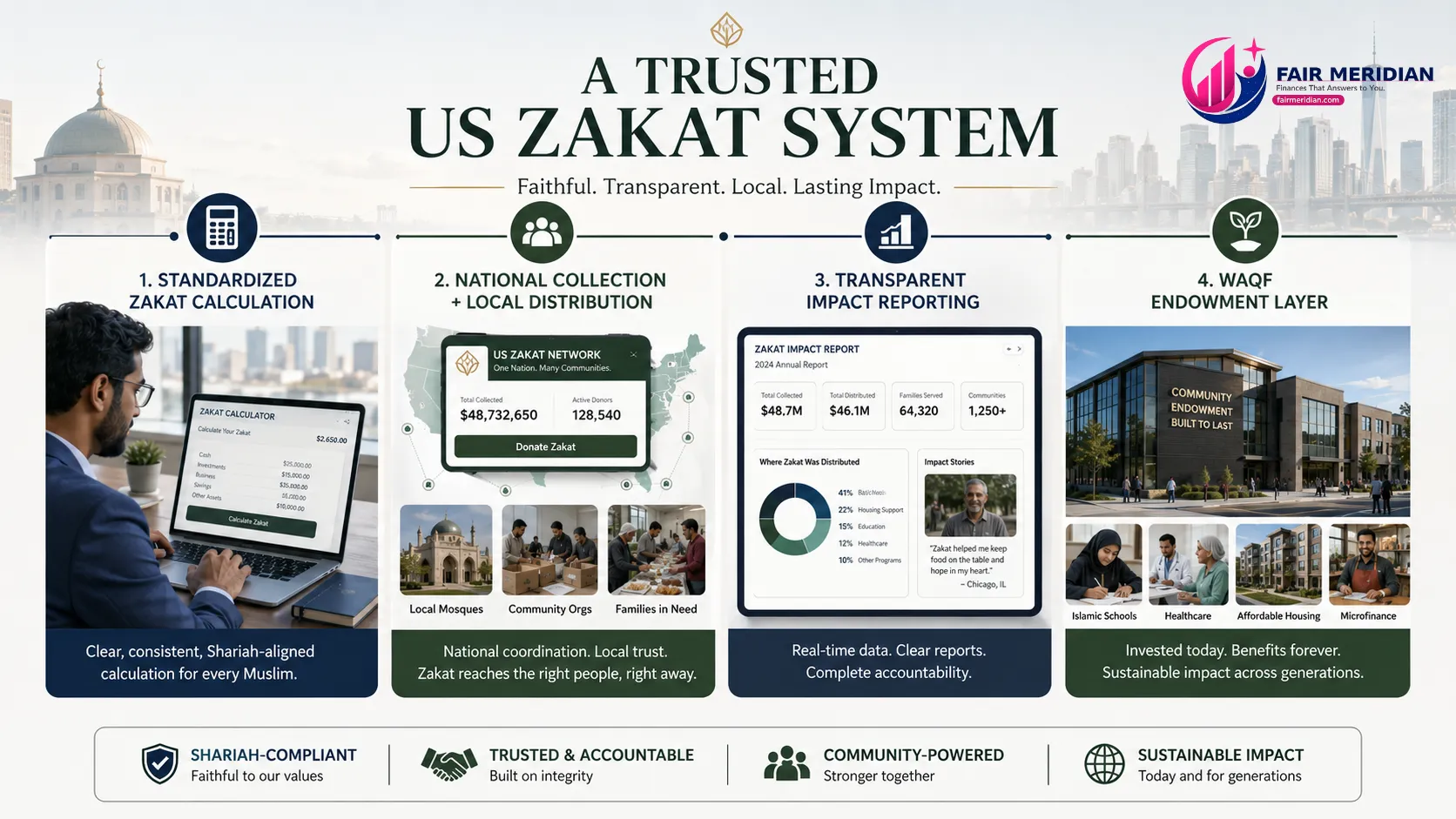
A coordinated US Muslim zakat system at full potential would have four elements:
Standardized national calculation tools: A single trusted calculator (with Sharia board endorsement) that handles modern US asset complexity — 401ks, SDIRA, SPUS holdings, business interests, home equity exclusion — and produces a clear annual obligation figure for any US Muslim household.
Federated national collection with local distribution: A national coordinating body that accepts zakat contributions and routes them to local certified distributors — mosques and community organizations with verified knowledge of local need. The efficiency of national collection with the targeting accuracy of local distribution.
Transparent impact reporting: Annual public accounts showing: total collected, total distributed, cost per dollar delivered, categories of recipients, and community outcome metrics. The data infrastructure to demonstrate impact and build the trust that drives increased compliance.
Waqf endowment layer: Alongside annual zakat, a parallel permanent endowment system that converts one-time major gifts into permanent institutional funding. The annual zakat covers immediate need; the waqf builds the infrastructure that reduces need over time.
Frequently Asked Questions
How much zakat do US Muslims owe annually?
Based on estimated US Muslim household wealth of $500–$575 billion and a 30–35% zakatable wealth ratio, US Muslims collectively owe approximately $4–5 billion in annual zakat. Current institutional collection is estimated at $800M–$1.2B annually — representing roughly 20–25% compliance with the theoretical obligation. The compliance gap of $3+ billion represents the largest untapped resource in US Muslim community development.
Could zakat actually solve poverty in the United States?
Muslim-only zakat at full compliance (~$4.5B) could effectively eliminate poverty within Muslim communities and fund significant adjacent community support — but represents 2.6% of the national poverty gap of ~$175B. A hypothetical universal US zakat system applied at 2.5% on all zakatable American wealth would generate ~$1.37 trillion annually — approximately 7.8× the amount needed to close the poverty gap. The obstacle is not the mechanism's scale potential; it is the gap between who currently pays it (approximately 1.5% of the US population) and the population that would need to participate for national-scale impact.
Why is US Muslim zakat compliance so low?
Five primary factors: (1) No trusted national collection infrastructure at scale — existing organizations collect a small fraction of theoretical obligation. (2) Calculation complexity for modern US financial portfolios that most Muslims have never been guided through clearly. (3) Ramadan concentration that creates operational mismatches between collection timing and year-round poverty need. (4) Direct informal payment (to family, community members) that is valid Islamically but untraceable in compliance estimates. (5) Post-9/11 trust damage to Islamic charitable institutions that has never fully recovered.
How does zakat compare to other anti-poverty mechanisms?
Zakat to fuqara and masakin is structurally identical to unconditional direct cash transfers — the anti-poverty intervention with the strongest evidence base in development economics. Research by Nobel Laureates Banerjee and Duflo, GiveDirectly's RCTs in East Africa, and Brazil's Bolsa Família at scale all demonstrate that direct cash transfers are among the most effective poverty interventions available. The US government spends approximately 3.9× the amount needed to close the poverty gap but delivers only a fraction of that as direct transfers — the rest goes to categorical programs with high administrative overhead and restricted usage. Zakat's design — direct transfer to verified need, recipient autonomy in allocation, community-level targeting — aligns with best practices that development economists independently derive from decades of research.
For the complete guide to calculating your personal zakat obligation — including 401k, SPUS holdings, gold jewelry, and business assets — see our Zakat Calculation Guide 2026. For the SPUS zakatable assets ratio used in investment zakat calculations, see our Halal ETFs Guide. For the qard hasan model of community interest-free lending that complements zakat distribution, read our Islamic Microfinance USA Guide.