
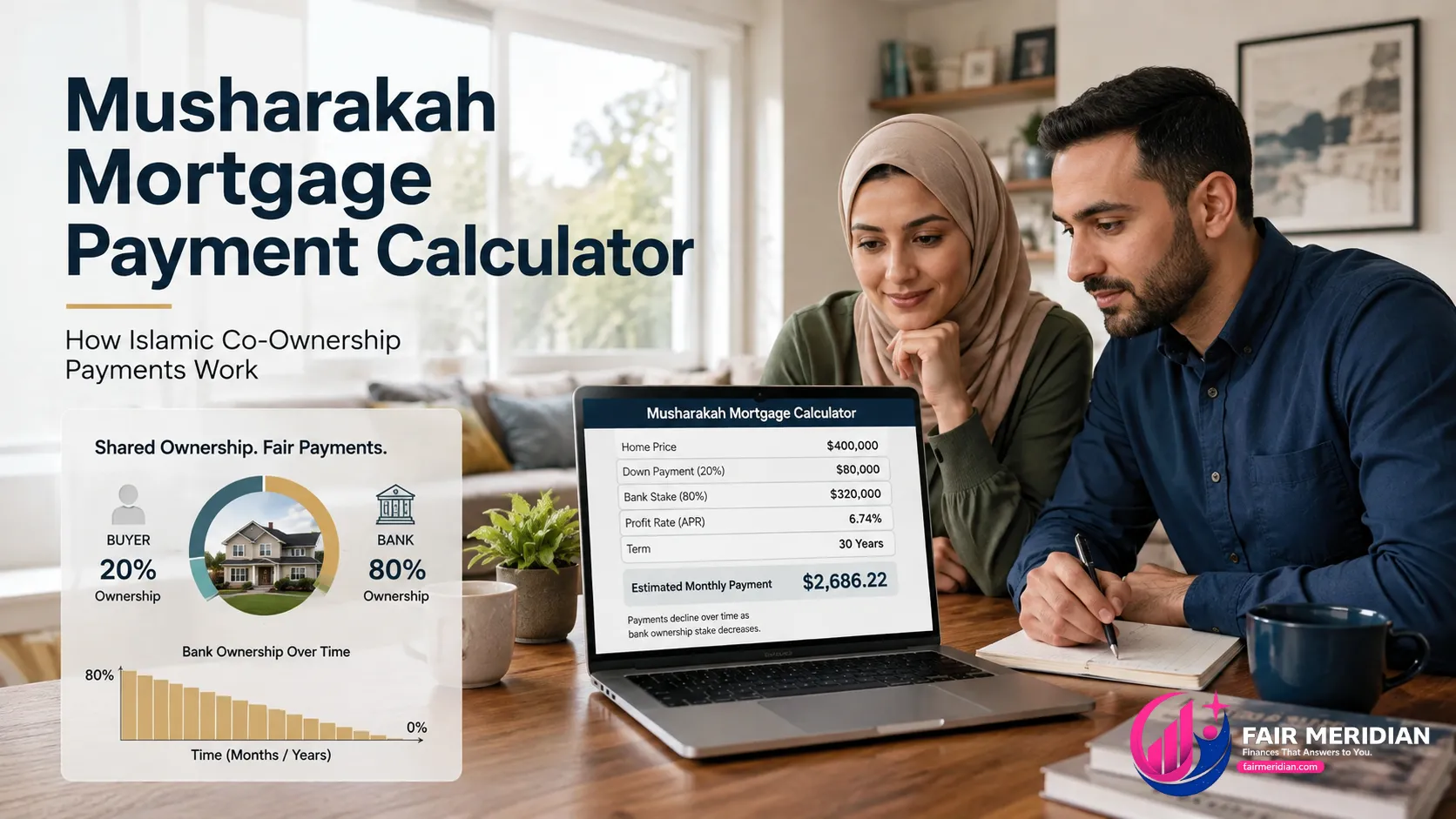
The standard mortgage calculator you find on Zillow, Bankrate, or your bank's website uses conventional amortization math — and gives you the wrong answer for a musharakah (Islamic co-ownership) mortgage. The monthly payment it calculates may be close to your actual musharakah payment, but the underlying math is structurally different in a way that matters: over 30 years, the pure musharakah model generates approximately $100,000 less in total payments than conventional amortization at the same profit rate. This post explains exactly how musharakah payments are calculated, shows you the year-by-year schedule, and explains why US lenders convert the classical model into a fixed monthly equivalent.
The Core Difference — Why Standard Calculators Give Wrong Answers
Conventional mortgage calculators use a formula called standard amortization. It works like this: you borrow $320,000 at 6.74% for 30 years. The lender calculates a fixed monthly payment that covers interest on the full outstanding balance plus a portion of principal — weighted so early payments are mostly interest, and later payments are mostly principal.
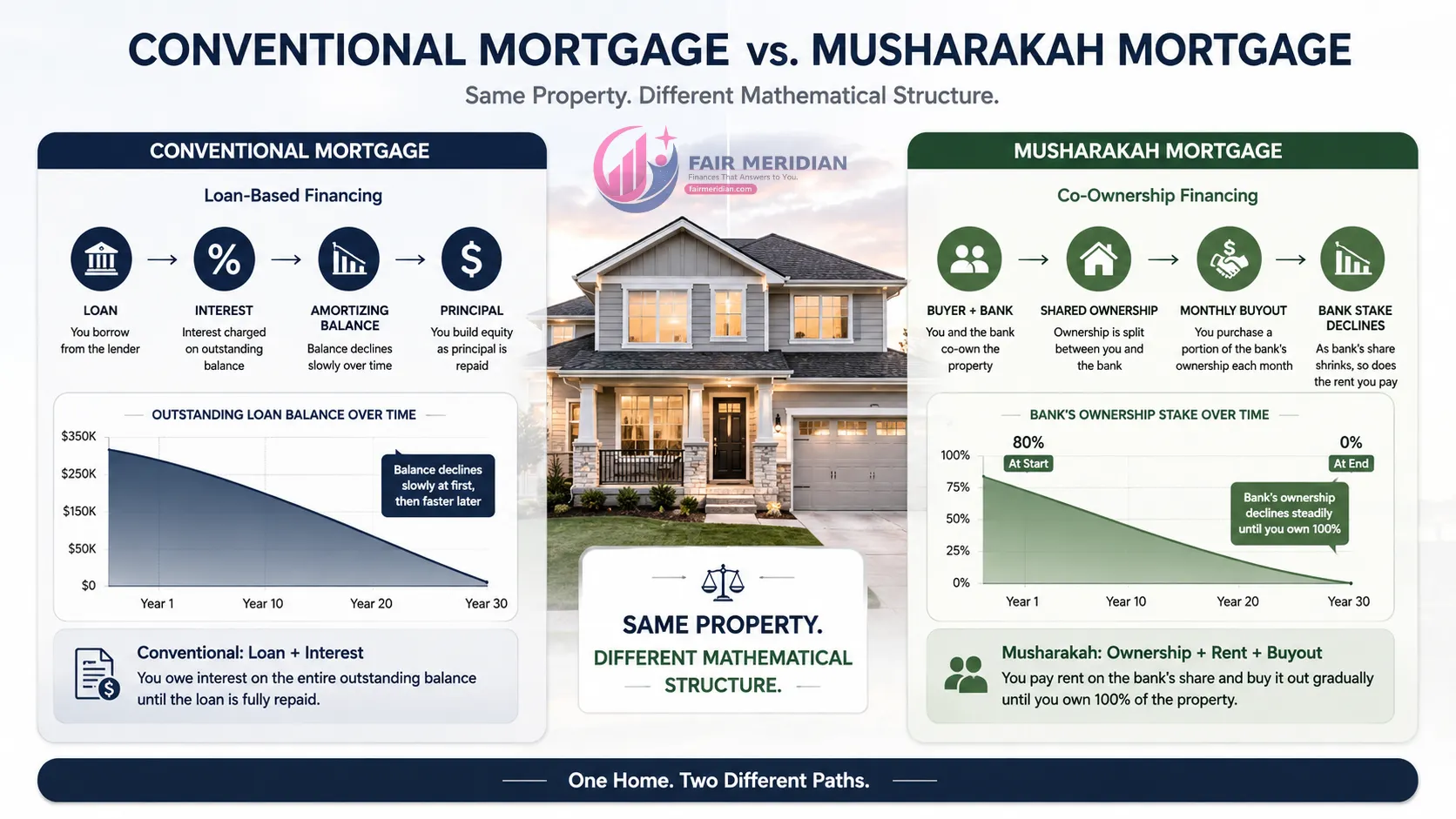
Musharakah does not use this formula. There is no loan. There is no "outstanding balance" in the lending sense. Instead:
You and the bank co-own the property
You pay rent on the bank's ownership stake
You pay a monthly buyout that reduces the bank's stake
As the bank's stake shrinks, the rent you pay on it also shrinks
Same property. Same profit rate. Completely different mathematical structure.
The Two Components of Every Musharakah Payment
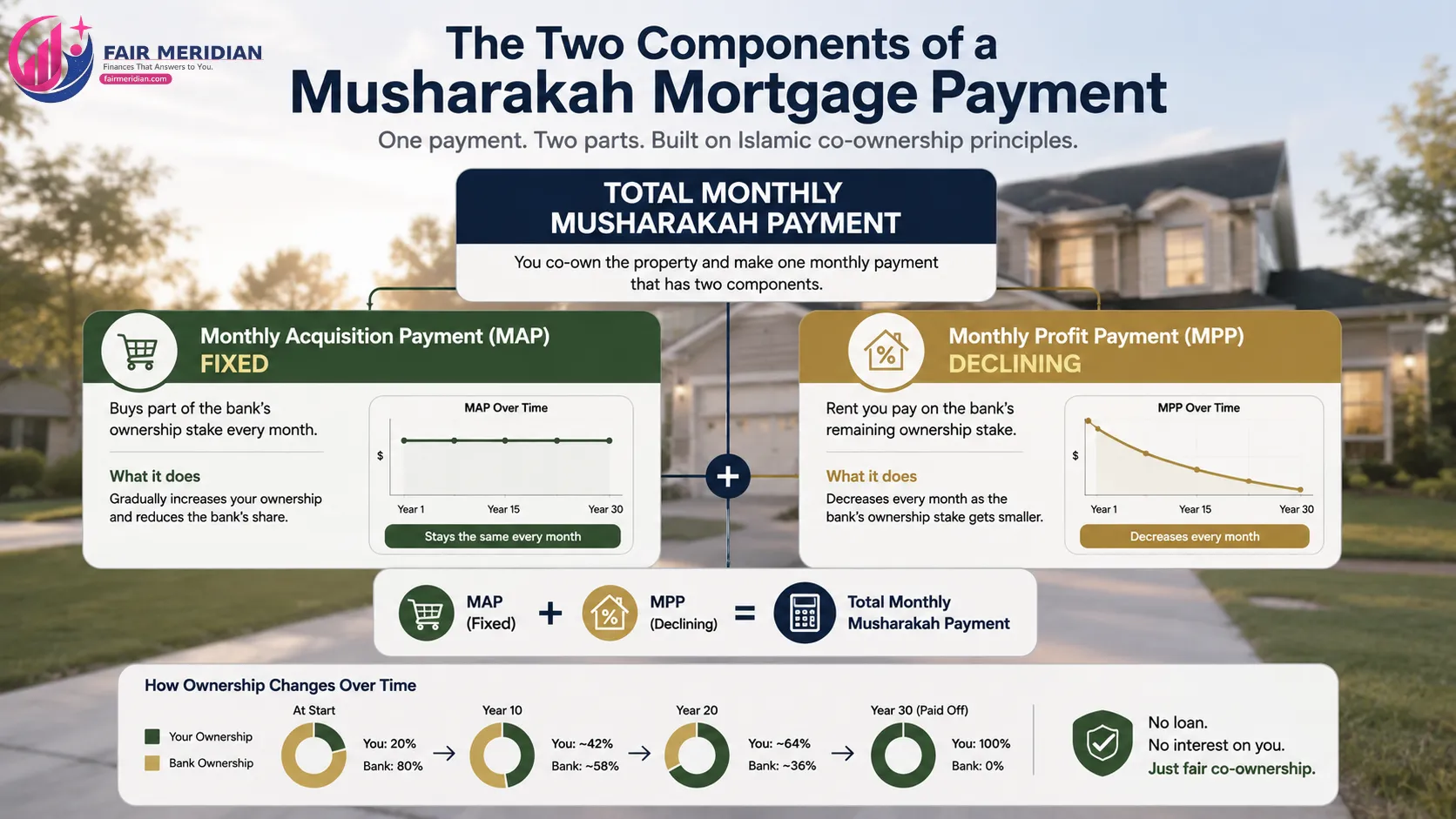
Every musharakah monthly payment has exactly two parts. Understanding each one is the key to understanding the entire system.
Component | What It Is | Changes Over Time? | Analogous To |
|---|---|---|---|
Monthly Acquisition Payment (MAP) | Your monthly purchase of a portion of the bank's ownership stake | Fixed — same amount every month | Principal payment in conventional mortgage |
Monthly Profit Payment (MPP) | Rent you pay on the bank's remaining ownership stake | Declining — decreases every month as bank's stake shrinks | Interest payment — but charged only on bank's remaining stake, not on original full amount |
In conventional amortization: you always owe interest on whatever outstanding loan balance remains — and principal repayment is back-loaded (you pay mostly interest early, mostly principal late). In musharakah: you buy out the bank's stake at the same rate every month (equal monthly acquisition payments) and pay rent only on what the bank still owns — which decreases at the same fixed rate every month.
The Worked Example — $400,000 Home, 20% Down, 6.74%, 30 Years
Starting Variables
Variable | Amount |
|---|---|
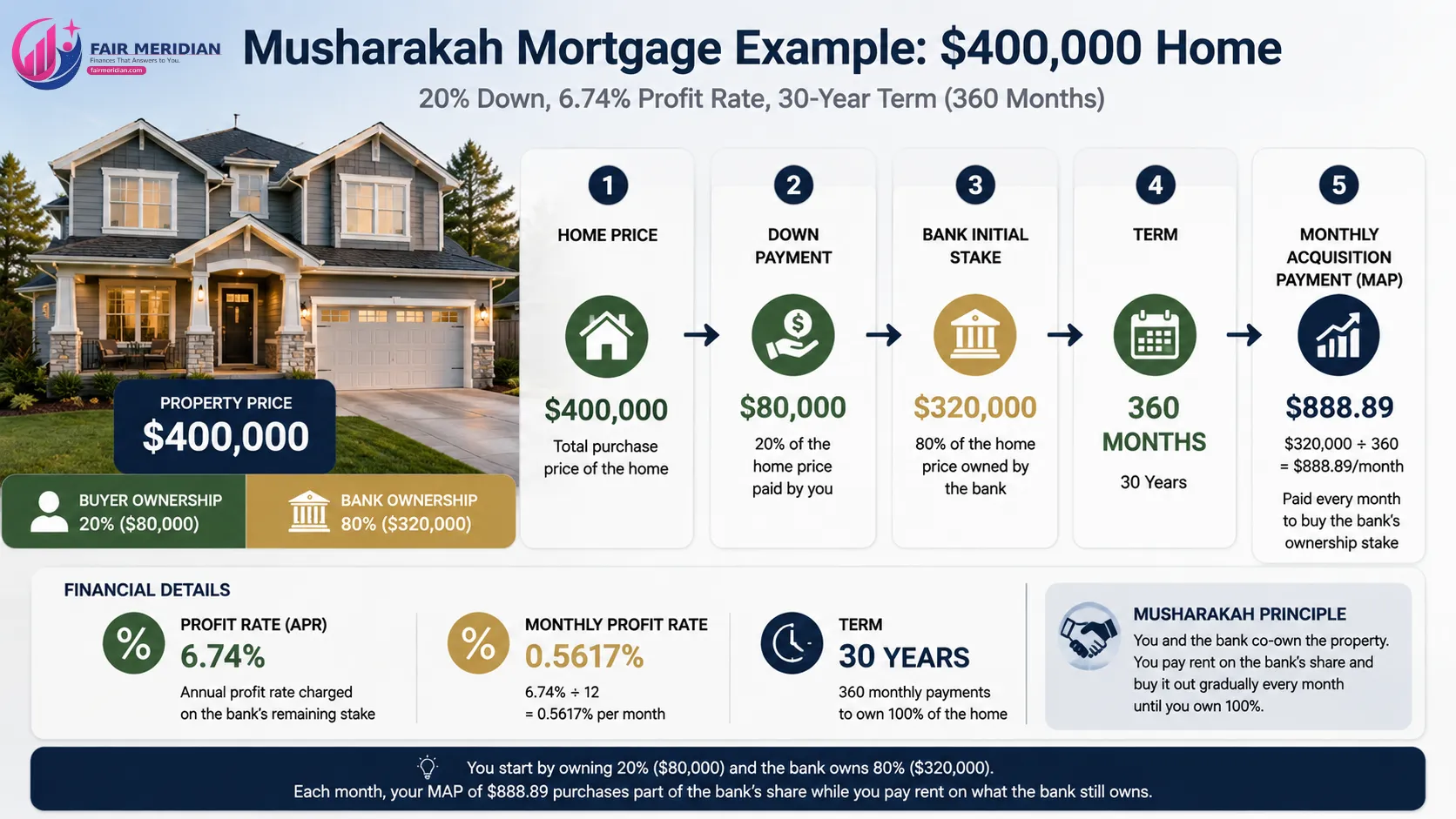
Home purchase price | $400,000 |
Your down payment (20%) | $80,000 |
Bank's initial stake | $320,000 (80% of $400,000) |
Annual profit rate | 6.74% |
Monthly profit rate | 6.74% ÷ 12 = 0.5617% |
Term | 30 years (360 months) |
Step 1: Calculate the Monthly Acquisition Payment (MAP)
The monthly acquisition payment is simple: divide the bank's initial stake by the number of payments.
MAP = Bank's Stake ÷ Number of Months
MAP = $320,000 ÷ 360 = $888.89/month
This amount never changes. Every month for 30 years, $888.89 of your payment goes toward buying out the bank's remaining ownership stake.
Step 2: Calculate the Monthly Profit Payment (MPP) for Any Given Month
MPP(month N) = Bank's Remaining Stake at Start of Month N × Monthly Profit Rate
Bank's Remaining Stake = Initial Stake − (MAP × Months Already Completed)
MPP(month 1) = $320,000 × 0.5617% = $1,797.33
MPP(month 2) = ($320,000 − $888.89) × 0.5617% = $319,111.11 × 0.5617% = $1,792.35
MPP(month 12) = ($320,000 − $888.89 × 11) × 0.5617% = $310,222.22 × 0.5617% = $1,742.57
Step 3: Total Monthly Payment = MAP + MPP
Month | Bank's Remaining Stake | Monthly Acquisition (MAP) | Monthly Profit (MPP) | Total Payment |
|---|---|---|---|---|
1 | $320,000.00 | $888.89 | $1,797.33 | $2,686.22 |
2 | $319,111.11 | $888.89 | $1,792.35 | $2,681.24 |
3 | $318,222.22 | $888.89 | $1,787.37 | $2,676.26 |
6 | $315,555.55 | $888.89 | $1,772.44 | $2,661.33 |
12 | $310,222.22 | $888.89 | $1,742.57 | $2,631.46 |
24 | $299,555.56 | $888.89 | $1,682.84 | $2,571.73 |
60 (yr 5) | $267,111.11 | $888.89 | $1,500.51 | $2,389.40 |
120 (yr 10) | $213,333.33 | $888.89 | $1,198.67 | $2,087.56 |
180 (yr 15) | $160,000.00 | $888.89 | $898.67 | $1,787.56 |
240 (yr 20) | $106,666.67 | $888.89 | $599.11 | $1,488.00 |
300 (yr 25) | $53,333.33 | $888.89 | $299.56 | $1,188.45 |
359 | $1,777.78 | $888.89 | $9.98 | $898.87 |
360 (final) | $888.89 | $888.89 | $4.99 | $893.88 |
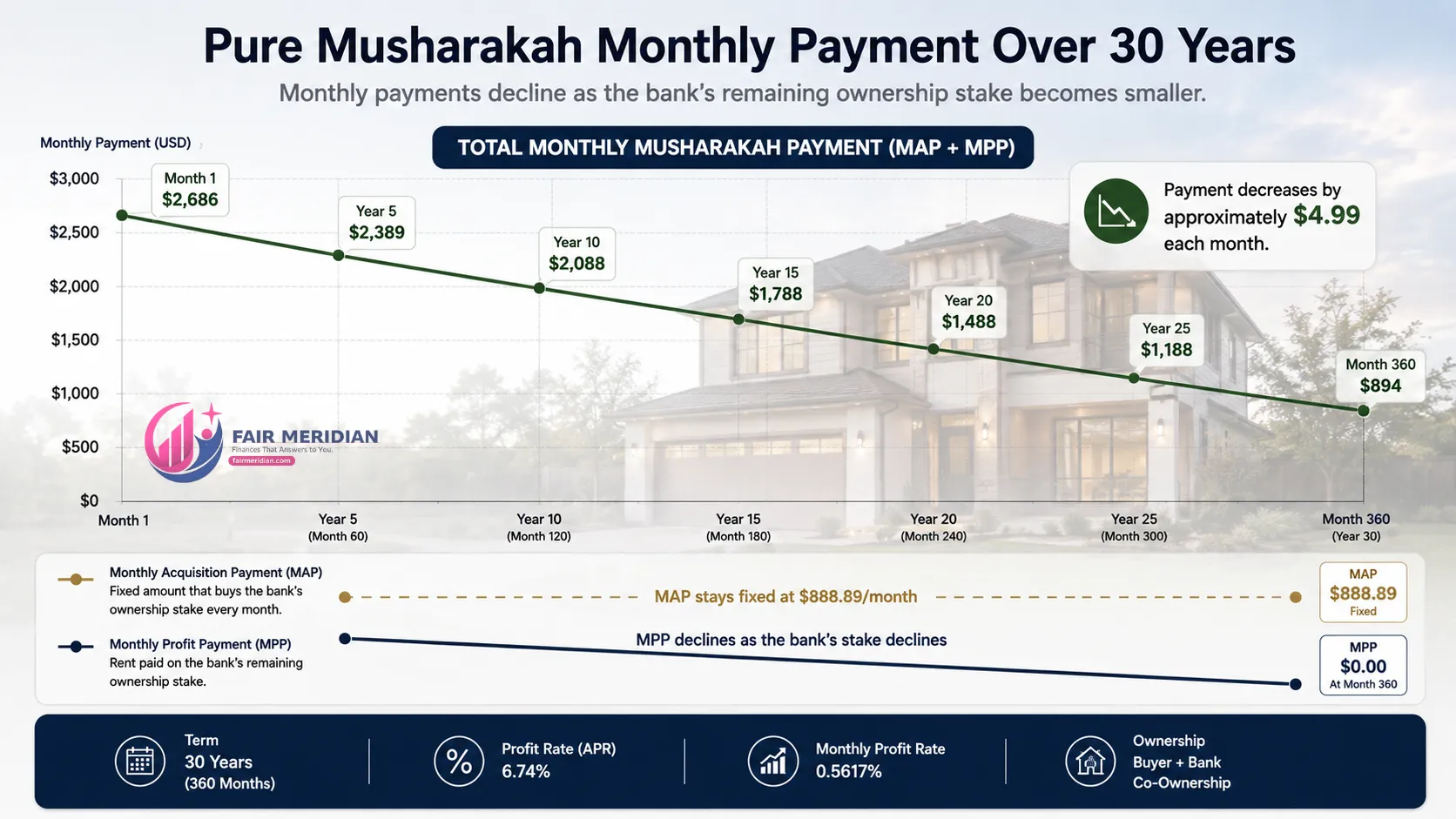
The musharakah payment starts at $2,686 and ends at $894. It declines by exactly $4.99 every month — the saved profit on the $888.89 monthly buyout.
The Total Cost Comparison — Why This Matters
This declining payment structure produces dramatically different total costs from conventional amortization — even at the same profit rate.
Total Profit Paid in Pure Musharakah
Total Profit = Monthly Rate × Sum of All Monthly Remaining Stakes
The monthly remaining stakes form an arithmetic series starting at $320,000 and ending at $888.89, decreasing by $888.89 each month.
Sum = 360 × (320,000 + 888.89) ÷ 2 = 360 × 160,444.44 = 57,760,000
Total Profit = 0.005617 × 57,760,000 = $324,439
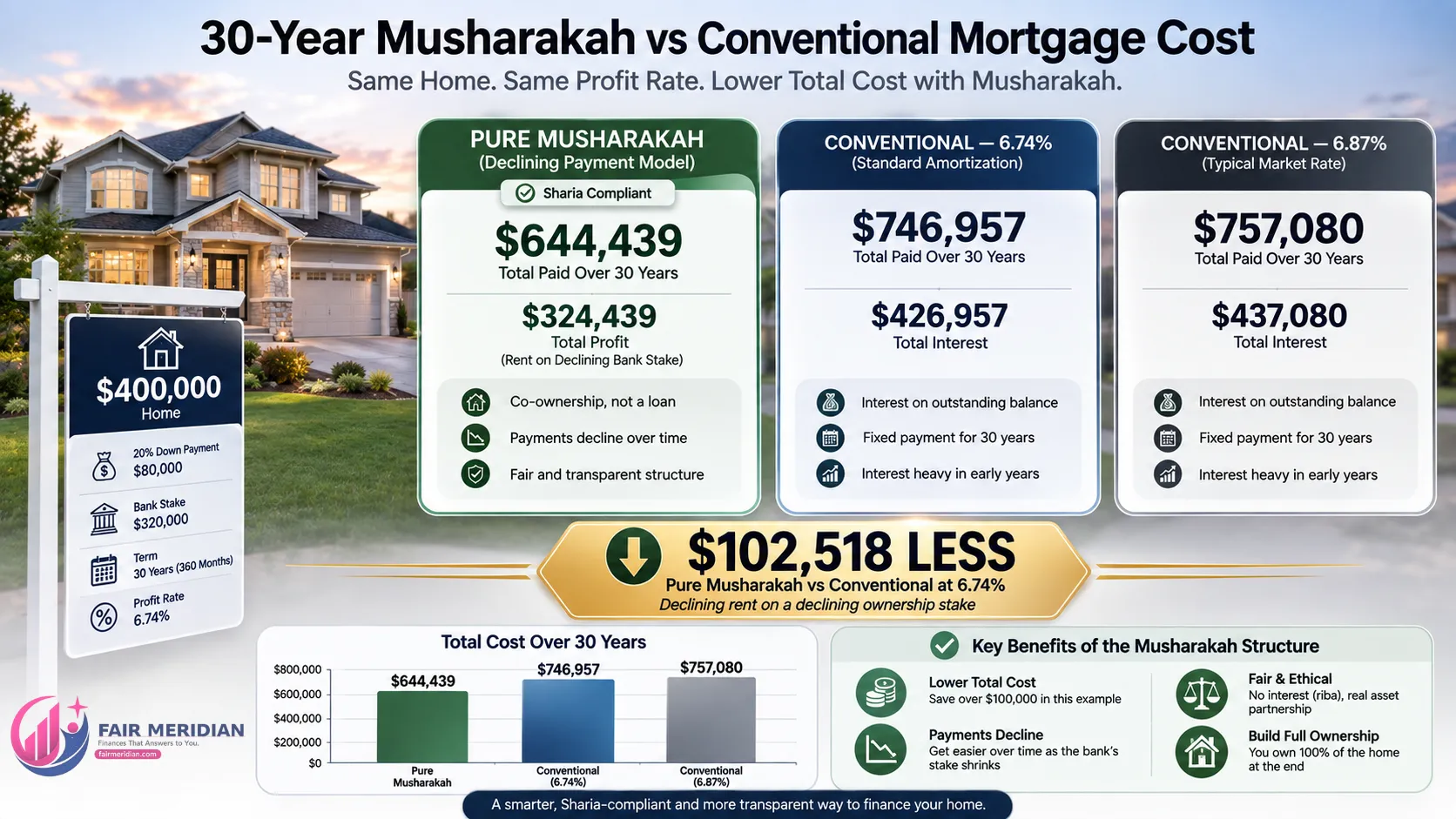
Pure Musharakah (6.74%) | Conventional (6.74%) | Conventional (6.87%) | |
|---|---|---|---|
Bank's initial stake / Loan amount | $320,000 | $320,000 | $320,000 |
Total acquisition/principal payments | $320,000 | $320,000 | $320,000 |
Total profit/interest paid | $324,439 | $426,957 | $437,080 |
Total paid over 30 years | $644,439 | $746,957 | $757,080 |
Savings vs conventional (same rate) | $102,518 less | Benchmark | — |
Savings vs conventional avg (6.87%) | $112,641 less | — | Benchmark |
The pure musharakah model produces $102,518 less in total payments than conventional amortization at the same 6.74% rate — purely from the structural difference between declining rent and compound amortized interest. No rate shopping required. No negotiation. The math produces a lower total cost by design.
The mechanism: in conventional amortization, early payments are almost entirely interest — you're paying interest on the full $320,000 for years before meaningful principal reduction happens. In musharakah, you're buying out the same $888.89 of the bank's stake from month one — reducing the basis for rent calculation immediately. The profit paid in month 1 of musharakah ($1,797) is already less than month 1 of conventional amortization ($1,797 is the same, actually, since it's the same rate on the same initial balance — the difference compounds over time as musharakah's stake reduction outpaces conventional's amortization schedule).
The intuitive explanation: In conventional amortization, your monthly payment is fixed — but in the early years, the bank is taking most of it as interest and giving you very little principal reduction. In musharakah, you reduce the bank's stake by exactly $888.89 every month from day one — no back-loading. Because your rent is calculated on an equally declining stake, you're paying rent on a smaller average balance over the 30-year term. Smaller average balance × same rate = lower total profit paid.
Why US Lenders Convert to Fixed Payments
The pure declining musharakah described above starts at $2,686/month and ends at $894/month. While mathematically clean and financially optimal, this creates practical problems in the US market:
Budget unpredictability: Most US homebuyers need to know their monthly payment for household budget planning. A payment that changes every month — even predictably — is harder to plan around than a fixed amount.
Secondary market requirements: Freddie Mac and Fannie Mae, who purchase halal mortgage contracts in the secondary market, underwrite on fixed payment schedules. A declining payment schedule requires different underwriting methodology.
Debt-to-income qualification: US mortgage qualification uses monthly payment vs monthly income (DTI ratio). If the payment changes monthly, which month's payment do you use?
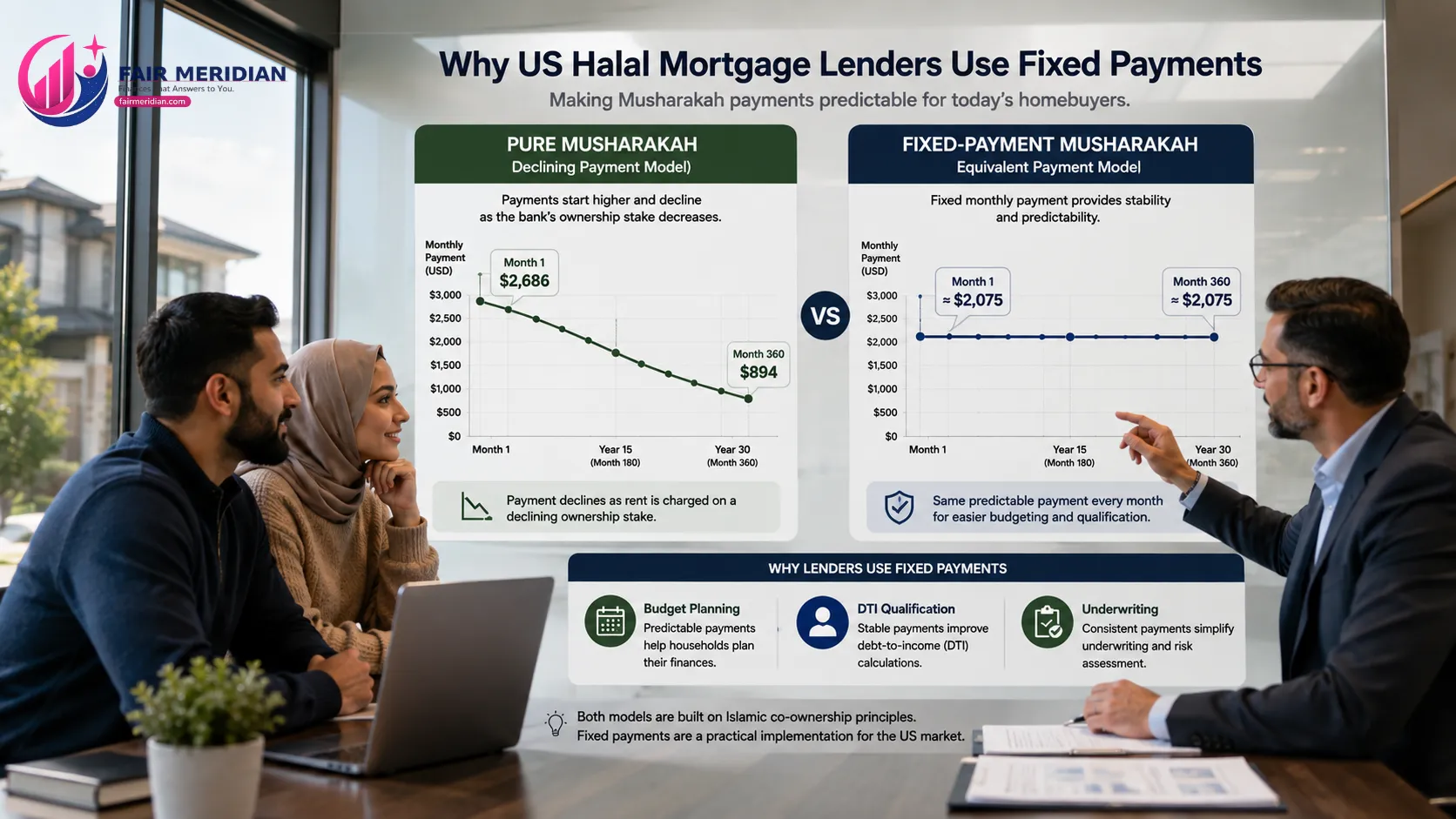
For these reasons, US halal lenders including Guidance Residential typically convert the pure musharakah into a fixed monthly payment equivalent. The fixed payment is calculated to produce a similar total financial outcome to the pure model while providing payment predictability. The structural difference from conventional amortization remains — the underlying calculation basis is still declining stake × rate — but the monthly amount presented to the buyer is fixed.
The Fixed-Payment Musharakah — How to Calculate the Equivalent
The fixed monthly payment for a musharakah can be approximated using a modified calculation. The most common approach: treat the musharakah as if it were a conventional amortization at the same profit rate. This produces a number that is close to what Guidance Residential and UIF actually quote — because that is effectively what they do in their US market implementation.
Fixed Musharakah Approximation (same as conventional formula):
M = P × [r(1+r)^n] ÷ [(1+r)^n − 1]
Where:
P = Bank's initial stake ($320,000)
r = Monthly profit rate (6.74% ÷ 12 = 0.5617%)
n = Number of months (360)
M = 320,000 × [0.005617 × (1.005617)^360] ÷ [(1.005617)^360 − 1]
(1.005617)^360 ≈ 7.496
M = 320,000 × [0.005617 × 7.496] ÷ [7.496 − 1]
M = 320,000 × 0.04212 ÷ 6.496
M = 320,000 × 0.006484
M ≈ $2,075/month
This is what a standard mortgage calculator produces — and it's a reasonable approximation of what Guidance Residential will quote you. The difference between the pure musharakah (which starts higher and ends lower) and the fixed equivalent is in the total cost: the fixed equivalent produces a higher total cost than the pure model because early payments under the fixed model are too low relative to the bank's still-large initial stake (similar to conventional amortization's front-loading of interest).
Comparing All Three Models Side by Side
Model | Month 1 Payment | Month 180 (yr 15) | Month 360 (final) | Total Paid |
|---|---|---|---|---|
Pure Musharakah (declining) | $2,686 | $1,788 | $894 | $644,439 |
Fixed Musharakah (US lender equivalent) | $2,075 | $2,075 | $2,075 | ~$746,957* |
Conventional Amortization (6.74%) | $2,075 | $2,075 | $2,075 | $746,957 |
Conventional (6.87% avg) | $2,107 | $2,107 | $2,107 | $758,520 |
The fixed musharakah and conventional at the same rate produce approximately the same total payment when the fixed equivalent uses the same formula. The pure declining musharakah's $102,518 savings reflect the pure classical model — Guidance Residential's actual contract structure sits between these models. Confirm exact total cost with your lender's amortization schedule.
How to Use a Standard Calculator for Musharakah Estimates
When you need a quick payment estimate before talking to a lender:
Enter the bank's stake as the "loan amount." This is your purchase price minus your down payment. On a $400,000 home at 20% down: enter $320,000.
Enter the profit rate as the "interest rate." Use the rate your lender has quoted or the current rate from our Halal Mortgage Rates guide.
Enter 30 (or 15) for the loan term in years.
The result is a reasonable approximation of your monthly musharakah payment. The actual payment may vary slightly depending on how your specific lender structures the fixed equivalent. Use this number for budgeting estimates; get the exact number from a pre-approval.
Quick reference — standard calculator results at Guidance's current 6.74%:
$200,000 bank stake → ~$1,297/month
$240,000 bank stake → ~$1,556/month
$280,000 bank stake → ~$1,815/month
$320,000 bank stake → ~$2,075/month
$360,000 bank stake → ~$2,334/month
$400,000 bank stake → ~$2,593/month
$480,000 bank stake → ~$3,112/month
These are P&I only — add property tax, homeowners insurance, and any applicable fees for your full monthly housing cost.
Prepayment in Musharakah — The Structural Difference
Prepayment works differently in musharakah than conventional mortgages — and it's one of musharakah's significant advantages.
Conventional Prepayment
In a conventional mortgage, prepaying a lump sum reduces your outstanding principal balance. Future interest is recalculated on the lower balance. If you prepay $20,000 in year 5, you eliminate interest on that $20,000 for the remaining term — generating total savings roughly equal to $20,000 × remaining rate × remaining years (simplified). You still owe the same monthly payment until you've built enough equity to pay off or refinance.
Musharakah Prepayment
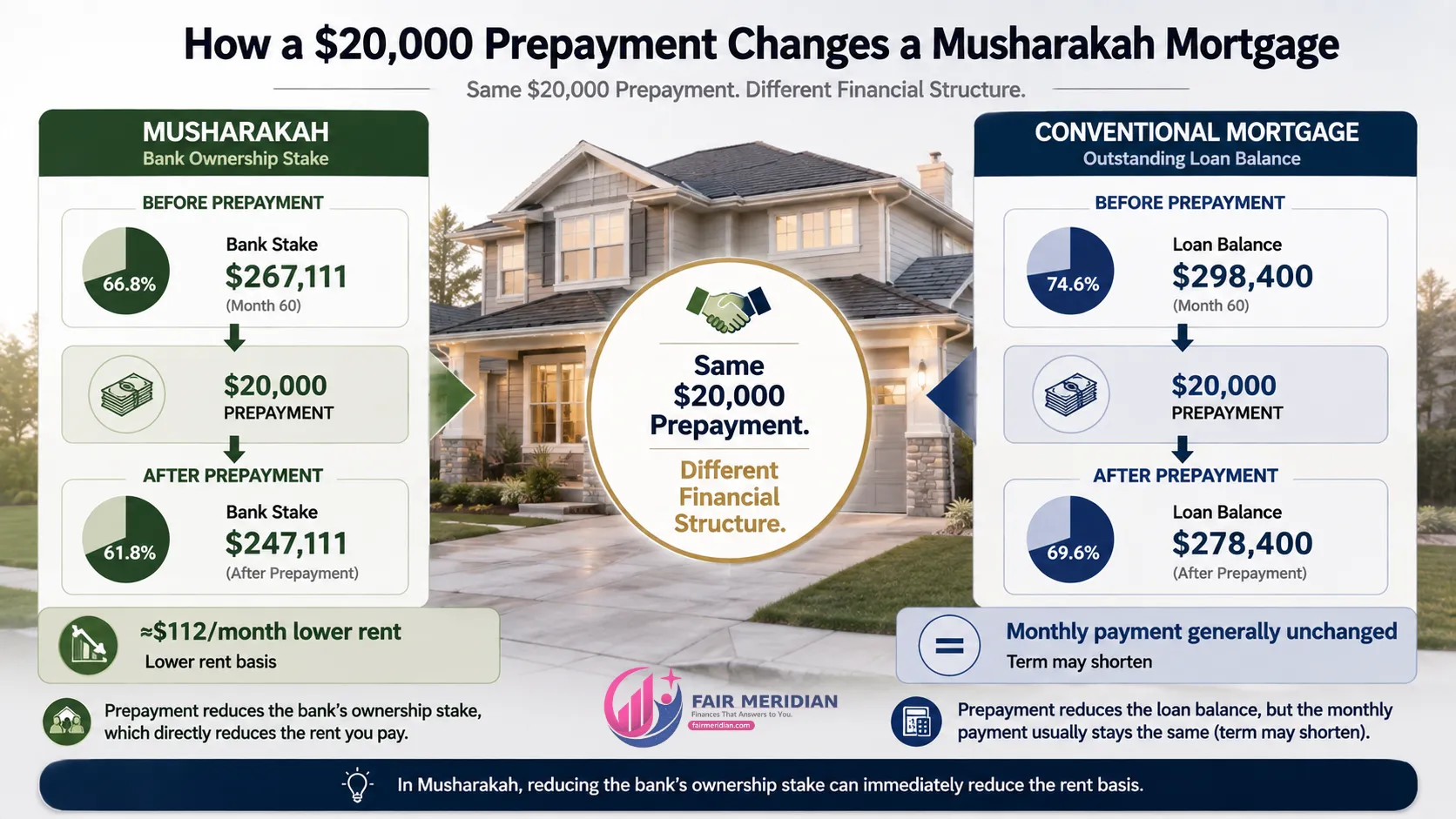
In the pure musharakah model: prepaying an extra $20,000 in month 60 means you've purchased an additional $20,000 of the bank's stake. The bank's remaining stake immediately drops by $20,000 — and so does the rent basis. Future profit payments are calculated on the now-lower remaining stake. Because there's no back-loading of profit (you've been paying proportional rent from day one), the savings profile of early prepayment in musharakah is more linear than in conventional amortization.
$20,000 Prepayment in Month 60 | Pure Musharakah (6.74%) | Conventional (6.74%) |
|---|---|---|
Bank stake / balance before prepayment | $267,111 stake | $298,400 balance |
After prepayment | $247,111 stake | $278,400 balance |
Immediate monthly payment reduction | $112/month lower rent (6.74%/12 × $20,000) | None — payment stays same; term shortens instead |
Total interest/profit saved | Approximately $65,000–$75,000 | Approximately $60,000–$70,000 |
One important question to ask your specific halal lender: does prepayment reduce your monthly payment immediately (pure model) or shorten the term while keeping payments the same (fixed model approach)? Different lenders implement this differently — Guidance Residential can explain their specific prepayment mechanics.
Year-by-Year Payment Summary — First 10 Years and Last 5 Years
Annual totals for the pure declining musharakah on $320,000 bank stake at 6.74%:
Year | Bank Stake (Start) | Annual Acquisition | Annual Profit | Total Annual | Your Equity |
|---|---|---|---|---|---|
1 | $320,000 | $10,667 | $20,849 | $31,516 | $90,667 |
2 | $309,333 | $10,667 | $20,169 | $30,836 | $101,333 |
3 | $298,667 | $10,667 | $19,489 | $30,156 | $112,000 |
4 | $288,000 | $10,667 | $18,809 | $29,476 | $122,667 |
5 | $277,333 | $10,667 | $18,129 | $28,796 | $133,333 |
6 | $266,667 | $10,667 | $17,449 | $28,116 | $144,000 |
7 | $256,000 | $10,667 | $16,769 | $27,436 | $154,667 |
8 | $245,333 | $10,667 | $16,089 | $26,756 | $165,333 |
9 | $234,667 | $10,667 | $15,409 | $26,076 | $176,000 |
10 | $224,000 | $10,667 | $14,729 | $25,396 | $186,667 |
Years 11–25 omitted for brevity — $680/year annual payment reduction | |||||
26 | $53,333 | $10,667 | $3,529 | $14,196 | $357,333 |
27 | $42,667 | $10,667 | $2,849 | $13,516 | $368,000 |
28 | $32,000 | $10,667 | $2,169 | $12,836 | $378,667 |
29 | $21,333 | $10,667 | $1,489 | $12,156 | $389,333 |
30 | $10,667 | $10,667 | $809 | $11,476 | $400,000 |
TOTAL | $320,000 | $324,439 | $644,439 | $400,000 |
Annual profit figures calculated from monthly totals; equity column includes $80,000 original down payment. Property appreciation not included — equity here is ownership stake value at purchase price.
Frequently Asked Questions
Can I use a regular mortgage calculator for musharakah?
Yes — as an approximation. Enter the bank's initial stake (purchase price minus down payment) as the loan amount, your profit rate as the interest rate, and 30 years as the term. The result gives you a reasonable fixed monthly payment estimate. For the exact payment, request a full payment schedule from your lender after pre-approval — this is the document that shows your actual monthly amounts and how they change over the term.
Why does my musharakah payment start higher than a conventional mortgage at the same rate?
In the pure musharakah model, Month 1's payment ($2,686 in our example) is higher than a conventional payment ($2,075) at the same rate. This is because the pure musharakah front-loads your acquisition payments (buying the bank's stake equally from month one) rather than back-loading them as conventional amortization does. The trade-off: you build equity faster in early years and your total payment over 30 years is $102,518 lower. Most US lenders convert this to a fixed payment to eliminate the higher early payments — at the cost of some structural savings.
Does musharakah really cost less than a conventional mortgage at the same rate?
Yes — the pure declining musharakah model generates approximately $102,518 less in total payments than conventional amortization at the same 6.74% rate on a $320,000 bank stake over 30 years. The savings come from the mathematical difference between declining rent on a declining stake (musharakah) and compound interest on an amortized balance (conventional). The fixed-payment musharakah used by most US lenders narrows this gap — confirm the total payment schedule with your specific lender.
How do I get the exact musharakah payment for my specific home purchase?
Request a pre-approval from Guidance Residential, UIF Corporation, or your chosen halal lender. The pre-approval process generates a Loan Estimate within 3 business days — a federal standardized form that shows your estimated monthly payment, interest rate equivalent (required by federal disclosure law), and total payments over the loan term. This is the exact number for your specific home price, down payment, and credit profile. The online calculators on this site and any standard mortgage calculator give approximations — the Loan Estimate is the authoritative figure.
Use our Halal Mortgage Calculator to estimate your monthly musharakah payment at current Guidance Residential rates. For the comprehensive guide to every US halal mortgage provider and their current rates, see our Halal Mortgage Rates USA Guide. To understand the full cost comparison between musharakah and conventional over 30 years, read our How Much Does a Halal Mortgage Cost? post.