A halal mortgage has five cost layers that don't all move in the same direction. The monthly rate is currently lower than conventional. The closing costs can be slightly higher. The down payment can be dramatically lower if you use Guidance Residential's 5% option. And the 30-year total cost is significantly lower due to the musharakah structure's arithmetic amortization vs conventional compound interest. This post puts every number on the table — on a real $400,000 home — so you can make the calculation yourself.
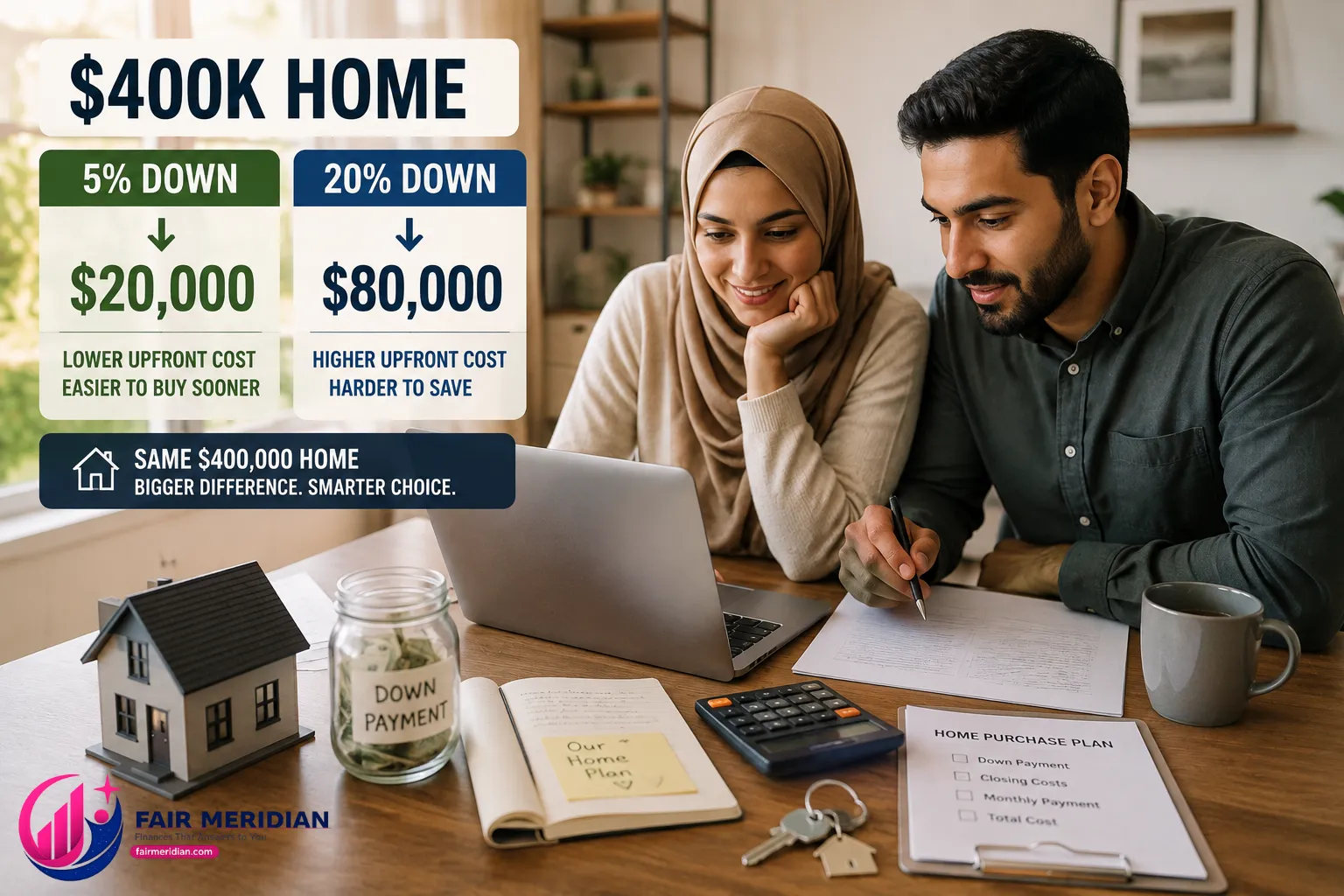
Cost Layer 1: The Down Payment
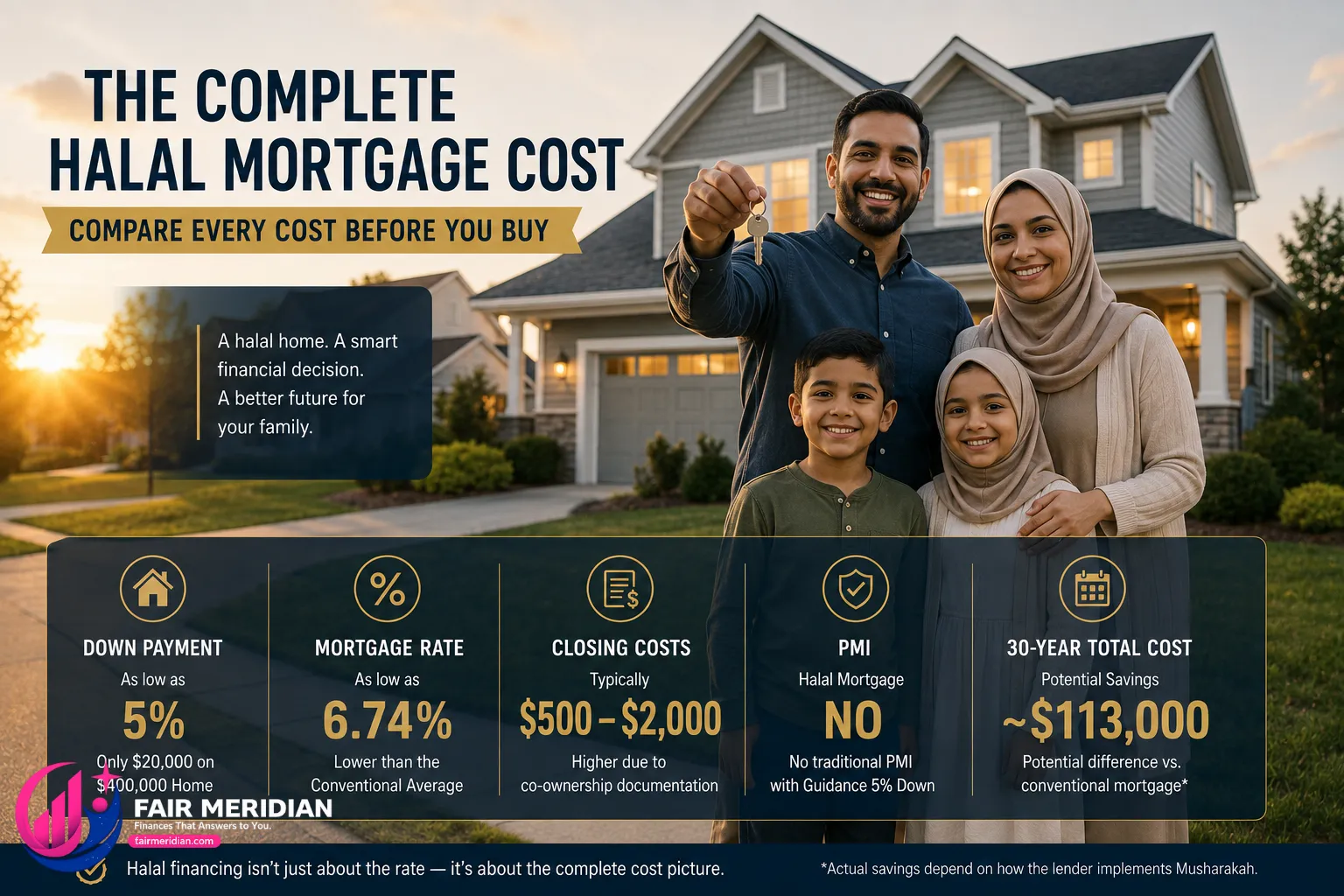
The down payment is the largest upfront cost for any homebuyer — and this is where the halal market has the most important variable: only one halal lender in the United States offers below 20% down.
Provider | Min. Down Payment | On $400K Home | On $600K Home | On $800K Home |
|---|---|---|---|---|
Guidance Residential | 5% | $20,000 | $30,000 | $40,000 |
UIF Corporation | 20% | $80,000 | $120,000 | $160,000 |
Devon Bank | 20% | $80,000 | $120,000 | $160,000 |
IjaraCDC | 20% | $80,000 | $120,000 | $160,000 |
Lariba Finance | 20% | $80,000 | $120,000 | $160,000 |
Conventional (FHA) | 3.5% | $14,000 | $21,000 | $28,000 |
Conventional (conforming) | 3–5% | $12,000–$20,000 | $18,000–$30,000 | $24,000–$40,000 |
The down payment decision is the first and most consequential: if you cannot currently save $80,000 for a $400,000 home, your halal options are Guidance Residential at 5% down ($20,000) or waiting until you have 20%. For most first-time Muslim homebuyers, the 5% Guidance program is the decisive factor that determines whether they can buy now.
Cost Layer 2: The Interest Rate
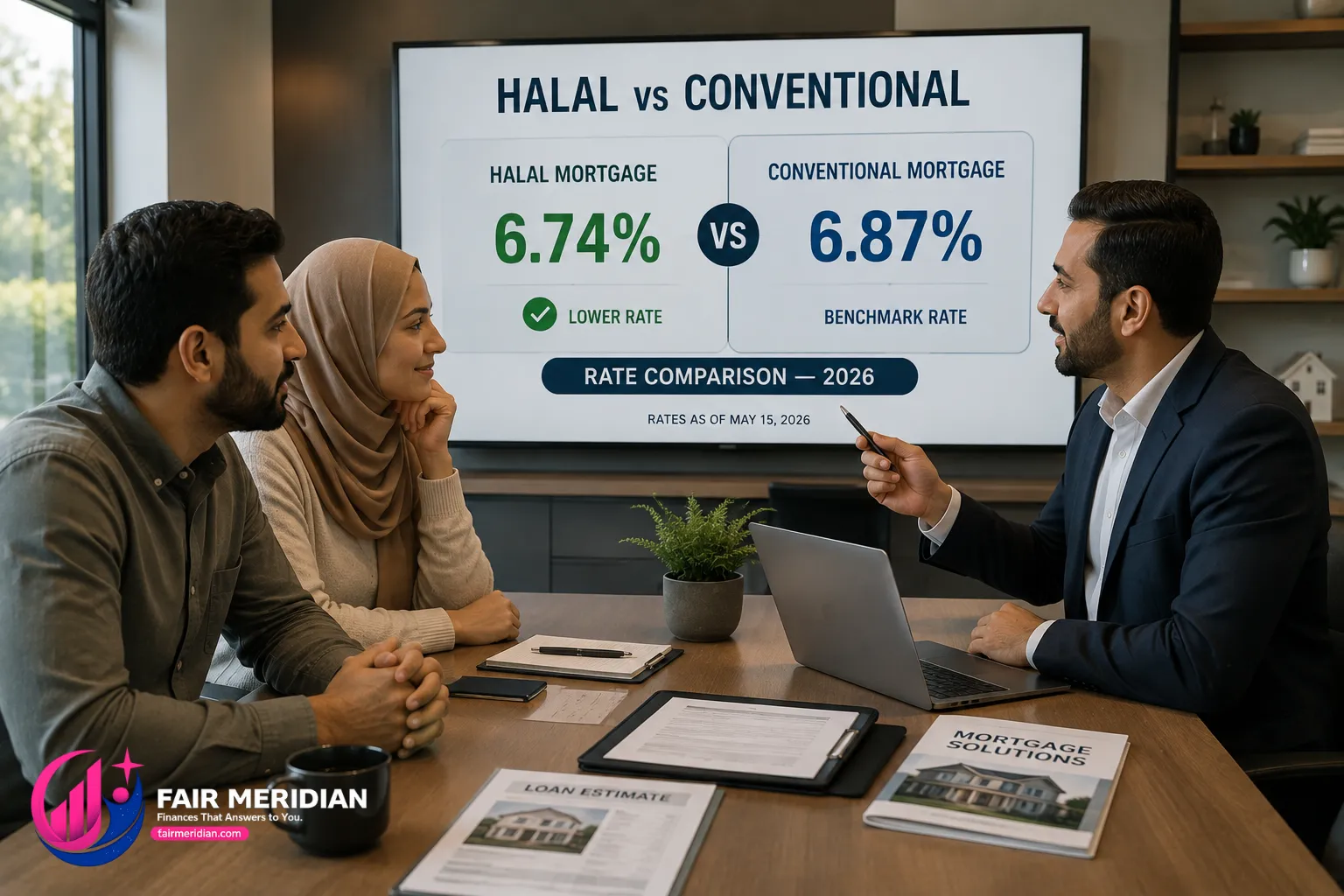
Current halal mortgage rates as of May 2026, compared to the conventional 30-year benchmark:
Provider | Rate (720+ FICO) | Rate (680–719) | vs Conventional |
|---|---|---|---|
Conventional avg (Freddie Mac) | 6.87% | ~7.30% | Benchmark |
Guidance Residential | 6.74% | 7.12% | 0.13% LOWER ✅ |
Lariba Finance | 6.85% | ~7.22% | 0.02% lower ✅ |
UIF Corporation | 6.89% | 7.24% | 0.02% higher ⚠️ |
IjaraCDC | 6.95% | ~7.35% | 0.08% higher ⚠️ |
Devon Bank | 7.10% | 7.45% | 0.23% higher ❌ |
Rates as of May 15, 2026. Rates change with market conditions — request personalized quotes before making decisions. FICO 720+ rates shown; lower FICO scores may receive higher rates.
The critical takeaway: the cheapest halal mortgage rate in the United States (Guidance at 6.74%) is currently cheaper than the average conventional mortgage (6.87%). The "halal costs more" belief is wrong at current rates with the right lender.

Cost Layer 3: Closing Costs
This is the layer where halal mortgages can genuinely cost slightly more — and it deserves an honest explanation rather than marketing language.
Standard Closing Costs (Same for Halal and Conventional)
Cost Item | Typical Amount | Notes |
|---|---|---|
Appraisal | $500–$900 | Required by all lenders; same cost |
Credit report | $30–$50 | Same for all |
Home inspection | $400–$800 | Buyer's choice; not lender-required |
Title search | $300–$600 | Same or slightly higher for halal |
Title insurance (lender's) | $500–$2,000 | Scales with loan amount; same |
Title insurance (owner's) | $1,000–$3,000 | Recommended for all buyers |
Prepaid property tax (escrow) | 2–6 months | Varies by closing date; same |
Homeowners insurance (prepaid) | $800–$2,500 | Same for all |
Attorney fee (attorney states) | $500–$2,000 | NY, NJ, CT, PA, GA require attorneys |
The Halal-Specific Additional Closing Costs
Cost Item | Amount | Why It Exists |
|---|---|---|
Co-ownership deed (musharakah) | $300–$800 | Recording the joint ownership structure requires additional documentation vs a single mortgage deed |
Origination/processing fee | 0.5–1% of financed amount | Similar to conventional — Guidance's is competitive |
Title company familiarity premium | $0–$500 | Title companies unfamiliar with co-ownership documents sometimes charge extra review time; using an experienced title company eliminates this |
Total Closing Cost Estimate — $400K Home
Conventional | Halal (Musharakah) | Difference | |
|---|---|---|---|
Typical total closing costs | $7,000–$14,000 | $7,500–$16,000 | $500–$2,000 higher |
As % of purchase price | 1.75–3.5% | 1.9–4% | 0.1–0.5% higher |
Honest answer: closing costs for a halal mortgage can be $500–$2,000 higher than a conventional mortgage due to co-ownership documentation requirements. This is real and worth budgeting for. It is also, as the 30-year total section below shows, recovered within the first few months of the rate savings.
How to minimize the gap: Ask Guidance (or your lender) to recommend a title company experienced with Islamic finance closings in your area. An experienced title company eliminates the unfamiliarity premium entirely.
Cost Layer 4: Monthly Payment
Scenario A: $400,000 Home, 20% Down ($320,000 Financed)
Product | Rate | Monthly P&I | vs Conventional |
|---|---|---|---|
Conventional (Freddie Mac avg) | 6.87% | $2,103 | Benchmark |
Guidance Residential | 6.74% | $2,073 | $30/month lower |
Lariba Finance | 6.85% | $2,099 | $4/month lower |
UIF Corporation | 6.89% | $2,109 | $6/month higher |
IjaraCDC | 6.95% | $2,124 | $21/month higher |
Devon Bank | 7.10% | $2,155 | $52/month higher |
Scenario B: $400,000 Home, 5% Down ($380,000 Financed) — Guidance Only
Product | Rate | Monthly P&I | PMI (if applicable) | Total Monthly |
|---|---|---|---|---|
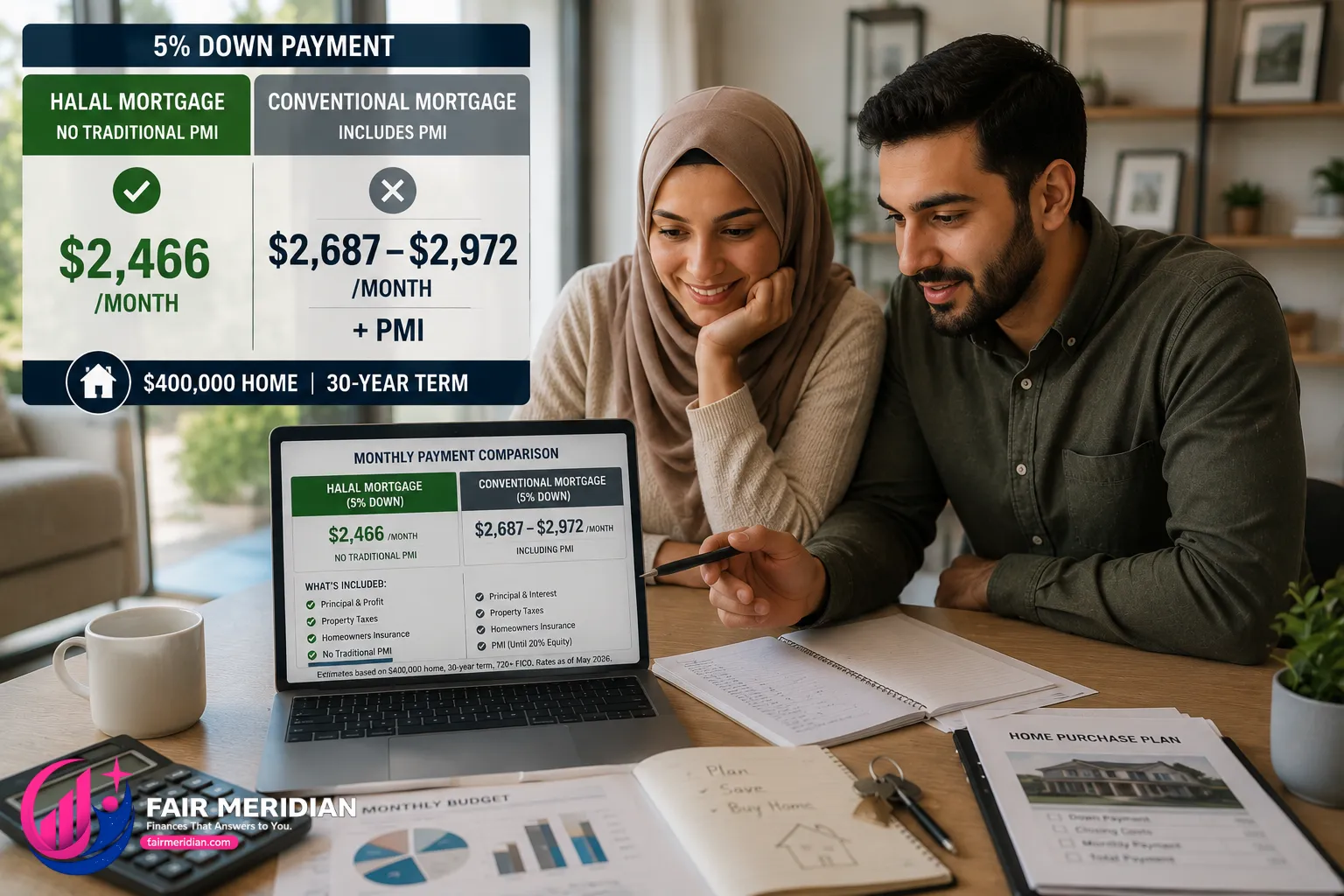
Conventional (5% down) | 6.87% | $2,497 | $190–$475/month | $2,687–$2,972 |
Guidance Residential (5% down) | 6.74% | $2,466 | No traditional PMI | $2,466 |
Monthly savings (Guidance vs conventional at 5% down): | $221–$506/month |
The 5% down comparison is where halal financing becomes dramatically more attractive. Conventional buyers who put 5% down must pay Private Mortgage Insurance (PMI) — typically 0.5–1.5% of the loan amount annually — until they reach 20% equity. On a $380,000 loan: $1,900–$5,700/year in PMI ($158–$475/month). Guidance's musharakah at 5% down has no traditional PMI obligation.
At 5% down on a $400K home: Guidance's total monthly payment is $221–$506/month lower than a comparable conventional mortgage with PMI. A buyer saving $300/month in PMI over 5 years (the typical time to reach 20% equity and remove PMI on a conventional loan) saves approximately $18,000 before PMI removal.
Cost Layer 5: The 30-Year Total
This is the number that matters most — the complete cost of homeownership over the full financing term. All figures assume $400,000 home, 20% down, $320,000 financed.
Conventional 6.87% | Guidance 6.74% | UIF 6.89% | |
|---|---|---|---|
Down payment | $80,000 | $80,000 | $80,000 |
Closing costs (est.) | $10,500 | $12,000 | $12,000 |
Total monthly payments (30yr) | $757,080 | $746,280* | $759,240 |
Total out-of-pocket | $847,580 | $838,280 | $851,240 |
vs Conventional | Benchmark | $9,300 cheaper | $3,660 more expensive |
*Rate-only comparison — fixed amortization math at 6.74%. See note below about the true musharakah structural advantage.
The Structural Advantage: Musharakah vs Compound Interest
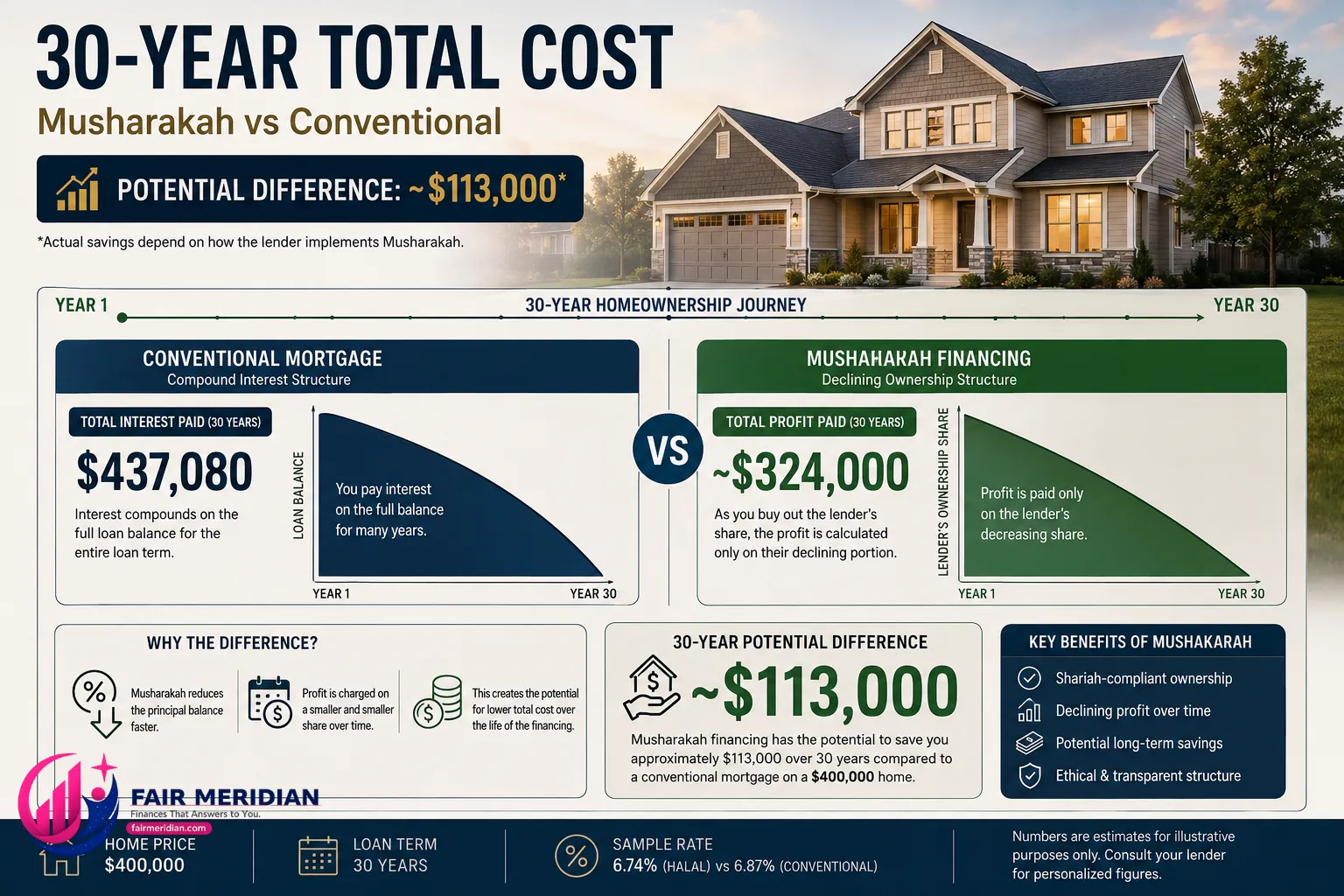
The table above uses standard amortization math (fixed monthly payment) to keep the comparison clean. The genuine musharakah structure saves an additional amount on top of the rate savings — because musharakah charges profit on a straight-line declining balance (bank's stake shrinks equally each month), not on a compound-amortized declining balance (where early payments are mostly interest and principal repayment is back-weighted).
Under true musharakah math on $320,000 at 6.74%:
Conventional 6.87% (compound amortization) | Musharakah 6.74% (true declining-balance) | Savings | |
|---|---|---|---|
Total profit/interest paid over 30yr | $437,080 | ~$324,000 | ~$113,000 less |
Total out-of-pocket (payments only) | $757,080 | ~$644,000 | ~$113,000 less |
The key caveat: this structural saving applies when musharakah is implemented with equal monthly buyout installments and declining rent — the classical model. Actual payment schedules vary by lender and contract structure. Confirm with your specific lender how their payment schedule is structured. The rate saving ($9,300 on the fixed-payment comparison) is always applicable; the structural saving is additional and depends on implementation.
The Complete Cost Picture — Side by Side
Cost Type | Halal vs Conventional | Dollar Impact ($400K Home) |
|---|---|---|
Down payment (Guidance 5%) | Halal CHEAPER (by $60K vs 20% down) | Save $60,000 upfront |
Rate (Guidance vs conventional) | Halal CHEAPER | Save $30/month; $9,300 over 30yr |
Closing costs | Halal HIGHER | Pay $500–$2,000 more at closing |
PMI (at 5% down) | Halal avoids PMI; conventional pays it | Save $158–$475/month for 5+ years |
Structural savings (musharakah vs compound) | Halal CHEAPER | Save ~$113,000 over 30yr |
NET RESULT | Halal is cheaper — on every meaningful metric | By $60K–$170K+ over the ownership period |
What Determines Your Actual Cost — Practical Checklist
Does Guidance Residential serve your state? They cover 22 states + DC. If yes: start with Guidance (best rate, 5% down option). If no: compare UIF and Devon Bank, both nationwide.
What is your FICO score? 720+ gets you the best rate. 680–719 adds roughly 0.35–0.40% to the rate. Below 680: work on your score before applying — halal lenders require at least 680 FICO.
How much do you have for down payment? If under 20%: Guidance's 5% program is your primary option. Budget $20,000 + $12,000 closing costs = approximately $32,000 total at closing for a $400K home.
Are you self-employed? Standard income documentation (W-2, pay stubs) works for all halal lenders. Self-employed with non-standard income: UIF's bank statement program is specifically designed for you.
Use an experienced title company. Ask your halal lender for a title company referral in your market. The closing cost premium for halal documentation shrinks or disappears entirely with an experienced company.
Frequently Asked Questions
Are halal mortgages more expensive than conventional mortgages?
No — not at current rates and not on total cost. Guidance Residential's musharakah rate (6.74%) is lower than the conventional 30-year average (6.87%). Closing costs can be $500–$2,000 higher for the co-ownership documentation. Over 30 years, the lower rate and musharakah structure produce total savings of approximately $9,000–$113,000 depending on which comparison methodology you use. The one lender where halal costs more than conventional is Devon Bank (7.10%), which charges $52/month more than the conventional average.
Do halal mortgages require private mortgage insurance (PMI)?
Halal mortgages don't use traditional PMI. Guidance Residential's 5% down musharakah program does not include a separate PMI line item. This is one of its most significant financial advantages over conventional financing with less than 20% down — conventional buyers at 5% down pay $158–$475/month in PMI until they reach 20% equity, adding $9,500–$28,500 to their total cost over 5 years.
What is the minimum down payment for a halal mortgage?
5% at Guidance Residential — the only halal lender in the United States with this option. All other halal lenders (UIF, Devon Bank, IjaraCDC, Lariba) require 20% down. At 5% down on a $400,000 home: $20,000 down payment plus approximately $12,000 in closing costs = roughly $32,000 needed at closing.
What FICO score do I need for a halal mortgage?
Minimum 680 FICO at most halal lenders. The best rates (Guidance's 6.74%) require 720+ FICO. For 680–719 FICO, expect a rate approximately 0.35–0.40% higher than the best rate — Guidance charges 7.12% for this tier. Below 680: focus on building your score before applying; halal lenders do not have sub-680 programs.
For current rates updated monthly from all five providers, see our Halal Mortgage Rates USA Guide. For the full Guidance Residential review including the 22 states they serve and the application process step by step, read our Guidance Residential 2026 Review. Use our Halal Mortgage Calculator to run your specific home price at current rates.