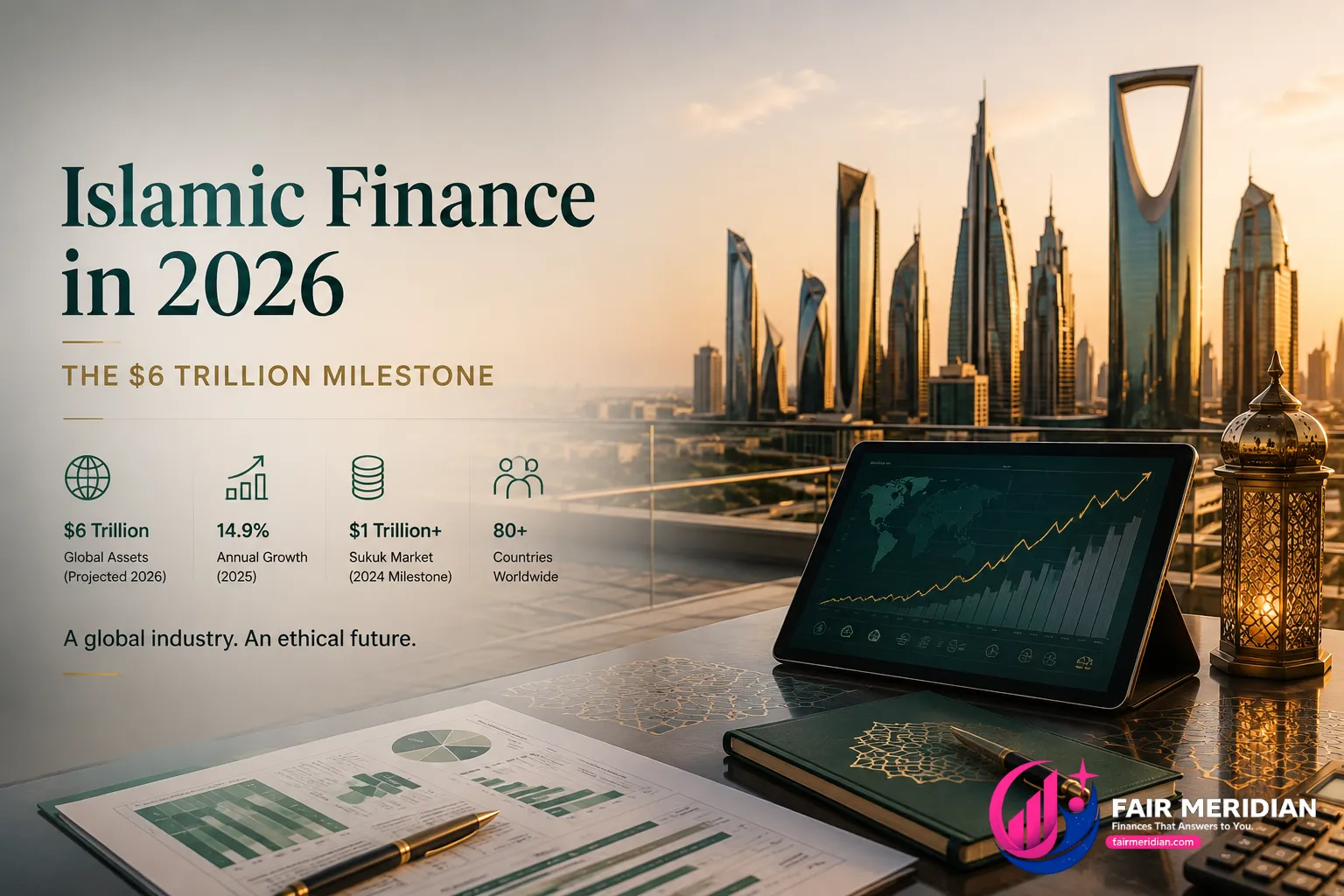
Somewhere around the end of 2026, the global Islamic finance industry will cross $6 trillion in total assets. That number is worth sitting with for a moment. The entire US federal budget is about $7 trillion. The entire GDP of Germany is around $4.5 trillion. An industry that barely existed as a formal academic discipline 50 years ago has built a $6 trillion financial system operating across 80+ countries — and it's still growing at nearly 15% annually while conventional banking grows at 4–6%. This is not a niche story anymore. This is a systemic shift in global finance, and most Americans — Muslim or not — have almost no idea it's happening at this scale.
This report covers what actually drove Islamic finance growth in 2025 and 2026, what the sukuk market crossing $1 trillion in outstanding volume actually means, where the industry is concentrated and where it's expanding, the ESG and Islamic finance convergence that's bringing non-Muslim institutional money into Sharia-compliant instruments, and honestly — where the United States fits in a global story that has largely happened without it.
The Numbers That Define 2026
Global Islamic finance assets reached approximately $5.2 trillion in 2025, according to the AlHuda Centre of Islamic Banking and Economics, representing 14.9% year-on-year growth. The ICD-LSEG Islamic Finance Development Indicator puts the figure slightly higher at $5.98 trillion when including all segments. The difference between estimates reflects methodological choices about what counts — Islamic windows of conventional banks, microfinance, fintech platforms — but every credible source agrees the industry is heading toward $6 trillion in 2026 and $8–9 trillion by the early 2030s.

To understand what this means, it helps to know the breakdown. Islamic banking accounts for roughly 70–72% of total assets — the $2.7 trillion in Sharia-compliant bank deposits, lending, and financial services that anchor the whole system. Sukuk (Islamic capital market instruments) are 19% and crossed $1 trillion in outstanding volume for the first time in 2024. Islamic funds and asset management are about 6%. Takaful (Islamic insurance) is 8% and growing faster than the rest.
The sukuk milestone matters particularly because it represents something that was impossible a decade ago: genuine institutional-scale Islamic capital markets with real secondary market depth. Total sukuk issuance in 2025 rose 14.5% to $291 billion, driven primarily by Gulf Cooperation Council transactions — a record year that pushed outstanding volume convincingly past the trillion-dollar threshold. When pension funds, sovereign wealth funds, and institutional asset managers can buy Islamic instruments at this scale, Islamic finance stops being a niche and starts being a mainstream asset class.

What's Actually Driving the Growth — It's Not Just Demographics
The easy narrative about Islamic finance growth points to the global Muslim population — 2 billion people, growing, increasingly urbanized and middle class. That demographic argument is real, but it's also incomplete. The more interesting story is about what's driving growth beyond the Muslim consumer base.
Saudi Arabia's Vision 2030 is the single biggest structural force in Islamic finance right now. The Saudi government has committed to transforming the kingdom's economy away from oil dependency, and that transformation requires massive capital markets development. Saudi Arabia became the world's largest sukuk issuer after launching its domestic program in 2017, and in 2024 Saudi Arabia alone was responsible for roughly two-thirds of GCC Islamic banking asset growth according to S&P Global Ratings. When the world's most important oil economy decides Islamic capital markets are how it funds its future, the global industry feels the gravity of that decision for decades.
ESG convergence is the growth story most people aren't watching yet. ESG sukuk outstanding surpassed $55 billion at end-September 2025, with year-to-date issuance setting a new annual record, and ESG sukuk claimed over 40% of all emerging-market ESG bond issuance (excluding China) in the first nine months of 2025 — up from 18% in 2024. Non-Muslim institutional investors who want emerging market ESG exposure are increasingly buying sukuk, not because of religious alignment but because the asset-backed, risk-sharing structure of Islamic instruments maps naturally onto ESG frameworks that require transparency about underlying assets and purpose. This is bringing European pension funds, US ESG-focused asset managers, and international development banks into Islamic capital markets. Their entry deepens liquidity, reduces pricing premiums, and makes Islamic finance more attractive to issuers — a virtuous cycle that demographic growth alone couldn't create.

Africa's entry is the frontier story. Tanzania, Zambia, and Kenya all issued sovereign sukuk in recent years, joining a growing list of sub-Saharan African governments that have discovered Islamic capital markets as an alternative to conventional Eurobonds. The appeal is practical: sukuk tap a different investor base than conventional bonds, potentially reducing borrowing costs through diversification. The Islamic Development Bank has been actively supporting African sukuk development, and the momentum is accelerating. Africa is to 2030s Islamic finance what Southeast Asia was to the 2000s — early-stage institutional development with significant long-term upside.
Islamic fintech is the fast-moving piece. The Islamic fintech sector is small by absolute measures but growing at rates that consistently outpace every other Islamic finance segment. Digital Sharia-compliant payment platforms, halal robo-advisors, Islamic peer-to-peer lending platforms, and blockchain-based sukuk issuance are all attracting venture capital and building addressable markets in Muslim-majority countries where conventional fintech has shallow penetration. Wahed Invest in the US, Nomo Bank in the UK, and dozens of platforms across Malaysia, Indonesia, and the UAE represent the early wave. Their long-term significance is that they reach Muslims who were previously excluded from Islamic finance not by choice but by geography — no Islamic bank near them, no halal investment products available locally.
The Geographic Concentration Problem
The $6 trillion number is impressive. The geographic distribution is less so. The GCC (Gulf Cooperation Council — Saudi Arabia, UAE, Qatar, Kuwait, Bahrain, Oman) accounts for roughly 50% of global Islamic finance assets. Southeast Asia (led by Malaysia and Indonesia) accounts for another 20%. Iran's entirely Islamic banking system adds a significant additional share. Add Pakistan and Bangladesh and you've accounted for about 85% of the global industry.
This concentration creates systemic risks that every serious Islamic finance observer acknowledges: over-exposure to oil price cycles (which drive GCC economies), political concentration in a small number of jurisdictions, and limited secondary market liquidity because most sukuk buyers hold to maturity rather than trading actively. The sukuk market continues to face structural limitations including shallow secondary market liquidity and a relatively concentrated investor base. These aren't new problems, and the industry has been discussing them for a decade. Progress exists — sukuk's inclusion in major emerging market bond indices has increased institutional trading — but the liquidity gap remains real.

The concentration also means the industry's growth is heavily dependent on GCC fiscal policy. When oil revenues are strong and Vision 2030 capital spending is high, Islamic finance assets grow fast. When geopolitical disruption hits Gulf economies — as it did in early 2026 when the Middle East crisis intensified — sukuk issuance momentum slows. Strong momentum in early 2026 lost steam in the wake of the major outbreak of the Middle East crisis at the end of February. A $6 trillion industry concentrated in a geopolitically volatile region carries concentration risk that diversification across Africa, Central Asia, and Western markets would meaningfully reduce.
Where the US Islamic Finance Market Stands in 2026
Against the backdrop of $6 trillion globally, the US Islamic finance market is tiny in absolute terms and significant in a different way.

The US has no Islamic banks. No sovereign sukuk. No government first-buyer assistance program for halal mortgages. No formally defined "alternative finance arrangements" category in federal tax law, the way the UK's Finance Act 2005 created. By every institutional metric, the United States is dramatically underserved relative to its Muslim population of 4.5 million and estimated Muslim household wealth of $500–575 billion.
But the US has something unique that no other Western country — and very few Islamic-majority countries — can claim: a functioning secondary market for Islamic mortgages. Guidance Residential's musharakah home financing contracts are approved for purchase by Freddie Mac and Fannie Mae — US government-sponsored enterprises. This means Islamic mortgages are securitizable through the world's deepest residential mortgage market. That is a structural achievement without global precedent. UK Islamic bank mortgages sit on lender balance sheets; US halal mortgages can be sold into the secondary market, recycling capital to fund more originations. The US has done something institutionally significant that the Islamic finance world hasn't fully noticed.
The US also has the world's deepest halal ETF market — SPUS at $892 million, HLAL at $245 million, UMMA at $104 million, AMAL at $63 million, SPRE at $54 million. Total US halal ETF assets of approximately $1.4 billion aren't large by global standards, but they're liquid, regulated, low-cost, and growing. A UK Muslim building a halal investment portfolio has to work harder than a US Muslim who can simply open a Roth IRA at Fidelity and buy SPUS. The US halal investment infrastructure, for all its limitations, is better than most people think.
The Three Biggest Stories in Islamic Finance Right Now
If you're a Muslim investor, practitioner, or community organizer trying to understand where this industry is going, three developments deserve specific attention beyond the headline asset figures.
AAOIFI Standard 62 and the sukuk market. The Accounting and Auditing Organization for Islamic Financial Institutions (AAOIFI) has been working on a revised Sharia Standard 62 for sukuk that would impose stricter requirements on the genuine asset-transfer nature of sukuk transactions. S&P Global Ratings flagged this as a potential disruption: if Standard 62 is adopted as proposed, some current sukuk structures that are widely accepted would need to be restructured, potentially fragmenting the market and increasing costs for issuers. The debate reflects a genuine and unresolved tension in Islamic finance between Sharia authenticity and market practicality — and it's happening at exactly the moment the sukuk market has achieved its most significant institutional milestones.
Islamic fintech regulation. Across Malaysia, the UAE, Saudi Arabia, and the UK, regulators are actively developing frameworks for Islamic fintech products — halal digital payments, Sharia-compliant buy-now-pay-later, robo-advisors, and blockchain sukuk. The regulatory frameworks matter because they determine whether Islamic fintech can scale or stays in the venture-funded startup phase. Malaysia's approach has been most comprehensive; the UAE is moving quickly under its Virtual Assets Regulatory Authority framework. In the US, Islamic fintech regulation doesn't exist as a category — companies like Wahed Invest operate under standard SEC registered investment advisor rules with no specific Islamic finance overlay.
Green and sustainability sukuk. This is the growth segment that matters most for the industry's long-term legitimacy in global capital markets. When a sukuk is structured around renewable energy assets, affordable housing development, or clean water infrastructure — and certified as both Sharia-compliant and ESG-aligned — it attracts a different and larger investor base than a conventional sukuk. The Islamic Development Bank's October 2025 green sukuk raised EUR 500 million with strong oversubscription. Saudi Arabia's Public Investment Fund has been a major green sukuk issuer. As institutional ESG mandates become more common globally, the natural alignment between Islamic finance's asset-backed, purpose-driven structures and ESG disclosure requirements will continue pulling non-Muslim institutional money into Islamic capital markets.
What This Means for Muslim Americans Specifically
The global growth of Islamic finance has two practical implications for Muslim investors in the United States.
First, the US is increasingly behind on Islamic finance infrastructure relative to the wealth it holds. $500+ billion in Muslim American household wealth is largely either sitting in conventional financial products generating riba, held in cash avoiding riba but forgoing growth, or navigating the thin US halal market. The five halal mortgage lenders and the four halal ETFs represent a genuinely good foundation — but the absence of Islamic banking, halal student finance, and government-backed programs means US Muslim wealth is less efficiently deployed toward halal purposes than the same dollar in Malaysia or the UK. That gap represents an advocacy opportunity for Muslim community organizations that hasn't been fully used.

Second, the global sukuk market's crossing of $1 trillion in outstanding volume has practical implications for AMAL, the US-listed sukuk ETF. As the sukuk market deepens and secondary liquidity improves, funds like AMAL should benefit from better pricing, lower transaction costs, and more diversified holdings. The global market development makes the US halal investment infrastructure better without US regulators having to do anything. That's a tailwind worth knowing about.
Frequently Asked Questions
How big is the Islamic finance industry in 2026?
Global Islamic finance assets reached approximately $5.2 trillion in 2025 and are projected to cross $6 trillion by end of 2026, based on assessments from the AlHuda Centre of Islamic Banking and Economics and projections from multiple industry research firms. The industry has been growing at approximately 10–15% annually — significantly outpacing conventional banking sector growth of 4–6% in most jurisdictions. Islamic banking accounts for roughly 70% of total assets, with sukuk at 19%, Islamic funds at 6%, and takaful at approximately 8%.
Which countries lead global Islamic finance?
The GCC (Gulf Cooperation Council) accounts for approximately 50% of global Islamic finance assets, with Saudi Arabia as the single most important market following the launch of its domestic sukuk program in 2017 and Vision 2030's capital requirements. Southeast Asia — led by Malaysia and Indonesia — represents about 20% of global assets. Malaysia in particular is the world's most developed Islamic capital market, with Islamic banking assets representing approximately 31% of total Malaysian banking assets. The UK is the most developed Islamic finance market in the Western world, with five licensed Islamic banks and two sovereign sukuk issuances.
What is the sukuk market size in 2026?
Total outstanding sukuk exceeded $1 trillion for the first time in 2024 — a significant institutional milestone. Global sukuk issuance in 2025 reached $291 billion according to LSEG, a 14.5% increase from 2024. The sukuk market is projected to reach approximately $1.53 trillion in outstanding volume by end of 2026, with growth driven by GCC sovereign issuance, ESG-aligned green sukuk, and expanding participation from African and non-traditional issuers.
How does the US Islamic finance market compare globally?
The US Islamic finance market is small relative to the size of its Muslim population and Muslim household wealth. The US has no Islamic banks, no sovereign sukuk, and no government-backed halal mortgage programs. However, it has two distinctive achievements: GSE secondary market approval for Islamic mortgages through Freddie Mac and Fannie Mae — something no other Western country has — and the world's deepest halal ETF market, with approximately $1.4 billion in assets across five funds. US halal mortgage lending and halal ETF infrastructure are more developed than most Muslim Americans realize, but the absence of Islamic banking and student finance represents a significant gap relative to the UK and Malaysia.
Is Islamic finance growing faster than conventional banking?
Yes — significantly. Islamic finance grew at 14.9% year-on-year in 2025 according to industry assessments, compared to average conventional banking sector growth of 4–6% in major markets. The CAGR for the global Islamic finance industry over the past decade has been approximately 10–12%, with recent years accelerating above that baseline. The growth is driven by GCC fiscal spending, Southeast Asian regulatory frameworks that mandate Islamic finance participation, expanding sukuk issuance, and ESG convergence bringing non-Muslim institutional investors into Islamic capital markets.
What are the biggest risks to Islamic finance growth in 2026?
Three specific risks deserve attention. First, geographic concentration — with 50% of assets in the GCC, the industry remains heavily exposed to oil price cycles and Middle East geopolitical disruption, which dampened sukuk issuance momentum in early 2026. Second, AAOIFI Sharia Standard 62, which if adopted as proposed could require restructuring of existing sukuk arrangements and fragment the market at exactly the moment it's achieving institutional scale. Third, shallow secondary market liquidity — most sukuk investors hold to maturity rather than trading, which limits the market's appeal to institutional investors who need liquidity management flexibility.
For the full comparison of UK vs US Islamic finance infrastructure and the five reforms that would transform the American market, read our Islamic Finance UK vs USA Analysis. For a complete breakdown of AMAL and the other US-listed halal ETFs including current AUM and performance data, see our Halal ETFs Guide 2026. For the development economics case for Islamic finance's poverty-reduction potential, read our How Zakat Could Solve US Poverty.