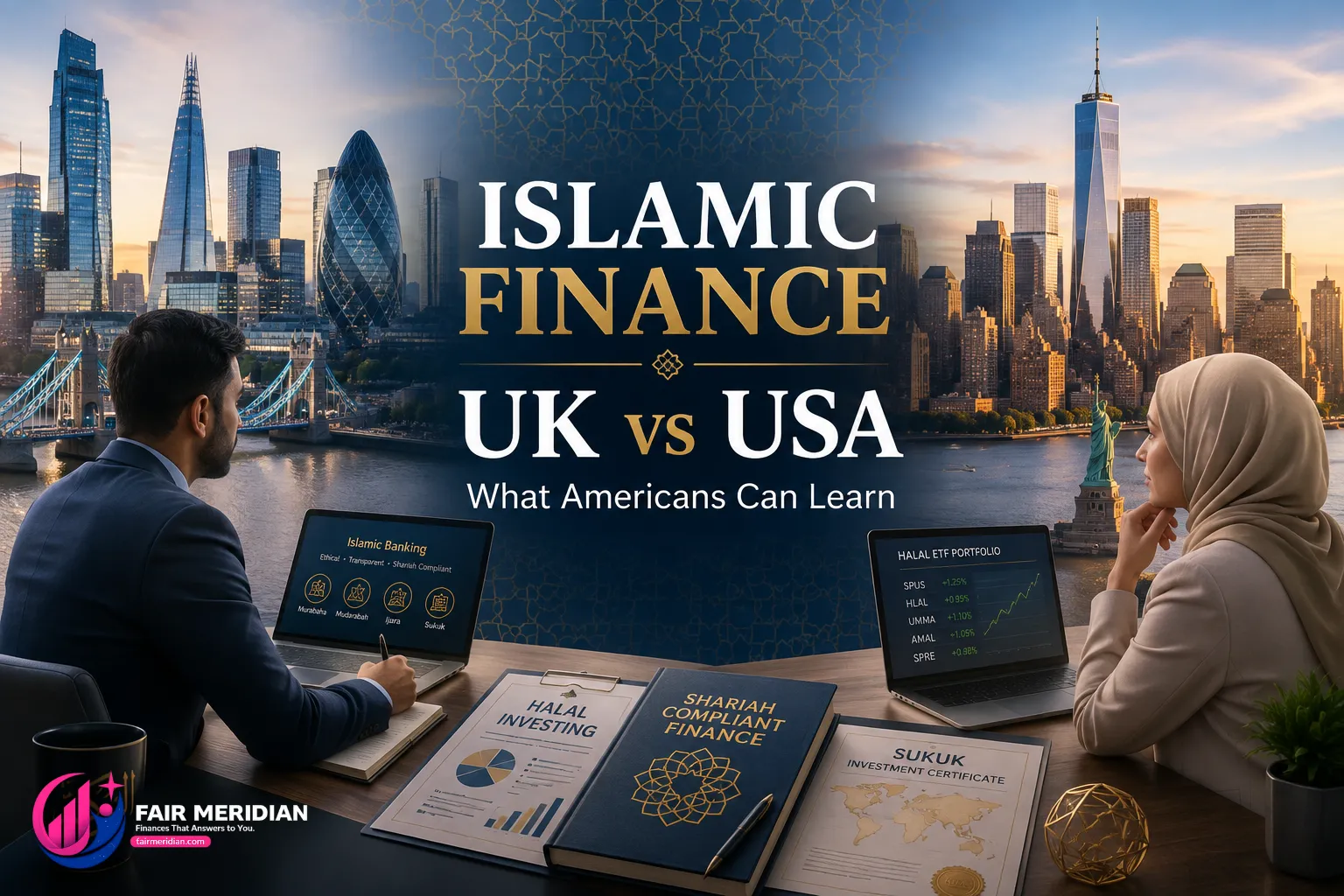
The United Kingdom is widely considered the most advanced Islamic finance market in the Western world — and for good reason. It has five fully licensed Islamic banks, a sovereign sukuk program, regulatory tax parity for Islamic mortgages established in 2003, an alternative student finance program that removes riba from university funding, and a growing halal pension ecosystem. The United States, with a Muslim population twice the size of the UK's and the world's deepest capital markets, has none of those things. It has five halal mortgage lenders, four halal ETFs, and a secondary market mechanism through Freddie Mac that no other Western country can match. Understanding why these two markets developed so differently — and what each can learn from the other — is the most practically useful Islamic finance policy analysis available to Muslim communities in both countries.
The Scoreboard — Before the Analysis
Product / Feature | United Kingdom | United States |
|---|---|---|
Full Islamic banks (deposit-taking) | ✅ 5 licensed banks (Al Rayan, Gatehouse, BLME, Bank of Ceylon, QIB UK) | ❌ None — closest is UIF division of University Bank |
Islamic current accounts (checking) | ✅ Al Rayan Bank fully operational current accounts | ❌ Not available — no Islamic bank to offer them |
Islamic savings accounts | ✅ Multiple providers; competitive expected profit rates; FSCS protected | ❌ Not available in true Islamic bank form |
Halal mortgages | ✅ Al Rayan, Gatehouse, and others; established market | ✅ Guidance Residential, UIF, Devon Bank, IjaraCDC, Lariba; 50,000+ completions |
Transfer tax parity | ✅ Stamp duty parity since 2003 — no double taxation on Islamic mortgage structure | ⚠️ State-by-state; some states impose double transfer tax on Islamic co-ownership |
Government sovereign sukuk | ✅ £200M (2014); £500M (2021); ongoing program | ❌ None — no US federal Islamic debt issuance |
Islamic student finance | ✅ Alternative Student Finance (ASF) program — government-backed, riba-free university funding | ❌ None — darurah framework or private savings only |
Government first-buyer Islamic scheme | ✅ Help to Buy equivalent available for Islamic mortgages | ❌ FHA/VA/USDA programs incompatible with halal structures |
Halal pension / retirement | ✅ Islamic pension schemes; halal SIPP available | ⚠️ SPUS in Roth IRA (effective but not institutionalized) |
Halal ISA / Tax-free investment | ✅ Al Rayan Cash ISA; Islamic Stocks & Shares ISA | ✅ SPUS Roth IRA (better structure — see below) |
Halal ETF market | ⚠️ Limited — primarily sukuk funds; less equity ETF depth | ✅ SPUS ($892M), HLAL ($245M), UMMA ($104M), AMAL ($63M), SPRE ($54M) — largest halal ETF market in the Western world |
Secondary mortgage market (GSE approval) | ❌ No equivalent — UK Islamic mortgages held on lender balance sheets | ✅ Freddie Mac + Fannie Mae approved — unique globally; enables capital recycling |
Islamic finance regulatory category | ✅ "Alternative Finance Arrangements" formally defined in Finance Act 2005 | ❌ No equivalent legislation — individual product-by-product regulatory approval only |
Muslim population | ~3.9 million (5.9% of UK) | ~4.5 million (1.4% of US) |
Estimated Muslim household wealth | ~£100–150 billion | ~$500–575 billion |
Why the UK Got There First — The Causal Story
The UK's Islamic finance advantage is not primarily due to a larger or wealthier Muslim population — US Muslims hold approximately 4–5× as much wealth as UK Muslims. The UK's lead comes from one specific regulatory decision in 2003 that unlocked everything else, and from a deliberate policy strategy that followed.
The 2003 Hinge — Stamp Duty Reform
Before 2003, Islamic mortgages in the UK were subject to double stamp duty — a tax imposed on each property transfer. A standard Islamic mortgage requires two transactions: the bank buys the property, then sells or leases it to the buyer. Under pre-2003 UK law, this triggered two stamp duty charges — making Islamic mortgages approximately 2–3% more expensive at closing than conventional equivalents. This rendered Islamic mortgages practically non-competitive.
Gordon Brown, as Chancellor of the Exchequer, announced in the 2003 Budget that the double stamp duty on Islamic mortgages would be eliminated — treating the Islamic mortgage structure's dual transaction as a single economic event for stamp duty purposes. This single change made Islamic mortgages cost-competitive with conventional mortgages for the first time in UK history.
Within two years: the Islamic Bank of Britain (now Al Rayan Bank) received its banking license and opened for business as the first standalone retail Islamic bank in Western Europe. The stamp duty reform was the unlocking mechanism — it proved government intent to enable Islamic finance at scale, gave institutional investors confidence to enter the market, and removed the cost barrier that had kept Islamic mortgages inaccessible to most UK Muslims.
The 2005 Finance Act — Formal Recognition
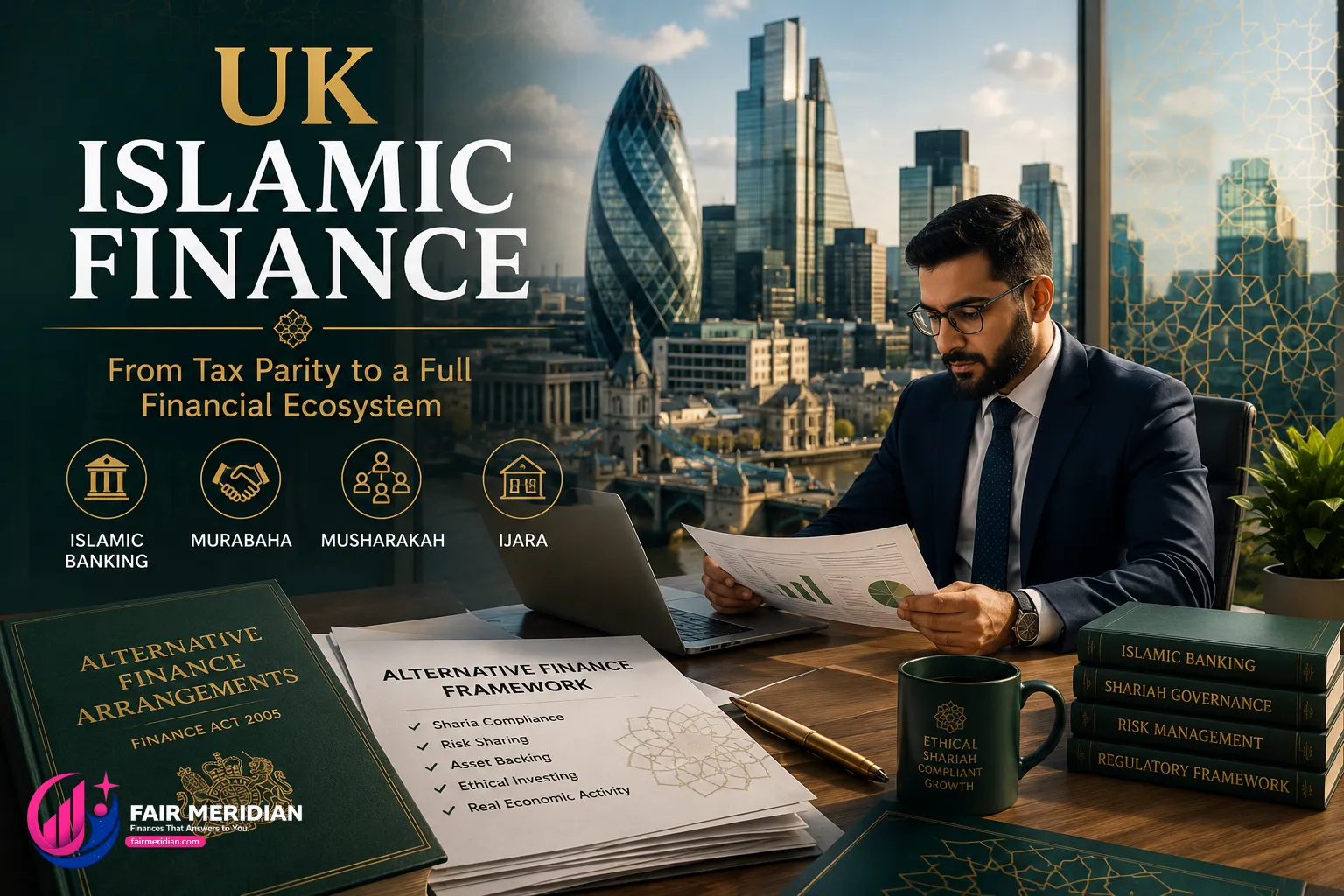
Two years later, the Finance Act 2005 formally defined "alternative finance arrangements" in UK tax law — creating a regulatory category that covered murabaha, diminishing musharakah, ijara, and other Islamic finance structures. Instead of requiring each Islamic product to individually navigate UK tax law (which was written for conventional transactions), the Act created a parallel track with equivalent tax treatment.
The US has nothing equivalent. Every US halal financial product must navigate tax law, securities law, banking law, and state-level regulations written entirely for conventional finance. Guidance Residential achieved Freddie Mac approval by working within existing conventional mortgage law frameworks — an extraordinary achievement — but it required years of legal structuring work that the UK eliminated by statute.
2014: The Sovereign Statement
In June 2014, the UK Treasury issued a £200 million sovereign sukuk — the first non-Muslim-majority country to do so. The sukuk was 10× oversubscribed, attracting £2 billion in bids from Islamic investors globally. In 2021, the UK issued a second £500 million sovereign sukuk, again heavily oversubscribed.
The sovereign sukuk sent a signal that no individual company or product could: Islamic finance is a recognized, legitimate instrument of UK government financing — not a niche accommodation for a minority religious community. This government endorsement catalyzed private market development in ways that years of community advocacy alone could not.
The UK Islamic Finance Ecosystem — What Americans Are Missing
Al Rayan Bank — The Real-World Difference
Al Rayan Bank (formerly Islamic Bank of Britain, founded 2004) is the clearest demonstration of what the US lacks. It offers:
Current accounts (checking): A fully functional everyday banking account with debit card, direct debit capability, online banking, mobile app — with no interest earned or charged. When you spend on your Al Rayan debit card, no riba is involved anywhere in the banking relationship.
Fixed-term deposits (savings): Al Rayan offers "Expected Profit Rate" savings accounts — funded through Sharia-compliant investments, protected by the UK's Financial Services Compensation Scheme (FSCS) up to £85,000. At time of writing, Al Rayan's expected profit rates were competitive with the best UK conventional savings rates.
Cash ISA: An ISA (Individual Savings Account) is the UK equivalent of a Roth IRA — savings that compound completely tax-free. Al Rayan offers a Sharia-compliant Cash ISA with competitive expected profit rates. A UK Muslim can save up to £20,000 per year in their Al Rayan Cash ISA tax-free.
Home Purchase Plan: Al Rayan's diminishing musharakah product for home purchase, available for residential and buy-to-let properties.
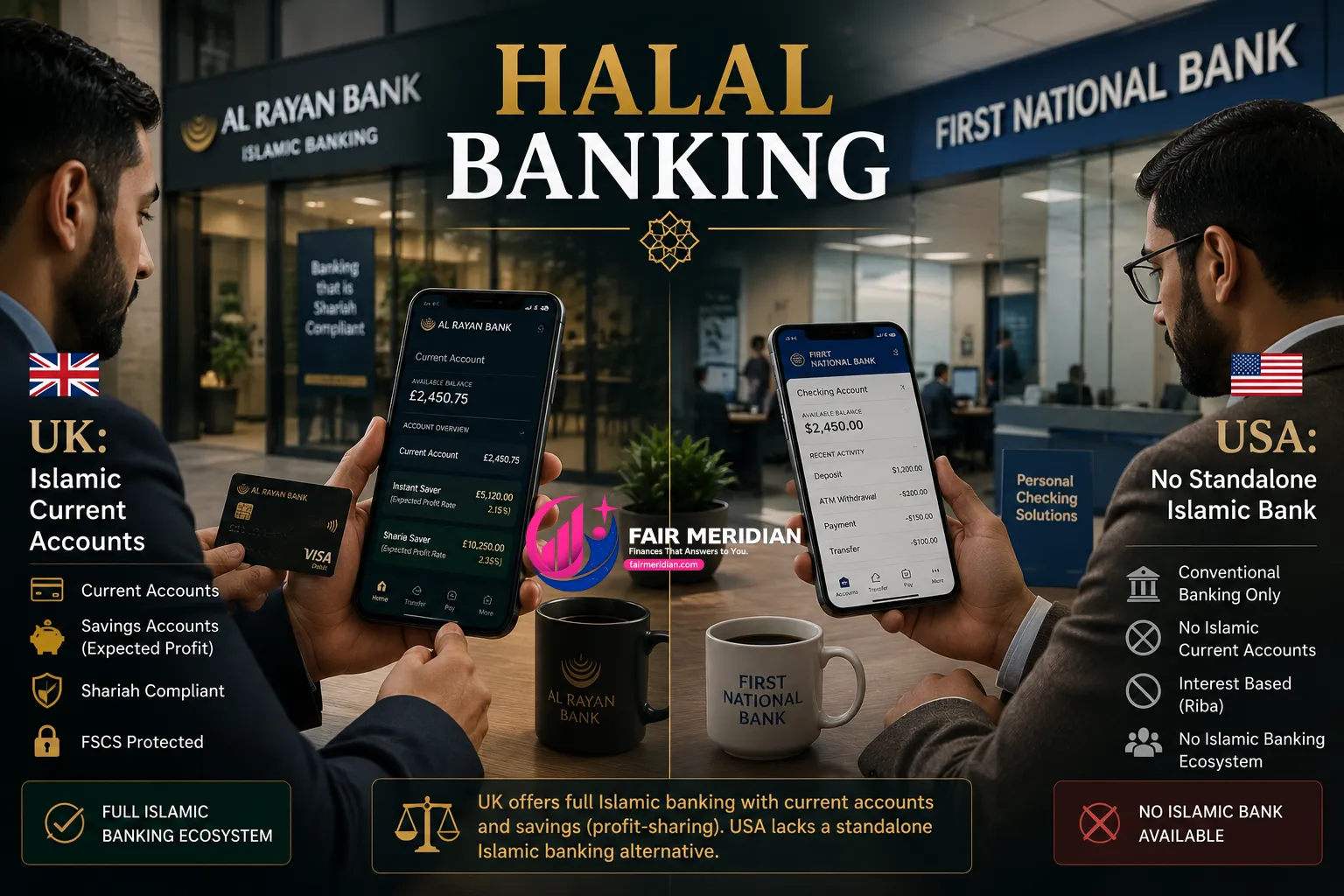
The UK has standalone Islamic banking options, while US Muslims lack an equivalent halal current-account ecosystem.
The Al Rayan current account is the single most important thing the US market lacks. Every US Muslim with a conventional bank account is engaging with a bank that uses their deposits to fund interest-bearing lending — the deposit is held by a riba institution. US Muslims have no institutional alternative. The closest approximation: holding cash at a halal lender or keeping minimum balances — neither of which is a functional everyday banking relationship.
The UK Alternative Student Finance (ASF) Program
The UK's Alternative Student Finance scheme, developed by the UK's Department for Education and Islamic Finance Council UK (UKIFC), is arguably the most important Islamic finance policy innovation in any Western country.
Under conventional UK student loans, students borrow from the Student Loans Company at a government-set interest rate and repay as a percentage of income above a threshold. For Muslim students, this is riba — triggering the same darurah debate that US Muslim students face.
The ASF scheme provides an alternative: a takaful-based arrangement where Muslim students make charitable contributions (tabarru) to a fund and receive educational support in return — functionally equivalent in cost to the conventional student loan, but structured without interest. The government underwrites the cost difference. Muslim students access the same amount of support, repay under the same income-contingent terms, but the underlying structure eliminates riba from the transaction.
The US equivalent would require Congressional legislation — but the UK model proves it is administratively feasible at national scale with government backing.
UK Sovereign Sukuk — What It Unlocked
The £200 million UK sovereign sukuk (2014) and £500 million (2021) were not primarily about the money — the UK can borrow at low cost through conventional gilts. The sukuk were policy signaling instruments. Their effect on the UK market:
Institutional investors who require "government-quality" Islamic assets for their portfolios now had UK gilts equivalent to add alongside Gulf sovereign sukuk
UK-based Islamic banks could hold UK sovereign sukuk as high-quality liquid assets (HQLA) for regulatory capital purposes — exactly as conventional banks hold UK gilts
The sukuk demonstrated that Islamic finance principles can be applied at sovereign scale in common law jurisdictions — validating the entire UK Islamic finance framework
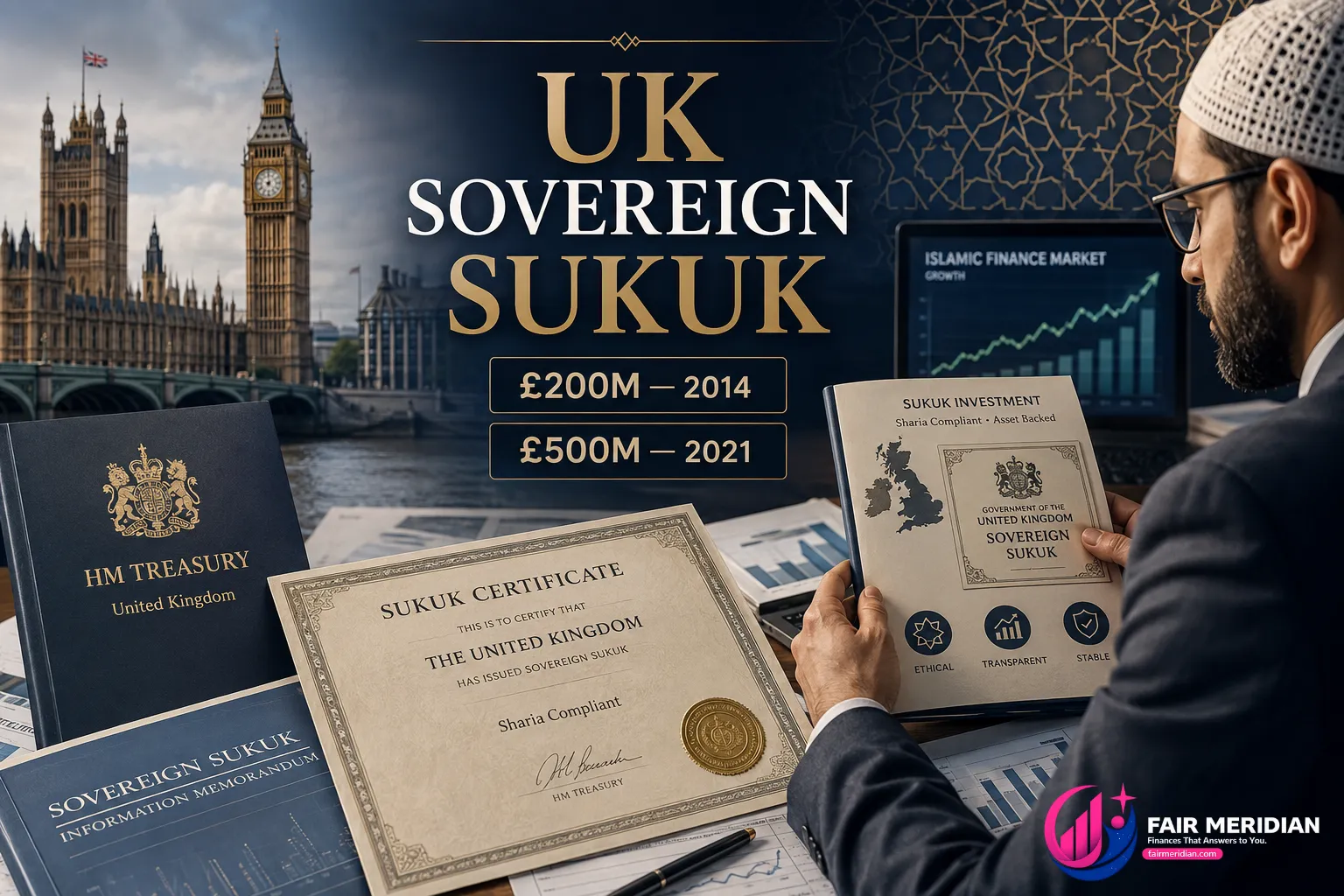
The UK's sovereign sukuk issuances helped establish Islamic finance as a legitimate institutional investment market.
Where the US Surprising Leads the UK
Despite the UK's institutional advantages, the US leads in three specific areas — and the gap is larger than most people realize.
Halal ETFs — US Has the Deepest Market
Fund | Country | AUM (May 2026) | Type |
|---|---|---|---|
SPUS | USA | $892M | Sharia-screened S&P 500 equity |
HLAL | USA | $245M | Sharia-screened US equity |
UMMA | USA | $104M | Sharia-screened US equity |
AMAL | USA | $63M | Global sukuk |
SPRE | USA | $54M | Sharia-screened REITs |
Total US halal ETF AUM | USA | ~$1.36 billion |
The UK does not have an equivalent halal ETF ecosystem. UK Muslims seeking Sharia-compliant equity investment access primarily through actively managed funds (higher fees, less transparent) or through the same US-listed halal ETFs that American Muslims use. The London Stock Exchange has listed some Islamic funds, but the US market's combination of large AUM, low expense ratios (SPUS at 0.49%), daily liquidity, and GSE-adjacent institutional credibility is simply more developed.
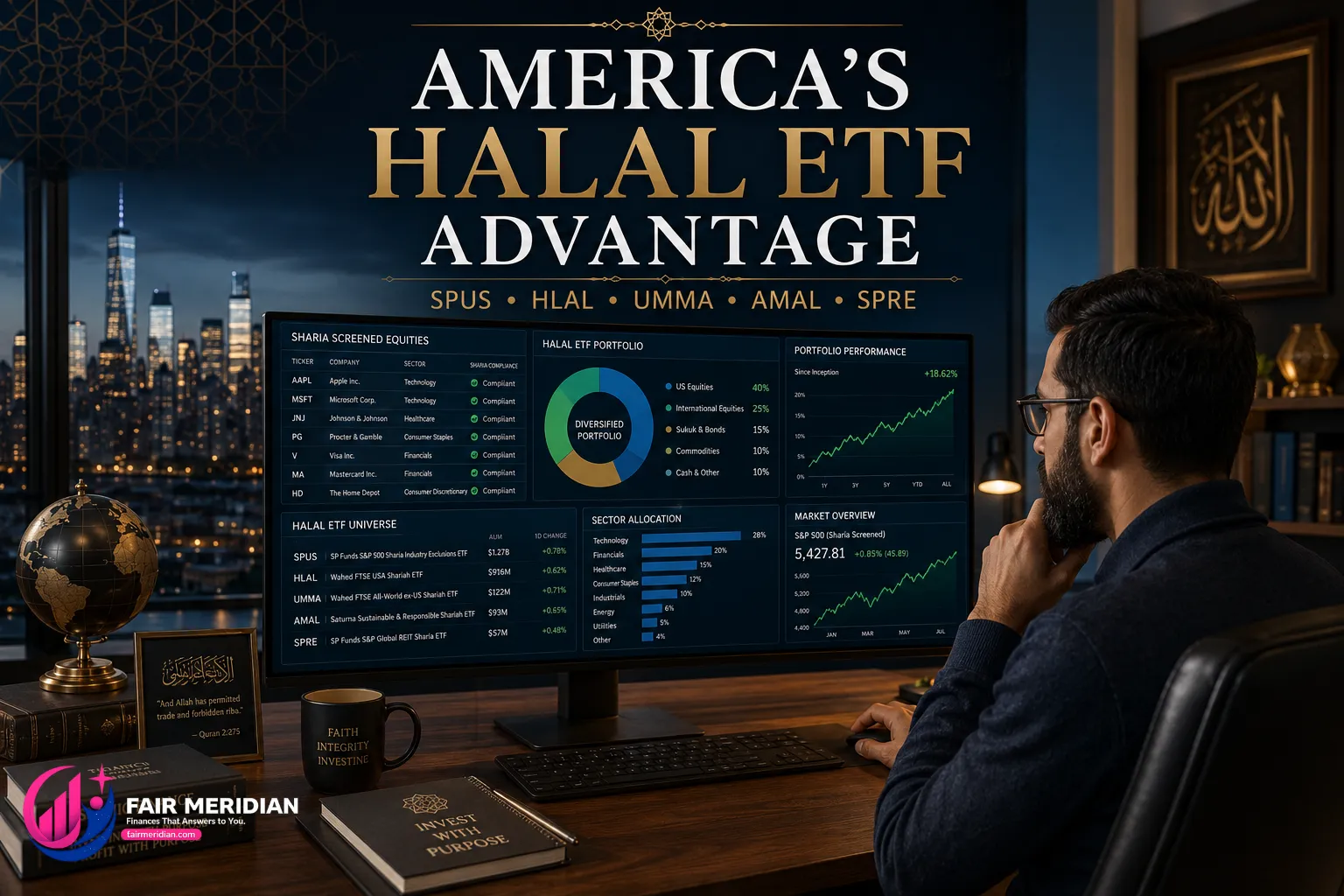
A UK Muslim investing in Al Rayan's Stocks and Shares ISA has far less choice of low-cost halal equity vehicles than a US Muslim opening a Roth IRA at Fidelity and buying SPUS.
GSE Secondary Market — A US Institutional Achievement
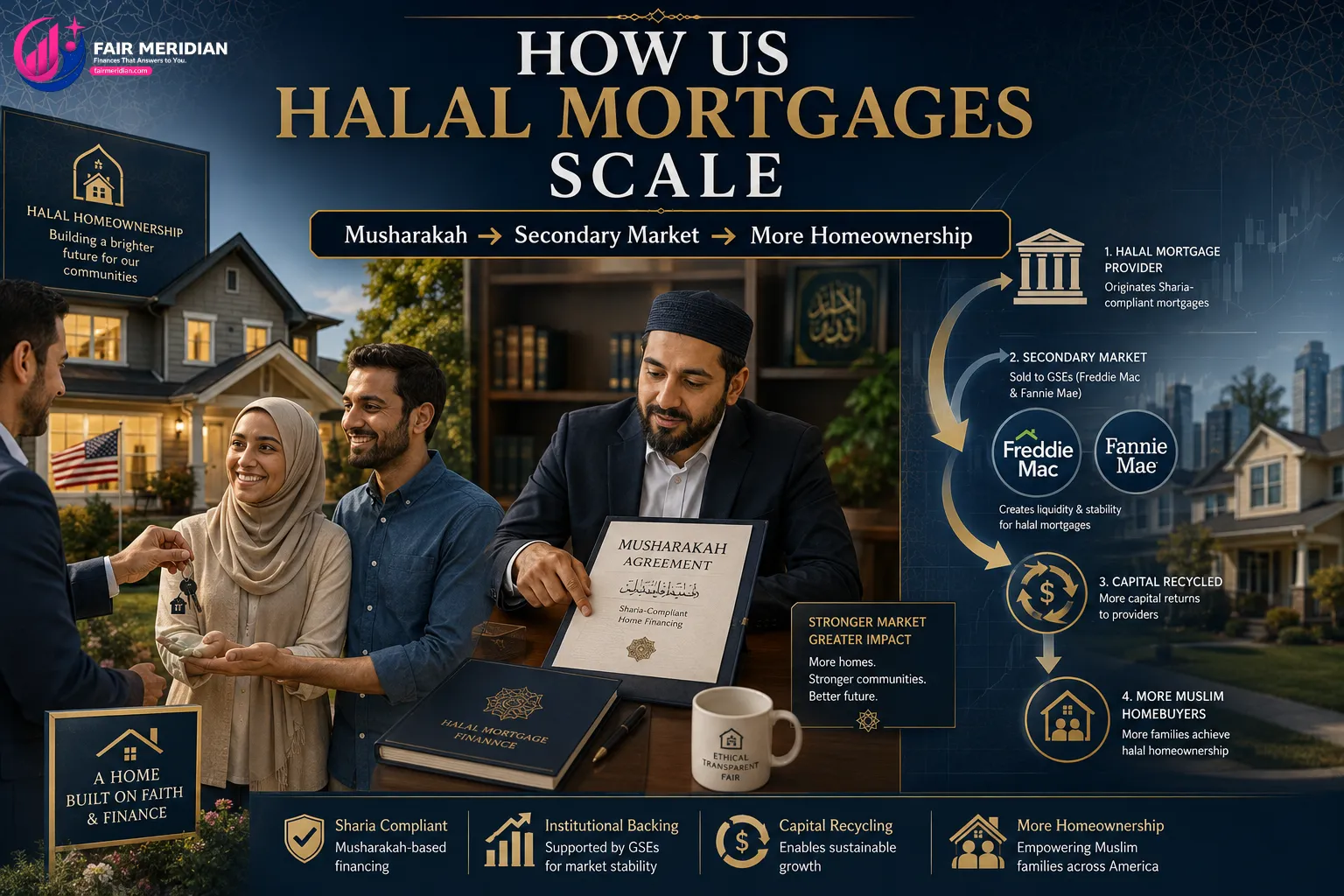
Freddie Mac and Fannie Mae's approval of musharakah mortgage contracts for secondary market purchase is a US achievement with no UK equivalent. Here is why it matters:
When Guidance Residential or UIF originates a halal mortgage, they can sell that contract to Freddie Mac. Freddie Mac pays them cash, which Guidance uses to fund new halal mortgages. Without this secondary market: Guidance would hold every mortgage it originates until maturity (30 years), requiring enormous ongoing capital. With the secondary market: Guidance can originate, sell, and originate again — multiplying the number of Muslim families they can serve from the same capital base.
UK Islamic banks like Al Rayan hold their home purchase plans on their own balance sheets — requiring much more capital per mortgage originated and limiting the scale of the market. The US GSE secondary market mechanism is the reason Guidance has completed 50,000+ transactions; Al Rayan's home purchase portfolio, by comparison, is measured in the low thousands of active accounts.
Scale of Potential
US Muslim household wealth (~$500–575 billion) is approximately 4–5× UK Muslim household wealth. If the US achieved the same institutional Islamic finance development as the UK, the US Islamic finance market would dwarf the UK's — not because of per-capita metrics but because of sheer scale. The US has the world's deepest capital markets, the most liquid bond markets, the largest equity exchanges, and the deepest mortgage securitization infrastructure. Applied to Islamic finance with proper regulatory frameworks, the US could become the world's dominant Islamic finance hub — surpassing even Kuala Lumpur and Dubai.
The Five Specific Things the US Should Adopt
These are not aspirational. They have precedent, they have been done in the UK, and they have policy pathways in the US legislative and regulatory system.

Lesson 1: Federal Transfer Tax Parity (The 2003 Stamp Duty Reform Equivalent)
The US equivalent of the UK's 2003 stamp duty reform would be federal legislation or IRS guidance treating Islamic mortgage co-ownership transactions as single economic events for transfer tax and recording fee purposes.
Currently, some US states (and some Islamic mortgage structures) trigger double transfer taxes because the Islamic mortgage's dual transaction structure (bank acquires, bank transfers to buyer) looks like two sales to a tax code written for conventional single-transaction mortgages. New York's transfer tax and recording fees, Georgia's intangibles tax, and similar state taxes apply in ways that create cost disadvantages for Islamic mortgage buyers in some jurisdictions.
The fix: IRS Revenue Ruling or Congressional legislation defining "alternative finance arrangement" transactions as single economic events for federal and state transfer tax purposes — exactly what the UK Finance Act 2005 accomplished. Cost to taxpayers: minimal (the tax revenue lost per transaction is small; the policy gain is massive).
Lesson 2: Alternative Student Finance
The UK's ASF scheme proves this is administratively feasible at national scale. The US version could work as follows:
Federal student finance alternative: Congressional legislation creating an "Income Share Agreement" variant for Muslim students — structured as a forward sale of a percentage of future income rather than an interest-bearing loan. The government receives a percentage of income above a threshold until an agreed total is repaid. No interest component. Economically equivalent to conventional student loans from the government's perspective; Sharia-compliant from the student's.
The political alignment: Income share agreements (ISAs) have bipartisan political support — conservatives like them as market-based alternatives to government loans; progressives like the income-contingent repayment feature. An Islamic-compatible ISA structure could pass as part of broader higher education financing reform.
Lesson 3: US Sovereign Sukuk
The US Treasury currently issues the largest debt market in the world — approximately $27 trillion outstanding at current figures. A portion of this could be issued as sovereign sukuk.
The mechanics: the Treasury identifies a pool of government-owned real assets (federal infrastructure, land holdings, buildings) and creates an SPV (Special Purpose Vehicle) that issues sukuk certificates representing beneficial ownership in those assets. Sukuk holders receive rent income from the assets. At maturity, the Treasury buys back the assets.
The economic rationale is not religious accommodation — it's access to capital. There is approximately $3–4 trillion in Islamic investment capital globally that specifically seeks high-quality sovereign sukuk. It currently flows primarily to Malaysian, Saudi, and UAE sovereign issuances. A US sovereign sukuk would redirect a portion of this capital toward US debt — potentially at competitive or lower rates given the quality premium US assets command globally.
The UK proved this is possible in a common law jurisdiction with a conventional debt structure. The US Treasury has the legal authority, asset base, and market position to do this without Congressional action — it requires only Treasury Department initiative.
Lesson 4: FHA-Equivalent for Halal Mortgages
FHA loans, VA loans, and USDA loans provide government-backed low-down-payment mortgages for qualifying US buyers. They are completely incompatible with Islamic co-ownership structures — because the government guarantees a loan, and musharakah has no loan to guarantee.
The UK solution (Help to Buy Islamic equivalent) involved the government taking an equity stake in the property alongside the Islamic bank and the buyer — a three-party co-ownership structure. The government's equity stake doesn't charge interest; it participates in property appreciation instead.
The US equivalent: HUD-sponsored legislation enabling FHA to guarantee Islamic mortgage co-ownership structures through a modified program — perhaps called "FHA Partnership Finance" — where FHA's role is as a co-ownership guarantor rather than a loan guarantor. This would bring the US Muslim community access to the same low-down-payment government backing that 8 million conventional American homebuyers access annually through FHA.
Lesson 5: OCC Framework for Standalone Islamic Banks
The UK's FCA created a licensing framework enabling standalone Islamic retail banks. The US OCC (Office of the Comptroller of the Currency) could create an equivalent "Alternative Finance Institution" charter — enabling a bank to take deposits, offer current accounts, and provide financing using Islamic structures, without requiring a parallel conventional banking operation.
Currently, the closest US equivalent is a conventional bank (University Bank) with an Islamic division (UIF). This creates regulatory complexity and means the Islamic operations are partially funded through the conventional bank's interest-based capital structure. A standalone Islamic bank charter would enable Muslim entrepreneurs to build Al Rayan-equivalent institutions in the US — serving the millions of US Muslims who currently have no halal current account option.
The Market Size Comparison — Why the US Should Act
Metric | UK Islamic Finance | US Islamic Finance | US Potential |
|---|---|---|---|
Muslim population | 3.9 million | 4.5 million | Growing to 6M+ by 2040 (Pew) |
Est. Muslim household wealth | ~£100–150B | ~$500–575B | ~$800B+ by 2030 |
Islamic banking assets | ~£7–8B (in UK Islamic banks) | ~$2–3B (halal mortgage portfolios) | $50–100B with full infrastructure |
Halal investment assets | ~£3–4B (Islamic funds) | ~$1.4B (halal ETFs) | $20–50B with ISA/pension equivalents |
Global Islamic capital attracted | ~£2–3B (sovereign sukuk oversubscription + London Islamic finance hub) | Negligible | $50–200B with US sovereign sukuk |
The Critical Difference — Political Will
The UK's Islamic finance development was not driven by market forces alone — it was driven by specific political decisions. Gordon Brown's stamp duty reform was a deliberate policy choice. The Finance Act 2005 was legislation. The sovereign sukuk was a Treasury initiative. The Alternative Student Finance was a Department for Education program.
Each of these was enabled by a specific political dynamic: UK Muslims represent approximately 5.9% of the UK population — a significantly larger electoral fraction than US Muslims (1.4% of US population). UK Muslim communities are heavily concentrated in key parliamentary constituencies (Birmingham, Leicester, Bradford, London boroughs) where they represent 20–40% of voters in some seats. This created political incentive to deliver Islamic finance policy.
US Muslims, at 1.4% of the population, have less electoral leverage per capita — but the wealth concentration and geographic concentration in swing-state communities (Metro Detroit, Northern Virginia, New Jersey suburbs, Houston) creates political leverage that advocacy organizations have not yet systematically exploited for Islamic finance policy.
The UK's Islamic finance story is not a story of organic market development — it is a story of organized Muslim community advocacy, sympathetic political champions, and specific regulatory innovations that created the space for private market development. The US Islamic finance community's path forward runs through the same playbook.
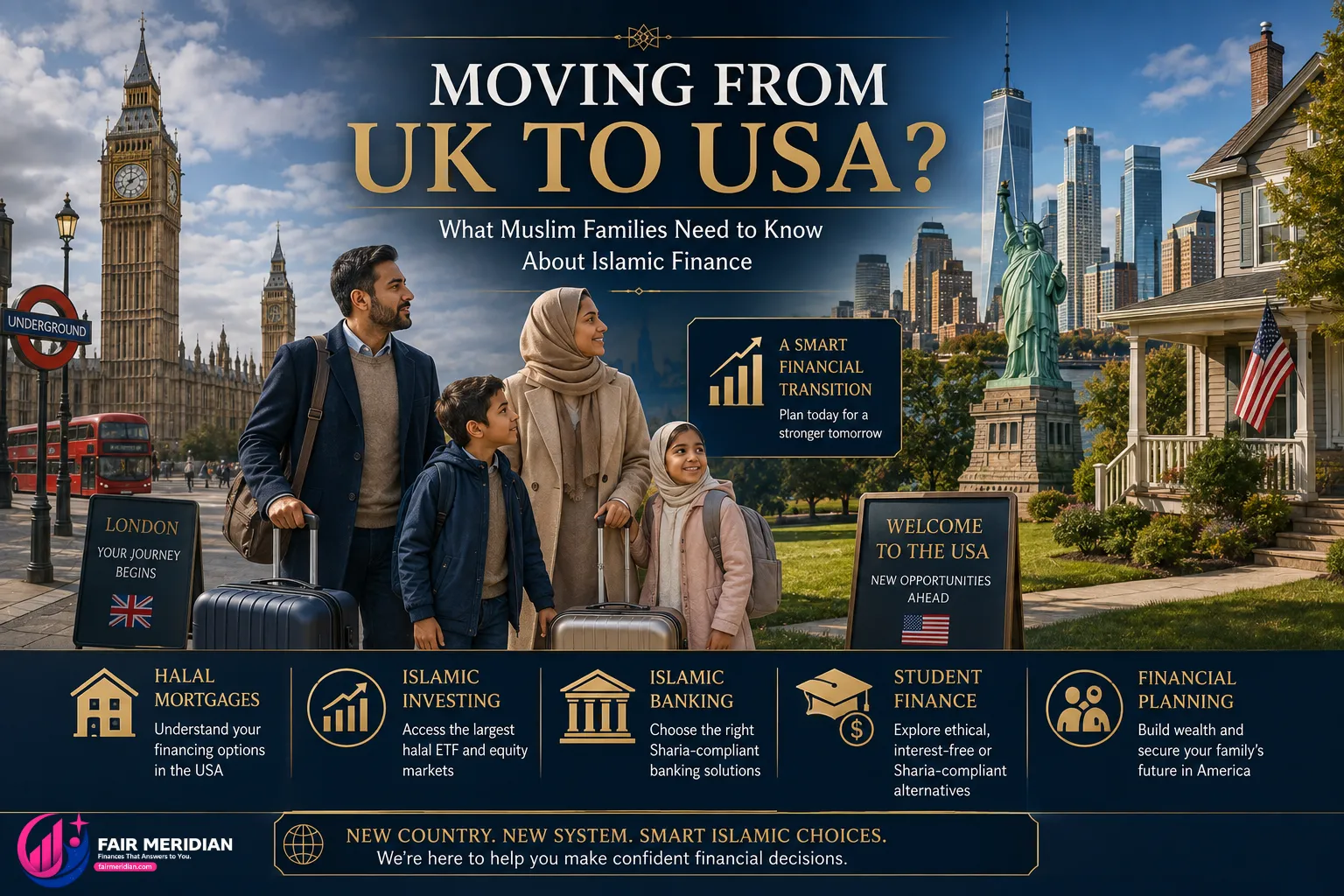
What UK Muslims Coming to the US Should Know
For UK Muslims who relocate to the US — a common pattern among British Muslim professionals in technology, medicine, and finance — the adjustment requires recalibration:
No halal current account: Your Al Rayan current account doesn't transfer. In the US, you will need a conventional bank account for everyday transactions unless you open with a conventional bank and treat the current account as purely transactional (not interest-earning — opt out of interest on checking).
The Roth IRA is better than the ISA: For long-term investment, the US Roth IRA is structurally superior to the UK ISA. The annual contribution limit is lower ($7,000 vs £20,000 ISA) but the Roth IRA's permanent tax-free status, no required minimum distributions, and inheritable tax-free nature make it a better long-term vehicle. SPUS in a Roth IRA is the best halal long-term investment vehicle in the Western world.
Halal mortgage coverage is actually good: Five providers, Freddie Mac and Fannie Mae approved, 5% down available through Guidance Residential. The product quality is comparable to UK Islamic mortgages and the 5% down option has no UK equivalent.
Student finance is more complicated: The UK's Alternative Student Finance has no US equivalent. Children attending US universities will face the darurah debate unless private funding (529 plans, scholarships) covers the cost.
What US Muslims Should Know — and Demand
US Muslims are the single largest under-served Islamic finance market in the Western world. The gap between the US Muslim community's wealth (~$500B), its political representation, and the Islamic finance infrastructure that wealth could support is an organizing opportunity. The UK model provides the legislative template, the product precedent, and the political playbook.
The most tractable near-term US Islamic finance policy victories — in rough order of feasibility:
Federal IRS guidance on transfer tax treatment of alternative finance arrangements (requires no legislation; Treasury initiative)
OCC "Alternative Finance Institution" charter enabling standalone Islamic banks (regulatory rulemaking; no legislation needed)
US sovereign sukuk (Treasury initiative; no legislation needed; immediate revenue potential)
FHA-compatible Islamic mortgage program (HUD regulatory change or legislation)
Alternative student finance program (Congressional legislation — hardest but highest impact)
Frequently Asked Questions
Does the UK have better halal mortgage options than the US?
The UK has more providers (Al Rayan, Gatehouse, and others) and complete stamp duty parity since 2003. The US has Guidance Residential's 5% down option — something no UK Islamic mortgage provider offers — and Freddie Mac secondary market approval that enables greater capital scale. For a UK Muslim moving to the US: the product quality is comparable; the 5% down option and rate (currently 6.74%) are actually competitive advantages in the US market. The US lacks the UK's government-backed first-buyer assistance for Islamic mortgages.
Can US Muslims use UK Islamic banks?
US residents cannot typically access UK Islamic bank products (Al Rayan, Gatehouse) as retail customers — UK banking regulation applies to UK residents and the accounts are GBP-denominated. The exception: some UK Islamic banks offer international wealth management services to non-UK residents with sufficient assets, but these are not retail banking products. US Muslims need US-based Islamic finance solutions.
Why doesn't the US have Islamic banks?
Two primary barriers: (1) The US OCC has not created a regulatory category for standalone Islamic banks — every US bank must be chartered under conventional banking law that requires or assumes interest-based operations at its foundation. (2) The US has had no equivalent of the UK's deliberate policy initiative to create regulatory parity. Guidance Residential and UIF exist despite the regulatory environment, not because of it — they navigated existing conventional frameworks rather than having a purpose-built Islamic finance framework to work within.
Is the Roth IRA better than the UK ISA for halal investment?
For long-term halal wealth building: yes — the US Roth IRA is structurally superior to the UK ISA. The Roth IRA has permanent tax-free status (no taxes ever on qualified withdrawals), no required minimum distributions, is inheritable tax-free by beneficiaries, and can hold SPUS — the world's largest halal equity ETF at $892M AUM. The UK ISA has a higher annual contribution limit (£20,000 vs $7,000) and more providers offering halal products, but the Roth IRA's structural tax advantages for long-term compounding exceed the ISA's contribution limit advantage for most investors.
For the complete halal investing guide using US-available vehicles — SPUS, Roth IRA, SDIRA — see our Halal Investing USA 2026 Guide. For the musharakah mortgage comparison across all five US providers, see our Halal Mortgage Rates USA Guide. For the development economics case for Islamic finance's anti-poverty potential, read our How Zakat Could Solve US Poverty post.