
There is a real tension at the center of this question, and most content about it pretends there isn't. The Islamic position on conventional life insurance is not straightforward. Scholars disagree. The halal alternative — takaful — barely exists at retail scale in the United States. And you, as a Muslim with dependents who rely on your income, have a genuine religious obligation to provide for your family even after you're gone. This post works through the actual arguments, tells you where scholars land, and gives you a real framework for making this decision — not a shortcut around it.
Why Most Scholars Say Conventional Life Insurance Is Problematic
The scholarly concern with conventional life insurance isn't arbitrary. It comes from three specific features of how insurance contracts work — and understanding these three issues is the foundation of everything else in this discussion.
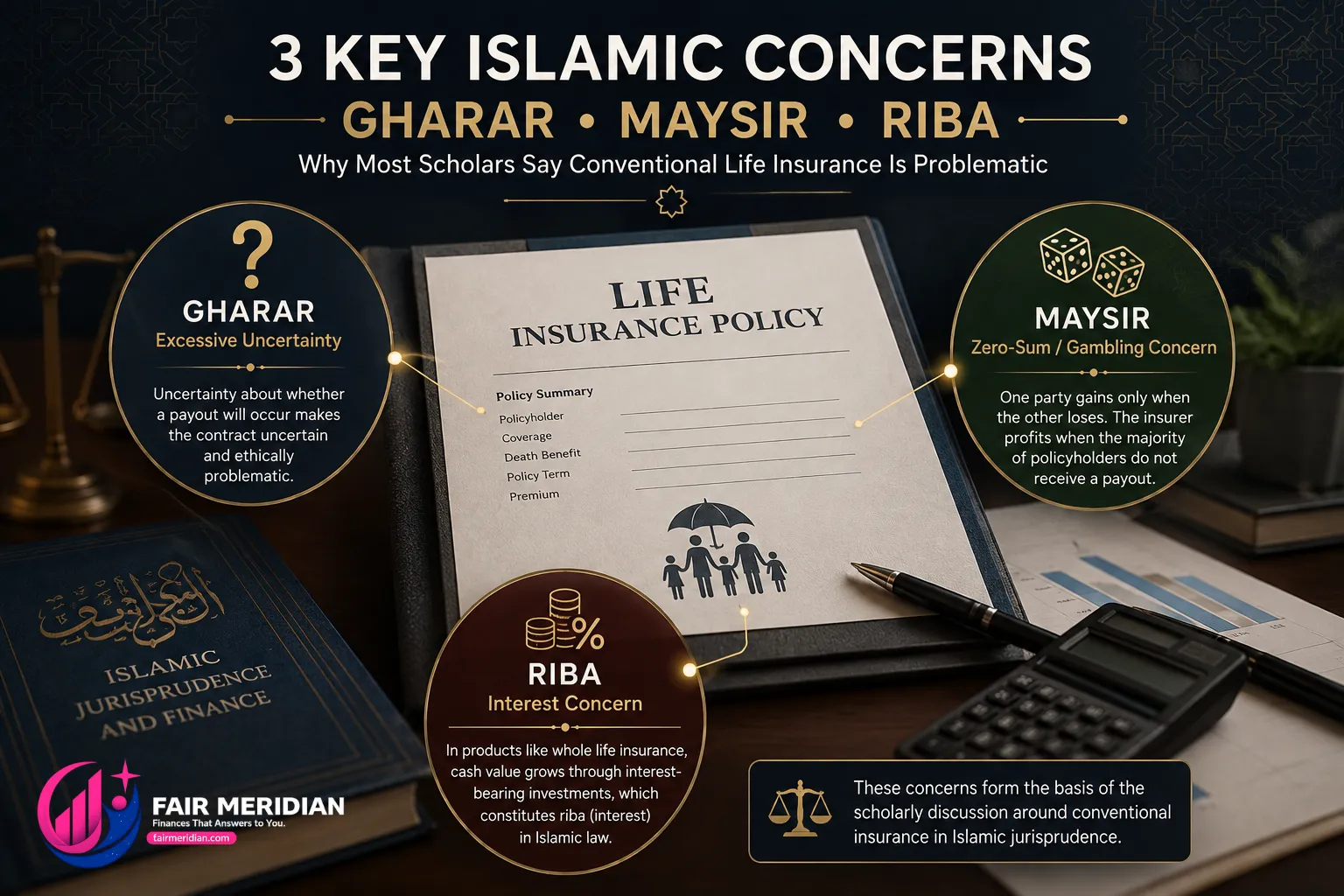
The first is gharar — excessive uncertainty in a contract. When you sign up for life insurance, you're paying premiums over many years without knowing whether you or your family will ever receive a benefit. The benefit might materialize, or it might not. The insurer doesn't know either. Islamic commercial law is uncomfortable with contracts where the fundamental subject matter — whether there will even be a payout — is unknown at the time of signing. That uncertainty is gharar, and major gharar invalidates contracts under Islamic jurisprudence.
The second is maysir — the zero-sum element. When you pay premiums your whole life and die without ever claiming, the insurer keeps your money. When you die young and they pay out far more than you contributed, you "win" and they "lose." This asymmetric outcome where one party's gain is structurally tied to the other's loss looks like gambling to many scholars — particularly because the entire business model of a life insurer depends on most policyholders dying after paying in more than they receive.
The third is riba — and this one applies specifically to whole life insurance, not term. Whole life policies have a cash value component that grows over time by earning interest. The insurer takes your premiums, invests them in interest-bearing instruments, and that interest accumulates in your policy's cash value. That is riba, unambiguously. This is why whole life and universal life insurance are the most clearly prohibited products in this space — they have all three problems simultaneously.
Term Life Is a Different Question
Here is where most discussions about life insurance and Islam go wrong: they treat all life insurance as one thing. It isn't.
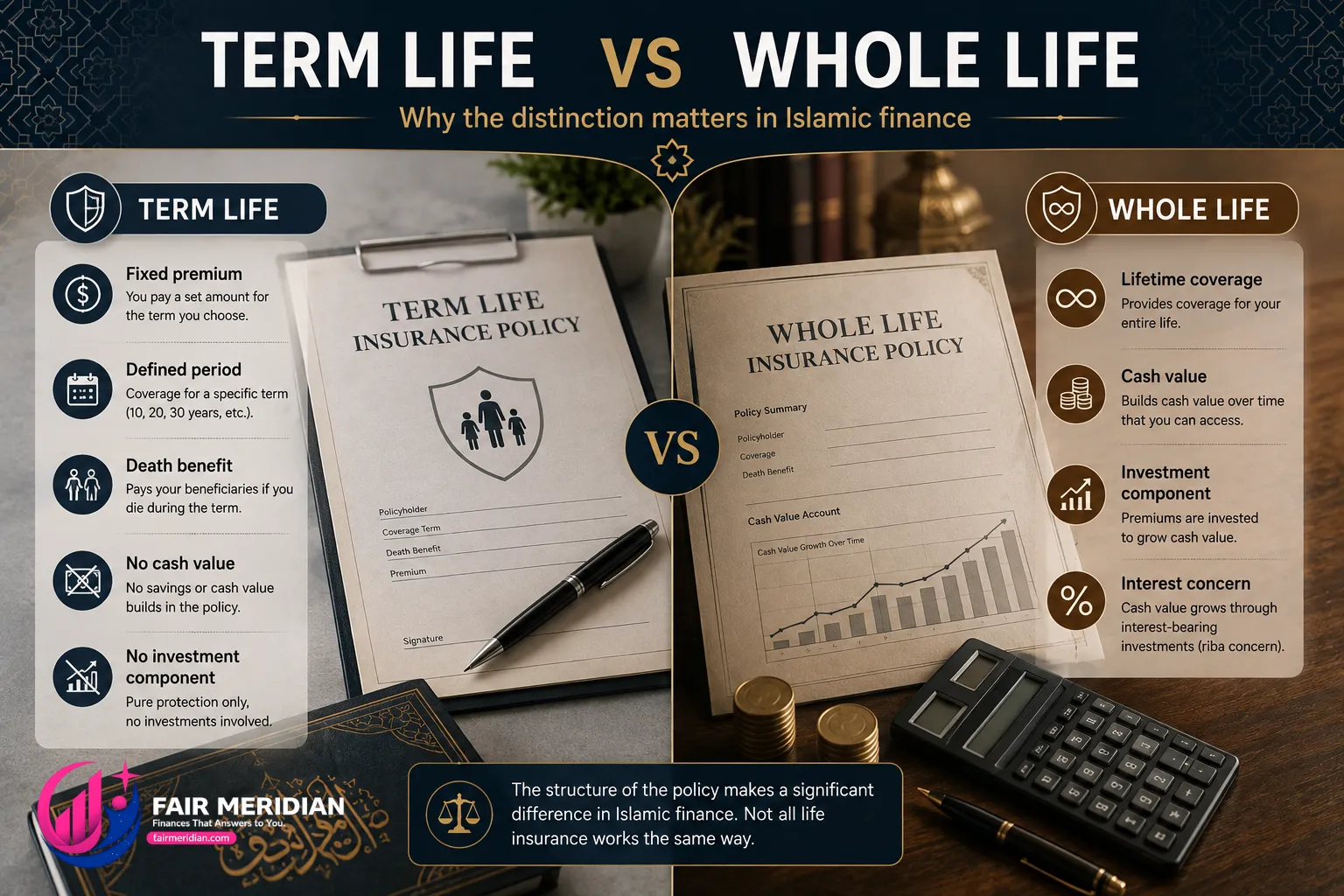
Term life insurance is structurally simple. You pay a fixed premium for a defined period — 20 years, 30 years, whatever term you choose. If you die during that period, your family receives the death benefit. If you outlive the term, the policy expires and you receive nothing. There is no cash value. There is no investment component. No interest accumulates anywhere in the transaction. The riba problem that makes whole life so clearly impermissible does not exist in a pure term life policy.
What remains is the gharar and maysir concern — the uncertainty about whether the payout will happen and the zero-sum nature of the outcome. These are real. But they look different when you consider what term life is actually doing: it's providing financial protection for your family against the risk of your early death. The purpose is legitimate, even noble. And the transaction is simpler and more transparent than conventional insurance products generally are.
This is why many contemporary scholars — particularly those grappling seriously with the practical reality of Muslim families in Western countries — reach different conclusions about term life than they do about whole life. They're not the same product.
What Takaful Is — and Why You Probably Can't Get It in America
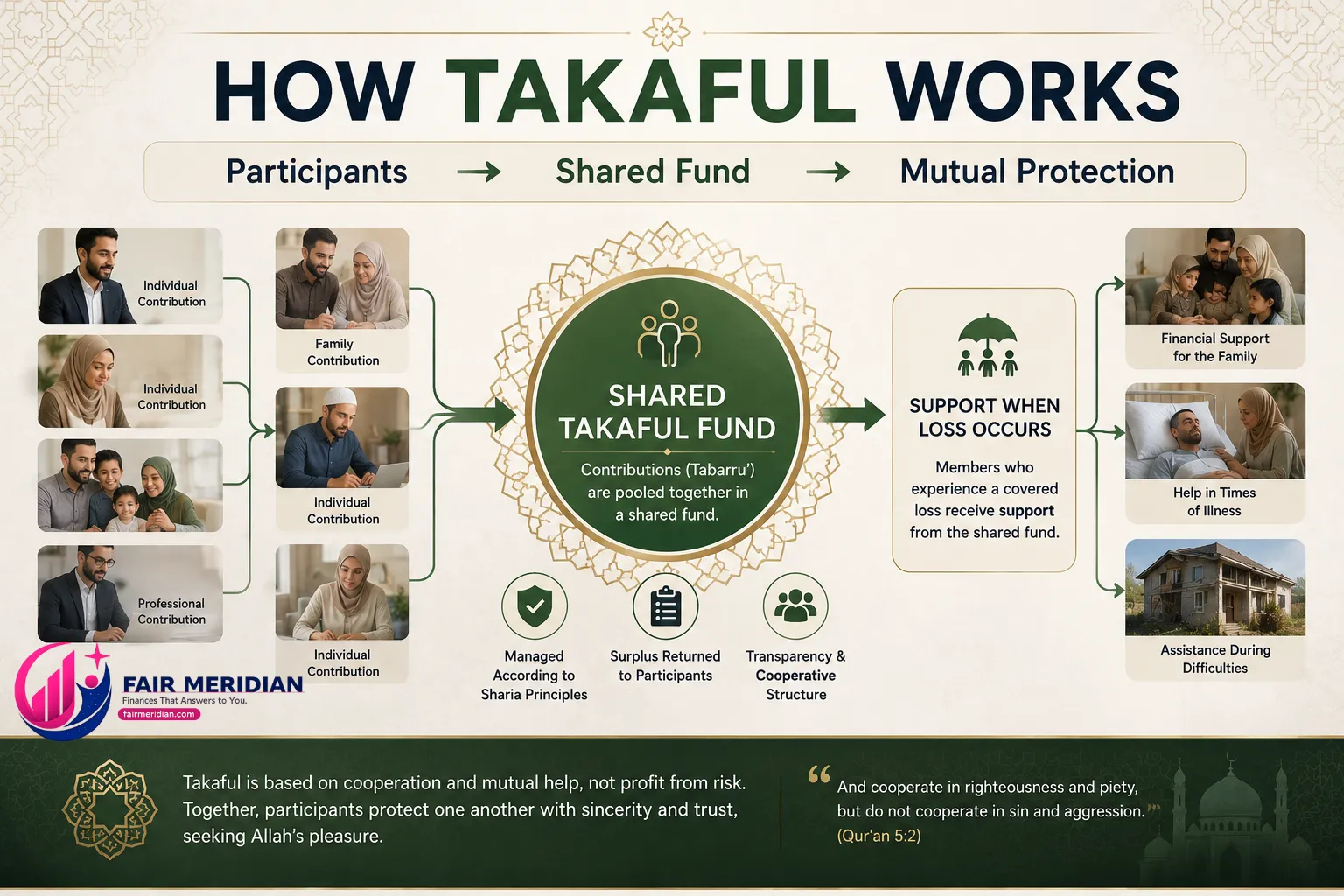
Takaful is the Islamic alternative to conventional insurance. The structure flips the commercial logic of insurance entirely: instead of paying a company to absorb your risk in exchange for profit, participants contribute to a shared fund (tabarru — a charitable donation) specifically to help each other when losses occur. If someone in the pool suffers a loss, they receive support from the fund. Surpluses are returned to participants. The takaful operator manages the fund for a fee, not for a share of the risk.
This resolves the gharar and maysir concerns elegantly. You're not purchasing an uncertain benefit from a profit-seeking counterparty — you're donating to a mutual fund and receiving support from that same community fund if you need it. The uncertainty is tolerated because the transaction is framed as charitable giving, not commercial exchange.
Takaful is widely available in Malaysia, Saudi Arabia, the UAE, and the UK. In the United States, it essentially doesn't exist at the retail level. There are companies that use the word "takaful" in their marketing, but genuine takaful — with a properly constituted tabarru fund, an independent Sharia supervisory board certifying the structure, and segregated participant funds — is not available as a consumer product in the American market as of 2026. The regulatory environment, the cost of building the infrastructure, and the relatively small addressable market have kept institutional takaful from taking root here the way it has in Muslim-majority countries and the UK.
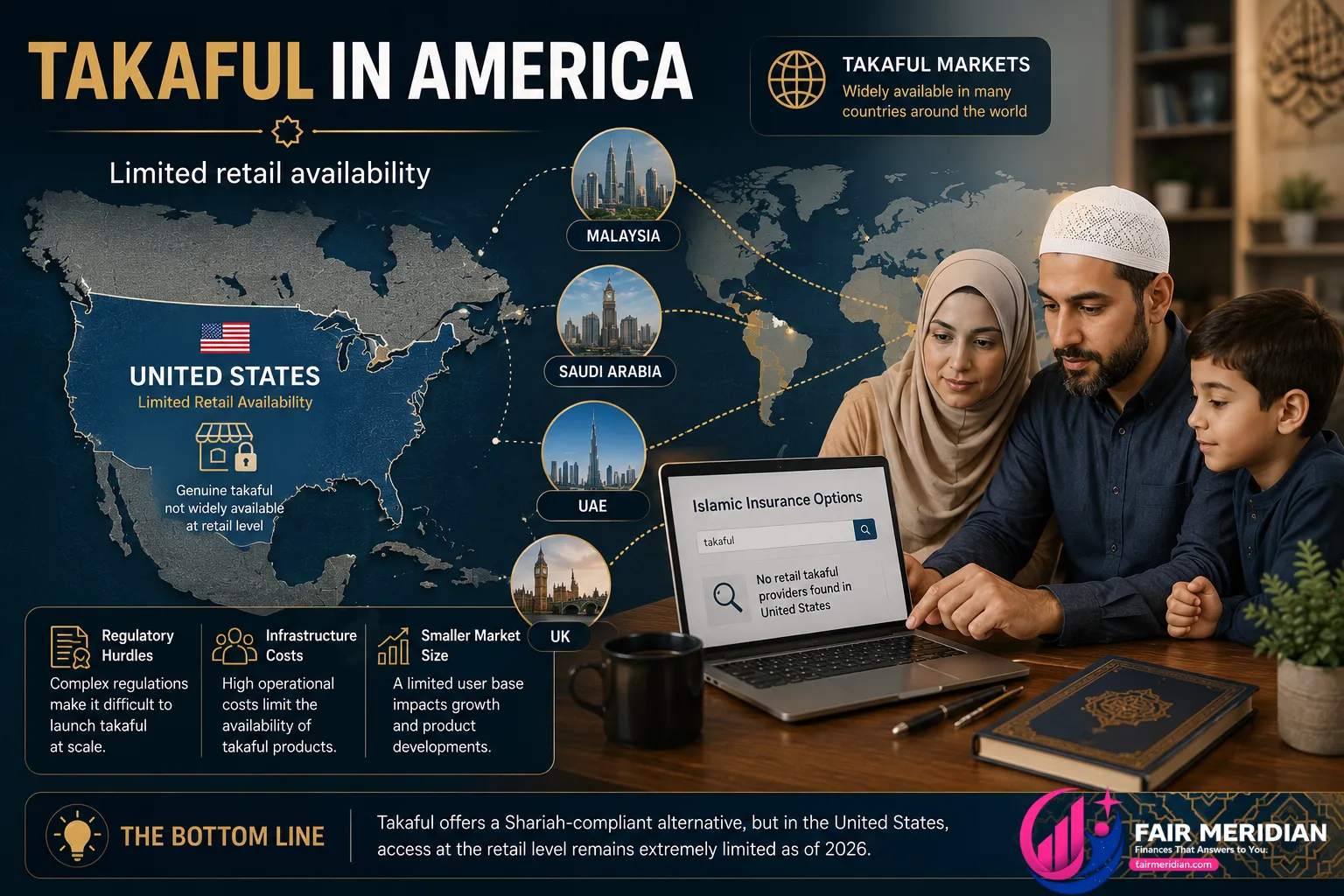
This is not a minor practical inconvenience. It's the central problem in the entire life insurance discussion for US Muslims. The theologically correct answer is "get takaful" — and in America, that answer currently leads nowhere.
The Darurah Argument — When Necessity Changes the Calculation
Islamic jurisprudence has a principle for exactly this situation: darurah, or necessity. The classical formulation is that necessity makes permissible what is otherwise prohibited — with specific conditions attached to prevent the principle from becoming a blank check for whatever is convenient.

Applied to life insurance, the darurah argument runs like this: you have a religious obligation to provide for your dependents. The Prophet (ﷺ) said: "It is enough of a sin for a person to neglect those he is responsible for" (Abu Dawud). If you die tomorrow and your family has no income, no savings sufficient to sustain them, and no other support structure — you have arguably failed that obligation. If the only mechanism available for fulfilling it is term life insurance, and no permissible alternative genuinely exists, the darurah principle may permit using it.
But darurah has conditions, and they matter:
The necessity must be genuine — not the necessity of convenience, but actual unavoidable need. If your family has substantial savings, other income sources, or family support structures that would realistically provide for them, the necessity argument weakens considerably. If your family is genuinely dependent on your income and has no financial cushion, the argument strengthens.
No permissible alternative must genuinely exist. If US-based takaful becomes available and accessible, the darurah argument for conventional insurance weakens immediately. You should revisit this decision whenever the market changes.
Only the minimum necessary should be taken. This means term life — not whole life with its investment component, not a policy with a cash value that generates interest income, not a 10x income multiplier when your family's actual needs are more modest.
Scholars who have explicitly permitted conventional term life insurance under darurah conditions for Western Muslim minorities include Shaykh Yusuf al-Qaradawi and various scholars in the European Council for Fatwa and Research. The Fiqh Council of North America has discussed this question but has not issued a uniform ruling that applies universally — which is itself informative. When the FCNA doesn't give you a clean answer, the issue is genuinely contested among qualified scholars.
Whole Life Insurance — This One Is Clearer

The above nuance around term life does not extend to whole life, universal life, variable life, or any insurance product with a cash value investment component. These products have all three problems — gharar, maysir, and riba — and the darurah argument doesn't hold because you don't need the investment and interest component to fulfill your family protection obligation. You need a death benefit. Term life provides that without the riba.
If an insurance agent — or well-meaning family member — is encouraging you toward whole life because "it builds cash value" or "it's an investment," that's actually the feature that makes it more problematic, not less. The death benefit component of whole life is not the issue. The interest-bearing savings vehicle wrapped around it is.
What This Means Practically — What Should You Actually Do?
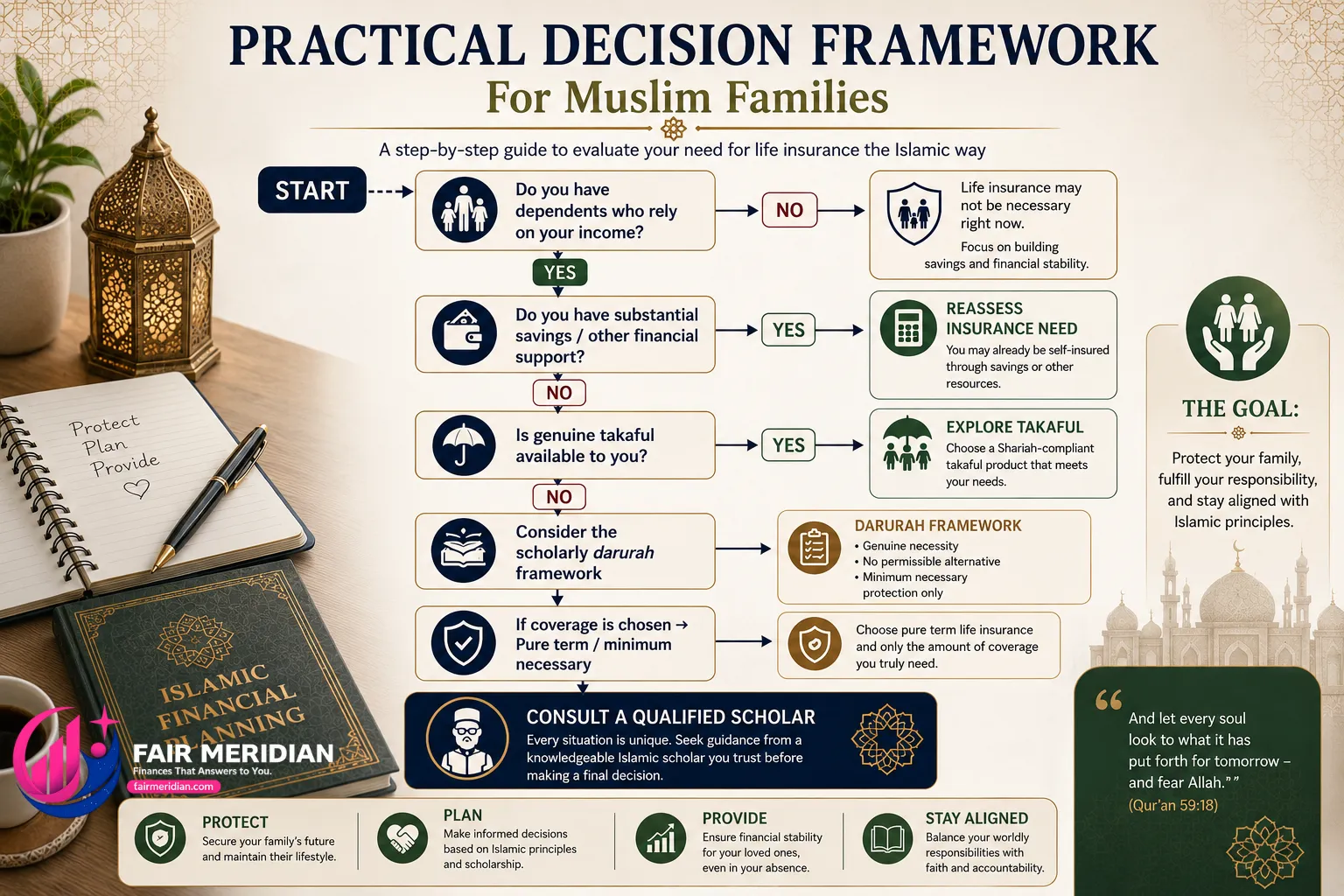
Here is the honest practical guidance, not as a fatwa but as a framework:
If you have no dependents, or your dependents have independent income and financial security, the necessity argument doesn't apply to you. Don't take out conventional insurance because someone told you it's financially prudent — take the religious position seriously and build wealth through halal means instead.
If you have young children, a spouse who depends on your income, a mortgage, and limited savings — and you cannot find genuine takaful in the US (which you currently cannot) — the darurah framework provides a path to term life insurance that many qualified scholars accept. Buy the minimum death benefit that covers your family's actual needs: typically 10–12 times your annual income, enough to replace your income for a meaningful period while your family rebuilds their financial position. Choose a pure term policy with no cash value and no investment component. Avoid whole life, universal life, or anything that accumulates interest.
Whatever you decide, make the decision deliberately. Don't drift into a conventional policy because an employer offers it and you never thought about it. Don't avoid the question entirely because it's complicated. Your family's financial protection after your death is a serious Islamic obligation — the question of how to fulfill it deserves the same serious attention you'd give any other major financial decision.
Consult a qualified scholar in your tradition before deciding. Show them this analysis if it helps frame the question. The most important thing is that you make an informed, deliberate choice rather than defaulting through inaction.
Frequently Asked Questions
Is life insurance haram in Islam?
Conventional life insurance raises serious concerns under Islamic law — specifically gharar (excessive uncertainty about whether the benefit materializes), maysir (the zero-sum structure where the insurer profits from non-claims), and riba (in whole life policies that accumulate interest). Most scholars consider conventional life insurance impermissible in its standard form. However, there is meaningful scholarly disagreement about pure term life insurance specifically — which has no investment component and serves a clear family protection purpose — particularly for Muslim minorities in Western countries where no genuine takaful alternative exists. The honest answer is that term life occupies contested scholarly territory; whole life is more clearly prohibited.
Is term life insurance halal?
This is the most debated question in this space. Pure term life insurance eliminates the riba concern because it has no cash value or investment component. What remains is the gharar and maysir concern, which is real. Many contemporary scholars — particularly those issuing fatwas for Muslim minorities in the West — permit term life under the darurah (necessity) principle when genuine takaful is unavailable and you have dependents who rely on your income. The conditions: genuine necessity, no permissible alternative available, minimum necessary coverage only, and pure term structure without investment components.
What is takaful and is it available in the US?
Takaful is the Islamic cooperative insurance model where participants donate to a shared fund (tabarru) rather than purchasing coverage from a profit-seeking insurer. It resolves the gharar and maysir concerns through its mutual structure. Genuine retail takaful — with proper Sharia board certification, segregated participant funds, and a real tabarru model — is not currently available to US consumers at the retail level. Some companies use Islamic-sounding terminology without the underlying takaful structure. US Muslims who want takaful should watch this space — the market is developing — but as of 2026, it is not a practical option for most American Muslim families.
Is whole life insurance haram?
Whole life insurance is the most clearly problematic form of life insurance under Islamic law. It combines the gharar and maysir concerns of all conventional insurance with an additional riba problem — the cash value component that accumulates interest over time. The darurah argument that some scholars apply to term life doesn't extend to whole life, because the interest-accumulating investment component isn't necessary to provide family protection. A Muslim who needs life insurance coverage and accepts a darurah argument should always choose pure term, not whole life.
My employer offers life insurance as a benefit — is it haram to accept it?
Employer-provided group life insurance (typically term life coverage at 1–2× your salary) occupies a different position in the scholarly discussion. You are not purchasing it — your employer provides it as part of your compensation, the way they provide health insurance or a retirement match. Many scholars are more permissive about accepting employer-provided insurance benefits under the logic that the employee is not the one entering the insurance contract — they are receiving it as employment compensation. This is not a universal scholarly position, but it is a meaningful one. If you can decline it and opt for alternative compensation without material loss, that's cleanest. If it comes as a standard benefit you cannot practically opt out of, most scholars would not hold you responsible for accepting what your employer provides.

Should I prioritize savings over life insurance as a Muslim?
In Islamic financial planning, building substantial liquid savings — in halal vehicles like a SPUS Roth IRA — is always preferable to relying on an insurance product. If you had three to five years of living expenses in accessible savings, the case for life insurance weakens considerably. The darurah argument for life insurance is strongest when you have young children, a large mortgage, and minimal savings. As your net worth grows and your mortgage shrinks, the coverage you need decreases. Most Muslims who follow this logic find that their need for life insurance naturally diminishes over time — which is the correct direction of travel. The goal isn't to have life insurance forever; it's to bridge the period when your family would be genuinely vulnerable without it.