If you're a Muslim professional earning a good income — a physician, software engineer, attorney, or any high earner — you've probably discovered that the IRS phases out your ability to contribute directly to a Roth IRA above certain income levels. In 2026, single filers are phased out between $150,000 and $165,000. Married filing jointly phases out between $236,000 and $246,000. Above those limits, the direct contribution door is closed. Many Muslim high earners assume this means halal tax-free retirement investing isn't available to them. It is — through a strategy called the backdoor Roth IRA. And the mechanics are straightforward enough to do yourself in an afternoon.
What the Backdoor Roth IRA Actually Is
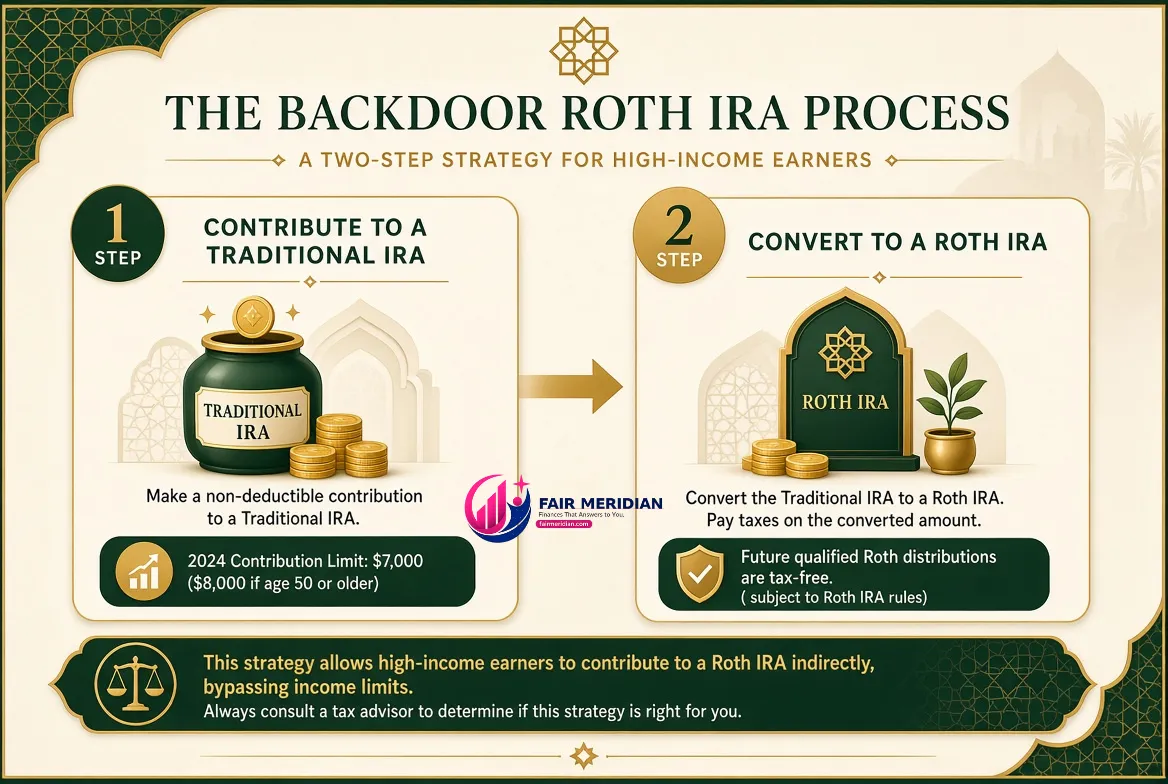
The backdoor Roth isn't a loophole or a trick you should be nervous about. It's an explicit consequence of how Congress wrote the tax code, and the IRS formally acknowledged its legitimacy in guidance issued years ago. Here's what it is: since 2010, there has been no income limit on converting a Traditional IRA to a Roth IRA — only on contributing directly to a Roth. The backdoor Roth takes advantage of this by using a two-step process. You contribute to a Traditional IRA first (anyone with earned income can do this regardless of income level), then convert that Traditional IRA to a Roth IRA. The result is the same as a direct Roth contribution — your money ends up in a Roth account growing permanently tax-free — but you got there through the back door instead of the front.
For Muslim investors, the appeal is the same as for anyone else: Roth IRA growth is tax-free forever. No taxes when it compounds. No taxes when you withdraw in retirement. No required minimum distributions forcing you to take money out on the government's schedule. No taxes for your heirs if they inherit it. Hold SPUS inside a Roth IRA for 30 years and every dollar of those gains is yours and your family's, permanently.
The Halal Question Specific to Muslim Investors
Conventional backdoor Roth guides don't address the Islamic finance angle. There are two questions worth asking before you proceed.
Is the Traditional IRA contribution itself halal? Yes. A non-deductible Traditional IRA contribution is simply moving your after-tax money into a tax-advantaged account. The contribution itself has no riba, gharar, or maysir component. The question is what you hold inside the account — which brings us to the next point.
What should you hold during the brief Traditional IRA period? This is the halal-specific detail no other guide covers. After your contribution arrives in the Traditional IRA, there's a brief window before you execute the Roth conversion — typically anywhere from a day to a few weeks. You should not hold this cash in a money market fund or any interest-bearing vehicle during that window. At Fidelity, the default cash position when cash arrives in an IRA is the Fidelity Government Money Market Fund (SPAXX), which earns interest. For a halal investor, you should move the contribution into SPUS or another halal position immediately — before it sits in SPAXX long enough to generate meaningful interest income. On $7,000 for a few days to two weeks, the interest is tiny (maybe $3–8) but the principle matters. Buy SPUS or hold as uninvested cash before converting, and make the conversion promptly.
Is the Roth conversion itself halal? Yes. A Roth conversion is a tax event — the IRS treats the converted amount as taxable income in the year of conversion — but it's not a financial transaction with any commercial counterparty. You're moving your own money from one account type to another, paying tax on the pre-tax portion converted. No riba is involved in the tax payment. No prohibited financial instrument is used. The conversion is a clean, permissible action.
The Pro-Rata Rule — The One Trap Muslim Investors Must Avoid
Here is where the backdoor Roth gets complicated, and where most guides gloss over the detail that could turn a tax-efficient strategy into a tax nightmare. The IRS applies what's called the pro-rata rule to Roth conversions. This rule says that when you convert money from a Traditional IRA to a Roth IRA, the IRS looks at ALL of your Traditional IRA balances combined to determine what fraction of the conversion is taxable.
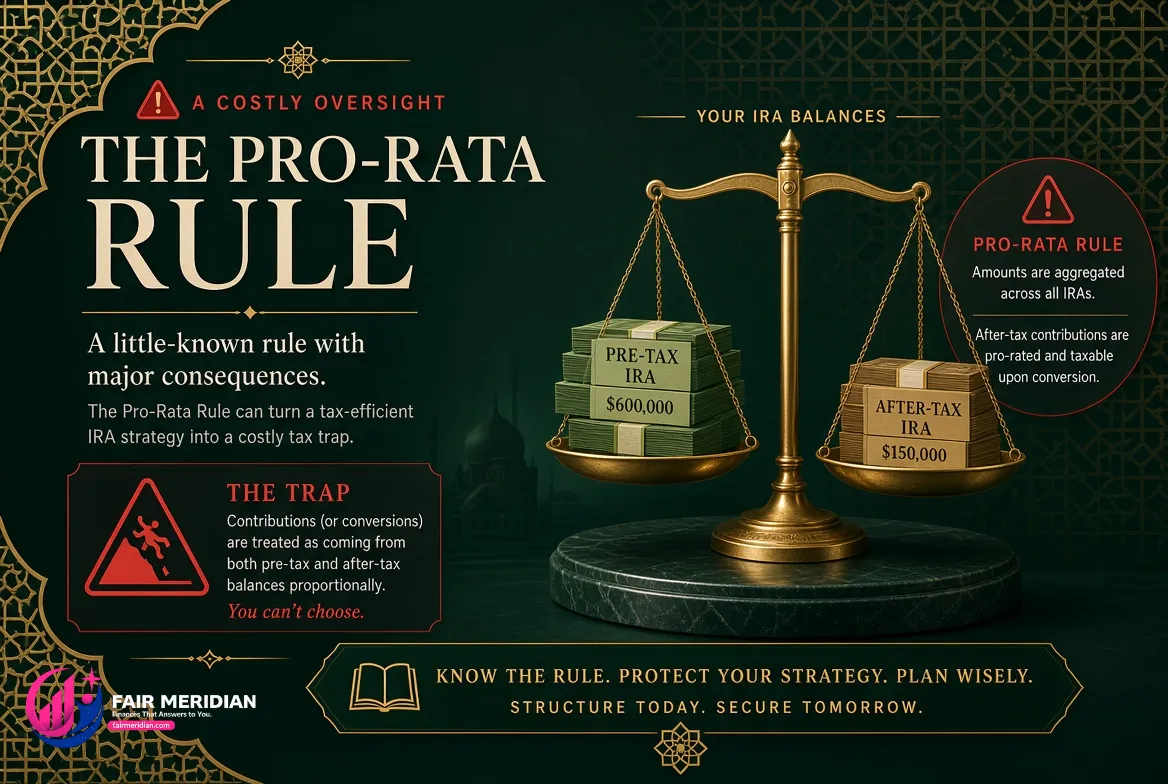
The problem: if you have a pre-existing Traditional IRA with, say, $100,000 in pre-tax money (from old 401k rollovers or previous deductible contributions), and you add a new $7,000 non-deductible contribution, the IRS doesn't let you just convert the $7,000 non-deductible portion tax-free. They treat your total IRA balance ($107,000) as a pool where $100,000 is pre-tax and $7,000 is after-tax. When you convert $7,000, only 6.5% of it ($7,000 / $107,000) is treated as your after-tax basis — meaning $6,545 of your $7,000 conversion is taxable. The backdoor Roth loses most of its benefit.
The solution is to have zero pre-tax money in Traditional IRA accounts before executing the backdoor Roth. If you have old Traditional IRA balances, roll them into your current employer's 401k before doing the backdoor Roth. Most 401k plans accept incoming rollovers. Once the Traditional IRA is at zero, contribute non-deductibly, then convert immediately — the pro-rata rule doesn't bite because there's no pre-tax pool to contaminate the conversion.
This is the single most important thing to understand about backdoor Roth conversions. Everything else is mechanics. The pro-rata rule is strategy.
Step-by-Step: The Halal Backdoor Roth at Fidelity
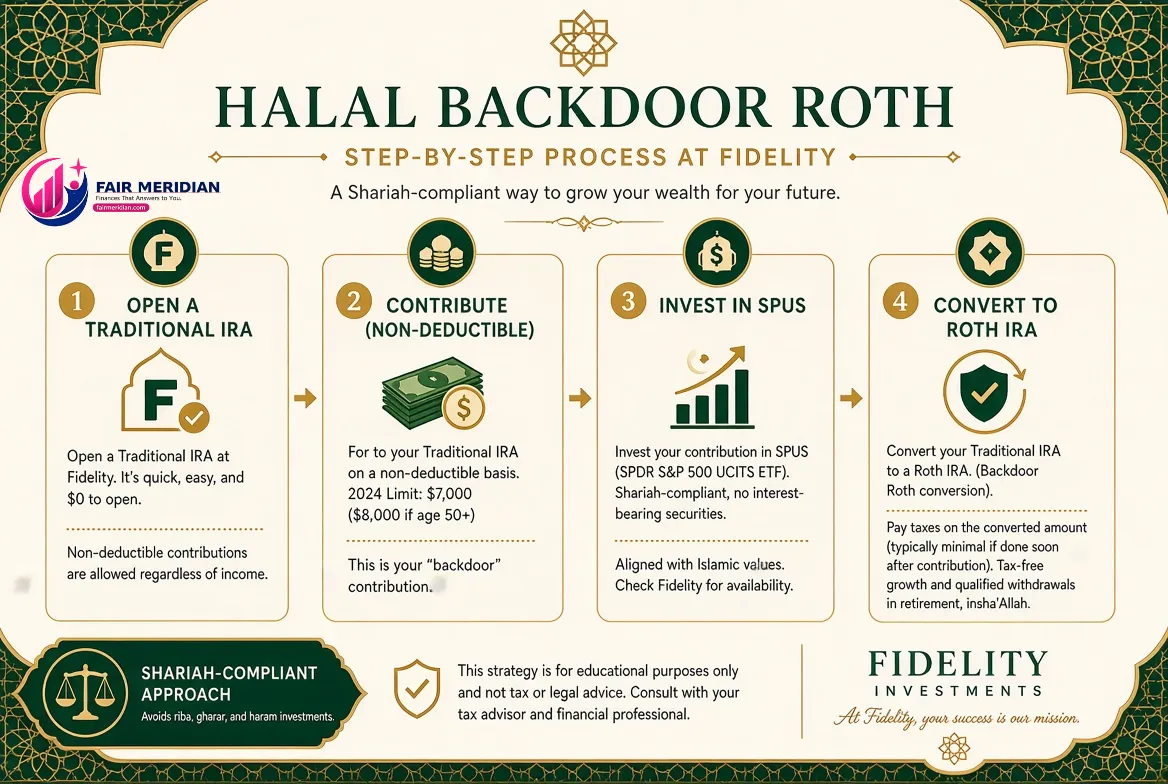
Fidelity is the recommended platform for this because it holds SPUS, has zero account minimums, and has an excellent interface for executing Roth conversions. Schwab works equally well. Here is the exact process:
Before you start — the pre-check: Confirm you have zero balance in any Traditional, SEP, or SIMPLE IRA. If you have balances in these accounts, roll them into your current employer 401k first, wait for the rollover to complete and settle, then proceed.
Step 1 — Open a Traditional IRA at Fidelity if you don't have one. Even if the balance will be zero, you need the account type. Go to fidelity.com, open an account, select Traditional IRA.
Step 2 — Make your non-deductible Traditional IRA contribution. Contribute $7,000 ($8,000 if you're 50 or over in 2026) to the Traditional IRA. This is an after-tax, non-deductible contribution — you won't get a tax deduction for it, but you're also not double-taxed when you convert, because the basis is tracked on Form 8606.
Step 3 — Do not let it sit in SPAXX. The moment the contribution settles (typically next business day for bank transfers), Fidelity may park it in their default money market fund (SPAXX), which earns interest. For a halal investor, either select "no core position" if Fidelity allows it in this account, or immediately place a buy order for SPUS the moment the cash settles. You're converting within days anyway, but principles matter.
Step 4 — Execute the Roth conversion. In Fidelity, go to Accounts & Trade → Transfer, and select "Convert IRA to Roth." Follow the prompts. You're converting the entire Traditional IRA balance — $7,000 — to your Roth IRA. Fidelity will ask if you want to convert the positions in-kind (your SPUS shares transfer directly to the Roth) or liquidate and transfer cash. Choose in-kind — SPUS transfers directly to your Roth IRA without selling, avoiding any brief period of being in cash.
Step 5 — Report it on Form 8606. When you file your taxes, Form 8606 is how you track your non-deductible Traditional IRA basis and report the conversion. Line 1 is your non-deductible contribution ($7,000). Line 6 is your year-end Traditional IRA balance (should be zero — you converted everything). Line 18 is your taxable conversion amount. If the pro-rata rule doesn't bite (zero pre-tax IRA balance), your taxable amount is effectively zero — you're converting after-tax money that was never deducted. Your tax software does this automatically if you enter the 1099-R that Fidelity sends for the conversion.
The whole process takes about 30–45 minutes spread across two days (waiting for the contribution to settle before converting). Do it once in January and again each year.
What If Your Employer Has a 401k with Conventional Investments?
Many Muslim professionals have employer 401ks that contain conventional funds — they've been contributing because the employer match is valuable, even though the fund options aren't halal. Rolling that 401k into a Traditional IRA to consolidate would trigger the pro-rata rule and ruin the backdoor Roth strategy.
The correct sequence: keep the conventional 401k at your employer (don't roll it to an IRA), do the backdoor Roth annually in a separate IRA with zero pre-tax balance, and separately advocate with your HR department for halal investment options within the 401k. If your employer's 401k accepts incoming rollovers AND you already have pre-tax IRA balances from old jobs, roll those old IRA balances into the current employer 401k — clearing the Traditional IRA to zero — then proceed with the backdoor Roth.
The Mega Backdoor Roth — If Your 401k Allows It
Some employer 401k plans allow after-tax contributions beyond the standard $23,500 pre-tax limit (2026 limit). If your plan permits this and also allows in-service withdrawals or in-plan Roth conversions, you can effectively put up to $69,000 per year into Roth-equivalent tax shelter. This is called the mega backdoor Roth.
For halal investors, the mega backdoor Roth is valuable but has an additional complication: the after-tax 401k contributions sit in your employer's plan, which probably offers only conventional investment options. If your plan allows immediate in-service conversion to the Roth 401k (or distribution and rollover to a Roth IRA), you minimize the time those after-tax contributions sit in conventional investments. If your plan requires you to hold them for an extended period in conventional funds, the halal benefit is reduced — you're paying for tax shelter with prohibited investment exposure. Whether that tradeoff is worth it depends on your specific plan options and the holding period. Consult a scholar familiar with Islamic finance before proceeding with the mega backdoor if your plan doesn't allow immediate conversion.
The Math — Why This Is Worth Doing
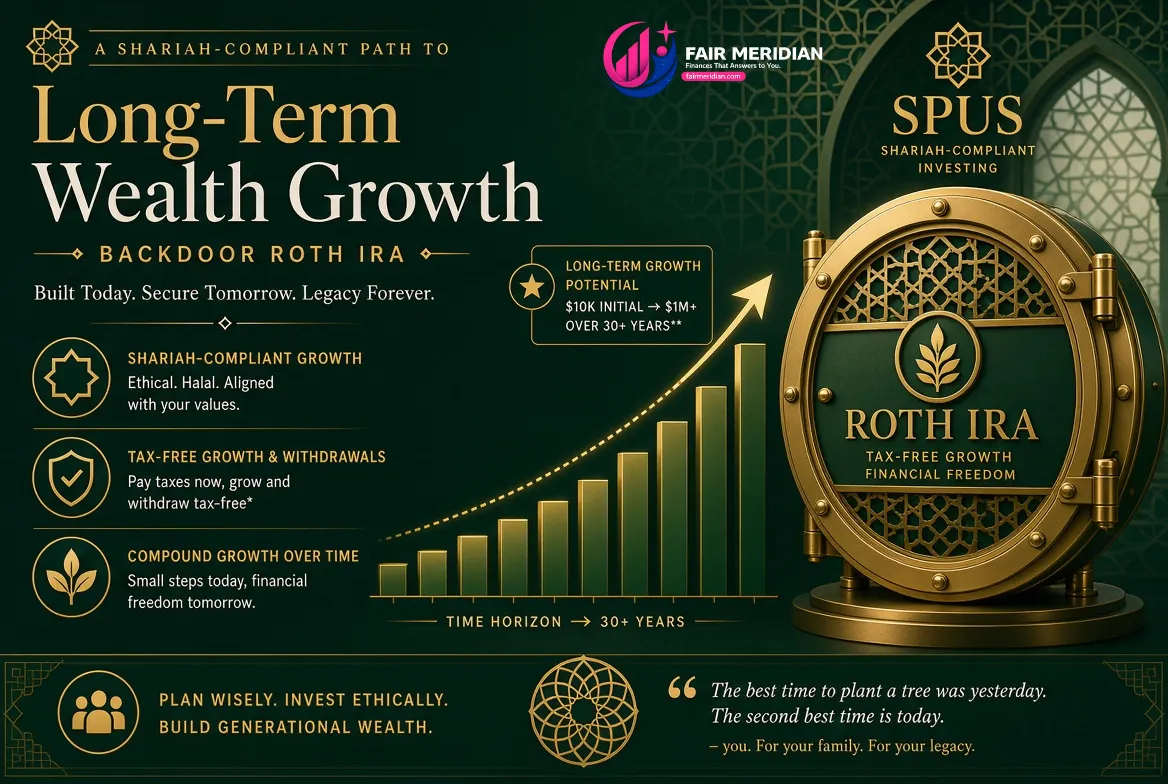
A Muslim physician who does the backdoor Roth for 30 years, contributing $7,000 annually and investing in SPUS at an average 9% annual return, accumulates approximately $920,000 in their Roth IRA by retirement — completely tax-free. Without the backdoor Roth, they'd need to hold those investments in a taxable brokerage account, where SPUS dividends are taxed annually and capital gains are taxed on sale. The tax drag in a taxable account at a 30% combined federal and state rate could reduce the ending balance by $200,000–$300,000 over that period. The backdoor Roth is not a marginal optimization — it's a significant wealth-building tool that high-income Muslim professionals are leaving on the table by assuming it doesn't apply to them.
Frequently Asked Questions
Is the backdoor Roth IRA halal?
Yes. The backdoor Roth IRA involves a non-deductible Traditional IRA contribution followed by a Roth conversion — both of which are permissible financial actions with no riba, gharar, or maysir component. The key halal consideration is what you hold during the brief Traditional IRA period before conversion: avoid interest-bearing money market funds and use SPUS or hold as uninvested cash until you convert. Execute the conversion promptly — within days of the contribution settling — to minimize time in any default interest-bearing position.
Who qualifies for the backdoor Roth IRA?
Any US taxpayer with earned income can do the backdoor Roth IRA, regardless of income level. The direct Roth IRA contribution is phased out for single filers between $150,000 and $165,000 MAGI in 2026, and for married filing jointly between $236,000 and $246,000. Above those limits, you can no longer contribute directly to a Roth — but you can still contribute non-deductibly to a Traditional IRA and then convert. The backdoor Roth is specifically designed for high-income earners above these phase-out thresholds.
What is the pro-rata rule and how does it affect backdoor Roth?
The pro-rata rule requires the IRS to treat all your Traditional IRA balances as a single pool when calculating how much of a Roth conversion is taxable. If you have $100,000 in pre-tax Traditional IRA money and add $7,000 in non-deductible after-tax money, only 6.5% of any conversion is tax-free. To avoid this, ensure you have zero pre-tax Traditional IRA balances before doing the backdoor Roth — roll any existing Traditional IRA balances into your current employer's 401k first. With a zero Traditional IRA balance, the backdoor Roth conversion is effectively tax-free.
Can I use SPUS in a backdoor Roth IRA?
Yes — SPUS is available at Fidelity and Schwab, both of which offer Traditional and Roth IRA accounts suitable for the backdoor Roth strategy. Buy SPUS in the Traditional IRA immediately after your non-deductible contribution settles, then execute the in-kind conversion to your Roth IRA — SPUS shares transfer directly without selling. Your SPUS position then grows permanently tax-free inside the Roth IRA.
How does the backdoor Roth IRA affect my taxes?
If executed correctly with zero pre-tax Traditional IRA balance, the backdoor Roth has minimal tax impact. You contribute $7,000 in after-tax money (no deduction), convert it to Roth (no additional tax because the entire amount is your after-tax basis). You report the contribution and conversion on Form 8606 when you file. Fidelity or Schwab sends you a 1099-R for the conversion — this is normal and doesn't mean you owe tax on it. Your tax software handles Form 8606 automatically if you enter the 1099-R correctly. Consult a CPA familiar with backdoor Roth if you have a complex IRA situation.
Is there a limit to how much I can put in through the backdoor Roth?
The backdoor Roth is limited by the annual IRA contribution limit — $7,000 per person in 2026 ($8,000 if age 50 or older). Married couples can each do their own backdoor Roth, for a combined $14,000 per year ($16,000 if both are 50+). For higher contributions, the mega backdoor Roth through an employer 401k (if the plan allows after-tax contributions and in-service conversions) can accommodate up to $46,000 in additional after-tax retirement savings annually, though the halal considerations within your specific 401k plan's investment options need careful evaluation.
For the complete guide to halal retirement investing including standard Roth IRA setup, SDIRA real estate, and SPUS portfolio strategy, read our Halal Retirement Planning Guide 2026. For the step-by-step Roth IRA setup at Fidelity with screenshots and current contribution limits, see our Halal Roth IRA at Fidelity Guide. For our complete SPUS analysis including current AUM, YTD returns, and purification amount, read the Halal ETFs Guide 2026.