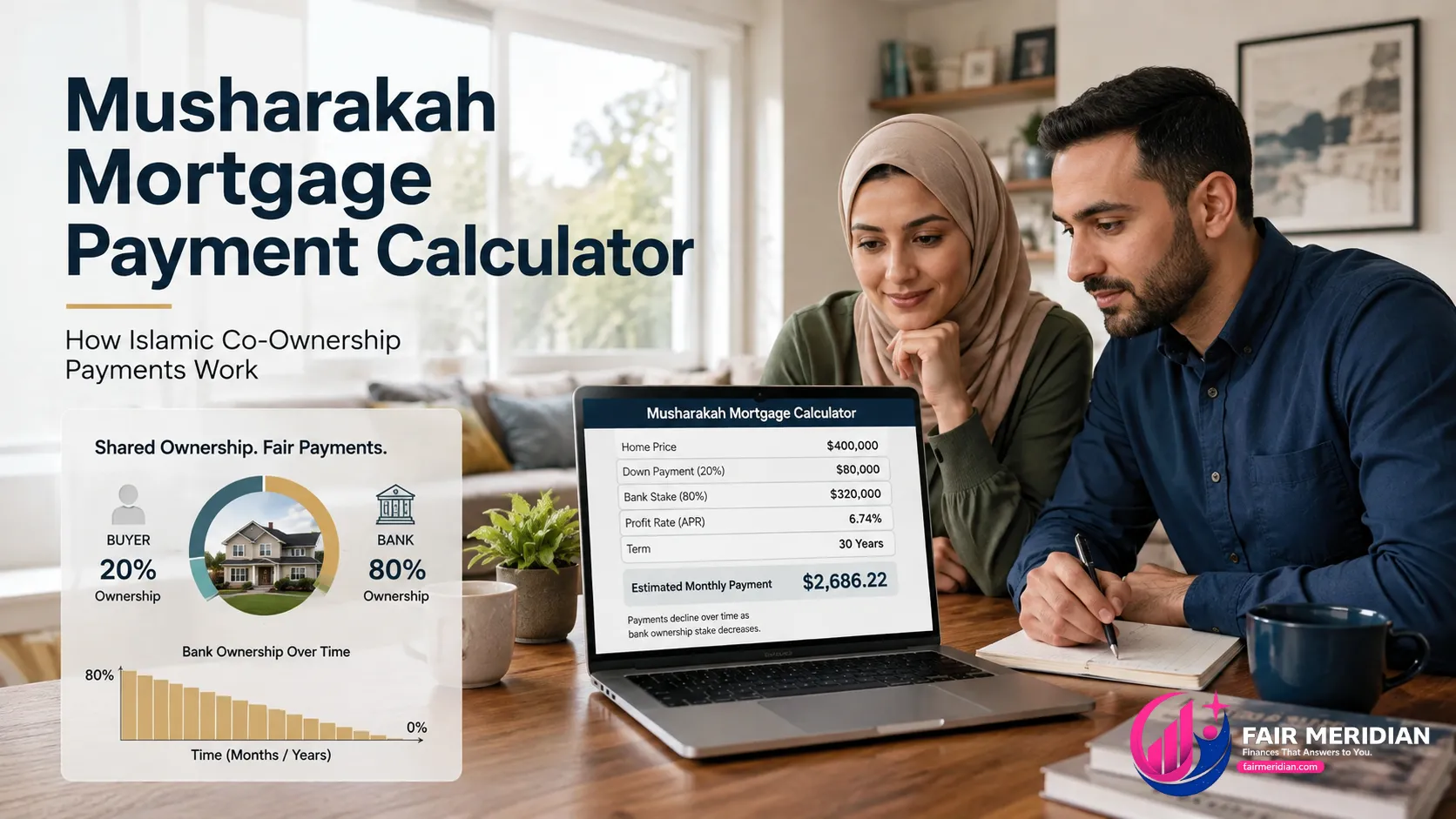

Rental income is halal — there is no scholarly dispute about that. Receiving rent from a property you own is one of the oldest and most clearly permissible forms of income in Islamic commercial law. The complication is not whether you can own rental property. The complication is how you finance the purchase of it. And most Muslims who search for "halal rental property investing" make the same mistake: they assume there's a halal mortgage product for investment properties the way there is for primary residences. There isn't. Guidance Residential, UIF Corporation, Devon Bank, and every other halal lender in the United States finances primary residences only. If you want to own a rental property the halal way, you need a different strategy entirely. This guide covers the two that actually work.
Why Halal Investment Property Financing Doesn't Exist — And Why That's Actually Fine
Halal home financing in the US works because Guidance Residential and Freddie Mac developed a co-ownership structure for primary residences that the secondary mortgage market could absorb. Investment property financing is a different regulatory and financial product — and the halal lenders haven't built that infrastructure for the investment side of the market. This means you can't call Guidance Residential and ask for a halal mortgage on a duplex you plan to rent out. That product doesn't exist yet.
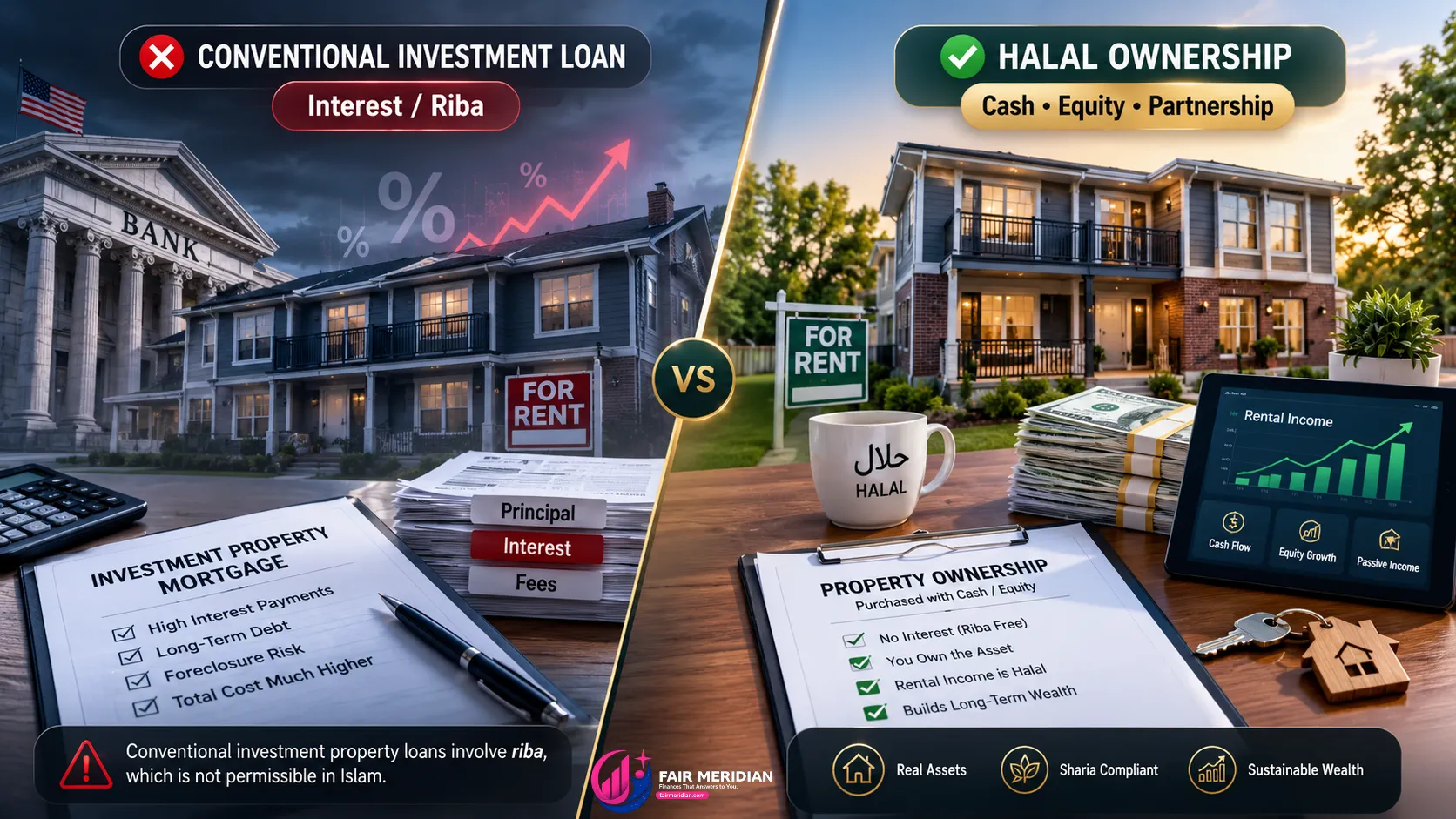
A conventional investment property mortgage — the kind a conventional bank would offer — is riba, full stop. The interest on an investment property loan is not different from the interest on a home loan just because the purpose is different. Riba is riba regardless of what the property is used for. And unlike primary residences, where the darurah (necessity) framework gives some scholars room to discuss permissibility in the absence of halal alternatives, investment property financing is harder to justify on necessity grounds — you don't need to own a rental property to fulfill an obligation. You want to. That's different.
The good news is that the constraint pushes you toward strategies that are genuinely better anyway. Real estate owned outright — with no debt — generates better cash flow, carries no foreclosure risk, and builds wealth more sustainably than leveraged investment property. The Muslim investor who buys rental property with cash is doing something that secular financial advisors increasingly recommend for exactly the same practical reasons Islamic law requires it.
Path One: Direct Cash Purchase
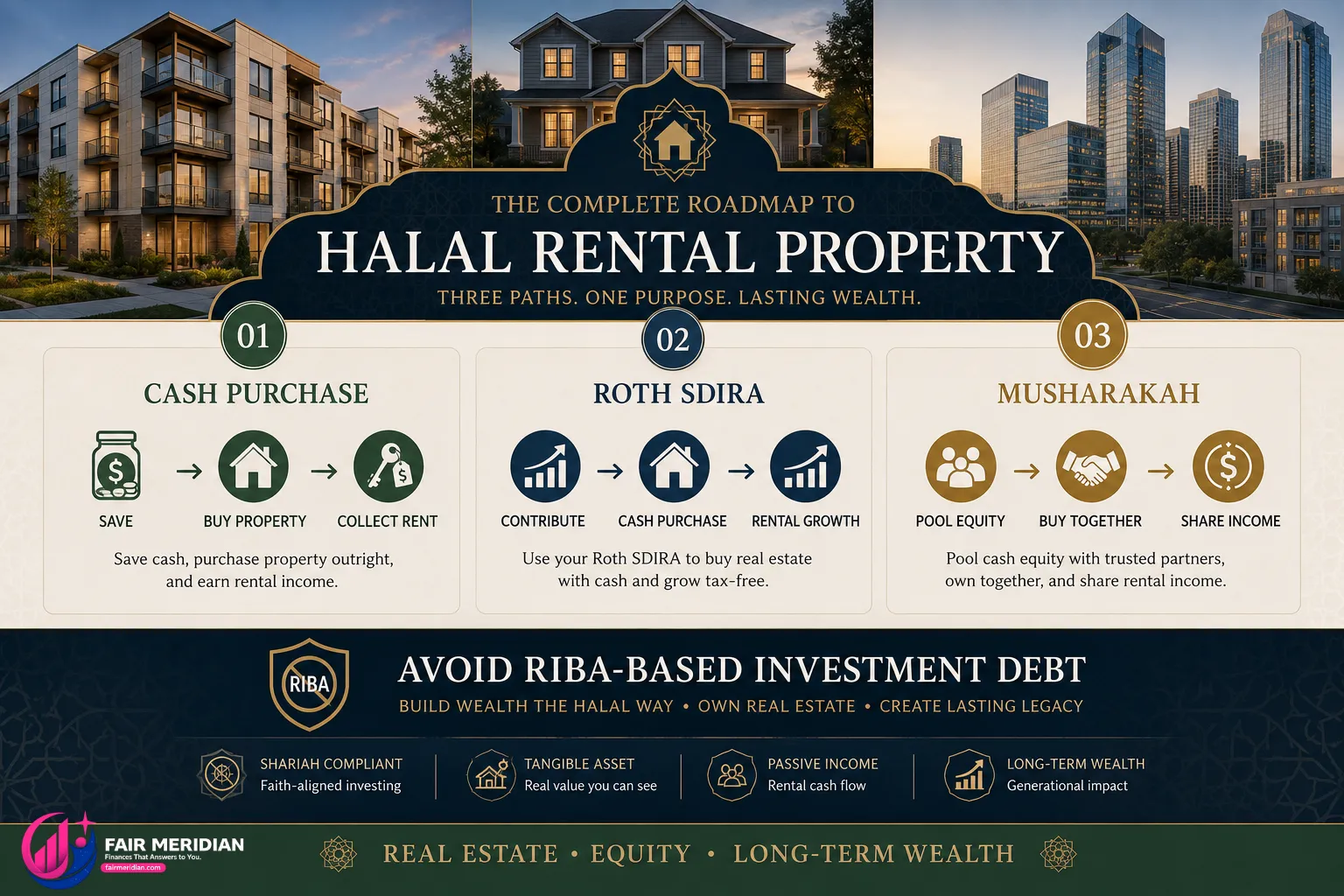
The most straightforward halal rental property strategy is the one that requires the least explanation: save the full purchase price, buy the property outright, collect rent. No lender, no interest, no prohibited transaction. Every dollar of rental income after expenses is genuinely yours.
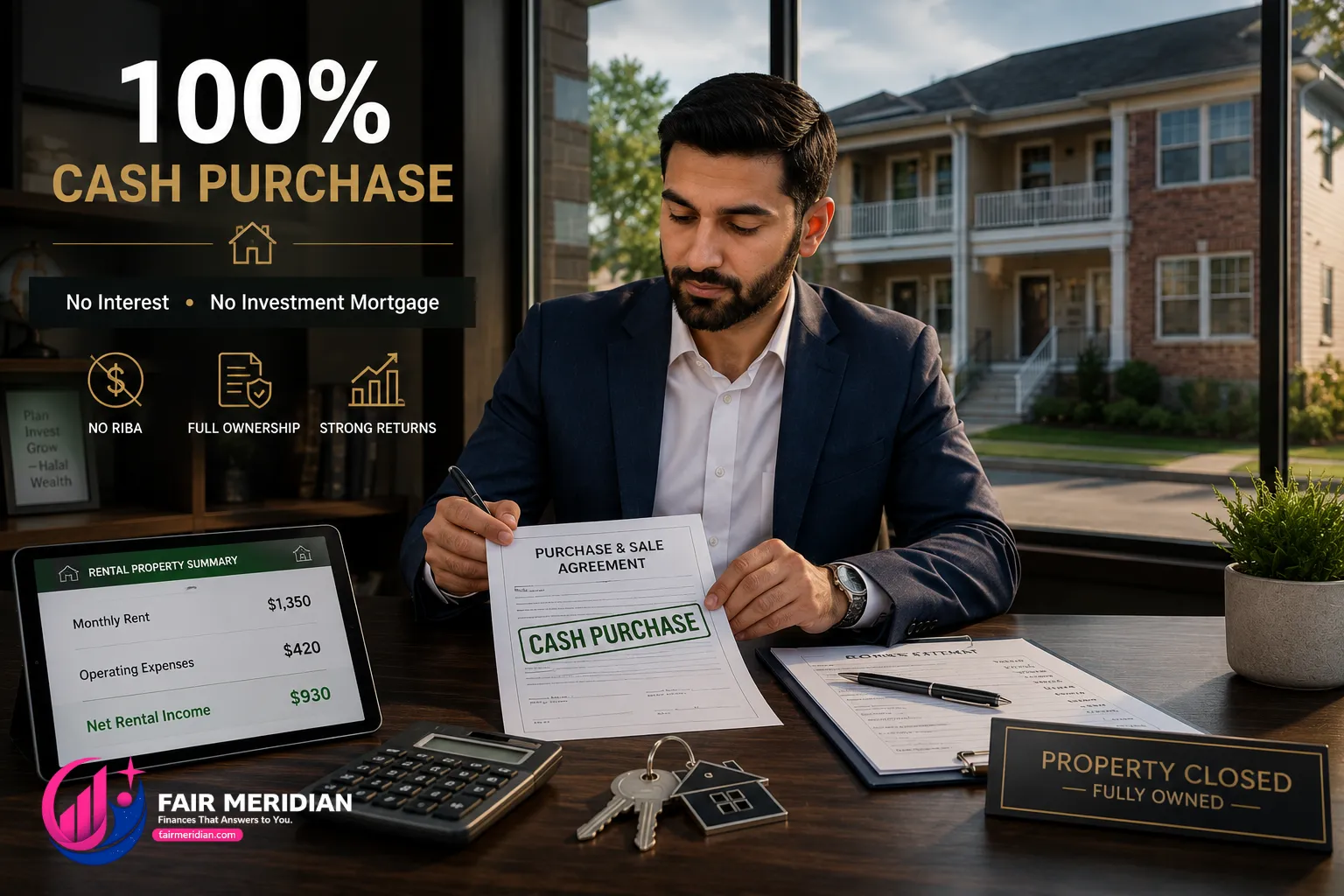
The practical question is where. Buying a $600,000 Los Angeles rental property with cash is not realistic for most people. Buying a $150,000 duplex in a Midwest city where Muslim communities have established roots is. The halal investor's market is not the same as the conventional investor's market — and that's not a disadvantage. High-priced coastal markets depend on leverage to make the numbers work. Cash-purchase markets work because the rents are strong relative to the purchase price. Cap rates in Hamtramck, Michigan, Cleveland, Ohio, and Memphis, Tennessee regularly run 7–10% — meaning a $150,000 property generates $10,500–$15,000 in annual net income. That's a better return than SPUS in most years, with an asset you physically own that also appreciates over time.
Hamtramck deserves specific mention because it's unique. It's the only Muslim-majority city in the United States, with a median home price around $140,000 and a stable rental market anchored by a multigenerational Arab-American and Yemeni community. A Muslim investor who buys a duplex in Hamtramck for $140,000 cash gets strong rental demand, community familiarity, and returns that most expensive-city investors can only achieve by taking on debt. The same logic applies to Dearborn Heights ($195,000), Buffalo ($200,000), and parts of Cleveland and Pittsburgh where Muslim communities have meaningful presence.
The direct cash path requires patience while you build the purchase price. Keep those savings in halal vehicles while you accumulate — SPUS in a taxable Fidelity account for medium-term savings, non-interest-bearing checking for funds you'll need within 12 months. When you have enough, move quickly. In accessible markets, well-priced rental properties don't sit long.
Path Two: The Self-Directed Roth IRA
This is where halal real estate investing gets genuinely powerful — and where most Muslim investors don't know what's available to them.
A Self-Directed IRA (SDIRA) is a retirement account that, unlike a standard Fidelity or Schwab IRA, can hold physical real estate. Not REITs, not real estate ETFs — actual property. A duplex, a single-family rental, raw land, whatever qualifies under the IRS rules. The SDIRA becomes the legal owner of the property. Rent flows into the SDIRA tax-free. Property appreciation grows tax-free. When you retire and withdraw, a Roth SDIRA produces zero tax on withdrawals — meaning 30 years of rental income and appreciation compounds in complete tax shelter.

For the halal investor, the SDIRA works because the property must be purchased with 100% cash. Non-recourse loans for SDIRAs exist in the conventional market — but they're interest-bearing, which makes them riba regardless of the IRA wrapper around them. The halal SDIRA real estate strategy is simple: contribute to the Roth SDIRA over time (or roll over an existing 401k), hold SPUS while the balance grows, and when you have enough to purchase a target property outright, direct the SDIRA custodian to buy it.
The tax math makes this extraordinary. Take the Hamtramck duplex example: $140,000 cash purchase inside a Roth SDIRA. Two units renting at $900/month each generates $21,600/year in gross rent. After expenses (taxes, insurance, maintenance at roughly 40%), net income is around $12,960 annually. In a taxable account, a 30% federal and state tax rate takes $3,888 of that each year. In a Roth SDIRA, zero. Over 20 years, that difference in annual tax savings compounds to approximately $119,000 in additional wealth — from a single $140,000 investment. That's the Roth SDIRA advantage.
The IRS rules for SDIRA real estate are strict, and violating them destroys the entire account's tax status. Three rules matter most: you cannot use the property personally (not even for one night), members of your immediate family cannot rent or use it, and all expenses must be paid from the SDIRA's cash balance — not from your personal funds. Every dollar of rent goes into the SDIRA. Every repair bill comes out of it. Your role is the account holder directing the investment, not a landlord with hands-on involvement in the property. A property management company handles tenant relationships; the SDIRA custodian handles the financial transactions.
Opening an SDIRA requires a specialized custodian — standard brokerages like Fidelity and Schwab don't offer this. Equity Trust Company is the largest SDIRA custodian with the most experience in real estate transactions. Rocket Dollar and IRA Financial are solid alternatives with flat annual fees that work well for active real estate investors. Annual fees range from $360 to $2,250 depending on the custodian and account value. On a $140,000 investment generating $12,960/year in tax-free income, the custodian fee is a minor cost of doing business.
Path Three: The Musharakah Partnership
Not every Muslim investor has $140,000 sitting in a retirement account. The musharakah (partnership) approach solves this by pooling equity from multiple Muslim investors to purchase a property none of them could buy alone with cash.
The structure is classical Islamic commercial law applied to American real estate: two, three, or four Muslim investors each contribute cash equity in proportion to the ownership stake they want. The group purchases the property outright with no debt. Rental income is distributed proportionally to ownership. Management responsibility is shared or assigned to one partner. Exit terms (what happens when someone wants to sell their stake) are agreed in writing before the purchase.
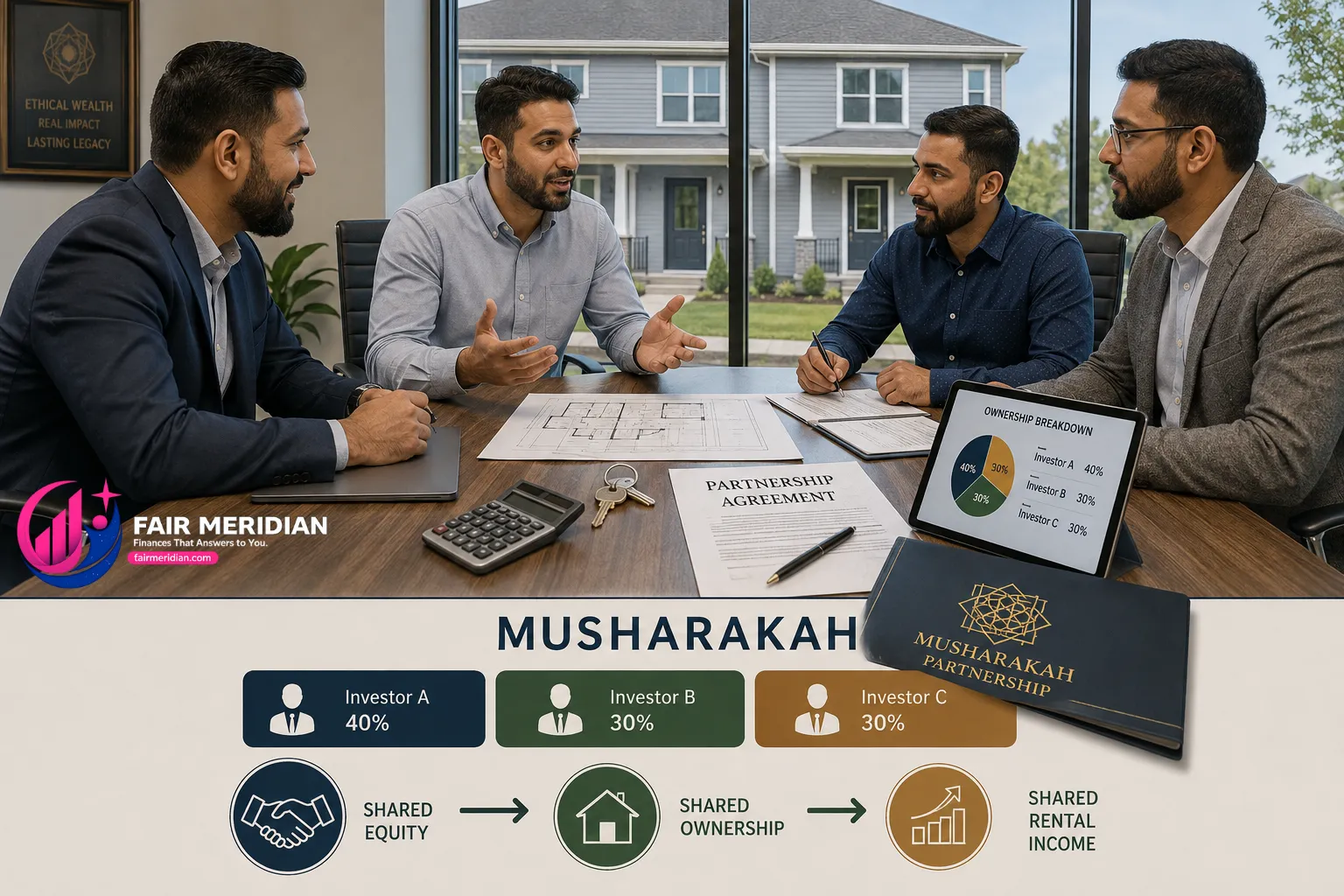
This isn't complicated in principle, but it requires real legal documentation. An attorney familiar with Islamic partnership structures — or at minimum, familiar with tenants-in-common agreements and buy-sell provisions — should draft the partnership agreement. Handshake deals among mosque friends have ended badly. Get the terms in writing. Specify: what each partner contributes, ownership percentages, how rental income is distributed, who makes management decisions, how expenses are handled, and what happens when one partner wants to exit. This document protects the partnership and everyone in it.
The musharakah partnership is best formed from within genuine community relationships — people you know, have worked with, and trust over time. The accountability that makes Islamic partnerships work is social and religious, not just legal. Partner with people whose character you know, not just people whose money you want.
What About the SPRE ETF?
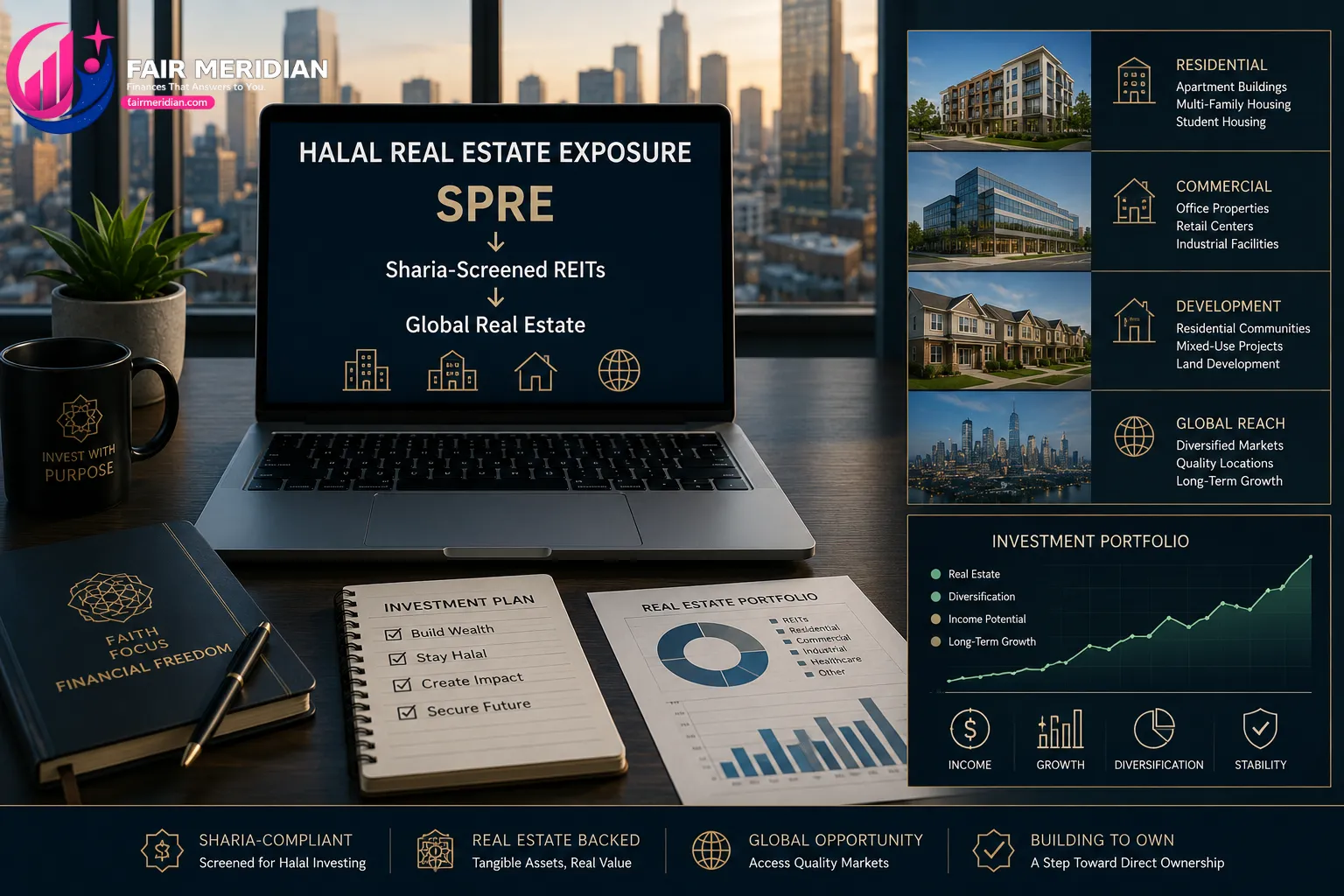
If you're not yet at the stage where you can buy a property outright or join a musharakah partnership, SPRE (SP Funds S&P Global REIT Sharia ETF) provides halal real estate exposure while you build toward direct ownership. SPRE holds Sharia-screened real estate investment trusts globally — excluding those with excessive debt or prohibited property types. At $54 million in assets and an annual yield of approximately 4–5%, it's not a replacement for owning property directly, but it keeps your capital in the halal real estate category while it grows. Hold it in your Fidelity Roth IRA alongside SPUS until your balance is large enough to fund a direct property purchase through an SDIRA.
Frequently Asked Questions
Is rental income halal in Islam?
Yes, rental income is halal — there is no scholarly dispute on this point. Earning income by leasing property you own to a tenant is one of the most clearly permissible forms of business income in Islamic commercial law. The ijara (lease) contract is a foundational structure in Islamic finance. The halal question in real estate investing is not whether you can collect rent — it's whether the method you used to acquire the property involved riba.
Can I get a halal mortgage for an investment property in the USA?
No — not currently. Guidance Residential, UIF Corporation, Devon Bank, and every other halal mortgage lender in the US finances primary residences only. There is no halal investment property mortgage product available to US Muslims as of 2026. The halal paths to rental property ownership are direct cash purchase, SDIRA real estate investment, and musharakah equity partnerships — all of which require 100% equity with no conventional debt.
Is a Self-Directed IRA halal for real estate?
A Self-Directed IRA is halal for real estate when the property is purchased entirely with cash — no conventional financing anywhere in the transaction. The SDIRA is a legal container; what makes the investment halal is the absence of riba in how the property is acquired. SDIRA non-recourse loans are not halal. A Roth SDIRA with a cash-purchased rental property is one of the most effective halal wealth-building strategies available in America — tax-free rental income compounding for decades.
How much money do I need to start halal real estate investing?
The minimum practical entry point for direct halal real estate ownership is around $150,000–$165,000 — enough to purchase a property in an accessible market like Hamtramck, Michigan or Utica, New York and maintain a cash reserve for expenses. For a musharakah partnership with other Muslim investors, your contribution could be $30,000–$50,000 depending on the group size and target property. While building toward those amounts, SPRE ETF in a Fidelity Roth IRA provides Sharia-screened real estate exposure starting from any dollar amount.
Is it haram to buy rental property with a conventional mortgage?
Yes — a conventional investment property mortgage involves paying interest (riba) on the loan, which is prohibited under Islamic law. Unlike primary residence financing, where some scholars apply the darurah (necessity) principle in the absence of halal alternatives, investment property financing is harder to justify on necessity grounds — you need a place to live, but you don't need to own investment property. The halal approach is patient accumulation toward a cash purchase rather than accessing leverage through riba-based financing.
What markets are best for halal cash purchase rental property in the USA?
The best markets for halal rental property investors are those where the cash purchase price is manageable and the cap rates are strong — making the investment viable without debt. Hamtramck, Michigan (~$140,000 median, 7–9% cap rates, Muslim-majority community), Dearborn Heights (~$195,000), Buffalo, New York (~$200,000), Cleveland, Ohio (~$150,000), and Memphis, Tennessee (~$190,000) represent the strongest combination of accessibility, community presence, and cash-on-cash returns for Muslim real estate investors working without conventional debt.
For a complete breakdown of the SDIRA setup process including custodian comparisons and the prohibited transaction rules in full detail, read our SDIRA Halal Real Estate Guide. For the musharakah partnership structure and how Islamic co-ownership law applies to US real estate, see our Halal Real Estate Investing Guide.