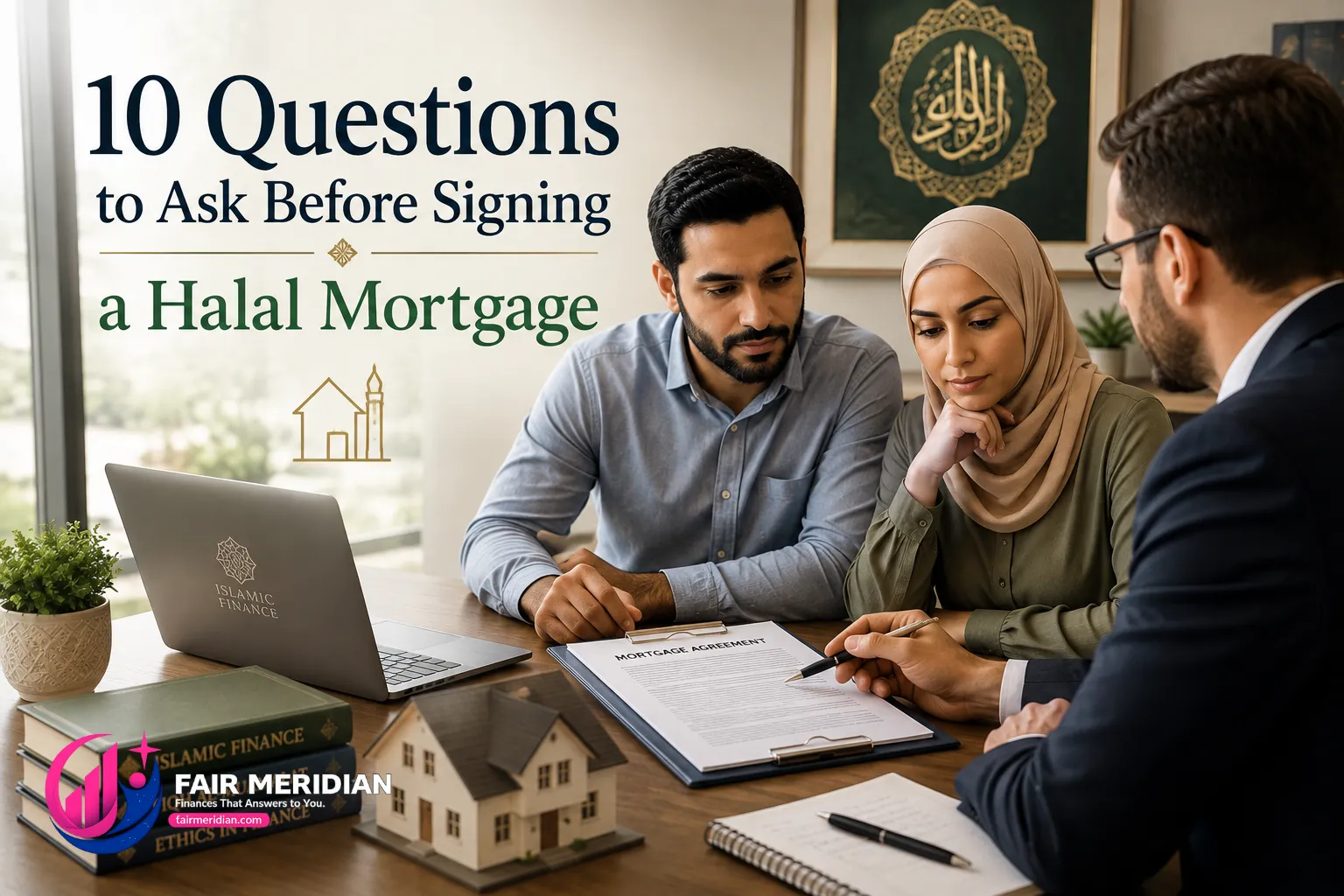
The marketing of halal mortgage products has grown significantly over the past decade — and so has the risk of encountering products that use Islamic terminology without changing the contract structure in the ways that matter. The word "musharakah" in a brochure does not make a product halal. The Sharia compliance is in the contract — specifically in the profit calculation method, the late payment clause, the default provision, and whether an independent qualified scholar has reviewed and certified that specific contract. These 10 questions will tell you which category your lender falls into before you sign anything.
The most important thing to know before you start: Print this list or save it on your phone. Ask every question to every lender. A legitimate Islamic finance lender will welcome every one of these questions — they have been asked before and they have clear answers. A lender who becomes evasive, rushes you past any of these questions, or cannot answer them clearly is telling you something important about their product.
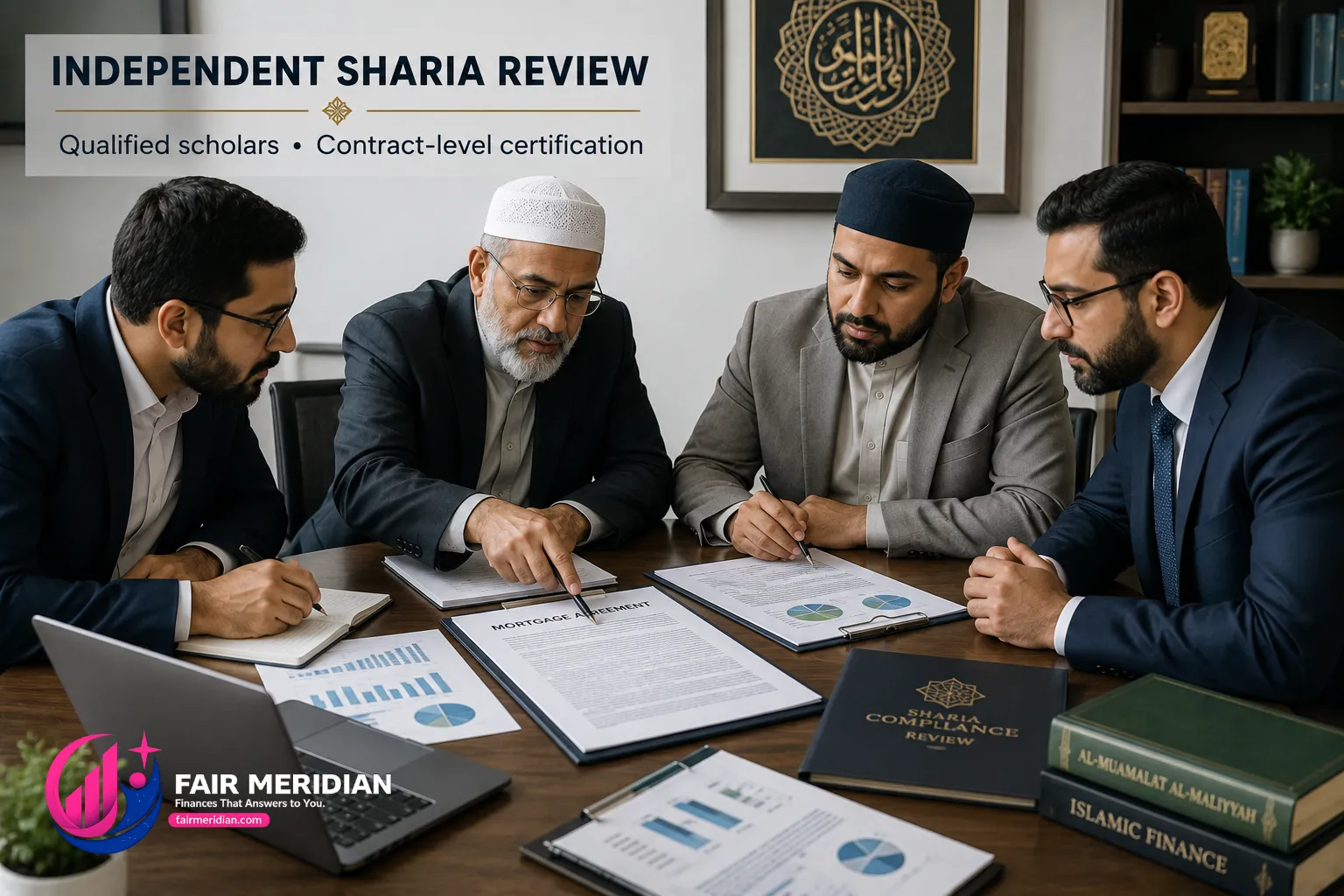
Question 1: Who Is Your Independent Sharia Supervisory Board — and Can You Name the Scholars?
Why This Question Matters
The Sharia supervisory board is the only institutional mechanism that separates genuine Islamic finance from Islamic-sounding marketing. The board must be independent — scholars who are not employed by the lender and whose income does not depend on certifying the product. They must be qualified — holding credentials in Islamic commercial law (fiqh al-mu'amalat), not just general Islamic studies. They must certify the actual contract, not just the general concept.
What a Good Answer Sounds Like
Named scholars with verifiable credentials and institutional affiliations. The lender should be able to tell you the scholar's name, their academic or religious institution, and confirm that the board certifies this specific product — not just that scholars were consulted in its design. Established US halal lenders have named external Sharia boards: Ratings Intelligence Partners (certifies SPUS and Guidance Residential's product framework), specific named scholars affiliated with recognized Islamic institutions.
Red Flag Answers
"Our internal team reviews our products for compliance" — internal review is not independent Sharia supervision
"We consulted scholars during product design" — past consultation is not ongoing certification
Inability or unwillingness to name specific scholars — no legitimate Islamic finance provider operates without knowing who their Sharia board is
"Our product is based on guidelines from [country] Islamic finance" — vague reference to external guidelines without a named certifying body
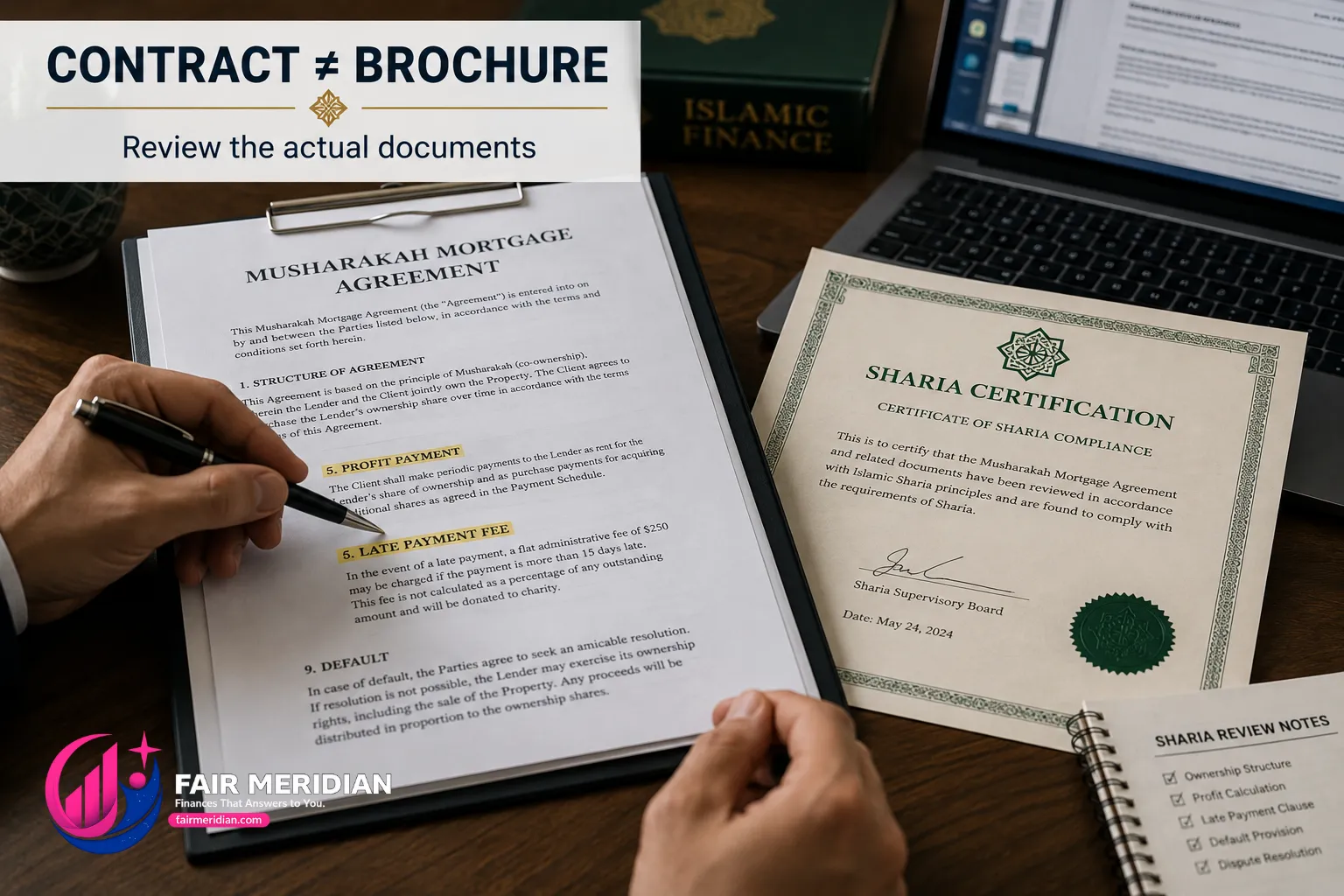
Question 2: Does Your Sharia Board Certify the Actual Contract Documents — or Just the General Product Concept?
Why This Question Matters
There is a meaningful difference between a scholar who advised on how a musharakah should work in theory and a scholar who has read, reviewed, and issued a formal fatwa certifying that the specific contract documents you will sign are compliant. Products can drift from their certified design through small contract modifications. Certification of the concept does not cover a contract that has been changed since the original review.
What a Good Answer Sounds Like
"Our Sharia board reviews our standard contract documents, not just the product concept. They issue a formal certificate of compliance that covers our current contract templates. When we make material changes to our contracts, we return to the board for re-review and re-certification. I can provide you with a copy of our most recent Sharia certification."
Red Flag Answers
"They helped us design the structure originally" — without confirmation of ongoing contract review
"The product is certified as halal" — without being able to specify what exactly was certified or when
Resistance to providing any written Sharia certification documentation
Question 3: Does Your Contract Use the Words "Loan," "Borrow," or "Interest on Outstanding Balance" to Describe My Obligation to You?
Why This Question Matters
US federal law (the Truth in Lending Act — TILA) requires mortgage lenders to disclose an Annual Percentage Rate. Legitimate Islamic finance lenders satisfy TILA by disclosing an "equivalent rate" for comparison purposes while being clear in their contracts that the product is a co-ownership arrangement, not a loan. The legal structure — not the TILA disclosure label — is what determines compliance. But the contract language itself must reflect the co-ownership structure, not loan structure.
What a Good Answer Sounds Like
"Our contract describes the arrangement as a co-ownership (musharakah) in which you purchase our ownership stake over time while paying rent on the portion we still hold. We satisfy TILA disclosure requirements by disclosing an equivalent rate for comparison purposes, but our legal relationship with you is co-ownership, not lending. You are not a borrower and we are not a lender in our contract."
Red Flag Answers
The contract calls you "the borrower" and the lender "the lender" throughout — without qualification
"Interest rate" is used to describe the profit component without any alternative framing in the contract
The lender cannot explain how their TILA disclosure differs from a conventional interest rate disclosure
Important nuance: TILA requires an "APR" disclosure — seeing APR in your loan estimate or closing disclosure does not mean your halal lender is charging conventional interest. The APR equivalent is a legal disclosure requirement, not evidence of a loan structure. Read the contract for the legal relationship — not just the disclosure tables.
Question 4: What Happens If I Miss a Payment — Does Any Fee Accrue as a Percentage of My Outstanding Balance Over Time?
Why This Question Matters
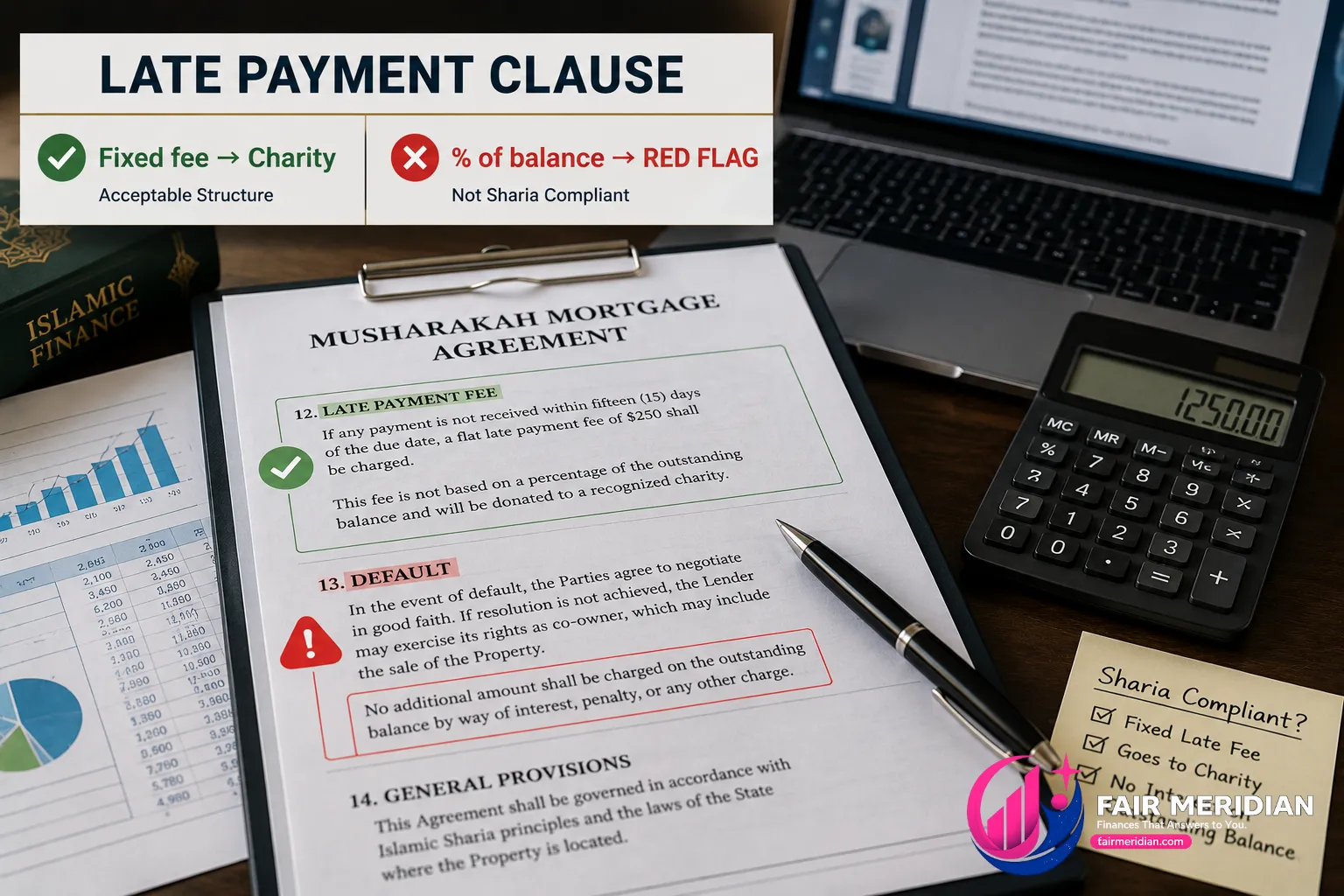
This is the question that catches the most nominally Islamic products. A late payment fee is permissible in Islamic finance — scholars accept fixed administrative fees for late payment. What is not permissible is a fee that accrues as a percentage of the outstanding balance over time, because that is functionally compound interest charged to the borrower regardless of what it is called. Some products marketed as halal include exactly this clause.
What a Good Answer Sounds Like
"We charge a fixed late fee of $[X] if your payment is more than [X] days late. This fixed fee does not compound, does not accrue over time as a percentage of any balance, and goes to charity — not to our revenue. Your profit rate does not change due to late payment."
Red Flag Answers
"A late payment fee of X% per month of the outstanding balance applies" — this is riba regardless of the label
"Late payments result in an increase in your profit rate" — a profit rate that increases due to lateness is functionally penalty interest
The contract contains language about "default interest" or "penalty rate" that applies to any unpaid balance
Late fees that go to the lender as revenue rather than to charity
Question 5: What Happens If I Default — Do You Charge Additional Fees or Amounts Beyond Recovering Your Co-Ownership Stake?
Why This Question Matters
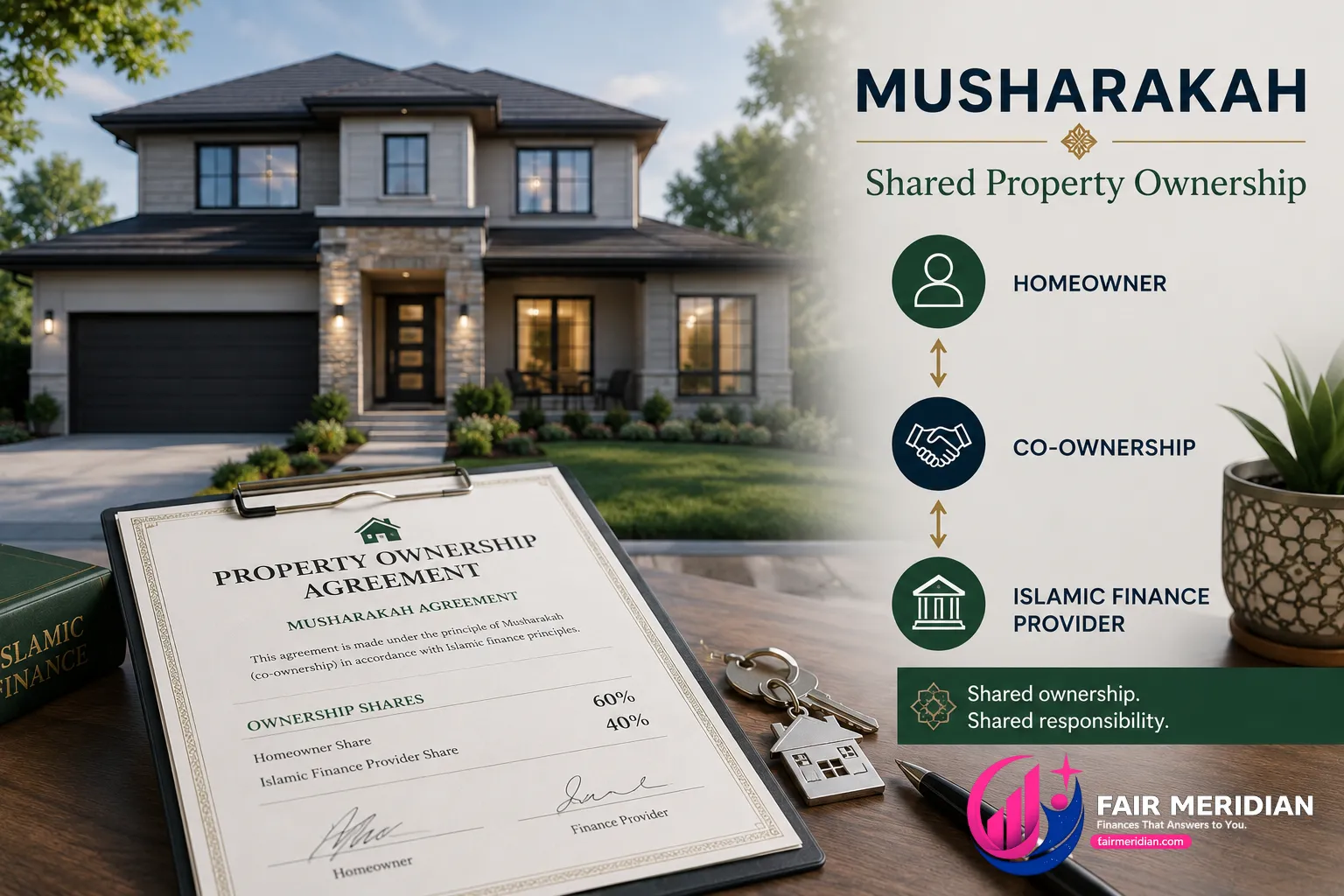
The default provision is where many "Islamic" products reveal that they are conventional loans in different packaging. In a genuine musharakah, you and the lender co-own the property. If the arrangement cannot continue, the property is sold and proceeds are divided according to ownership percentages — the bank recovers its stake. In a conventional loan structured as Islamic: default triggers an outstanding balance that accrues interest until paid — the same as any conventional mortgage. Ask the question directly.
What a Good Answer Sounds Like
"In the event of default, we work with you on a resolution plan first. If we cannot reach resolution, we exercise our co-ownership rights — which means we may seek to sell the property at fair market value and recover our proportional ownership stake from the proceeds. We do not charge interest on any deficiency. If the sale proceeds are less than our ownership stake's value, we bear that loss as a co-owner."
Red Flag Answers
Any reference to "default interest" accruing on an outstanding loan balance
"You will owe [outstanding balance] plus [percentage] per annum until paid" — this is a conventional debt structure, not co-ownership
A deficiency judgment process identical to conventional mortgage default without any explanation of how it differs under the co-ownership structure
Question 6: Are You Approved by Freddie Mac or Fannie Mae for This Specific Product?
Why This Question Matters
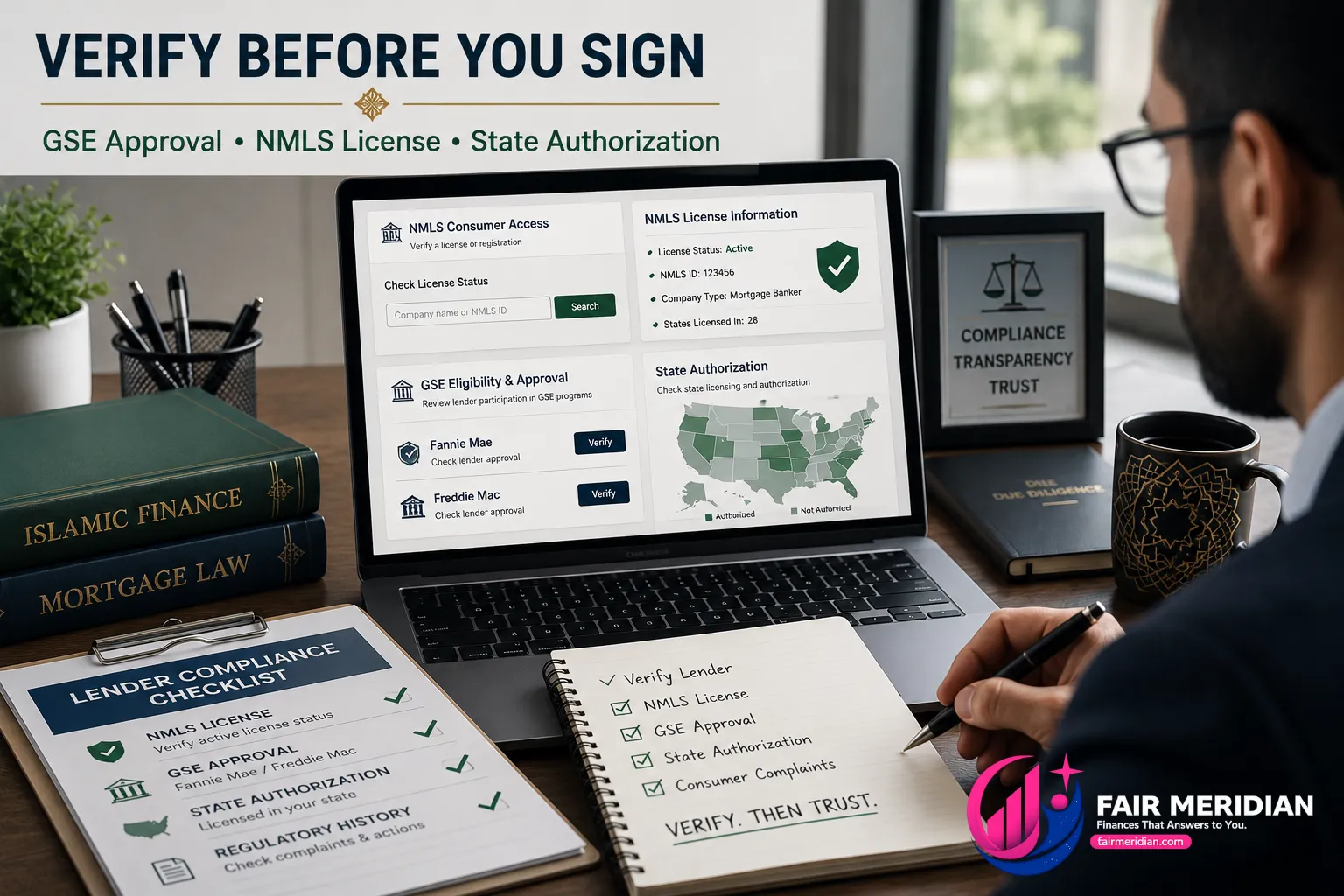
Freddie Mac and Fannie Mae are US government-sponsored enterprises that purchase mortgages in the secondary market. They review every mortgage product they purchase for legal validity and structural compliance with their guidelines. When a halal lender has GSE approval for their Islamic finance product, it means a federal agency with no Islamic finance agenda independently evaluated the contract structure and certified it as legally valid and structurally sound. This is the strongest available institutional validation of a genuine structural difference from conventional lending — because no one works harder to ensure they're not buying repackaged conventional loans than Freddie Mac's legal team.
What a Good Answer Sounds Like
"Yes, our musharakah [or ijara] product is approved by Freddie Mac and Fannie Mae. We can sell these contracts into the secondary market through their programs. You can verify this on their lender approval lists."
Confirmed US halal lenders with GSE approval: Guidance Residential (musharakah), UIF Corporation (musharakah), and others.
Red Flag Answers
"No, we hold all our contracts on our own balance sheet" — not inherently disqualifying, but removes the independent institutional validation. Ask why not.
"GSE approval isn't necessary for Islamic finance" — this is technically true but the absence of it removes the strongest form of external structural validation
Confusion about what Freddie Mac approval means or inability to confirm their status
Question 7: Can I Read the Full Contract Documents Before I Apply — Not Just a Brochure or Term Sheet?
Why This Question Matters
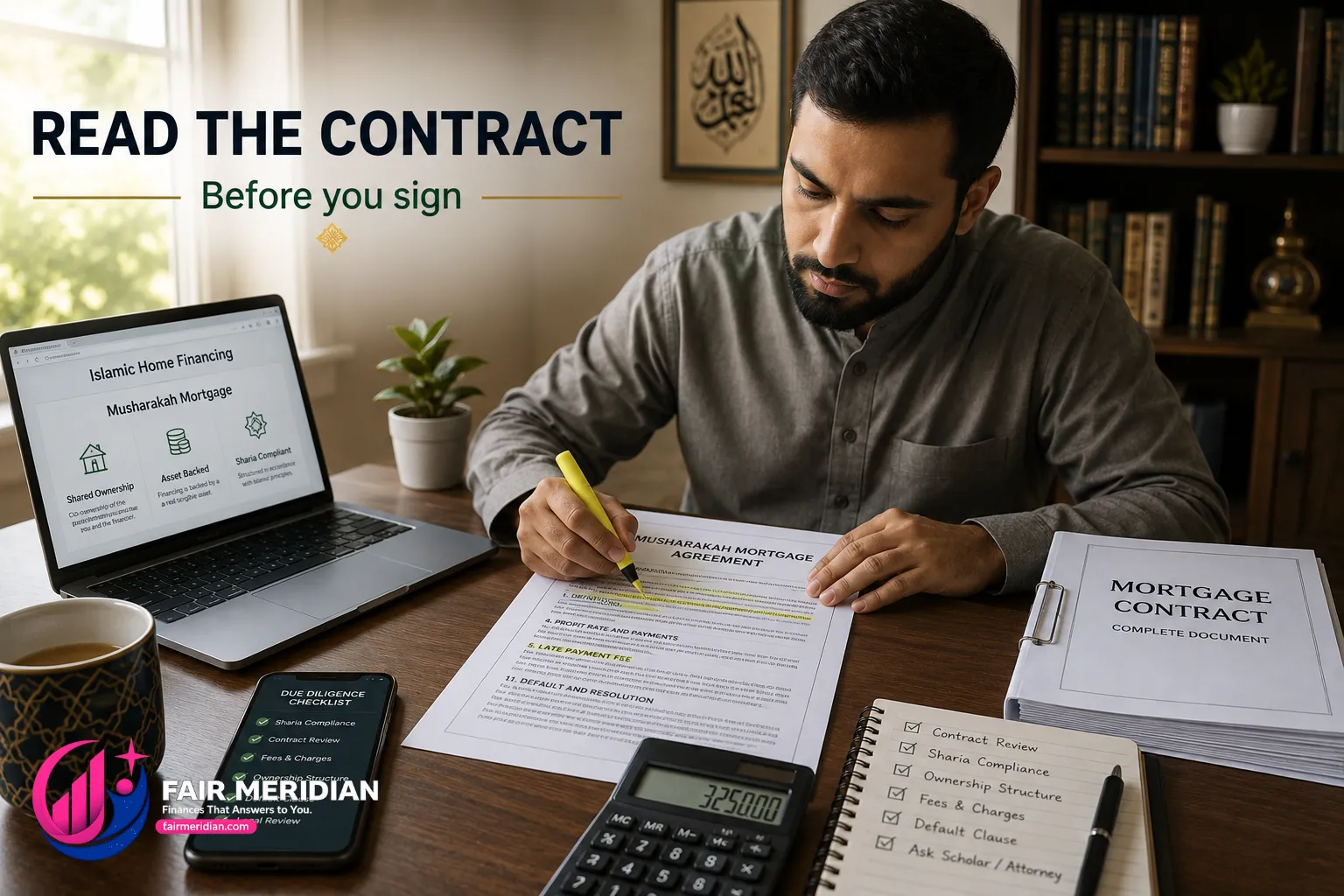
The entire argument for whether a halal mortgage is genuinely halal is in the contract. Brochures and term sheets describe what the lender wants you to believe about the product. The contract describes what you are actually agreeing to. A lender who will not share their standard contract documents before application is withholding the only document that actually matters for Sharia evaluation. No legitimate Islamic finance provider refuses to share their contract with a prospective buyer.
What a Good Answer Sounds Like
"Of course — here is our standard musharakah agreement. Please take as much time as you need to review it. We encourage you to share it with your own scholar or Islamic finance attorney. The documents you'll sign at closing are substantially the same as this standard form."
Red Flag Answers
"You'll receive the documents at closing" — this is the single biggest red flag on this list. You should never see a contract for the first time at closing.
"Our contracts are proprietary" — the existence of your contract template is not a trade secret that prevents sharing it with a buyer who will sign it
"Just trust the process — the scholars have reviewed it" — you are entitled to your own review regardless of what scholars have done
Sharing only a summary or highlights document rather than the actual contract
Question 8: What Is the Total Amount I Will Pay Over the Full Term — As a Specific Written Number?
Why This Question Matters
One of the benefits of a fixed-rate halal mortgage is total cost transparency. Unlike a variable-rate product whose future cost depends on unknown rate movements, a fixed musharakah or murabaha should produce a calculable total cost from day one. Ask for this number in writing. It should appear in your loan estimate and closing disclosure. The ability to provide this number — and the willingness to put it in writing — confirms the fixed nature of the obligation.
What a Good Answer Sounds Like
A specific dollar amount: "On a $320,000 financed amount at our current profit rate over 30 years, your total payments will be approximately $746,280 — consisting of your $320,000 acquisition payment and $426,280 in profit payments. This figure is fixed and does not change unless you pay off early."
Red Flag Answers
"It depends on your payment history" for a product marketed as fixed-rate — if the total changes based on your payment history, something in the contract is variable in a way you need to understand
Inability or unwillingness to provide a total payment figure in writing
"We'll disclose that at closing" — the Loan Estimate form, which must be provided within 3 business days of application, includes total payment information for all US mortgage products
Question 9: What Is Your NMLS License Number and Which States Are You Licensed In?
Why This Question Matters
Every legitimate US mortgage lender — halal or conventional — must be licensed through the Nationwide Multistate Licensing System (NMLS) in each state where they originate loans. NMLS licensing requires background checks, financial requirements, ongoing education, and state regulatory compliance. An unlicensed lender operates outside the consumer protection framework that governs all legitimate US lending. You can verify any lender's license status, license history, and complaint record at nmlsconsumeraccess.org in approximately 30 seconds.
What a Good Answer Sounds Like
Immediate, confident provision of a specific NMLS number. "Our NMLS number is [X]. You can verify our licensing and complaint history at nmlsconsumeraccess.org. We are currently licensed in [states]."
Red Flag Answers
Any hesitation, inability to provide an NMLS number, or explanation that they "don't need" NMLS licensing because of their product structure — there is no exemption from NMLS licensing for Islamic finance products
"We operate under a different type of license" without being able to specify what license and how to verify it
Operating in your state without a license for that state — licenses are state-specific; verify your state specifically, not just that the company is NMLS registered generally
Do this right now: Before going further with any halal lender, go to nmlsconsumeraccess.org and search for them. Review their license status in your state, any regulatory actions taken against them, and any formal complaints filed. This takes 2 minutes and provides more objective information than any sales call.
Question 10: Can I Have at Least 3 Business Days to Review the Final Contract With My Own Scholar and Attorney Before Signing?
Why This Question Matters
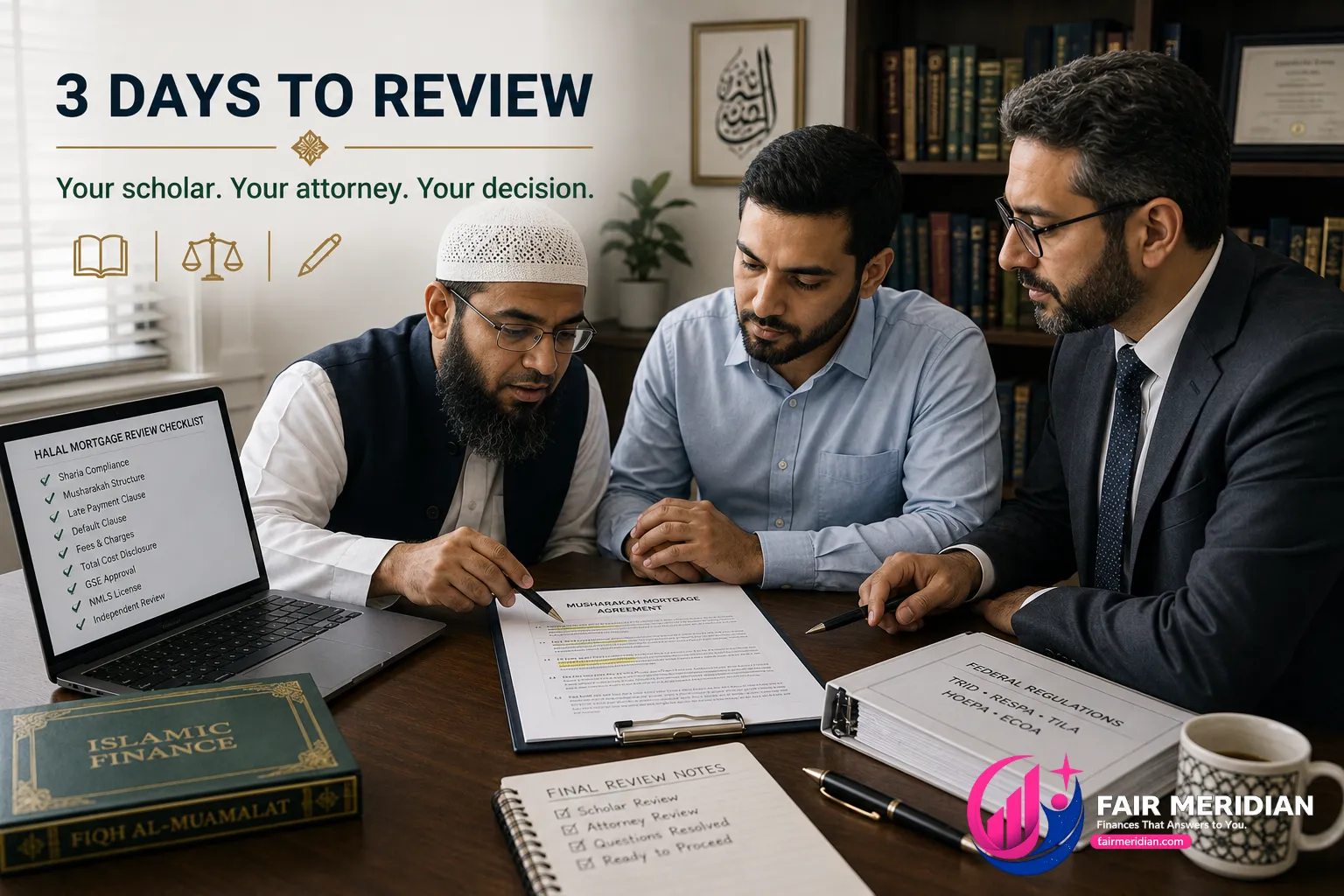
US federal law (the TRID rule — TILA/RESPA Integrated Disclosure) requires a mandatory 3-business-day waiting period between receiving the final Closing Disclosure and signing — for all mortgage products. This is your legal right. Beyond the legal minimum: you should use those three days to have your own scholar review the contract, not just the lender's Sharia board. The lender's Sharia board works for the lender. Your scholar works for you. These may reach the same conclusion — but confirming that independently is your right and your protection.
What a Good Answer Sounds Like
"Yes — federal law actually requires it for the Closing Disclosure. Beyond that, we strongly encourage you to review the full contract with your own scholar before closing. There is no pressure to sign on any specific date. If you need more time, we can reschedule. We've had buyers take their contracts to scholars at their mosque or to Islamic finance attorneys — we welcome that."
Red Flag Answers
Any suggestion that you shouldn't need independent review because the lender's Sharia board has already reviewed it — the board's review is for the product; your review is for your specific transaction
"The rate lock expires tomorrow" or any time pressure that discourages careful review
"Other buyers don't ask for this" or any suggestion that your due diligence is unusual or excessive
Resistance to allowing a scholar or attorney to see the contract before closing
Three Bonus Questions Worth Asking
Bonus 1 (For Musharakah Products): Who Holds Legal Title During the Financing Period?
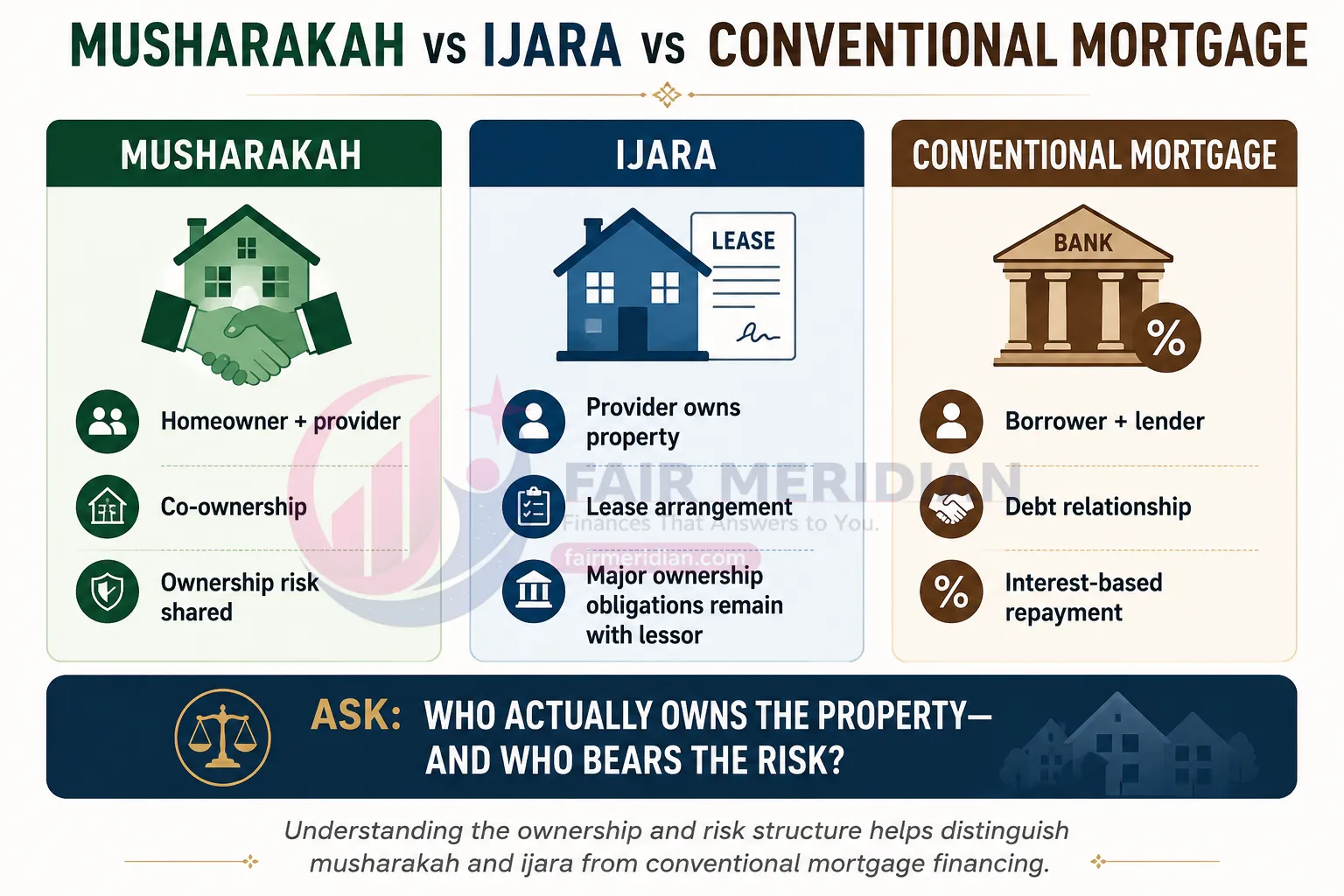
In a genuine musharakah co-ownership, both you and the lender should be on title as co-owners from day one. If the lender holds 100% of legal title and transfers it to you at the end — with you having no legal ownership interest during the financing period — the arrangement may be structured as an ijara (lease) rather than musharakah. Both can be halal, but the answer tells you which structure you actually have.
Bonus 2 (For Ijara Products): Who Bears Major Structural Maintenance Costs?
In a genuine ijara (lease), the lessor (lender) bears major structural maintenance obligations because they own the property. If the "Islamic lease" contract requires you to bear all maintenance as a lessee while also building equity as if you own it — with the lender bearing no ownership risk — the arrangement may not comply with the ijara structure's ownership obligations. Ask specifically: "If a major structural issue occurs during the financing period, who is responsible under the contract?"
Bonus 3: What Happens to My Payments If the Property Is Damaged or Destroyed?
In a genuine co-ownership or lease: the lender as co-owner bears proportional risk if the property is destroyed. In a conventional loan: you still owe the full balance regardless of what happens to the property (which is why homeowners insurance is required). How your lender answers this question reveals whether they bear genuine ownership risk (halal) or whether their "co-ownership" protects them from all downside like a conventional lender.
The Quick Summary Checklist
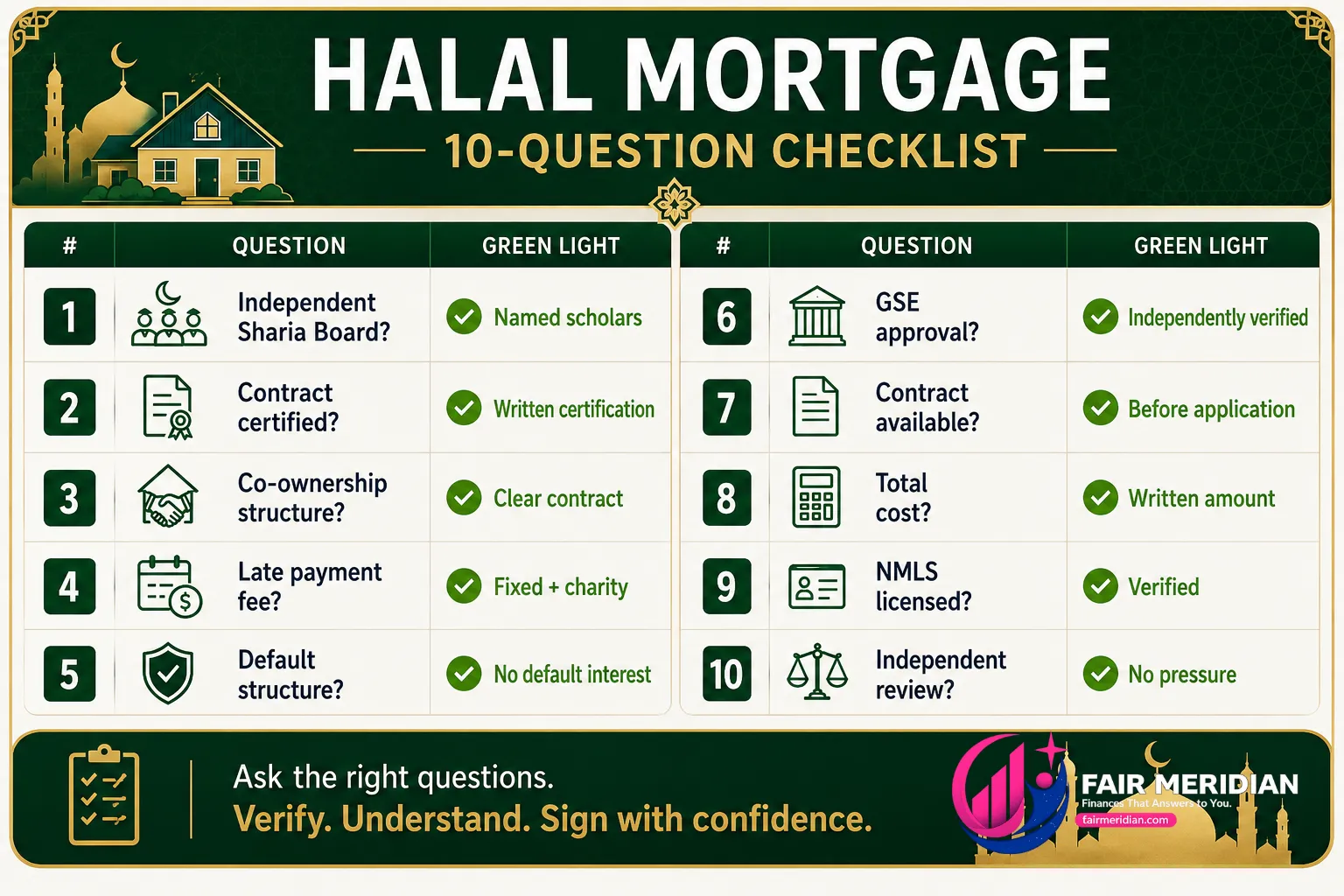
# | Question | Green Light | Stop Sign |
|---|---|---|---|
1 | Named independent Sharia board? | Named scholars, verifiable credentials | Internal review, unnamed consultants |
2 | Board certifies actual contracts? | Written fatwa on current contract documents | Concept-only review, no ongoing certification |
3 | Contract avoids loan/interest language? | Co-ownership language throughout | "Borrower" / "interest rate" / "loan" unqualified |
4 | Late fees are flat, go to charity? | Fixed dollar fee to charity | % of balance per month; goes to lender |
5 | Default = co-ownership recovery, no interest? | Property sale, proportional recovery | Default interest on outstanding balance |
6 | Freddie Mac / Fannie Mae approved? | Yes — can verify on GSE lender lists | No (weaker, not definitive); cannot answer |
7 | Full contract available before application? | Immediately provided; review encouraged | "You'll see it at closing" |
8 | Total payment figure in writing? | Specific dollar amount, fixed in writing | Cannot calculate; "depends on payment history" |
9 | NMLS licensed in your state? | NMLS number provided immediately; verified | Cannot provide number; claims exemption |
10 | Time to review with own scholar? | Yes, encouraged; no time pressure | Any pressure to sign without independent review |
What to Do With the Answers
A lender who answers all 10 questions cleanly — named Sharia board, contract-level certification, fixed late fees to charity, no default interest, GSE approval, contract available upfront, NMLS verified, total cost in writing, and time to review — is operating transparently and deserves your serious consideration. The established US halal lenders (Guidance Residential, UIF Corporation, Devon Bank, IjaraCDC, Lariba Finance) can answer all 10. They've been asked them before.
A lender who becomes evasive on late payment clauses, cannot name their Sharia scholars, won't share the contract before closing, or cannot provide an NMLS number should not receive your business regardless of how competitive their rate appears. A lower rate on a product that charges compound penalty interest on late payments is not cheaper — it is a conventional loan with Islamic branding.
Frequently Asked Questions
How do I know if a halal mortgage is really Sharia compliant?
The three most reliable indicators: (1) Named independent Sharia supervisory board that certifies the actual contract — not just the concept. (2) GSE approval from Freddie Mac or Fannie Mae, which requires independent structural review by a federal agency. (3) A late payment clause that charges a flat fee going to charity, not a percentage of the outstanding balance — this single clause reveals whether the product has been genuinely restructured or just rebranded.
Can I ask my own scholar to review the halal mortgage contract?
Yes — and you should. The lender's Sharia board certifies that the product as designed is compliant. Your own scholar can confirm that the specific contract you are signing matches what was certified. Ask for the contract well before your closing date — at least two weeks — so you have adequate time for independent review. No legitimate Islamic finance lender will refuse this request or pressure you to close before completing it.
What is an NMLS number and why does it matter?
The Nationwide Multistate Licensing System (NMLS) is the regulatory licensing system for all US mortgage lenders. Every legitimate lender — halal or conventional — has an NMLS number and is licensed in each state where they originate loans. NMLS licensing requires background checks, financial requirements, and compliance with state consumer protection laws. You can verify any lender's license status, state coverage, and complaint history at nmlsconsumeraccess.org by searching their company name or NMLS number. An Islamic finance company without NMLS licensing has no regulatory oversight and no consumer protection accountability.
What if I've already signed and I'm worried the mortgage isn't really halal?
Review your contract carefully against these criteria — specifically the late payment clause and default provision. If you find genuine concerns, consult a qualified Islamic finance scholar and a consumer protection attorney. Federal law provides a rescission right within 3 business days of signing for certain mortgage transactions — though this does not apply to purchase money mortgages (loans used to buy the home). For concerns discovered later, the right path is scholarly guidance on your specific situation, not a general online ruling.
For the complete comparison of all five US halal mortgage providers — including which pass all 10 of these criteria — see our Halal Mortgage Rates USA Guide. For our independent review of Guidance Residential specifically, read our Guidance Residential 2026 Review. For UIF Corporation's bank statement program, read our UIF Corporation 2026 Review.