
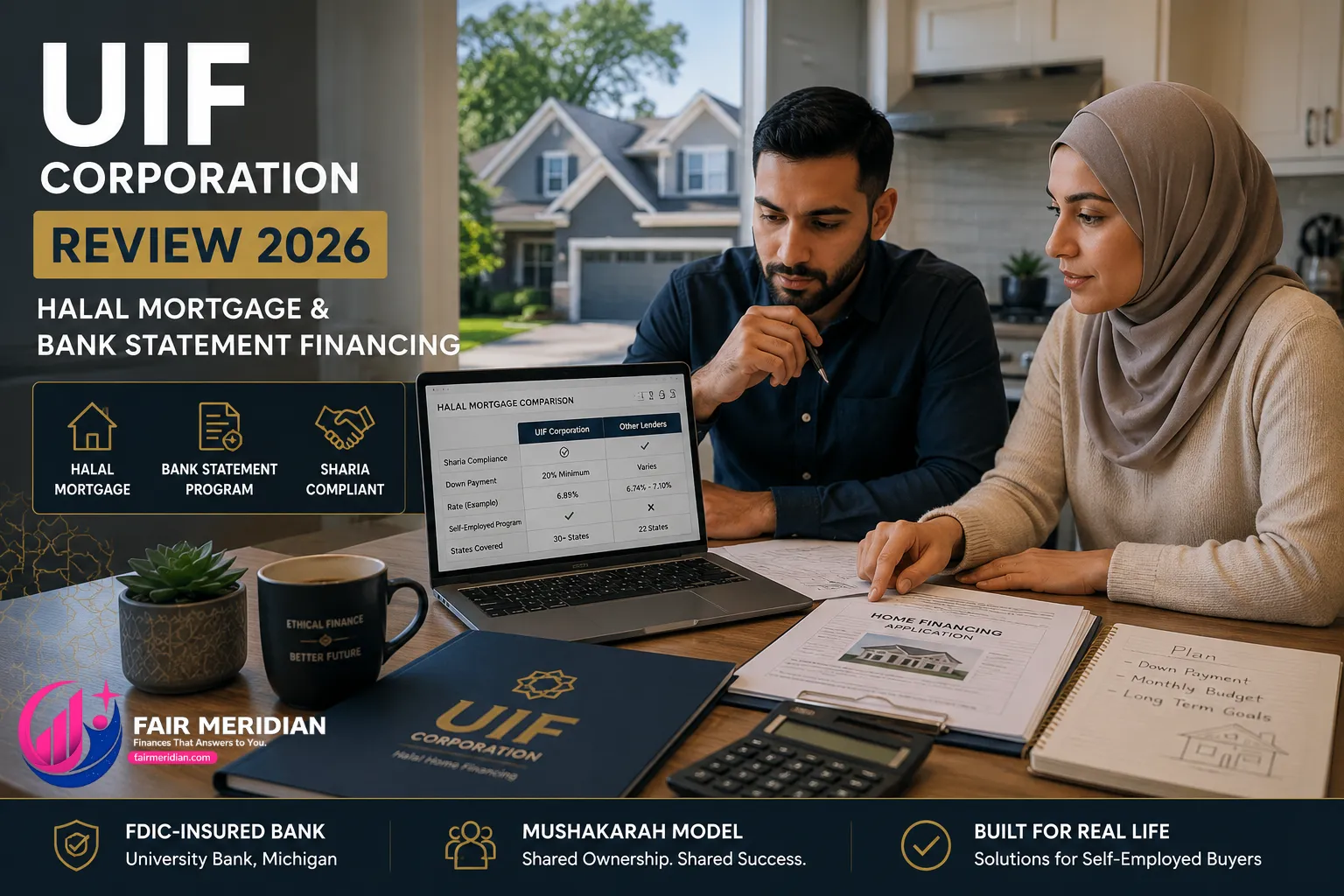
UIF Corporation is halal, legitimate, and genuinely different from Guidance Residential in one critical way: it is the only halal mortgage lender in the United States with a bank statement income program for self-employed buyers. For the Muslim physician with a private practice, the restaurant owner whose Schedule C shows minimal net profit, the contractor paid in cash deposits, or the real estate investor whose returns look like losses on paper — UIF may be the only halal home financing path available. This review covers everything that matters.
Quick Verdict
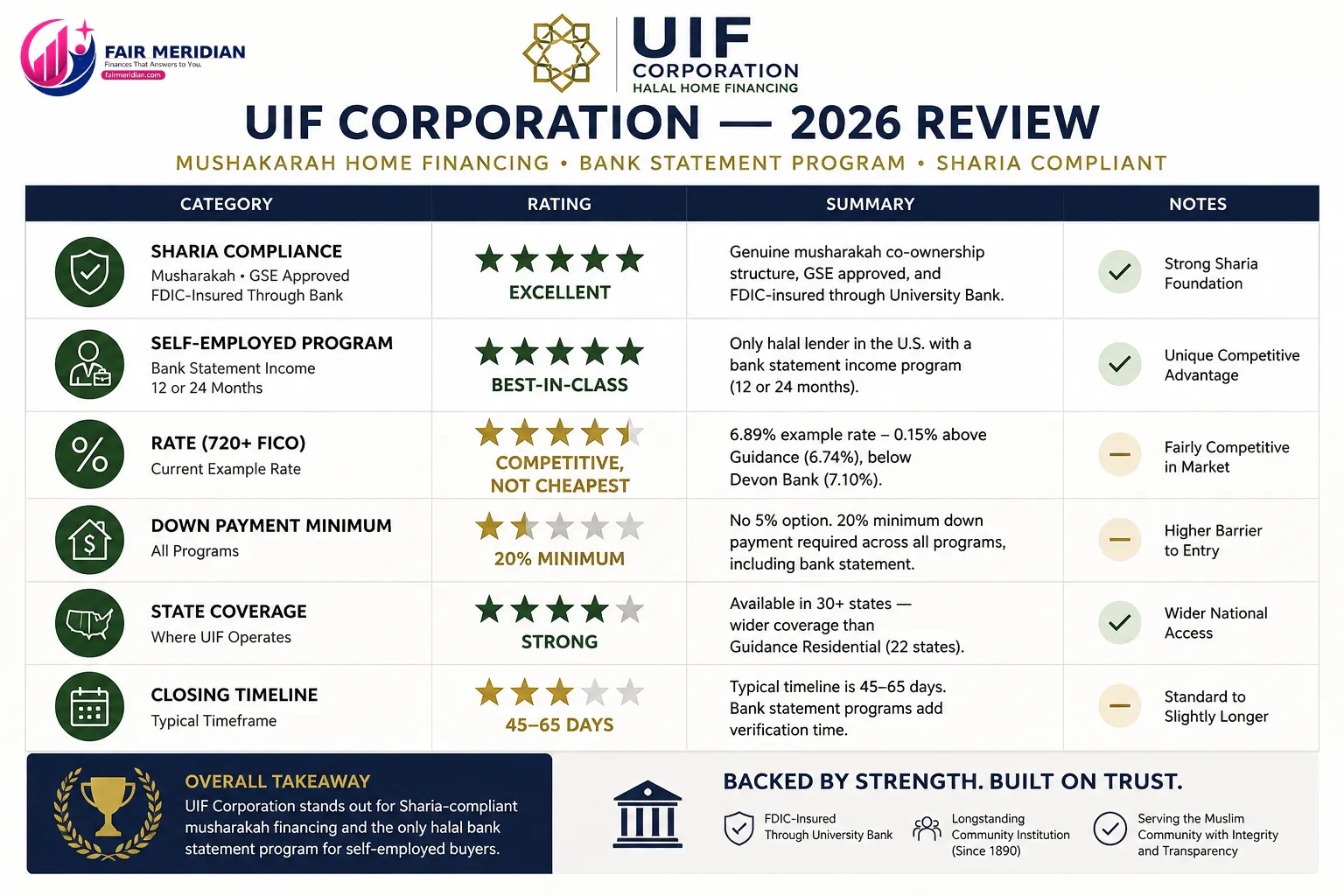
Category | Rating | Notes |
|---|---|---|
Sharia compliance | ✅ Excellent | Genuine musharakah co-ownership; GSE approved; FDIC-insured through University Bank |
Self-employed program | ✅ Best-in-class halal | Only halal lender with bank statement income qualification — 12 or 24 months |
Rate (720+ FICO) | ⚠️ Competitive, not cheapest | 6.89% — 0.15% above Guidance (6.74%); below Devon Bank (7.10%) |
Down payment minimum | ⚠️ 20% required | No 5% option; 20% minimum across all programs including bank statement |
State coverage | ✅ Strong | 30+ states — wider than Guidance's 22 |
FDIC insured | ✅ Yes | Through University Bank, Ann Arbor, Michigan — only FDIC-insured halal bank offering musharakah |
Closing timeline | ⚠️ Standard to slightly longer | 45–65 days; bank statement programs add verification time |
Track record | ✅ Established | University Bank founded 1890; Islamic finance division with long community track record |
Who UIF Is — The Background That Matters
UIF Corporation (University Islamic Financial) is the Islamic finance division of University Bank — a federally chartered, FDIC-insured community bank headquartered in Ann Arbor, Michigan. University Bank is one of the oldest community banks in Michigan with roots going back over a century. Its UIF division was established to serve the substantial Muslim community in Michigan's Ann Arbor–Dearborn corridor — the largest concentration of Arab-American Muslims in the United States.

This origin matters for three reasons:
FDIC protection: Your deposits and dealings are with a federally regulated bank, not an independent mortgage company. University Bank is subject to OCC (Office of the Comptroller of the Currency) oversight, regular examinations, and federal consumer protection requirements.
Deep self-employed Muslim community knowledge: Dearborn's Muslim business community — restaurant owners, auto dealers, medical professionals, contractors — represents exactly the buyer profile that banks with standard income documentation requirements cannot serve. UIF's bank statement program was built because they knew this community existed and was underserved.
Institutional stability: University Bank is not a startup or a fintech experiment. It is a century-old regulated bank whose Islamic finance division has deep community roots.
The Bank Statement Program — UIF's Most Important Feature
This is the section that matters most for most people reading a UIF review. Understanding exactly how the bank statement program works determines whether it can help you qualify.
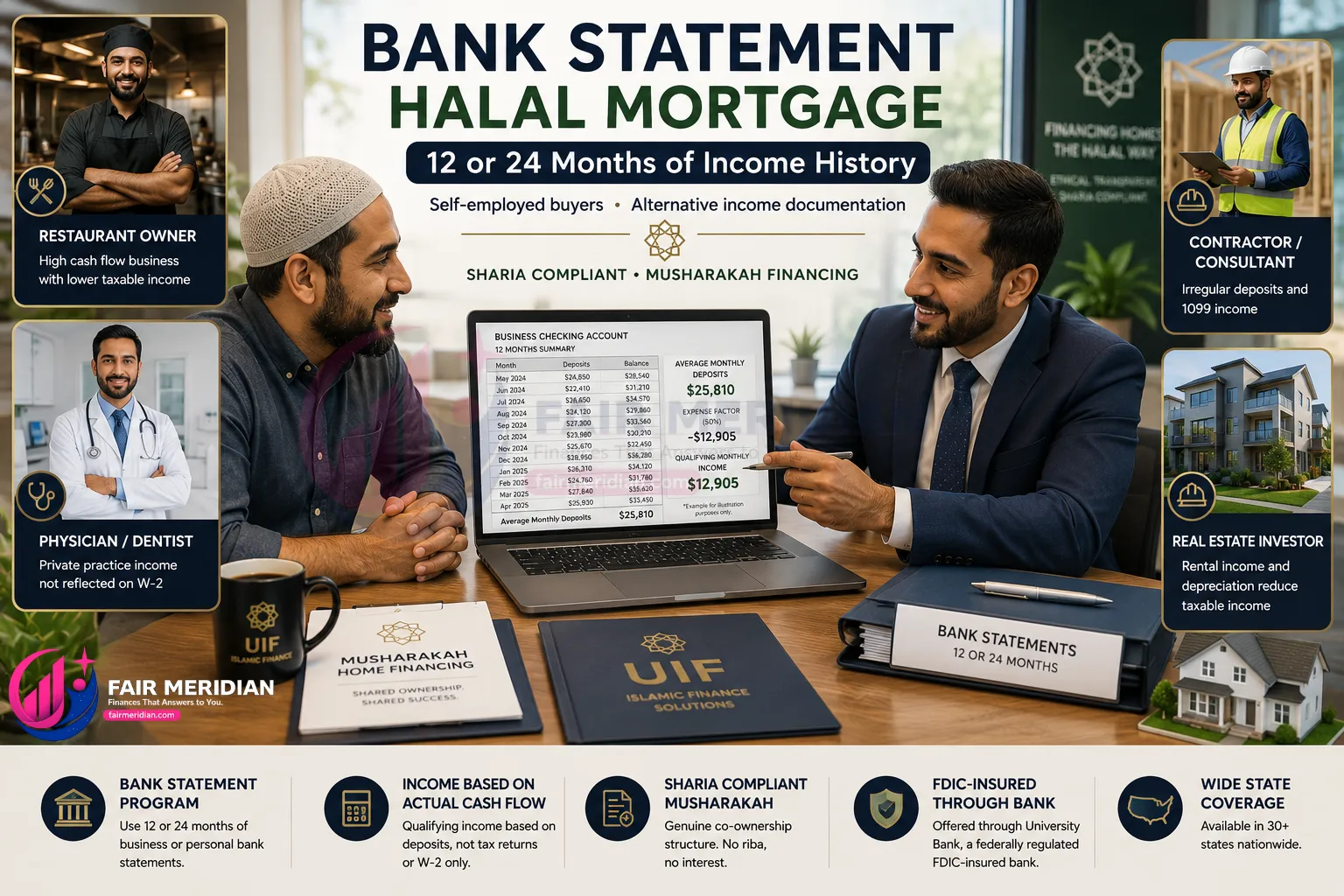
Who the Bank Statement Program Is For
Buyer Type | The Documentation Problem | How UIF Solves It |
|---|---|---|
Restaurant / food business owner | Schedule C shows $40K net income after business expenses; actual cash deposits are $150K+/year | Bank statements show $12,500+/month average deposits; qualifying income calculated from actual cash flow |
Physician / dentist with private practice | Practice is profitable but physician takes low W-2 salary and leaves profits in the business | Business bank statements show true practice revenue; personal + business bank statements combined for qualifying |
Contractor / consultant | 1099 income; irregular monthly deposits; deductions make net income appear low on tax returns | 12 or 24 months of deposits averaged out; consistent cash flow demonstrated through bank history |
Real estate investor | Rental income on Schedule E; depreciation deductions minimize taxable income on paper | Rental deposits into business account show actual cash flow; depreciation recaptured for qualifying purposes |
Import / wholesale business owner | High gross revenue; significant cost of goods reduces net income; tax returns look income-poor | Business bank statement deposits averaged; expense factor applied to calculate qualifying income |
How the Bank Statement Calculation Works
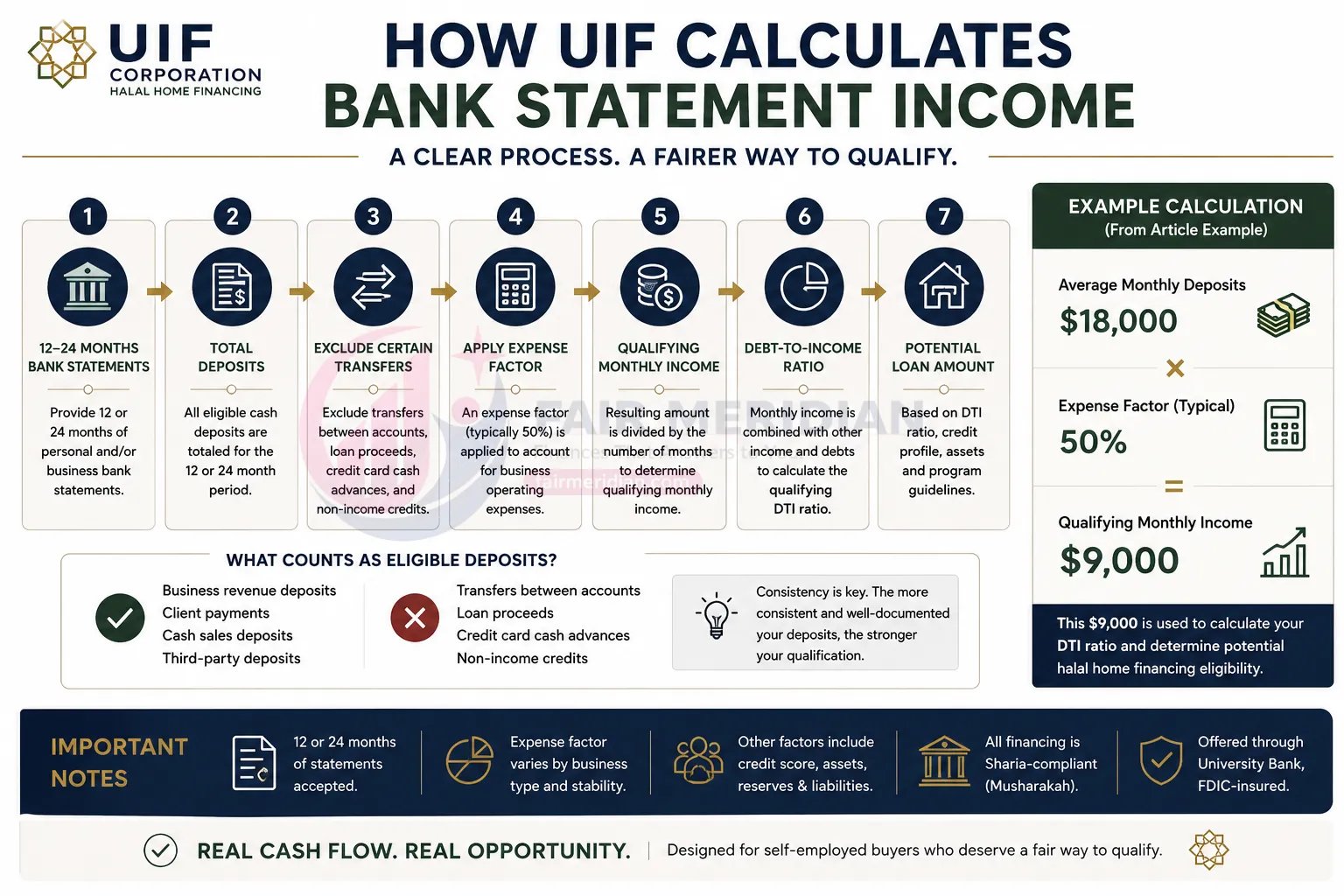
The bank statement program does not use your tax returns or W-2s. Here is the exact mechanics:
You provide 12 or 24 months of bank statements. Business account, personal account, or both — depending on where your income flows. All pages of every month are required; no gaps permitted.
UIF totals all deposits over the statement period. They add every deposit that goes into the account. Large transfers between your own accounts are typically excluded to prevent double-counting.
They apply an expense factor. The expense factor accounts for the fact that business deposits include both income and pass-through revenue. Typical factors:
Sole proprietor / single-member LLC: 50% expense factor — meaning they treat 50% of deposits as qualifying income
Some business types with verifiably lower overhead may qualify for a lower expense factor (40%)
The resulting monthly qualifying income determines your loan amount. Example: average monthly business bank deposits of $18,000 × 50% expense factor = $9,000 qualifying monthly income. Standard debt-to-income ratios (typically 43–50% maximum) then determine the maximum monthly payment you can qualify for.
Worked Example: Restaurant Owner in Dearborn
Metric | Tax Return (Shows) | Bank Statement (Actual) |
|---|---|---|
Annual gross revenue | $480,000 | $480,000 |
Business expenses / COGS | ($380,000) | Not shown — cash out, not deposits |
Net income (Schedule C) | $100,000 | N/A |
Average monthly deposits | N/A | $40,000/month |
UIF qualifying income (50% factor) | N/A | $20,000/month |
Maximum monthly payment (43% DTI) | $3,583/month (based on $100K) | $8,600/month (based on $240K) |
Approximate qualifying loan amount | ~$510,000 | ~$1,250,000+ |
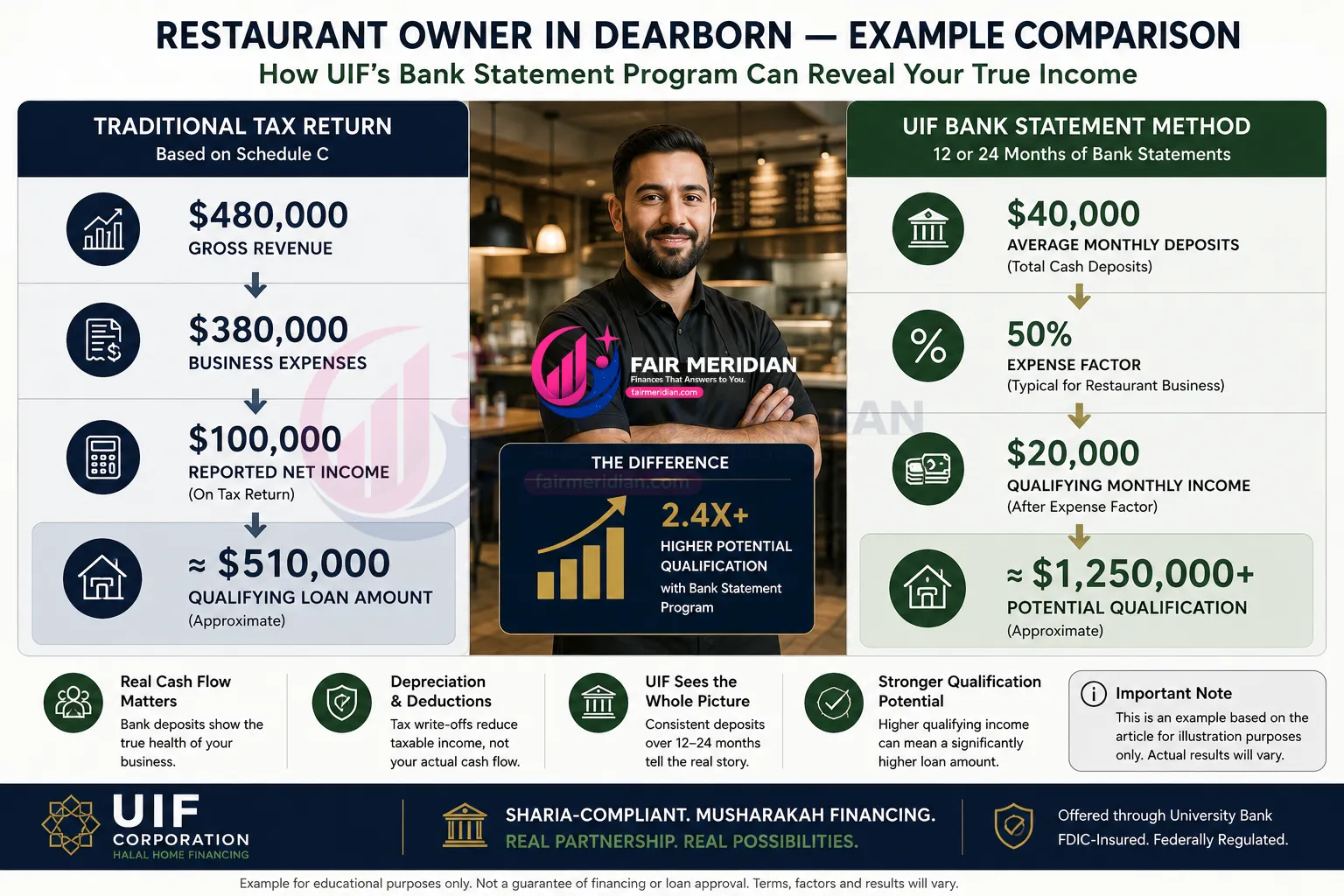
The same buyer who appears to qualify for ~$510,000 based on tax returns qualifies for over $1,250,000 based on bank statements. This is not a loophole — it is an accurate representation of actual income that tax minimization strategies obscure. UIF is assessing the buyer's real ability to repay, not their accountant's optimization.
Current Rates — Aug 2026
Program | FICO 720+ | FICO 680–719 | vs Conventional (6.87%) |
|---|---|---|---|
UIF Standard (W-2 income) | 6.89% | 7.24% | 0.02% above conventional |
UIF Bank Statement Program | ~7.25–7.50%* | ~7.60–7.85%* | 0.38–0.63% above conventional |
*Bank statement program rates are typically 0.35–0.65% higher than standard income documentation rates due to higher perceived risk. Exact rate depends on loan amount, down payment, and documentation specifics. Request a personalized quote — these are approximate ranges. Rates as of Aug 15, 2026.
The bank statement rate premium in context: A self-employed buyer using UIF's bank statement program pays approximately 0.50% more than a W-2 buyer using Guidance Residential. On a $400,000 loan: that's approximately $133/month more. For a buyer who cannot qualify for a halal mortgage at all on standard documentation, paying $133/month more for access to halal financing is not a premium — it's the cost of the only available path. Comparing the bank statement rate to "what I'd pay at Guidance" is the wrong comparison; compare it to "what I'd pay if I used a conventional mortgage instead."
States Served — 30+ vs Guidance's 22
UIF Corporation serves more states than Guidance Residential — an important coverage advantage for buyers in states where Guidance does not operate.
Region | UIF Coverage | Guidance Coverage |
|---|---|---|
Mid-Atlantic / Southeast | VA, MD, DC, NC, GA, FL, SC | VA, MD, DC, NC, GA, FL |
Northeast | NY, NJ, PA, CT, MA, NH, RI | NY, NJ, PA, CT, MA |
Midwest | MI, IL, OH, IN, WI, MN, MO | MI, IL, OH, IN, WI |
South | TX, TN, KY, AR, AL | TX, TN |
West | CA, CO, WA, OR, AZ, NV, UT | CA, CO, WA |
State coverage changes — verify current availability at uif.com before applying. States shown are approximate based on Aug 2026 information.
For buyers in states like Minnesota, Missouri, Arkansas, Alabama, Oregon, Nevada, or Utah — UIF may be the primary or only halal musharakah option available. Devon Bank and Lariba Finance also serve broader geographies, but for buyers who specifically want musharakah rather than murabaha/ijara, UIF is the wider-coverage musharakah lender.
UIF's FDIC Advantage — Why It Matters to Some Buyers
UIF operates as a division of University Bank, an FDIC-insured federally chartered bank. Guidance Residential is not a bank — it is an independent mortgage company. Both are legitimate, both are NMLS-licensed, but the regulatory difference matters to certain buyers:
Factor | UIF (University Bank) | Guidance Residential |
|---|---|---|
FDIC insured? | ✅ Yes — through University Bank | ❌ No — independent lender |
Bank regulator | OCC (federal bank supervision) | State mortgage regulators + CFPB |
Capital requirements | Federal bank minimum capital ratios | State-specific mortgage company requirements |
Examination frequency | Regular federal bank examinations | State mortgage license examinations |
Community Reinvestment Act | Subject to CRA requirements | Not subject to CRA |
For buyers who feel more comfortable working with a federally regulated bank — or whose financial advisors recommend FDIC institutions specifically — UIF is the halal musharakah option that provides this assurance. Most buyers don't need to choose based on this; Guidance's GSE approval provides its own institutional credibility. But for buyers to whom the FDIC distinction matters, UIF is the answer.
Down Payment Requirements
Program | Minimum Down | On $350K Home | On $500K Home |
|---|---|---|---|
UIF Standard (W-2) | 20% | $70,000 | $100,000 |
UIF Bank Statement Program | 20% | $70,000 | $100,000 |
Guidance Residential | 5% | $17,500 | $25,000 |
UIF's 20% down minimum is the most significant limitation for buyers with limited savings. There is no 5% option, no FHA-equivalent program, and no workaround. For a self-employed buyer who can qualify based on bank statement income but cannot save $70,000+ for a down payment, UIF cannot help them today — they need to either save longer or explore whether Guidance Residential can work with their income.
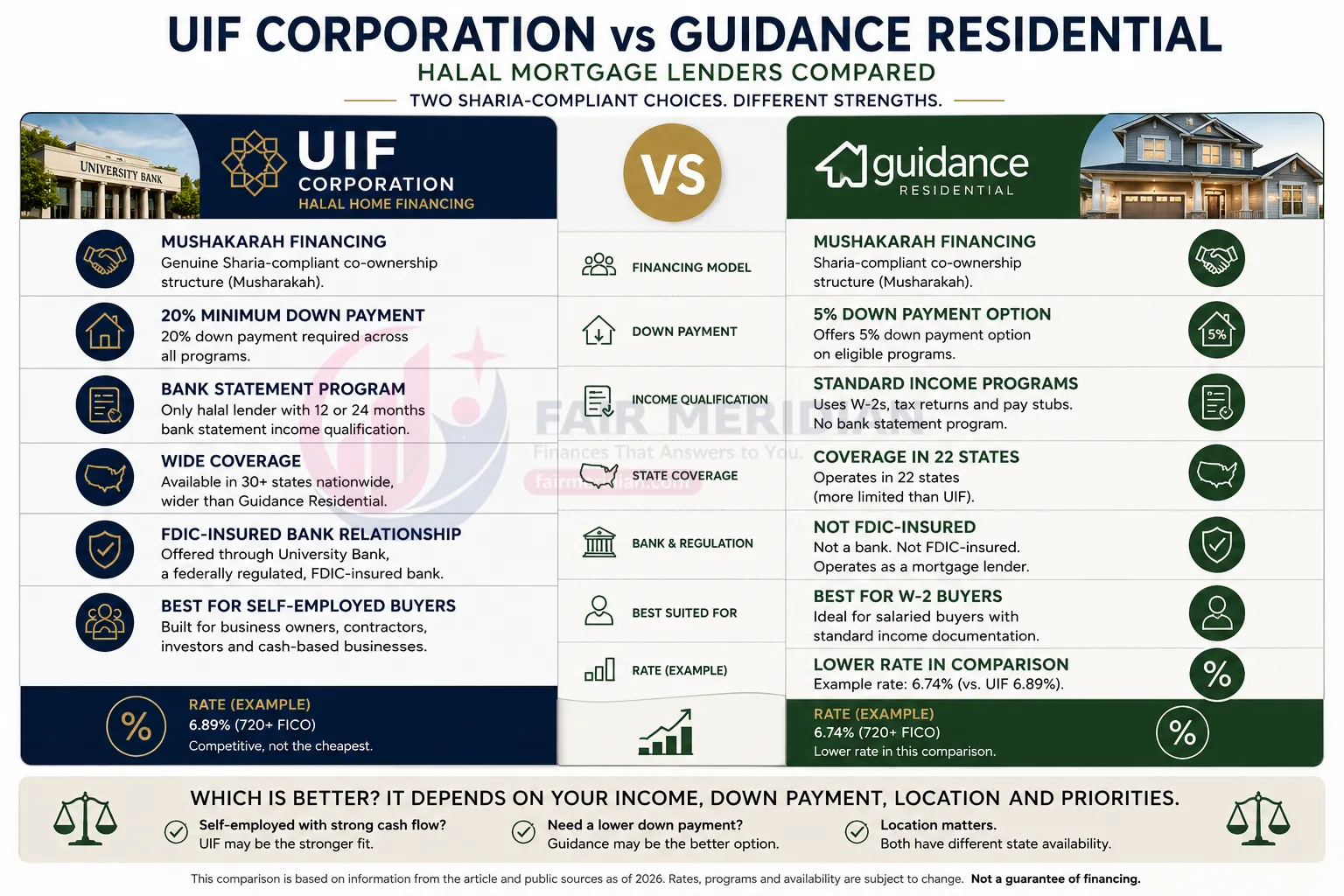
UIF vs Guidance Residential — The Decision Framework
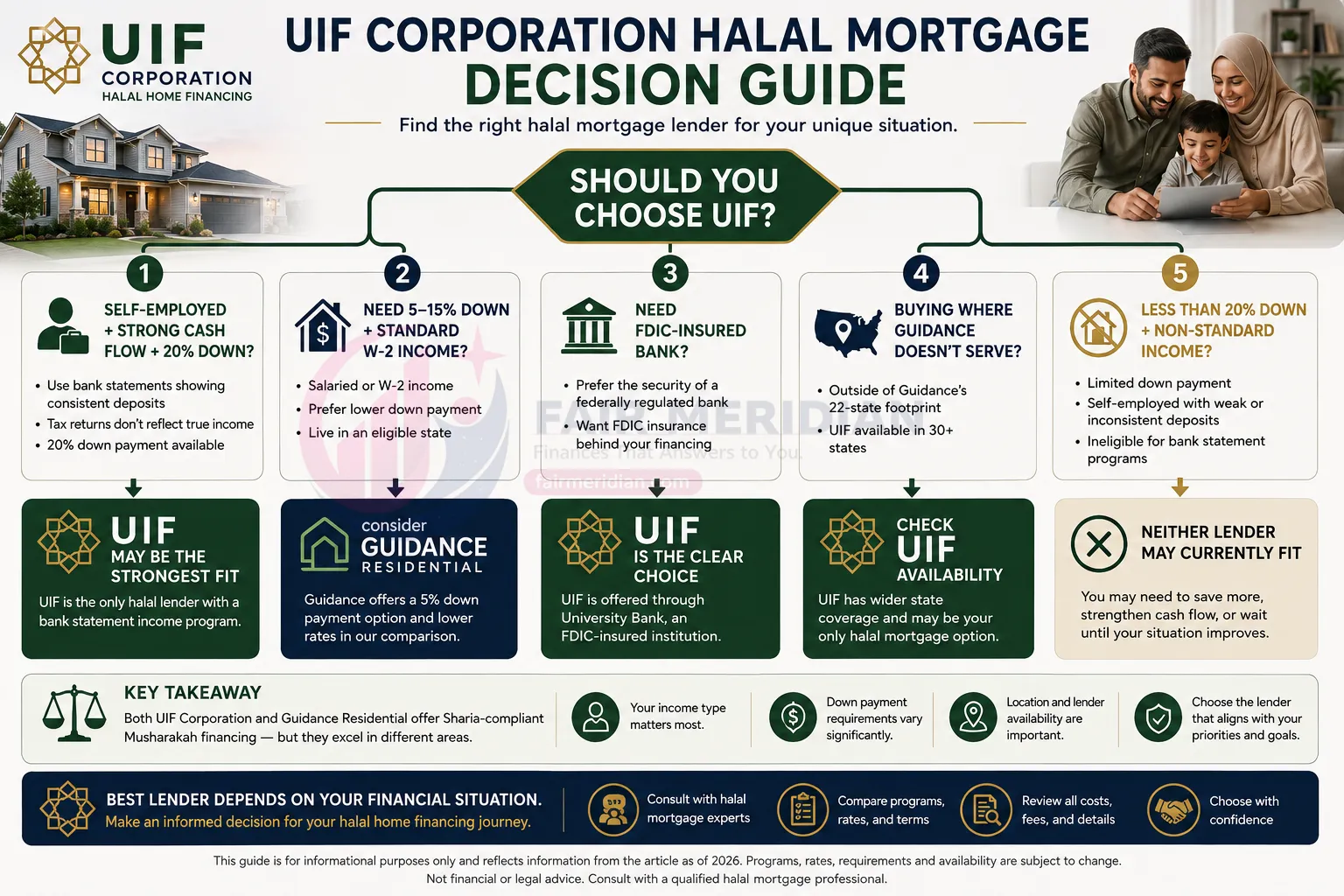
Your Situation | Choose | Why |
|---|---|---|
W-2 employee, under 20% down, state served by Guidance | Guidance Residential | Only halal 5% down option; lower rate (6.74%) |
W-2 employee, 20%+ down, rate-focused | Guidance Residential | 6.74% vs UIF's 6.89% — $30/month savings on $350K loan over 30yr = $10,800 total |
Self-employed, standard income docs won't work, 20%+ down available | UIF Corporation | Only halal lender with bank statement income program — may be your only halal path |
Want FDIC-insured bank specifically | UIF Corporation | Only FDIC-insured halal musharakah lender |
Buying in state Guidance doesn't serve | UIF Corporation | 30+ state coverage vs Guidance's 22 |
W-2 employee, Michigan, established community relationship matters | UIF or Guidance | UIF's local Michigan roots vs Guidance's lower rate — personal preference |
Self-employed but less than 20% down | Neither — save more first | UIF requires 20% minimum; Guidance 5% program requires standard income docs |
How the Process Works — Step by Step
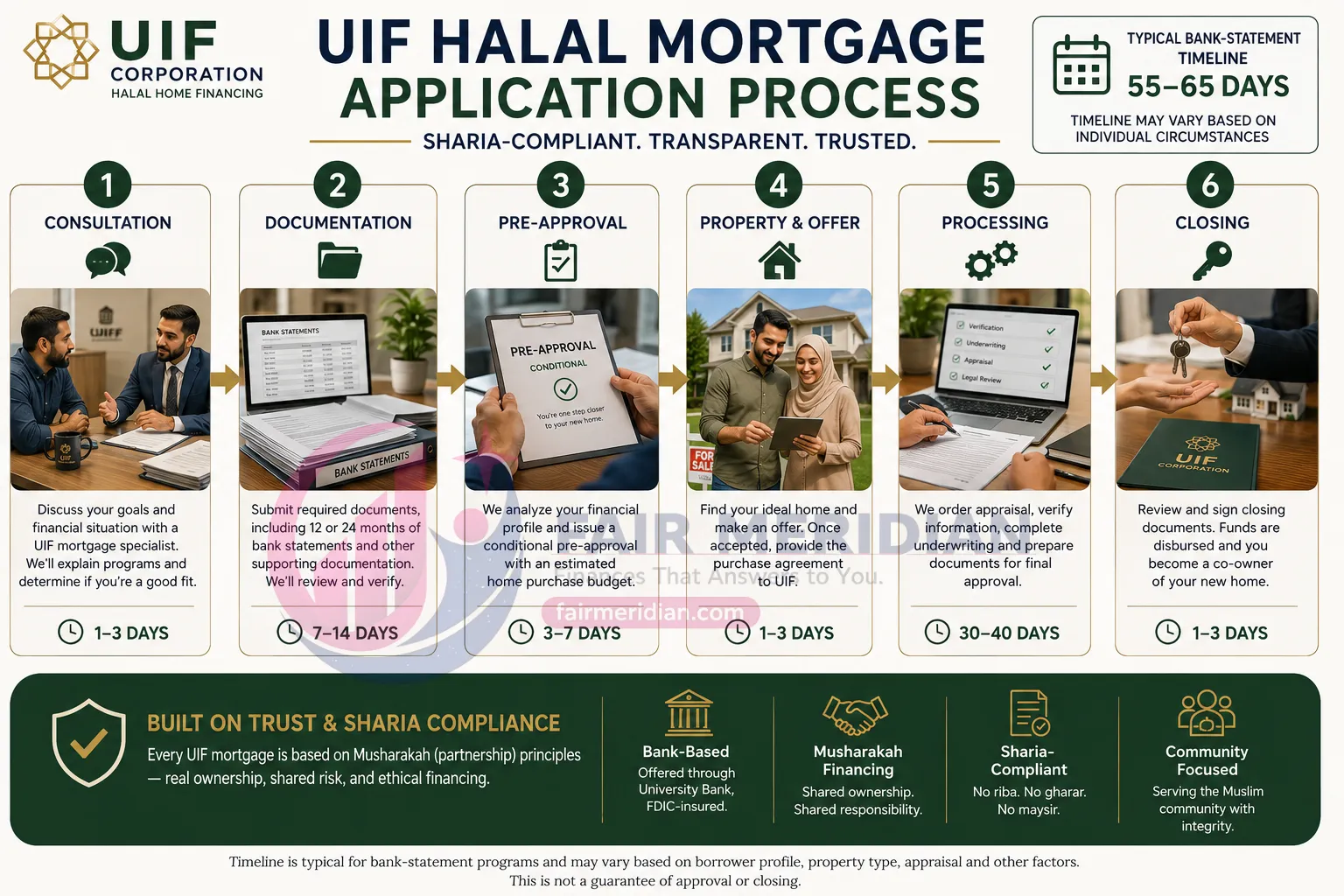
Step 1: Initial Contact and Consultation
Contact UIF through uif.com or by phone. For the bank statement program specifically, ask to speak with a loan officer who handles self-employed / alternative documentation loans — not all UIF loan officers handle the bank statement program. The initial consultation covers: income type, business structure, target property price, and down payment available.
Step 2: Gather Documentation
Standard income buyers (W-2):
Last 2 years W-2s
Most recent 2 pay stubs
2 years federal tax returns
3 months bank statements
Government ID and SSN
Bank statement program buyers:
12 or 24 months complete business bank statements (all pages, no gaps)
Business license or CPA letter confirming 2+ years of self-employment
P&L statement (may be required for some programs)
2 years personal tax returns (even though income is not taken from them)
Evidence of business ownership (LLC operating agreement, articles of incorporation)
Government ID and SSN
Down payment funds: 20% of purchase price plus closing costs documentation
Step 3: Pre-Approval
UIF processes complete applications and issues pre-approval letters typically within 7–10 business days for bank statement applications (longer than standard income due to additional verification). Request pre-approval before beginning your home search.
Step 4: Property Identification and Offer
Use your pre-approval letter when making offers. Request a 60-day closing period in your contract — bank statement applications can take 55–65 days from full documentation to closing due to the additional verification process. Sellers in Muslim community real estate markets (Dearborn, Chicago suburbs, New Jersey) are familiar with extended halal mortgage timelines.
Step 5: Processing and Closing
UIF processes the application, verifies deposits, orders appraisal, and coordinates title. All Islamic co-ownership documentation is standard across halal musharakah providers — any title company experienced with halal mortgages can close a UIF transaction. Ask UIF for title company referrals in your market.
Honest Assessment — Where UIF Excels and Where It Doesn't
Where UIF Is Genuinely the Best Option
Self-employed buyers with strong cash flow: No other halal lender in the US offers bank statement income qualification. For this buyer, UIF is not second-best — it is the only option.
State coverage gaps: For buyers in Minnesota, Oregon, Utah, Nevada, and other states not served by Guidance, UIF fills the halal musharakah gap.
FDIC preference: For buyers who specifically want a federally regulated bank, UIF delivers this alongside halal musharakah structure.
Where UIF Loses to Guidance Residential
Rate for W-2 buyers: 6.89% vs Guidance's 6.74% — $30/month more, $10,800 more over 30 years on a $350,000 loan. For a standard W-2 employee with a good credit score, Guidance is cheaper.
Down payment: No 5% option. The buyer who needs to buy with 5–15% down must use Guidance or wait. UIF is a 20%-down-or-nothing lender.
Processing timeline: Bank statement applications are slower to process — 55–65 days vs Guidance's 45–55. In competitive markets where sellers want faster closings, this can be a disadvantage.
Frequently Asked Questions
Is UIF Corporation legitimate and halal?
Yes. UIF Corporation (University Islamic Financial) is the Islamic finance division of University Bank — a federally chartered, FDIC-insured bank headquartered in Ann Arbor, Michigan. Their musharakah co-ownership product has been reviewed and approved by Freddie Mac and Fannie Mae (government-sponsored enterprises that purchase and securitize these contracts in the secondary market). UIF is NMLS-licensed and subject to state and federal mortgage regulations. Their Sharia board certifies the musharakah product independently from UIF's business operations.
What is UIF's bank statement program?
UIF's bank statement program qualifies self-employed buyers for halal home financing using 12 or 24 months of business bank statements instead of W-2s and tax returns. UIF averages monthly deposits over the statement period and applies an expense factor (typically 50% for sole proprietors) to calculate qualifying income. A buyer with average monthly business deposits of $15,000 qualifies for $7,500/month in income — regardless of what their tax return shows. This is the only such program in the US halal mortgage market.
What is UIF's minimum down payment?
20% — with no exceptions. UIF does not have a 5% or 10% down payment program for any borrower type, including bank statement income buyers. For buyers who cannot save 20% down, Guidance Residential's 5% musharakah program (for states they serve, for W-2 income buyers) is the only halal alternative.
How does UIF compare to Guidance Residential?
For W-2 employees with 20%+ down: Guidance Residential is better — lower rate (6.74% vs 6.89%), identical Sharia structure, Freddie Mac and Fannie Mae approved. For self-employed buyers with non-standard income: UIF is the only option in the halal market. For buyers in states not served by Guidance: UIF's 30+ state coverage fills the gap. For buyers who specifically want an FDIC-insured bank: UIF is the only halal musharakah provider with this status.
How long does UIF take to close?
Standard income applications: 45–55 days. Bank statement income applications: 55–65 days due to additional deposit verification and documentation review. Budget 65 days when writing your purchase contract to ensure adequate closing time, particularly if using the bank statement program.
For the complete halal mortgage rate comparison across all five providers, see our Halal Mortgage Rates USA Guide. For the Guidance Residential review covering their 5% down program and 22-state coverage, read our Guidance Residential 2026 Review. Use our Halal Mortgage Calculator to model your specific home price at UIF's current 6.89% rate.