Microsoft is one of the most widely held stocks in the world, and for Muslim investors the question of whether it's halal comes up constantly — particularly for anyone who receives Microsoft RSUs through their employer, holds a 401k with tech exposure, or wants to know what they actually own inside SPUS. The short answer: Microsoft passes every quantitative Sharia screen with comfortable margins, carries a minor purification obligation, and has one qualitative concern — LinkedIn's advertising platform — that's worth understanding even though it doesn't change the verdict. This post goes through all of it with actual numbers, not reassuring generalities.
What Microsoft Actually Does — The Revenue Picture
Microsoft's business in 2026 is really three things operating under one company. Intelligent Cloud — Azure, SQL Server, cloud infrastructure — is the largest and fastest growing segment, generating approximately $130 billion annually and accelerating due to AI-driven demand. Productivity and Business Processes covers Office 365, Teams, LinkedIn, and Dynamics 365 — roughly $80 billion. More Personal Computing covers Windows licensing, Xbox, Surface hardware, Bing advertising, and gaming — approximately $60 billion. Total revenue: approximately $270 billion in FY2025.
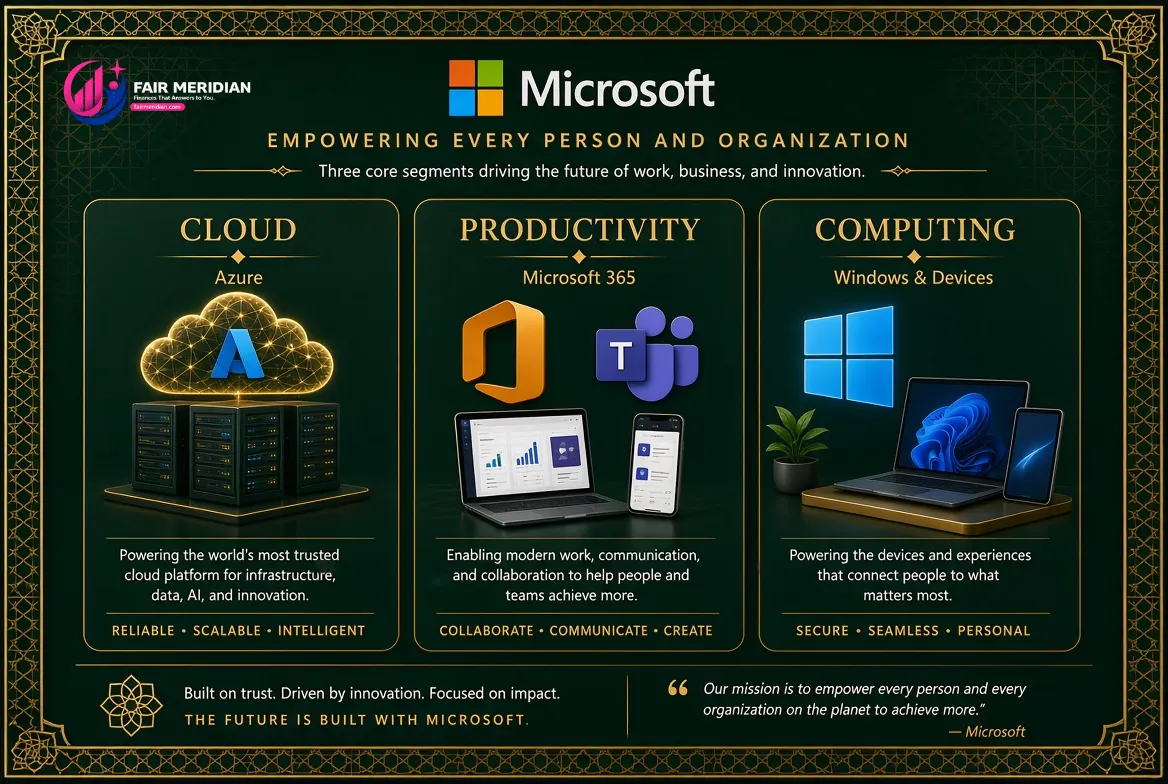
The core of Microsoft's business — cloud computing, productivity software, operating systems, developer tools — is entirely permissible under Islamic commercial law. There is no riba mechanism in Azure, no maysir in Office 365, no prohibited goods in Windows licensing. The business activity concern, if any exists, lives in two specific places: LinkedIn and the interest generated by Microsoft's enormous cash reserves.
The LinkedIn Question — The Only Real Business Activity Concern
LinkedIn is Microsoft's professional networking platform with over a billion members globally. It generates revenue through subscriptions (LinkedIn Premium, Recruiter, Sales Navigator) and advertising. The advertising platform shows sponsored content and display ads to LinkedIn's professional audience — and some of those ads are placed by alcohol brands, conventional financial institutions promoting interest-bearing products, and other advertisers whose underlying businesses Islamic law considers problematic.
This is a facilitation (i'anah) concern, not a direct prohibition. Microsoft doesn't sell alcohol or charge interest — it provides an advertising platform that some prohibited businesses use to reach customers. The question scholars apply is: what percentage of revenue comes from facilitating prohibited activity?
LinkedIn's total revenue is approximately $16–17 billion annually. The advertising portion is roughly half of that — around $8 billion. Of that advertising revenue, the fraction attributable to prohibited categories (alcohol brands, conventional lending, gambling) is a subset of a subset. Conservative estimates put the prohibited facilitation revenue from LinkedIn advertising at well under 1% of Microsoft's total $270 billion. By the standard AAOIFI-aligned threshold of 5%, this passes with significant room to spare.
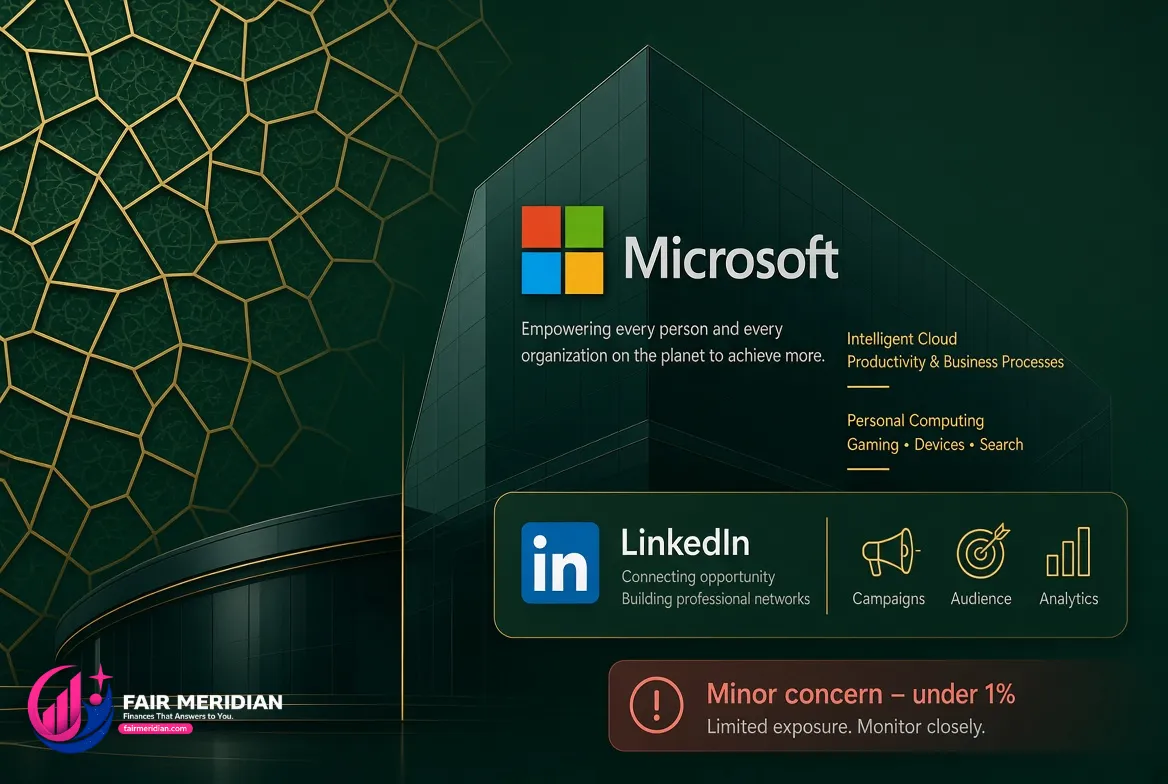
The honest qualitative note: LinkedIn's facilitation concern is more intentional than incidental. Unlike Amazon, which incidentally lists some prohibited products alongside millions of permissible ones, LinkedIn actively courts alcohol and finance advertisers as a business category. This doesn't change the quantitative outcome — the numbers are well under threshold — but it's worth knowing before you decide this is a holding you're comfortable with long-term.
Microsoft's OpenAI Investment — Does It Create a Concern?
Microsoft has made substantial investments in OpenAI — the company behind ChatGPT — and integrates OpenAI's models throughout its products as Microsoft Copilot. Some Muslim investors have asked whether this investment creates a Sharia concern.
The answer is no. OpenAI develops AI models and software — a permissible technology business. The fact that some users use AI for impermissible purposes doesn't make the underlying technology haram, for the same reason that Microsoft Word being used to write impermissible content doesn't make Office 365 haram. Technology is a neutral tool; its permissibility is assessed at the level of the technology provider's business model, not the end use of every customer. OpenAI's business model — building and licensing AI models — contains no prohibited element under Islamic commercial law.
Financial Ratio Screen — All Three Tests with FY2025 Numbers
Test 1: Debt-to-Asset Ratio — Must Be Under 33%
Microsoft carries approximately $45–50 billion in long-term debt on a total asset base of approximately $500–520 billion. That puts the debt-to-asset ratio at roughly 9–10%. This is one of the lowest among major US technology companies and represents a clear pass with more than three times the margin to threshold. Microsoft's extraordinary cash generation means it hasn't needed to lever up meaningfully despite major acquisitions like Activision Blizzard.
Test 2: Interest Income — Must Be Under 5% of Revenue
Microsoft holds approximately $80 billion in cash and short-term investments. At current short-term interest rates of around 4.5–5%, this generates approximately $3.5–4 billion in annual interest income. On total revenue of roughly $270 billion, that's approximately 1.3–1.5% — comfortably below the 5% threshold and actually lower than Nvidia's ratio on a percentage basis despite Microsoft's larger absolute cash position.
The monitoring note here is worth stating: Microsoft is generating extraordinary free cash flow — approximately $70 billion annually in FY2025 — and the cash pile is growing. If Microsoft's cash grows to $120–130 billion while revenue doesn't keep pace, the interest income ratio could approach 2.5–3%. Still below 5%, but the trend is worth watching annually through Zoya's updated screening reports.
Test 3: Cash + Receivables — Must Be Under 50% of Assets
Cash and short-term investments (~$80B) plus accounts receivable (~$55–60B) gives approximately $135–140 billion. Against total assets of ~$510 billion, that's roughly 26–27%. This passes with significant headroom — Microsoft's asset base is heavy with goodwill and intangibles from acquisitions (Activision, LinkedIn, GitHub) which reduces the cash + receivables percentage as a proportion of total assets.
Summary of All Three Screens
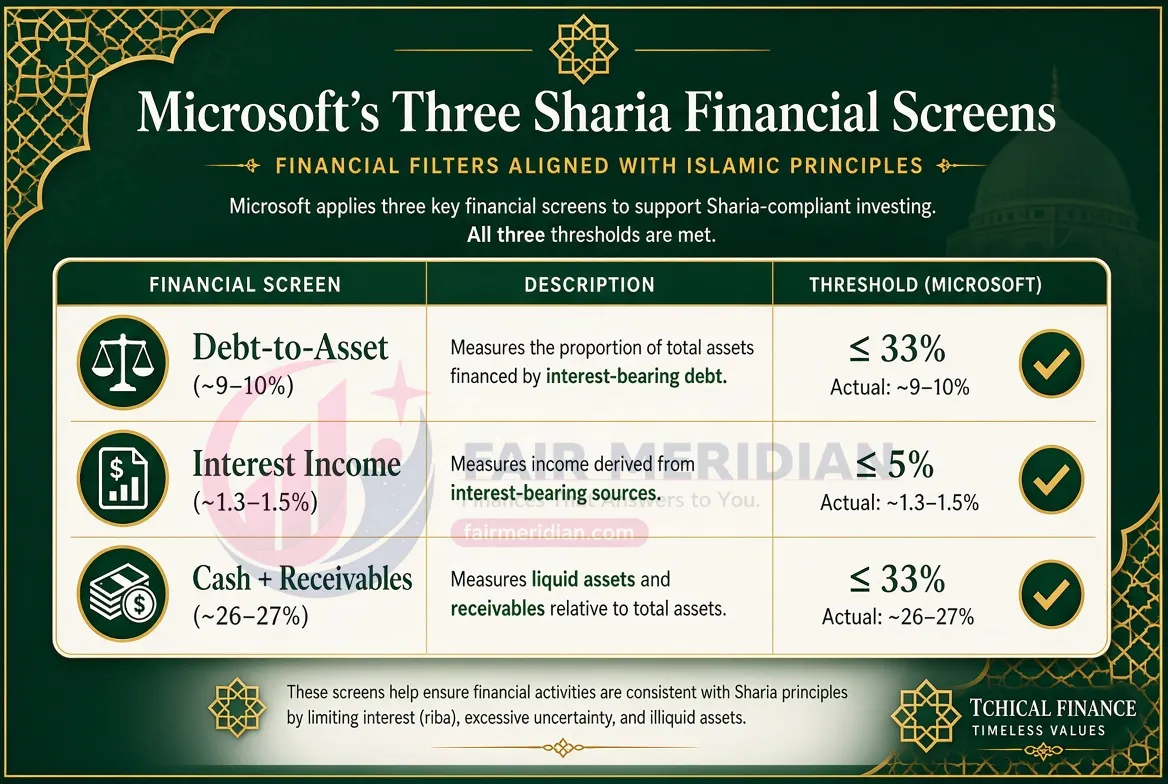
Screen | Microsoft (FY2025 est.) | Threshold | Result |
|---|---|---|---|
Debt-to-Asset Ratio | ~9–10% | Under 33% | ✅ Pass — wide margin |
Interest Income / Revenue | ~1.3–1.5% | Under 5% | ✅ Pass — monitor trajectory |
Cash + Receivables / Assets | ~26–27% | Under 50% | ✅ Pass — comfortable margin |
Business activity (core) | Cloud, software, productivity | No prohibited primary business | ✅ Pass |
LinkedIn advertising facilitation | Under 1% of revenue | Under 5% threshold | ✅ Pass (qualitative note) |
Is Microsoft in SPUS? The Institutional Confirmation
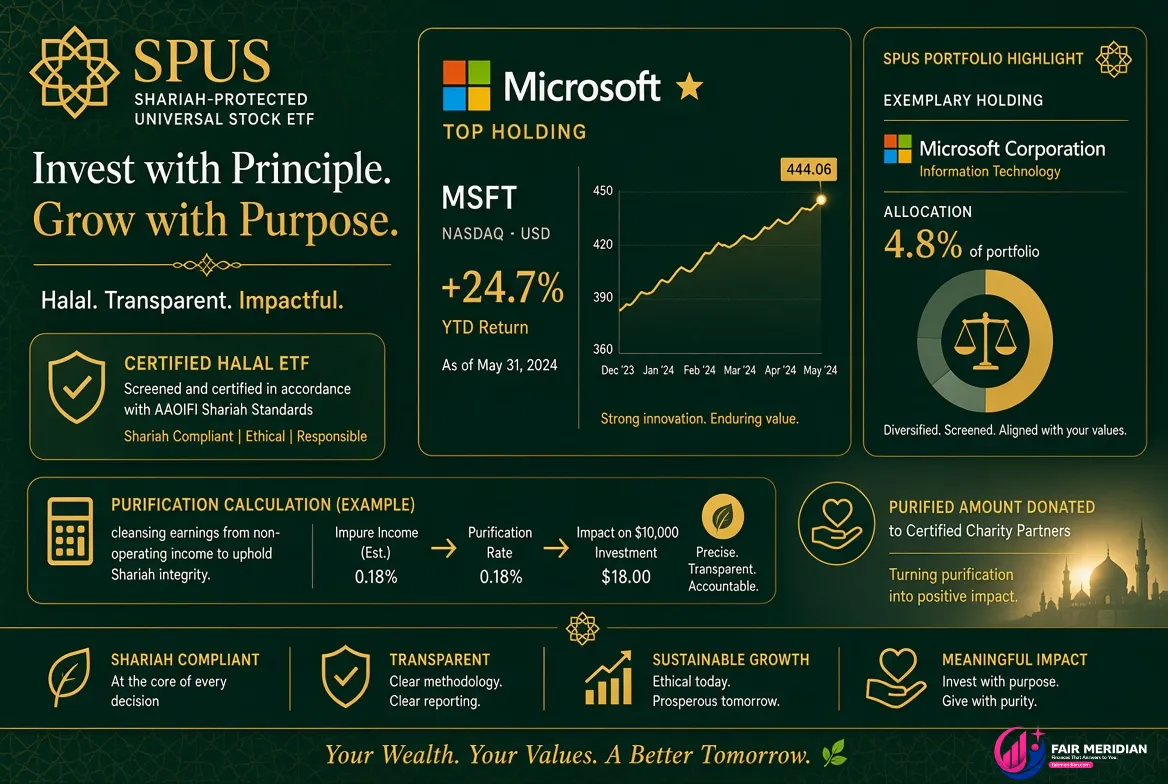
Yes — and by a significant margin. Microsoft (MSFT) is SPUS's second-largest holding at approximately 8.9% of the fund's portfolio as of May 2026. Only Nvidia is comparable in weight. Ratings Intelligence Partners, the independent Sharia supervisory board that certifies SPUS, has reviewed Microsoft's complete business activities and financial ratios on a quarterly basis and has maintained certification continuously.
If you hold SPUS in your Roth IRA — the recommended halal investing setup for most US Muslims — you already own approximately 8.9% Microsoft exposure within a fully certified halal portfolio. The question of whether to buy Microsoft individually is separate from the Sharia question: it's whether you want additional concentration on top of your SPUS position, not whether it's permissible to own.
HLAL (Wahed FTSE USA Shariah ETF) also holds Microsoft prominently, providing a second institutional Sharia certification from a different supervisory board (Amanie Advisors). When two independently operated halal ETFs with different Sharia boards both hold the same stock, that's meaningful external validation.
How Microsoft Compares to the Other Major Tech Stocks
This is the context that helps Muslim investors calibrate their portfolio decisions. Microsoft sits clearly in the permissible tier but with different characteristics than its peers.
Company | Debt/Assets | Interest Income % | Cash+Rec % | Main Concern | In SPUS? | Verdict |
|---|---|---|---|---|---|---|
Nvidia | ~7.6% | ~1.1–1.5% | ~46% | Cash pile ratio (monitor) | ✅ ~7.4% | ✅ Clearest halal |
Microsoft | ~9–10% | ~1.3–1.5% | ~27% | LinkedIn ads (minor) | ✅ ~8.9% | ✅ Halal |
Apple | ~28.8% | ~0.95% | ~29% | Apple Card facilitation | ✅ ~9.8% | ✅ Halal |
Amazon | ~29.5% | ~0.70% | ~33% | Amazon Lending; Prime content | ✅ ~2.8% | ✅ Halal (passes at threshold) |
Tesla | ~6.7% | ~1.4% | ~34% | Tesla Insurance (~0.7% rev) | ✅ ~2.9% | ✅ Halal |
Microsoft's profile is notably cleaner than Apple's on the debt ratio (9–10% vs 28.8%) and cleaner than Amazon's on the interest income ratio. Its LinkedIn advertising concern is more direct than Apple's App Store facilitation concern but similar in scale and outcome. Among the five major tech stocks, Microsoft and Nvidia are the two with the strongest combined screening profiles.
Purification Amount and What to Do With It
No investment in a publicly traded company is completely free of incidental prohibited income — even the cleanest companies hold cash that earns interest and may have negligible business activities in borderline categories. The purification obligation addresses this.
For Microsoft, the estimated annual purification amount is approximately $0.15–$0.25 per share based on interest income as a percentage of revenue (~1.3–1.5%) applied to the share price. Verify this through Zoya (zoya.finance) after each Microsoft fiscal year close — they publish per-share purification amounts for screened stocks. On a $450 Microsoft share, this is approximately $0.67–$1.13 in annual purification — roughly 0.15–0.25% of share value.
Donate the total annual purification amount to any charity. It doesn't need to go to an Islamic charity specifically — any permissible charitable cause fulfills the purification obligation.
Frequently Asked Questions
Is Microsoft stock halal?
Yes. Microsoft passes all three AAOIFI-aligned financial ratio screens — debt-to-asset ratio (~9–10%), interest income ratio (~1.3–1.5%), and cash plus receivables ratio (~26–27%) — with significant margin on each. The business activity screen passes because Microsoft's primary revenue comes from cloud computing, productivity software, and operating systems, all of which are permissible. LinkedIn's advertising platform creates a minor facilitation concern estimated at under 1% of Microsoft's total revenue — well within the 5% tolerance threshold. Microsoft is SPUS's second-largest holding at approximately 8.9%, certified by Ratings Intelligence Partners.
Is Microsoft in SPUS?
Yes — Microsoft (MSFT) is SPUS's second-largest holding at approximately 8.9% of the fund as of May 2026. HLAL also holds Microsoft prominently. Any investor holding SPUS in their Roth IRA already has significant Microsoft exposure within a fully certified halal portfolio.
Is LinkedIn haram for Muslim investors in Microsoft?
LinkedIn doesn't make Microsoft haram. The concern is that LinkedIn's advertising platform is used by some alcohol brands and conventional financial institutions — creating a facilitation (i'anah) concern. However, the revenue attributable to prohibited advertisers represents well under 1% of Microsoft's total revenue — comfortably below the 5% threshold used in AAOIFI-aligned screening. LinkedIn's primary revenue comes from professional subscriptions (Premium, Recruiter, Sales Navigator), which are entirely permissible. The facilitation concern is real but proportionally small.
Is Microsoft's OpenAI investment haram?
No. OpenAI develops artificial intelligence models — a permissible technology business. Microsoft's investment in and integration of OpenAI's models through Microsoft Copilot doesn't create a Sharia concern. The AI technology itself is neutral; its permissibility is assessed at the provider level, not based on how every end user applies it. OpenAI's business model contains no prohibited element under Islamic commercial law.
Is Microsoft better than Apple for halal investing?
Both are halal, but they screen differently on specific metrics. Microsoft has a significantly lower debt-to-asset ratio (~9–10% vs Apple's ~28.8%), meaning it's further from the 33% threshold on the debt screen. Apple has a slightly lower interest income ratio (~0.95% vs Microsoft's ~1.3–1.5%). Apple's main concern is Apple Card facilitation; Microsoft's is LinkedIn advertising. Neither concern changes the verdict for either stock — both pass. For a Muslim investor who wants the cleanest possible screening profile, Microsoft's debt ratio advantage is meaningful. For someone who holds both through SPUS, the distinction is academic.
What is Microsoft's purification amount for 2025?
Approximately $0.15–$0.25 per share annually, based on Microsoft's interest income as a percentage of total revenue (~1.3–1.5%). On a $450 share price, this represents approximately 0.15–0.25% of share value. Verify the exact current figure on Zoya (zoya.finance) after each Microsoft fiscal year close — July, typically — as they publish updated per-share purification amounts for all screened stocks.
For the complete halal tech stock comparison including Nvidia, Apple, Amazon, and Tesla, see our individual stock analysis posts. For the best way to hold Microsoft in a halal, tax-efficient structure, read our Halal Roth IRA Setup Guide — SPUS in a Roth IRA gives you ~8.9% Microsoft exposure within a fully certified halal portfolio at 0.49% annual fee. For the full halal ETF comparison including SPUS and HLAL, see our Halal ETFs Guide 2026.