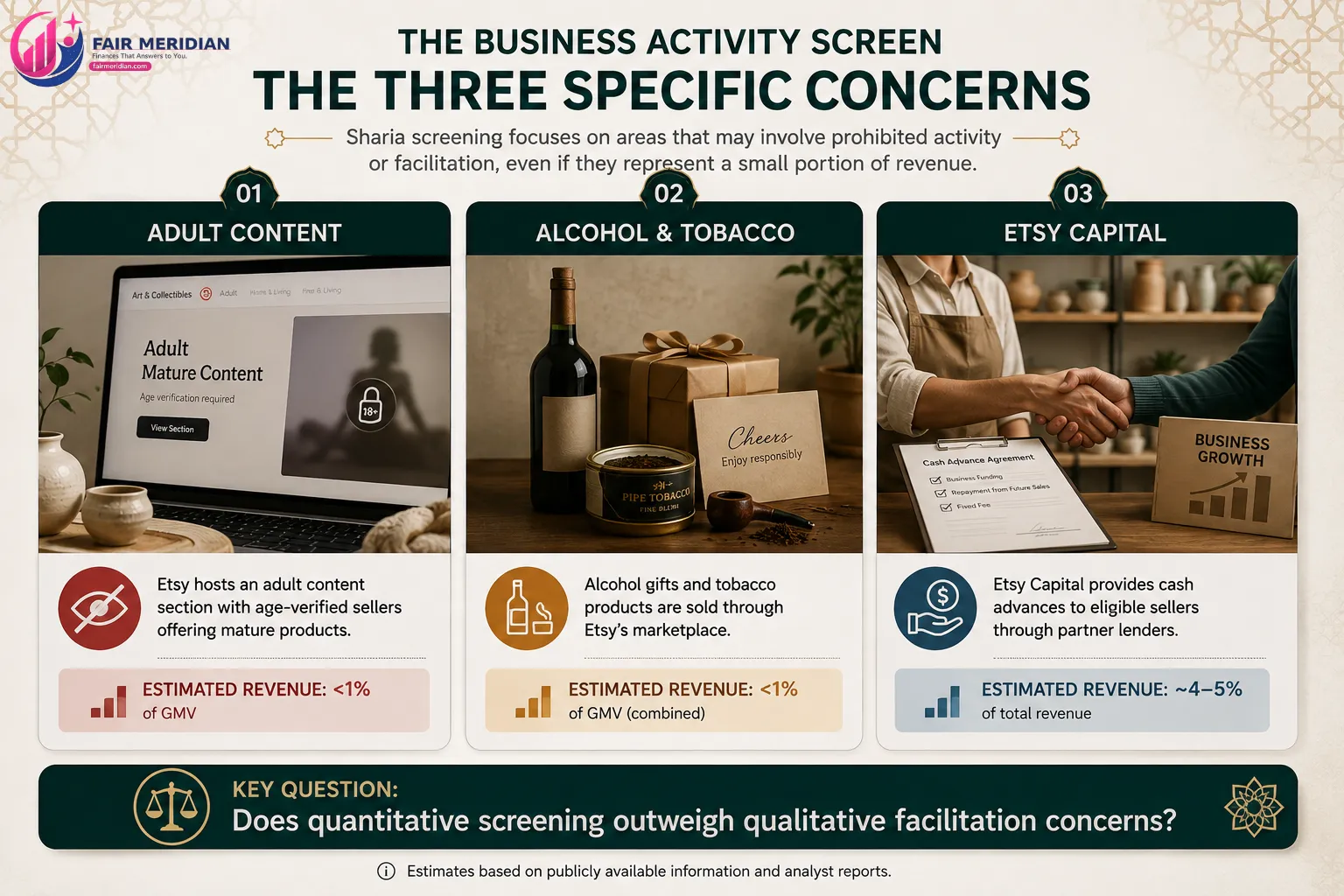
Etsy (ETSY) is not a simple halal or haram verdict. The business model is structurally one of the cleanest in e-commerce — a marketplace that earns transaction fees, not a lender. The financial ratio screens pass comfortably. But three specific features of Etsy's business create genuine questions that deserve honest examination: adult content hosted on the platform, alcohol and tobacco products sold through its marketplace, and Etsy Capital's seller cash advance program. This post applies the same methodology used for Apple, Nvidia, and Amazon to Etsy — with the same honesty about what passes, what doesn't, and what remains genuinely uncertain.
Quick Verdict
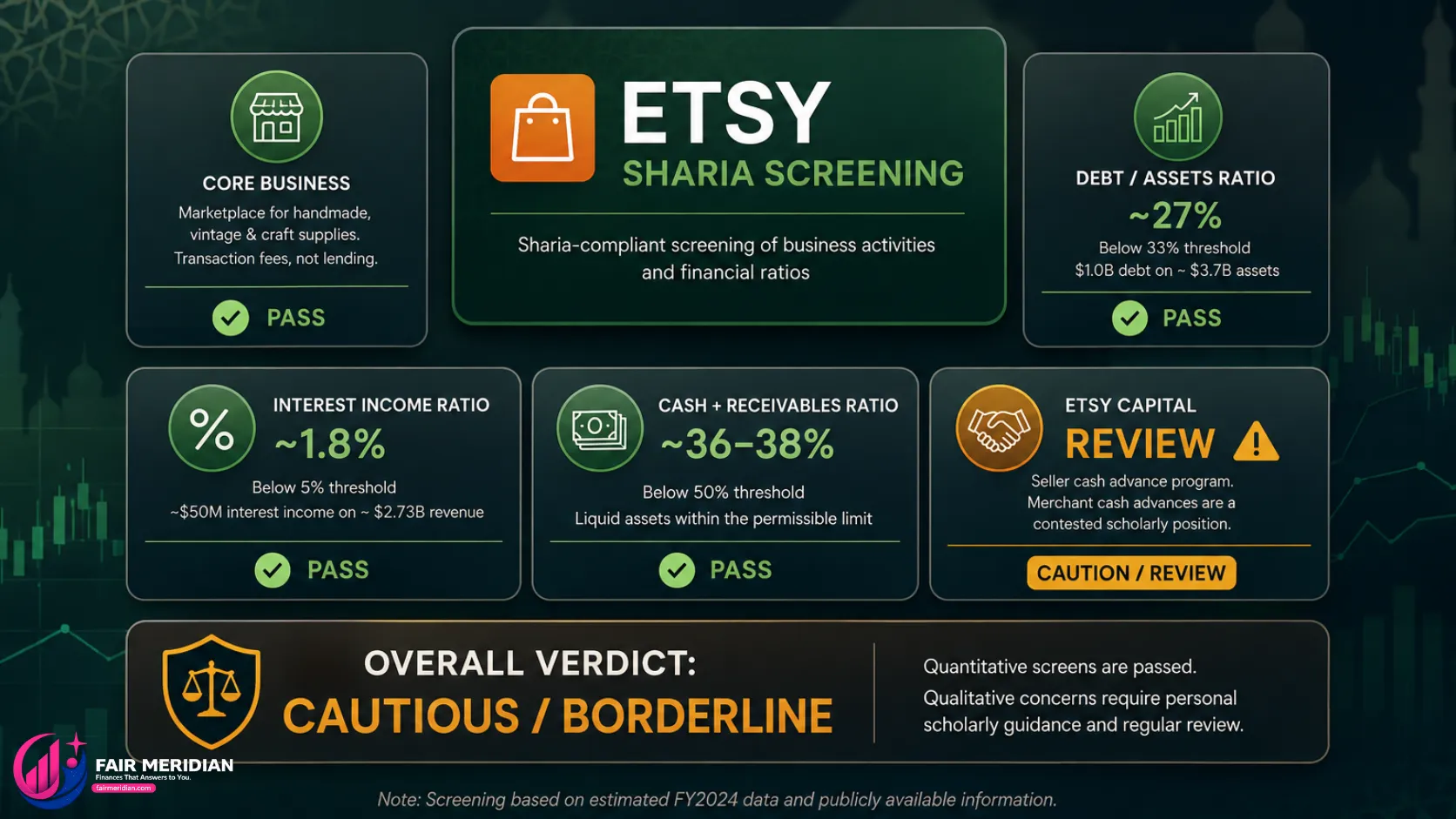
Screen | Result | Detail |
|---|---|---|
Core business activity | ✅ Pass | Marketplace for handmade, vintage, craft supplies — entirely permissible core business |
Adult content facilitation | ⚠️ Concern (quantitatively minor) | Etsy hosts an adult content section; estimated under 2% of GMV; below 5% threshold but real facilitation concern |
Alcohol / tobacco on platform | ⚠️ Concern (quantitatively minor) | Alcohol gifts and tobacco products sold through Etsy; estimated under 2% of GMV combined |
Etsy Capital seller advances | ⚠️ Concern (small % revenue) | Cash advance program for sellers; merchant cash advances occupy a contested scholarly position |
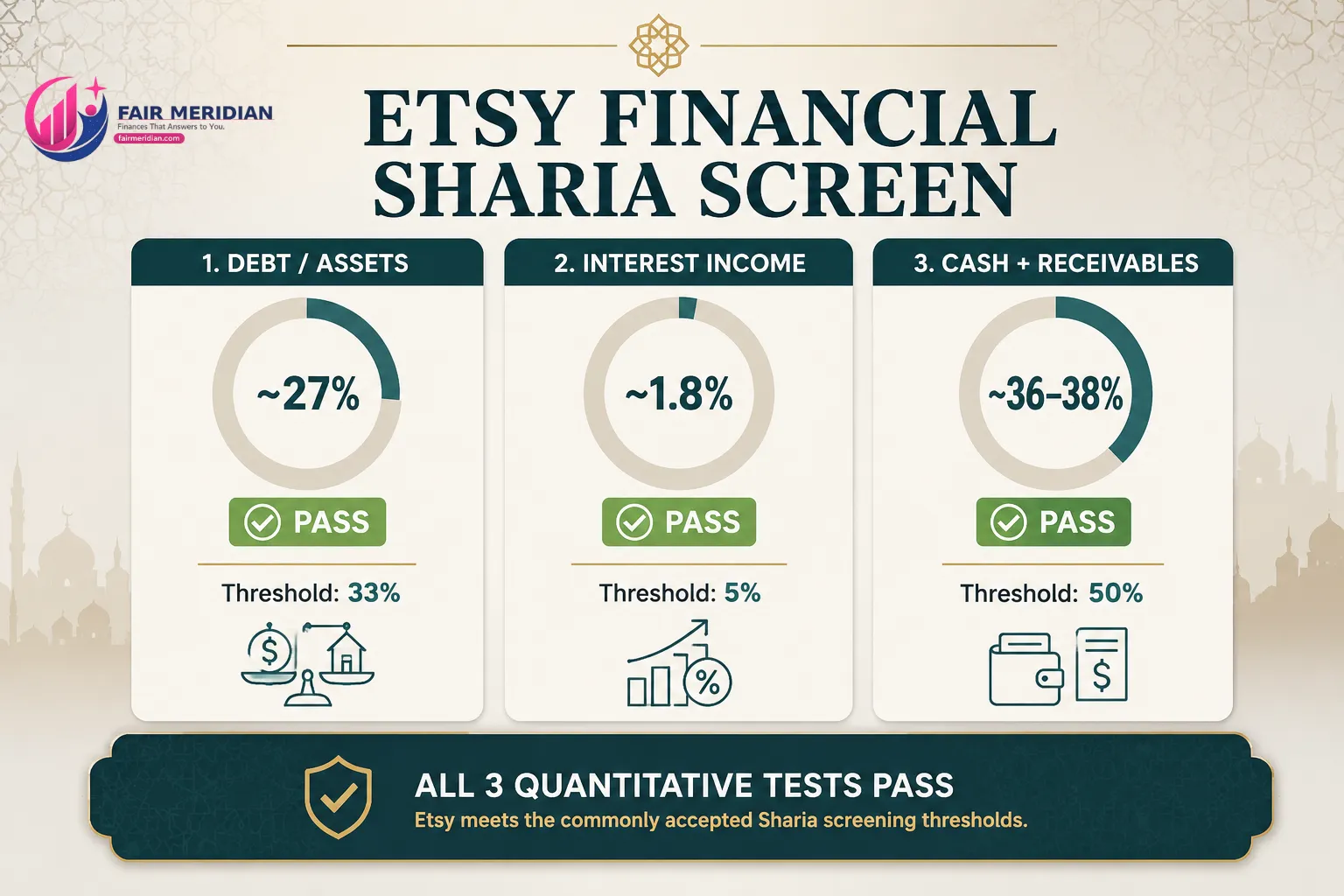
Debt-to-asset ratio | ✅ Pass (~27%) | Under 33% threshold; $1.0B debt on ~$3.7B assets |
Interest income ratio | ✅ Pass (~1.8%) | ~$50M interest income on ~$2.73B revenue; well under 5% threshold |
Cash + receivables ratio | ✅ Pass (~36–38%) | Under 50% threshold |
In SPUS? | ⚠️ No | Etsy is not currently in the S&P 500 (removed 2024); therefore not in SPUS |
Zoya verdict (May 2026) | ⚠️ Check Zoya directly | Screening outcome depends on current revenue composition and Etsy Capital treatment; verify at zoya.finance |
Overall | ⚠️ Cautious / Borderline | Passes quantitative screens; qualitative concerns require personal scholarly guidance |
What Etsy Actually Does — Revenue Breakdown
Understanding Etsy's verdict requires understanding how it makes money — because the three concerns above all represent small slices of a larger business that is overwhelmingly permissible.
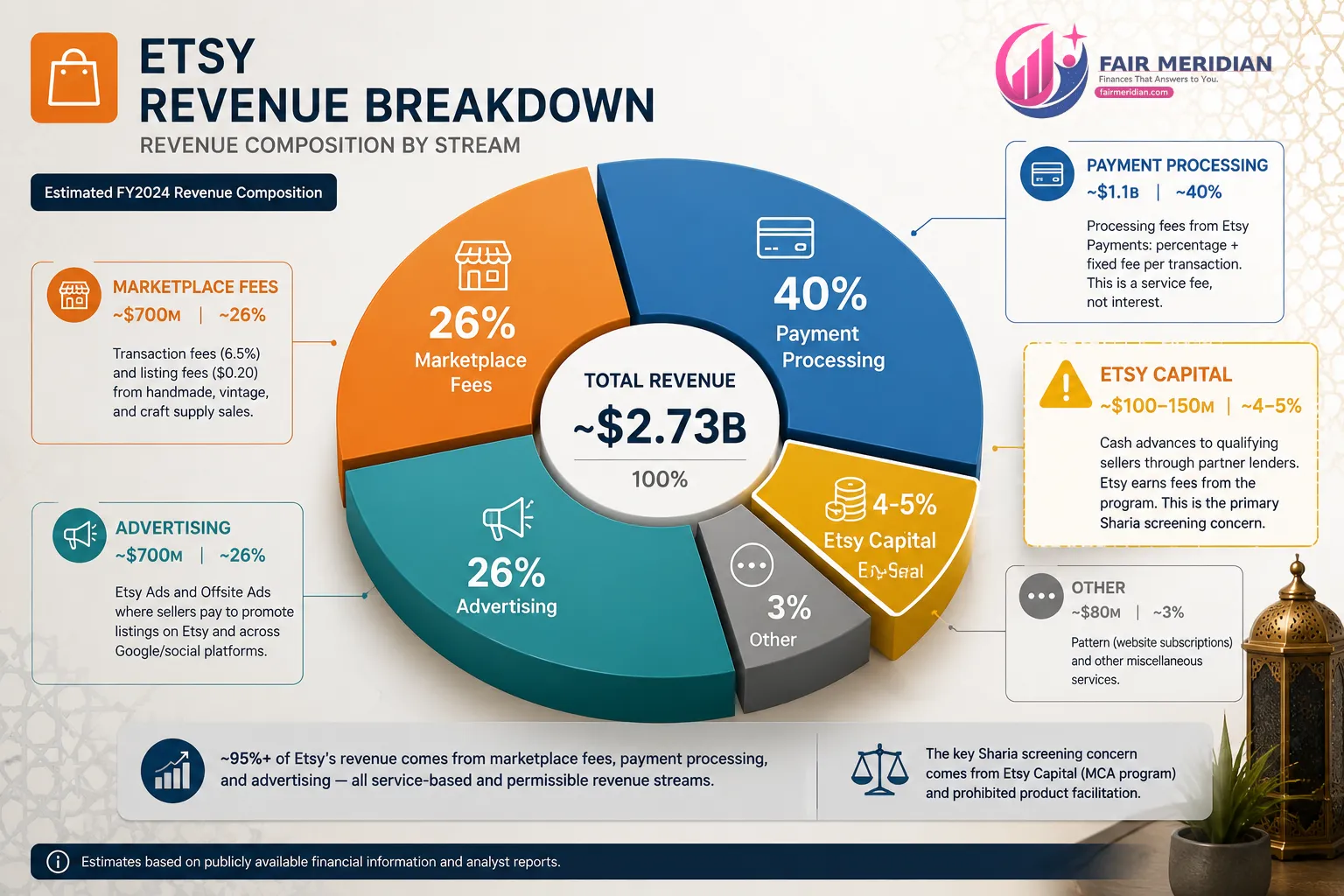
Revenue Stream | FY2024 (Est.) | % of Revenue | Activity | Halal? |
|---|---|---|---|---|
Marketplace fees (transaction + listing) | ~$700M | ~26% | 6.5% transaction fee + $0.20 listing fee on handmade, vintage, craft supply sales | ✅ |
Payment processing (Etsy Payments) | ~$1.1B | ~40% | Percentage + fixed fee per transaction processed through Etsy Payments — a service fee, not interest | ✅ |
Advertising (Etsy Ads + Offsite Ads) | ~$700M | ~26% | Sellers pay to promote listings on Etsy and across Google/social platforms | ✅ (ads for permissible goods) |
Etsy Capital (seller cash advances) | ~$100–150M | ~4–5% | Cash advances to qualifying sellers through partner lenders; Etsy earns fees from the program | ⚠️ Contested |
Other (Pattern, other subscriptions) | ~$80M | ~3% | Website subscription service (Pattern) and miscellaneous services | ✅ |
Total | ~$2.73B | 100% |
Revenue estimates based on publicly available FY2024 financials. Etsy does not break out Etsy Capital separately in most filings — estimate based on analyst reports and disclosed program details.
The structural headline: approximately 95%+ of Etsy's revenue comes from entirely permissible sources — marketplace fees, payment processing fees, and advertising. These are clean, service-based revenue streams with no riba mechanism. The questions arise in the remaining 5% and in the content policies that govern what the 95% facilitates.
The Business Activity Screen — The Three Specific Concerns
Concern 1: Adult Content on Etsy
Etsy maintains an adult-only section of its marketplace where age-verified sellers can list mature content — adult art, adult novelty items, and other 18+ products. Etsy earns its standard transaction and payment processing fees from these sales. This creates a facilitation (i'anah) concern: Etsy's platform infrastructure enables the sale of content that Islamic law prohibits.
The quantitative test: what percentage of Etsy's GMV (Gross Merchandise Volume — total value of goods sold) comes from adult content?
Etsy's total GMV (FY2024 estimated): ~$13 billion
Adult content estimated GMV: industry analysts estimate adult content represents approximately 1–3% of Etsy's total GMV
Revenue from adult content (at ~6.5% blended fee rate): approximately $8.5M–$25M
As % of total revenue: approximately 0.3–0.9%
On quantitative grounds: this passes the 5% threshold that most AAOIFI-aligned screening methodologies apply to incidental prohibited revenue. The adult content revenue represents well under 1% of Etsy's total revenue by the best available estimates.
The qualitative concern remains: unlike Amazon, which facilitates adult content incidentally within an enormous general marketplace, Etsy maintains a dedicated adult section with active policies supporting this content. This is a deliberate business decision, not incidental. Whether deliberate facilitation of a prohibited category at under-5% revenue threshold is permissible is a question where scholars genuinely differ.
Concern 2: Alcohol and Tobacco on Etsy
Etsy permits the sale of alcohol as a gift item (wine, spirits, beer presented as experiences or gifts) and tobacco products (cigars, pipe tobacco, tobacco accessories) in markets where such sales are legal. These are clearly prohibited goods in Islamic law.
Quantitative test:
Alcohol and tobacco combined GMV estimate: approximately 0.5–1.5% of total Etsy GMV — Etsy is primarily known for handmade craft goods, not wine or tobacco, and these categories are niche within the platform
Revenue from these categories: approximately $4M–$13M
As % of total revenue: approximately 0.1–0.5%
On quantitative grounds: well under 1% of revenue — a clear pass on the 5% threshold. The concern is real but proportionally small relative to Etsy's total business.
Combined Prohibited Activity Assessment
Prohibited Category | Estimated Revenue | % of Total Revenue | 5% Threshold |
|---|---|---|---|
Adult content facilitation | $8.5M–$25M | 0.3–0.9% | ✅ Pass |
Alcohol facilitation | $4M–$10M | 0.1–0.4% | ✅ Pass |
Tobacco facilitation | $2M–$5M | 0.1–0.2% | ✅ Pass |
Total prohibited facilitation (estimated) | $15M–$40M | ~0.5–1.5% | ✅ Pass |
These are estimates based on platform composition analysis and analyst reports. Etsy does not disclose GMV by product category. Verify current figures through Zoya before making investment decisions.
Concern 3: Etsy Capital — The Most Complex Issue
Etsy Capital is a program that offers working capital to qualifying Etsy sellers. The mechanism: a seller receives a cash advance; Etsy (through partner lenders) collects repayment as a percentage of the seller's future Etsy sales until the advance plus a fixed fee is repaid.
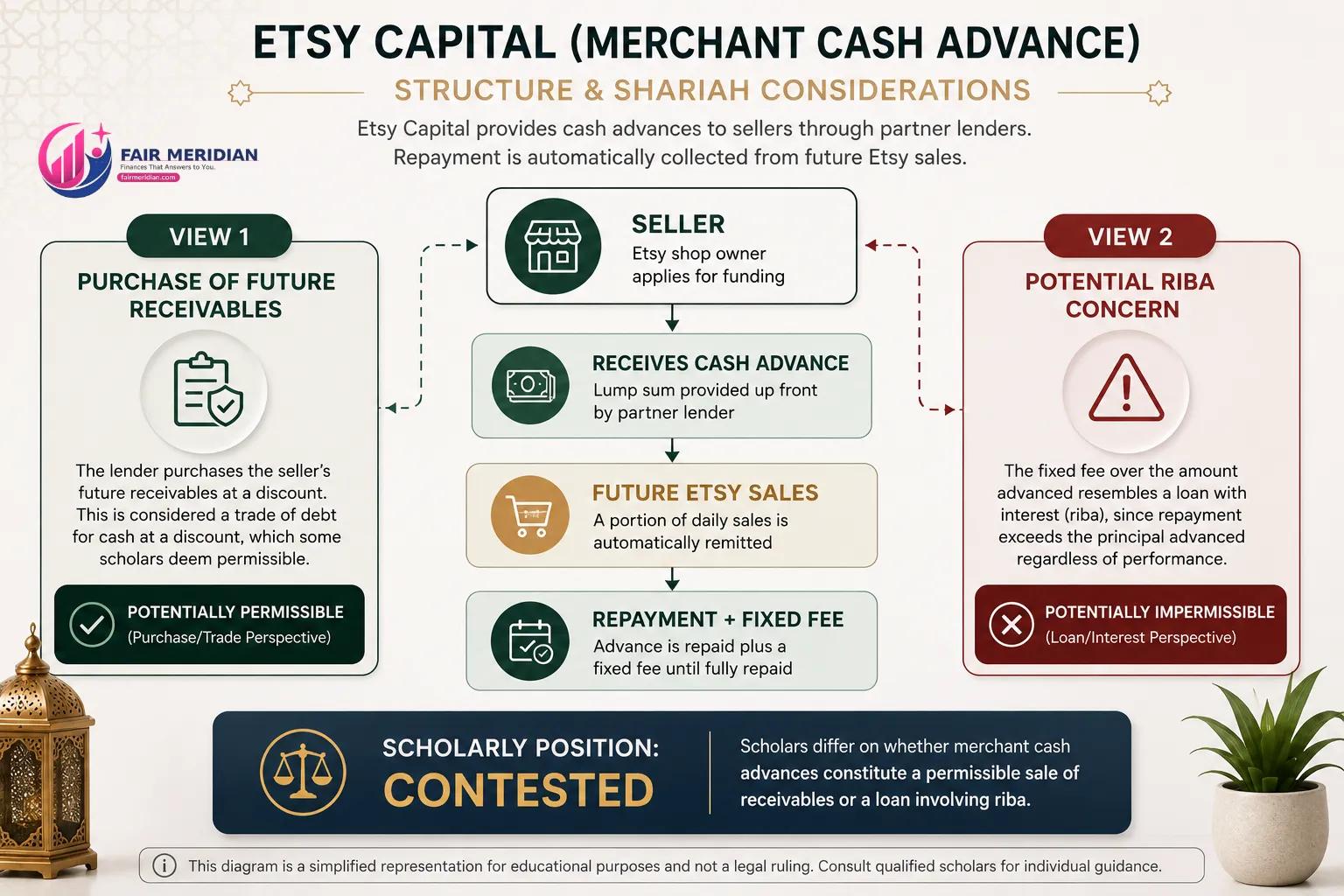
This is a merchant cash advance (MCA) — not technically a conventional interest-bearing loan. The scholarly debate on MCAs:
Position | Reasoning | Scholars / Bodies |
|---|---|---|
MCA is permissible | An MCA is a purchase of future receivables — the advance provider buys a portion of the seller's future revenue. This is a sale transaction (bay'), not a loan (qard), so the riba prohibition doesn't apply. The advance provider bears genuine risk that future sales may be lower than expected. | Some contemporary Islamic finance scholars; some AAOIFI practitioners |
MCA is effectively riba | Despite the "future receivables purchase" framing, the economic reality is: pay $X now, receive more than $X in return, regardless of form. The risk is theoretical — in practice, MCA providers set rates that ensure profitability across the portfolio. Functionally indistinguishable from lending at high interest rates. | Mufti Taqi Usmani and mainstream AAOIFI position; most Hanafi scholars |
The Etsy Capital concern has an additional dimension: Etsy itself is not the lender. Etsy partners with third-party financial companies who provide the actual capital. Etsy's revenue from Etsy Capital consists of referral fees and program fees — not the advance interest itself. Etsy's direct involvement is as a distributor and facilitator of a financial product that may itself be problematic.
This multi-layered facilitation (Etsy facilitating a lender that may be practicing riba) is treated differently by different scholars:
Stricter position: Etsy's direct facilitation of a riba-adjacent product contaminates the revenue regardless of the percentage
Majority screening position: Apply the 5% threshold — if Etsy Capital fees represent under 5% of total revenue, the overall investment passes
Etsy Capital revenue estimate: approximately $100–150M annually, or roughly 4–5% of total Etsy revenue. This places it right at the 5% screening threshold — making it the most consequential concern in Etsy's Sharia screening.
Financial Ratio Screen — All Three Tests
Test 1: Debt-to-Asset Ratio — Must Be Under 33%
Total Debt | Total Assets | Ratio | Threshold | Result |
|---|---|---|---|---|
~$1.0B (convertible notes) | ~$3.7B | ~27% | 33% | PASS ✅ |
Etsy's debt consists primarily of convertible senior notes — a standard corporate financing tool. At ~27% debt-to-assets, Etsy passes this screen with meaningful headroom. Etsy has been paying down debt and repurchasing shares as cash flow has improved.
Test 2: Interest Income — Must Be Under 5% of Revenue
Interest & Investment Income | Total Revenue | Ratio | Threshold | Result |
|---|---|---|---|---|
~$50M (est.) | ~$2.73B | ~1.8% | 5% | PASS ✅ |
Etsy holds approximately $1.0–1.1B in cash and short-term investments, earning interest on those balances. At current rates (~4.5–5%), this generates approximately $50M in annual interest income — roughly 1.8% of revenue. Well below the 5% threshold.
Test 3: Cash + Receivables — Must Be Under 50% of Assets
Cash + Investments + Receivables | Total Assets | Ratio | Threshold | Result |
|---|---|---|---|---|
~$1.35B (est.) | ~$3.7B | ~36–38% | 50% | PASS ✅ |
Etsy's total assets include significant goodwill and intangibles from past acquisitions (~$1.0–1.2B), which dilutes the cash + receivables percentage relative to total assets. The ratio passes comfortably at approximately 36–38%.
Is Etsy in SPUS?
No. Etsy (ETSY) was removed from the S&P 500 in 2024 following a significant decline in market capitalization. SPUS tracks S&P 500 constituents after Sharia screening — since Etsy is not currently in the S&P 500, it is not in SPUS regardless of its Sharia status.
The absence from SPUS removes the institutional Sharia certification that provides the strongest external validation for stocks like Nvidia and Apple. An individual investor considering Etsy must rely on Zoya's individual stock screening, their own research, or consultation with a qualified Islamic finance scholar — rather than the proxy validation that SPUS inclusion provides.
Etsy vs Amazon — The Consistency Question
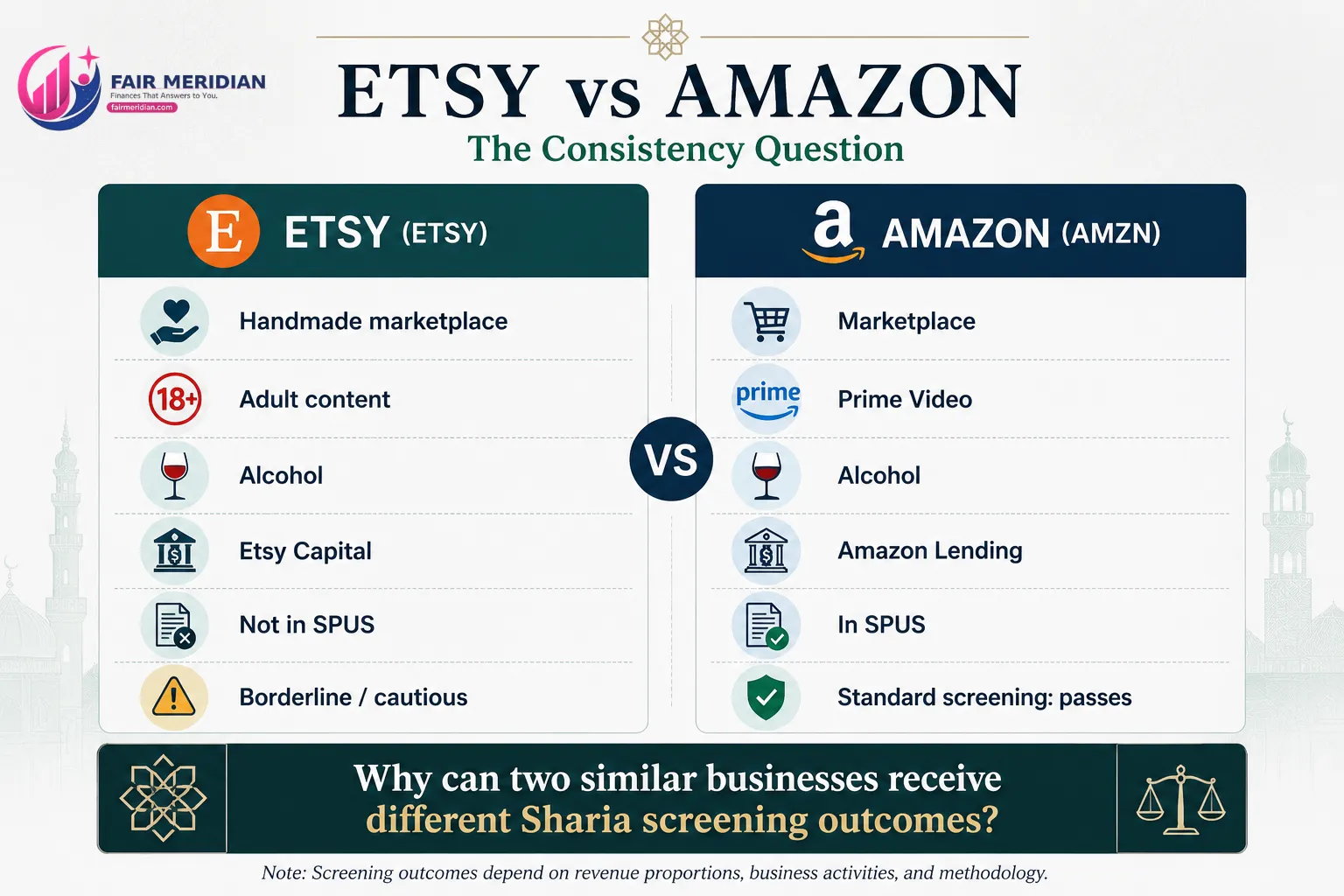
Muslim investors who pass Amazon through their halal screens need to engage with an uncomfortable consistency question: Amazon facilitates significantly more prohibited content and goods than Etsy — and yet Amazon passes standard Sharia screens while Etsy is more borderline. Why?
Factor | Etsy (ETSY) | Amazon (AMZN) |
|---|---|---|
Adult content on platform? | Yes — dedicated adult section | Yes — significant adult content through Prime Video and marketplace |
Alcohol facilitation? | Yes — alcohol gifts sold through Etsy marketplace | Yes — Amazon Fresh sells alcohol; Amazon marketplace sells liquor |
Financial products? | Etsy Capital (contested) | Amazon Lending (direct business loans — also contested) |
Prohibited % of revenue | ~0.5–1.5% (facilitation) + ~4–5% (Etsy Capital) | Amazon Lending + advertising for prohibited goods; Prime Video content |
In SPUS? | No (not in S&P 500) | Yes (~2.8% of SPUS) |
Standard screening verdict | Borderline / cautious | Halal (passes at threshold) |
The honest answer to the consistency question: Amazon passes standard Sharia screens because Amazon's lending revenue (Amazon Lending) and content revenue from prohibited categories each fall below the 5% threshold when measured against Amazon's enormous total revenue. Etsy's Etsy Capital program, at an estimated 4–5% of total revenue, sits right at the threshold where Amazon's equivalent programs are a smaller percentage.
Structurally, Etsy's core marketplace business is cleaner than Amazon's (Etsy doesn't own AWS, doesn't run advertising technology for alcohol companies, doesn't produce streaming content). The borderline nature comes specifically from Etsy Capital's proportion of revenue relative to Etsy's smaller total revenue base.
The Muslim Etsy Seller Investor — A Special Consideration
Many Muslims asking "is Etsy halal" are themselves Etsy sellers — or their spouse or family member sells halal handmade goods through Etsy. This personal connection creates a specific perspective worth addressing.
Selling on Etsy as a Muslim seller is entirely permissible — you are using Etsy's platform as a tool to sell your halal handmade goods, paying Etsy a fee for that service. The question of whether other sellers on the same platform sell prohibited goods does not affect the halal status of your own sales any more than renting a stall at a market where some other vendors sell impermissible goods would affect your own booth.
Investing in Etsy stock is a separate question. As a stock investor, you hold a proportional ownership stake in all of Etsy's business — including Etsy Capital, the adult content section, and the alcohol listings. The selling-on-Etsy analysis and the investing-in-Etsy-stock analysis use different frameworks.
The Purification Amount
For investors who hold Etsy and follow a scholarly position that it is permissible with purification:
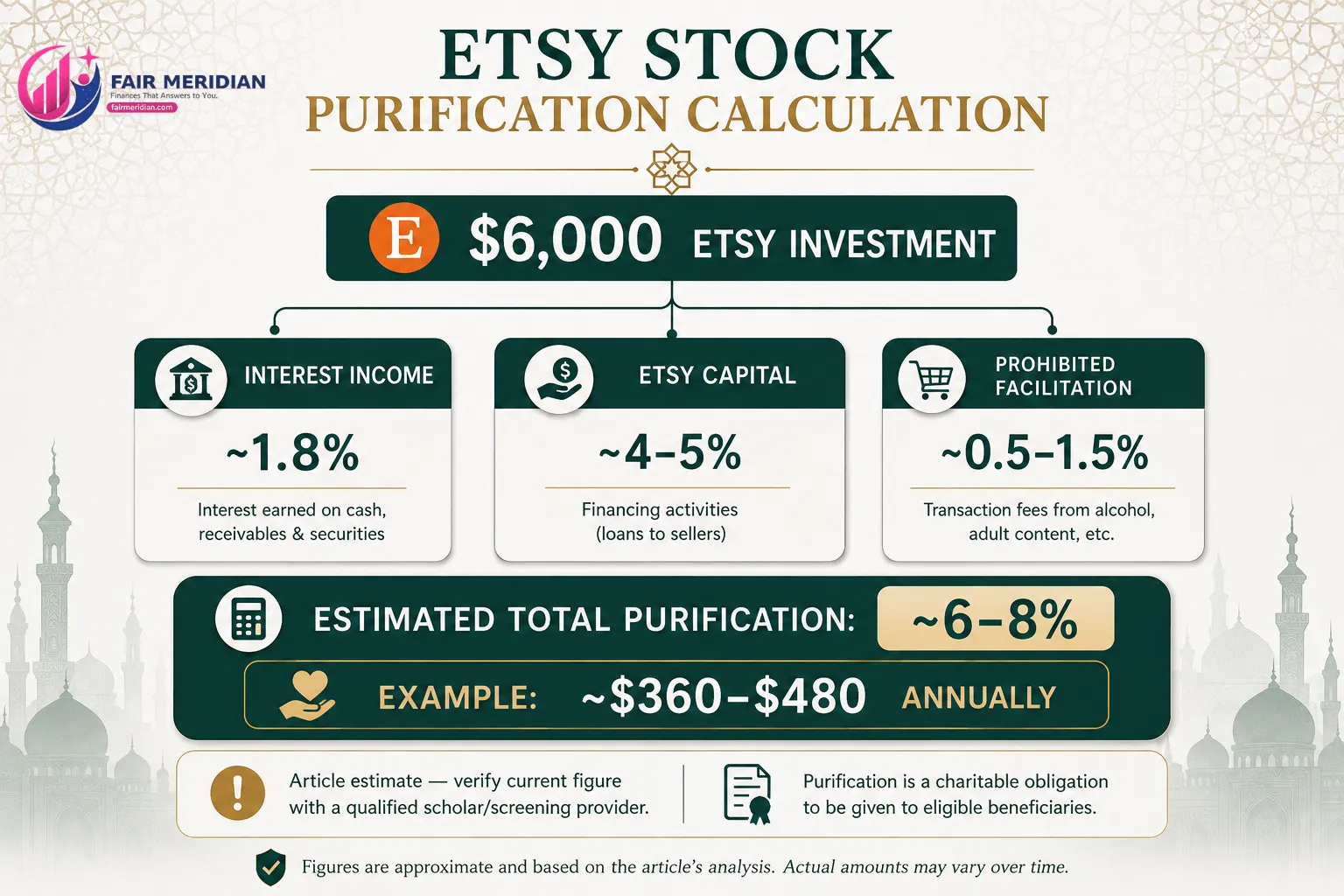
Interest income purification: At ~1.8% interest income ratio, the purification amount would be approximately 1.8% of the share's value per year. On 100 shares at $60/share ($6,000 value): approximately $108 per year in interest purification.
Etsy Capital purification: For investors whose scholar treats Etsy Capital as a purification item rather than a disqualifying activity: add approximately 4–5% of share value annually. On $6,000 position: approximately $240–$300 additional purification.
Prohibited goods facilitation: Add approximately 0.5–1.5% of share value for the adult content, alcohol, and tobacco facilitation categories.
Total purification estimate: approximately 6–8% of investment value annually — significantly higher than SPUS holdings (SPUS's annual purification is typically 0.5–2% of value). This elevated purification rate reflects the multiple overlapping concerns in Etsy's business.
Frequently Asked Questions
Is Etsy halal or haram?
Etsy occupies genuinely borderline territory in Sharia screening. The financial ratio screens (debt-to-asset ~27%, interest income ~1.8%, cash + receivables ~37%) all pass comfortably. The business activity screen passes on quantitative grounds — prohibited facilitation categories (adult content, alcohol, tobacco) are estimated at under 2% of total revenue combined. The primary concern is Etsy Capital, whose fee revenue is estimated at 4–5% of total revenue and whose merchant cash advance structure is contested among scholars. Etsy is not in the S&P 500 and therefore not in SPUS, removing the institutional certification that higher-profile stocks carry. Most screening tools will rate Etsy as requiring scrutiny rather than giving a clean verdict either way.
Is it halal to sell on Etsy?
Yes — selling halal goods on Etsy's platform is permissible. You are using Etsy as a marketplace tool, paying a fee for their service, and selling your own permissible products. The fact that Etsy also hosts other sellers selling different products does not affect the halal status of your own sales. This analysis applies to selling on Etsy; investing in Etsy stock is a separate question governed by stock screening methodology.
Does Etsy pass the AAOIFI Sharia screening criteria?
Etsy passes the three quantitative financial ratio tests in AAOIFI-aligned screening methodology. The business activity screen is more nuanced: prohibited facilitation categories appear to fall under the 5% revenue threshold on quantitative measurement. However, Etsy Capital's fee revenue at approximately 4–5% of total revenue sits at the edge of the threshold, and the merchant cash advance structure's permissibility is itself contested under AAOIFI frameworks. AAOIFI has not issued a specific ruling on Etsy.
Is there an annual purification amount for Etsy stock?
Yes — for investors who hold Etsy based on a scholarly opinion that it is permissible with purification. The estimated annual purification amount is approximately 6–8% of investment value — higher than typical S&P 500 halal holdings due to the multiple overlapping concern categories (interest income, Etsy Capital fees, prohibited goods facilitation). This elevated purification rate should be factored into your total return calculation. Verify the current exact figure on Zoya (zoya.finance) which publishes annual purification amounts for screened stocks.
What halal e-commerce stocks are cleaner alternatives to Etsy?
For investors seeking e-commerce exposure with a cleaner Sharia profile: Shopify (SHOP) is worth examining — it provides e-commerce infrastructure without directly hosting a marketplace, though it also has financial services arms that require scrutiny. Amazon (AMZN) passes standard Sharia screens and is in SPUS at ~2.8% weight, providing e-commerce exposure through an SPUS-certified vehicle. For the purest halal investing with no e-commerce-specific concerns, SPUS itself provides broad market exposure including tech infrastructure companies without requiring analysis of individual marketplace content policies.
For the full halal investing framework — including SPUS, the financial ratio methodology, and how to build a complete halal portfolio — read our Halal Investing USA 2026 Guide. For the stock screening methodology applied to Apple, Nvidia, and Amazon, see our individual stock analysis posts. Use Zoya for real-time updated Etsy screening status and current purification amounts.