
Here is the thing nobody tells you when you search for halal investment apps: there is no single app that does everything. The best halal investing setup in America right now is actually a combination — one app to screen what's permissible, one platform to actually buy it. Most people either don't know this or spend months going in circles between apps that sound Islamic but don't quite deliver what they need. This guide cuts through that confusion. Five tools, what each one actually does, who it's right for, and the honest limitations nobody in the marketing materials mentions.
First: The Difference Between a Screening App and a Brokerage
Before anything else, you need to understand a distinction that trips up a lot of Muslim investors. A screening app tells you whether a stock is halal. It doesn't let you buy anything. A brokerage lets you buy investments. It doesn't tell you whether they're halal. The best halal investing setup combines both — a screening tool to verify permissibility and a brokerage to execute the investment.

Zoya, which is probably the most well-known name in this space, is a screening app. Fidelity is a brokerage. They do completely different things, and you likely need both. Once you understand this, the whole landscape makes more sense.
1. Zoya — The Halal Stock Screener Every Muslim Investor Needs
Zoya (zoya.finance) is the most important tool in a Muslim investor's toolkit — not because it lets you invest, but because it tells you what you're allowed to invest in. The app applies AAOIFI-aligned Sharia screening criteria to thousands of US-listed stocks: checking whether the company's business activities include anything prohibited, whether its debt exceeds 33% of assets, whether interest income exceeds 5% of revenue, and what the annual purification amount should be for stocks that pass with minor impurities.
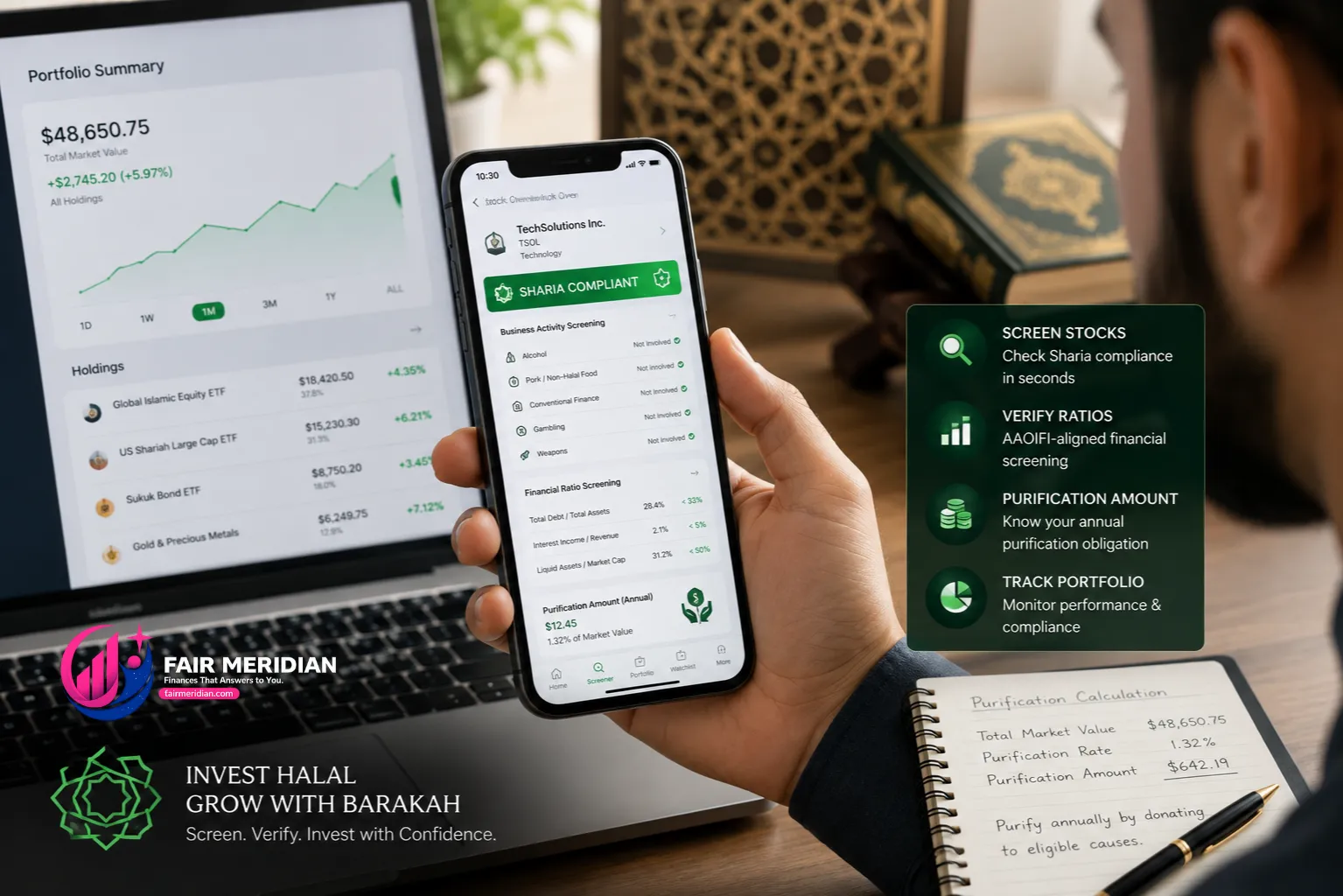
For individual stock investors, Zoya is non-negotiable. Before you buy any stock that isn't in SPUS, check Zoya first. It takes thirty seconds and answers the question you'd otherwise spend hours researching. The app also tracks your portfolio and tells you your total annual purification obligation — which most Muslim investors have never calculated correctly because it requires knowing the zakatable assets ratio for each holding, not just the overall investment value.
The free tier gives you basic halal/haram verdicts for individual stocks. The premium tier ($4.99/month or around $36/year) adds detailed screening reports, portfolio tracking, and purification calculations. If you're investing any meaningful amount, the premium tier pays for itself in the peace of mind alone.
What Zoya doesn't do: It cannot buy or sell investments. It has no brokerage function. After Zoya tells you Apple is halal, you still need to open Fidelity or Schwab to actually buy it.
Best for: Every Muslim investor — this is the starting point regardless of which brokerage you use.
2. Fidelity — The Best Platform for Halal Investing in America
Fidelity is not an Islamic finance company. It's a conventional brokerage. But it is, by a meaningful margin, the best platform for halal investing in the United States — for one specific reason: SPUS is available on Fidelity commission-free, and Fidelity's Roth IRA is the most powerful tax-advantaged account available to US investors.

SPUS (SP Funds S&P 500 Sharia Industry Exclusions ETF) is the largest halal equity ETF in the world at $892 million in assets as of May 2026. It has returned +12.4% year-to-date in 2026 — outperforming the conventional S&P 500 (SPY) at +10.9%. It excludes conventional banks, alcohol, tobacco, gambling, and weapons. It costs 0.49% per year in fees. You can buy it on Fidelity in about four minutes.
The setup that most Muslim investors should be using: open a Roth IRA at Fidelity, set up automatic monthly investments into SPUS, and let it compound permanently tax-free. At $583/month in SPUS over 30 years at a 9% average annual return, you end up with approximately $1.35 million that you never owe a dollar of tax on — not when it grows, not when you withdraw it in retirement, not when you leave it to your children. This is the most straightforward halal wealth-building path available to any Muslim American, and it lives inside a completely standard, highly regulated brokerage that you can download on your phone in minutes.
HLAL and SPRE are also available on Fidelity. HLAL (Wahed FTSE USA Shariah ETF, $245M AUM, +11.8% YTD 2026) is a solid alternative or complement to SPUS. SPRE gives you halal real estate exposure. Between these three ETFs, you can build a genuinely diversified halal portfolio without ever buying an individual stock.
What Fidelity doesn't do: It won't tell you which investments are halal. Use Zoya alongside Fidelity for individual stocks. For SPUS, HLAL, and SPRE, the Sharia certification comes from their respective Sharia boards — you don't need Zoya to tell you they're halal.
Best for: Long-term halal investors, Roth IRA builders, anyone who wants to invest in SPUS or other halal ETFs with no trading commissions and excellent account management tools.
3. Wahed Invest — The Halal Robo-Advisor
Wahed Invest is the closest thing to a purpose-built Islamic investment app in the United States. Founded in 2015 by Junaid Wahedna, Wahed is a registered investment advisor with a Sharia supervisory board that certifies its portfolios. You answer a few questions about your risk tolerance, and Wahed builds you a diversified halal portfolio across equities, sukuk, and gold — automatically rebalancing over time. The minimum investment is $100 and the management fee is 0.49% annually.

Wahed's biggest advantage is simplicity. You don't need to know what SPUS is or how to evaluate a halal ETF. You open an account, deposit money, and Wahed handles the rest. For a Muslim who wants to start investing halally today without learning the mechanics first, Wahed removes the barrier completely.
The honest comparison with Fidelity + SPUS: Wahed charges 0.49% annually for the managed service. SPUS inside a Fidelity Roth IRA costs 0.49% as the ETF's expense ratio. If you're investing $10,000, Wahed costs you an additional $49/year compared to a simple SPUS purchase — and Wahed doesn't offer a Roth IRA wrapper, which is a meaningful tax disadvantage over decades. Wahed works; it's just not as cost-efficient as the DIY Fidelity approach for investors who are willing to spend fifteen minutes setting up an automatic investment.
That said, Wahed's portfolio includes sukuk (Islamic bonds through AMAL) and gold exposure that you'd have to add manually in a Fidelity account. If you want a truly diversified halal portfolio without any assembly required, Wahed does that in one product.
Best for: Beginners who want a managed halal portfolio with no learning curve. Muslims who want sukuk and gold exposure without building it themselves. Anyone who finds the DIY brokerage approach overwhelming.
4. Charles Schwab — The Fidelity Alternative
If you already have a Schwab account, or if you prefer Schwab's interface over Fidelity's, you don't need to switch. SPUS, HLAL, UMMA, and SPRE are all available on Schwab commission-free. The Roth IRA structure is identical. Schwab's fractional shares program ("Schwab Stock Slices") lets you invest in companies like Microsoft or Apple for as little as $5, which is useful for individual halal stock investing alongside your ETF positions.
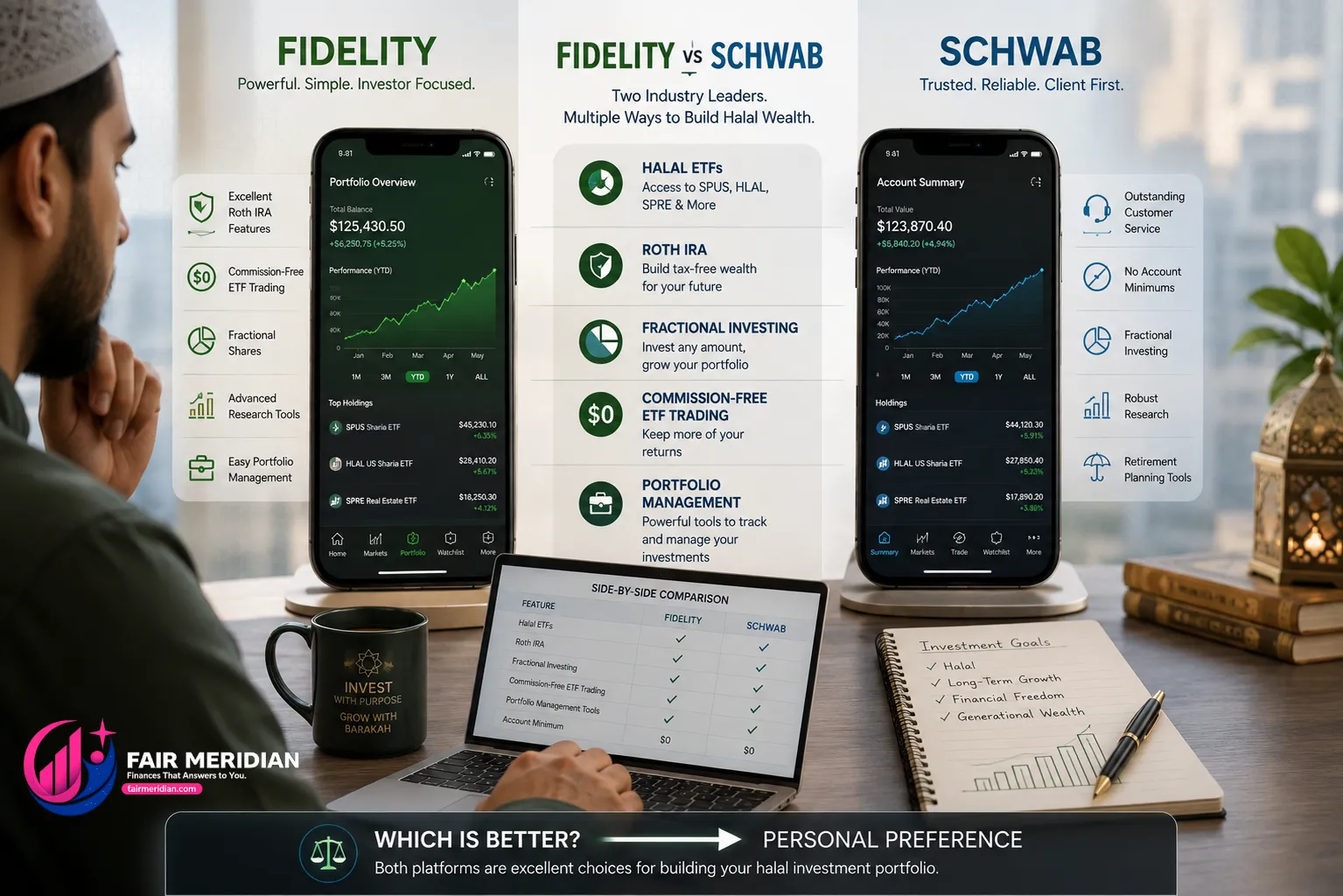
The choice between Fidelity and Schwab for halal investing comes down to personal preference — both platforms offer everything a halal investor needs. Fidelity has a slight edge in its research tools and mobile app design for beginners. Schwab is preferred by many investors who appreciate its customer service. Neither is wrong.
Best for: Anyone who prefers Schwab or is already a Schwab customer. Functionally equivalent to Fidelity for halal ETF investing.
5. Saturna Capital (Amana Funds) — The Long-Track-Record Option
Saturna Capital's Amana funds have been the flagship halal investment option for US Muslims since 1986 — long before the word "halal ETF" existed. The Amana Growth Fund and Amana Income Fund are actively managed mutual funds that apply Islamic screening criteria. Saturna is also the manager of AMAL, the sukuk ETF available on Fidelity and Schwab.
The case for Amana funds is the track record. Almost 40 years of Sharia-compliant investing with a board of Islamic scholars that has been continuously overseeing the portfolios. For older Muslim investors, particularly those who started investing before ETFs existed and have long positions in Amana funds, there's genuine value in that history and stability.
The honest limitation: actively managed mutual funds have higher expense ratios than ETFs. The Amana Growth Fund charges around 1.0% annually — roughly double what SPUS costs at 0.49%. Over 30 years, that difference in fees compounds into a meaningful performance gap. For new investors starting today, SPUS in a Roth IRA at Fidelity produces better long-term outcomes than Amana funds in a taxable account — both because of lower fees and because of the Roth's tax advantage.
Best for: Existing Amana fund investors with long-established positions. Investors who specifically want an actively managed halal equity fund with a 40-year history. Anyone who wants to hold AMAL sukuk through Saturna directly rather than through a brokerage.
What to Actually Do — The Setup That Works
If you're a Muslim American who wants to start investing halally and you don't know where to begin, here is the practical setup that makes the most sense for most people:

Download Zoya on your phone. Use it every time you consider buying an individual stock. Set it up with your portfolio so it tracks your annual purification obligation automatically.
Open a Roth IRA at Fidelity (fidelity.com). This takes about fifteen minutes online. Fund it with the 2026 annual limit if you can ($7,000 if you're under 50, $8,000 if you're 50 or over). Buy SPUS. Set up an automatic monthly investment so you contribute consistently without having to think about it. This is your primary halal wealth-building vehicle.
If you want diversification beyond US equities, add HLAL for broader market exposure or AMAL for sukuk (Islamic bond equivalent). SPRE adds halal real estate exposure if that appeals to you.
If you are genuinely overwhelmed by any of that and want someone to manage it for you, use Wahed. It costs a little more than the DIY approach, but a managed halal portfolio you actually fund consistently beats a theoretically optimal setup you never get around to.
Apps That Sound Islamic But Aren't
A few quick answers to questions that come up repeatedly. Robinhood is not halal — it's a conventional brokerage with no Sharia screening, and its payment-for-order-flow model has additional ethical concerns beyond the halal investing question. Acorns is not halal — it invests automatically in conventional ETF portfolios that include interest-bearing bonds and conventional bank stocks. Betterment and Wealthfront are not halal — they are conventional robo-advisors investing in broadly diversified portfolios with no Sharia screening whatsoever.
None of these can be made halal by buying only certain assets through them. The platform itself isn't the issue — Fidelity is also conventional. What matters is what you buy through it. SPUS at Fidelity is halal. An S&P 500 index fund at Fidelity is not. The brokerage is just the infrastructure.
Frequently Asked Questions

What is the best halal investment app in the USA?
There is no single best app — the optimal setup is a combination. Zoya for halal stock screening, and Fidelity (or Schwab) as the brokerage to actually invest through. Inside Fidelity, SPUS is the best halal equity investment for most Muslim Americans — a Sharia-screened S&P 500 ETF with $892M in assets, 0.49% annual fee, and +12.4% year-to-date return as of May 2026. If you want a managed portfolio without the DIY component, Wahed Invest is the legitimate halal robo-advisor alternative.
Is Wahed Invest actually halal?
Yes. Wahed Invest is certified by an independent Sharia supervisory board and invests in halal equities, sukuk, and gold through a managed portfolio model. It is a legitimate halal investment platform registered with the SEC as an investment advisor. The main consideration versus a DIY approach through Fidelity is cost — Wahed's 0.49% management fee adds to the underlying ETF expenses — and the absence of a Roth IRA wrapper, which matters significantly for long-term tax-free compounding.
Is Zoya a brokerage?
No. Zoya is a halal stock screening app — it tells you whether a stock passes Islamic screening criteria and calculates your annual purification obligation. It cannot buy or sell investments. To invest, you need a separate brokerage account (Fidelity, Schwab, or Wahed). Zoya and your brokerage do completely different jobs and you need both.
Can I invest halally on Fidelity?
Yes — Fidelity is actually the best platform for halal investing in America because SPUS, HLAL, UMMA, AMAL, and SPRE are all available there commission-free. Open a Roth IRA at Fidelity, buy SPUS, and set up automatic monthly contributions. This is the most tax-efficient, lowest-cost halal wealth-building strategy available to US Muslims.
Is Robinhood halal?
Robinhood is not an Islamic investment platform and has no halal screening. Using Robinhood to buy halal stocks (ones that pass Zoya's screening) is technically possible, but Robinhood doesn't offer a Roth IRA wrapper, charges for some features, and its business model has ethical concerns beyond the halal question. Fidelity or Schwab are better platforms for Muslim investors in every meaningful way.
What is the minimum amount to start halal investing in the US?
Effectively zero. Fidelity has no account minimum for a Roth IRA. SPUS can be purchased for whatever its current share price is — around $50–60 per share — and Fidelity offers fractional shares if you want to invest a specific dollar amount rather than a whole share. Wahed Invest requires a $100 minimum. There is no reasonable minimum-balance barrier to starting halal investing in America today.
For a deeper understanding of SPUS and how it compares to other halal ETFs, read our Halal ETFs Guide 2026. For step-by-step instructions on opening a Roth IRA and buying SPUS at Fidelity, see our Halal Roth IRA Setup Guide. For the full zakat calculation on your investment portfolio including SPUS's zakatable assets ratio, read our Zakat Calculation Guide 2026.