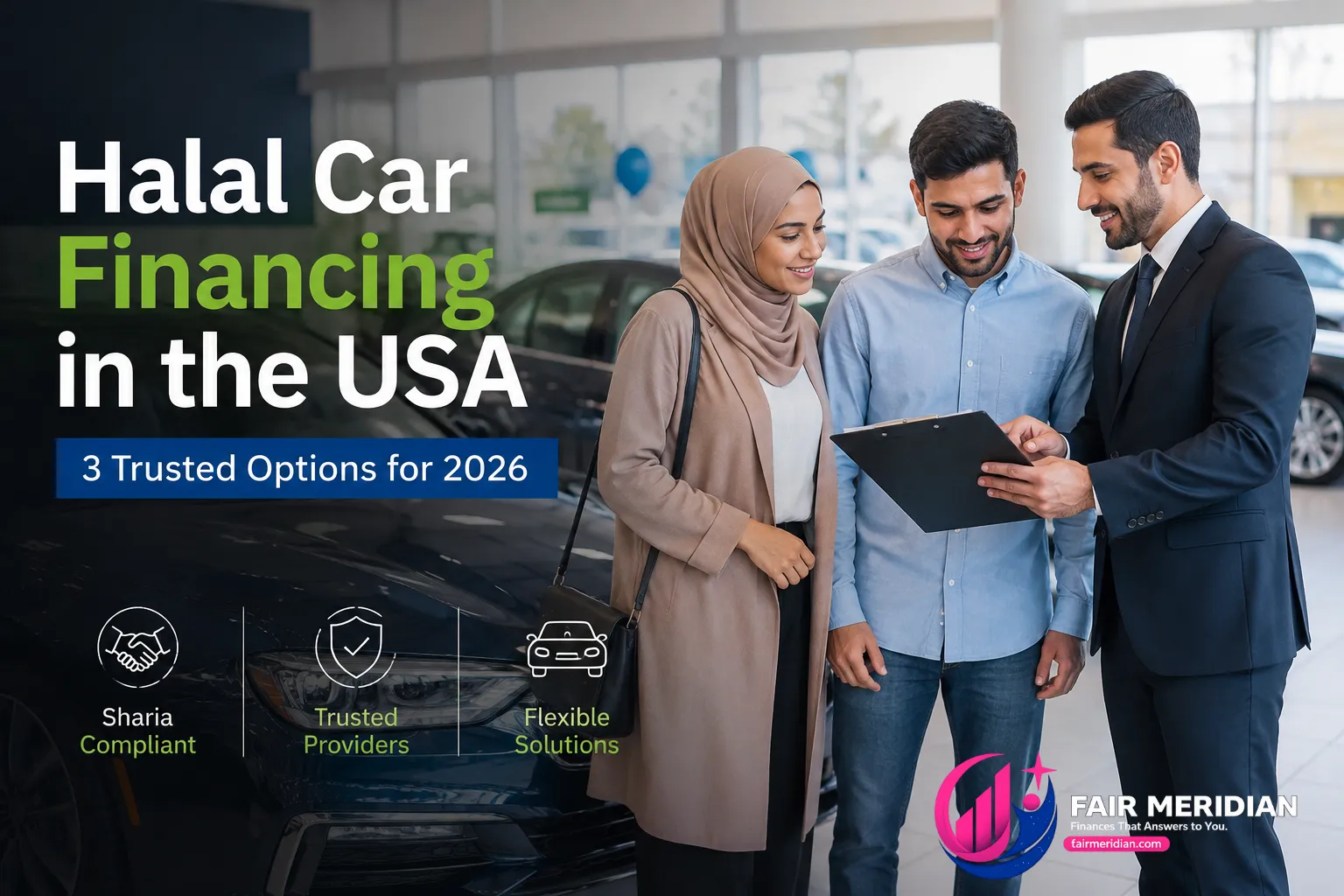
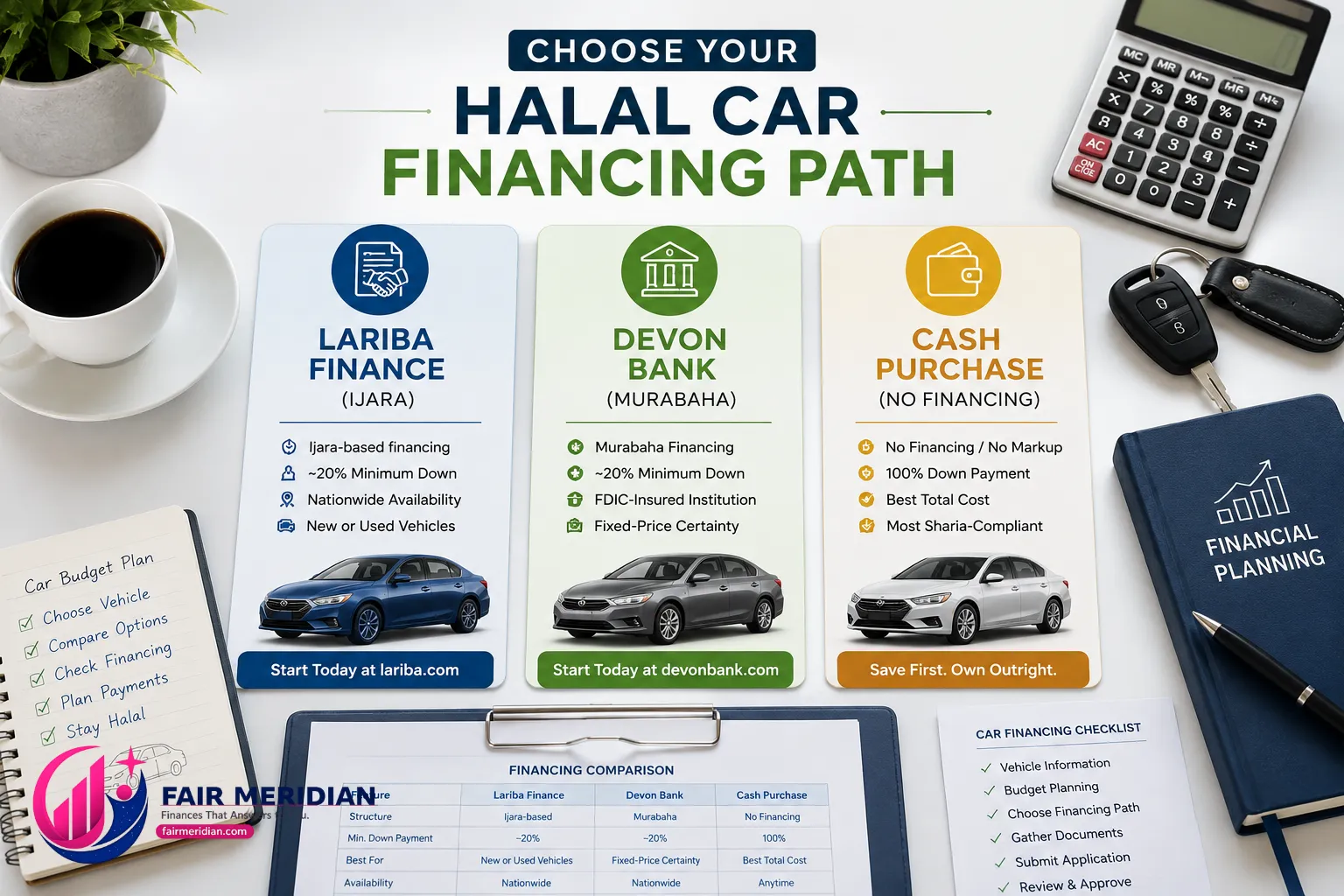
Halal car financing in the United States is available — but the market is much thinner than halal home financing. Two dedicated providers serve the nationwide market: Lariba Finance (ijara-based) and Devon Bank (murabaha). A third path — paying cash — is often the most practical halal option for buyers who can build the savings. This post gives you the exact steps for each.
Your Three Realistic Halal Car Financing Paths
Path | Provider | Structure | Min. Down | Best For | Time to Get Started |
|---|---|---|---|---|---|
Path 1 | Lariba Finance | Ijara-based | ~20% | Nationwide buyers; new or used vehicles | Today — lariba.com |
Path 2 | Devon Bank | Murabaha | ~20% | Fixed-price certainty; FDIC-insured institution | Today — devonbank.com |
Path 3 | Cash Purchase | No financing | 100% | Best total cost; most Sharia-compliant; requires savings | 2–36 months (save first) |
Path 1: Lariba Finance — The Dedicated Halal Auto Specialist
Lariba Finance (American Finance House Lariba, lariba.com) is the oldest Islamic finance company in the United States, founded in 1987 in Arcadia, California. They specialize in halal auto financing using an ijara-based structure — and they have financed more US Muslim vehicle purchases than any other provider. Start here.
Step 1: Identify Your Specific Vehicle First
Unlike halal home financing, where you get pre-approved before searching, Lariba needs to know the exact vehicle before processing your application. Before contacting Lariba, have:
Make, model, year, and trim of the vehicle you want
VIN number (for new vehicles: get this from the dealer's window sticker; for used: from the listing)
Dealer name and address (if buying from a dealer)
For used vehicles: vehicle history report (Carfax)
Your target price / dealer quote
Step 2: Gather Your Documents
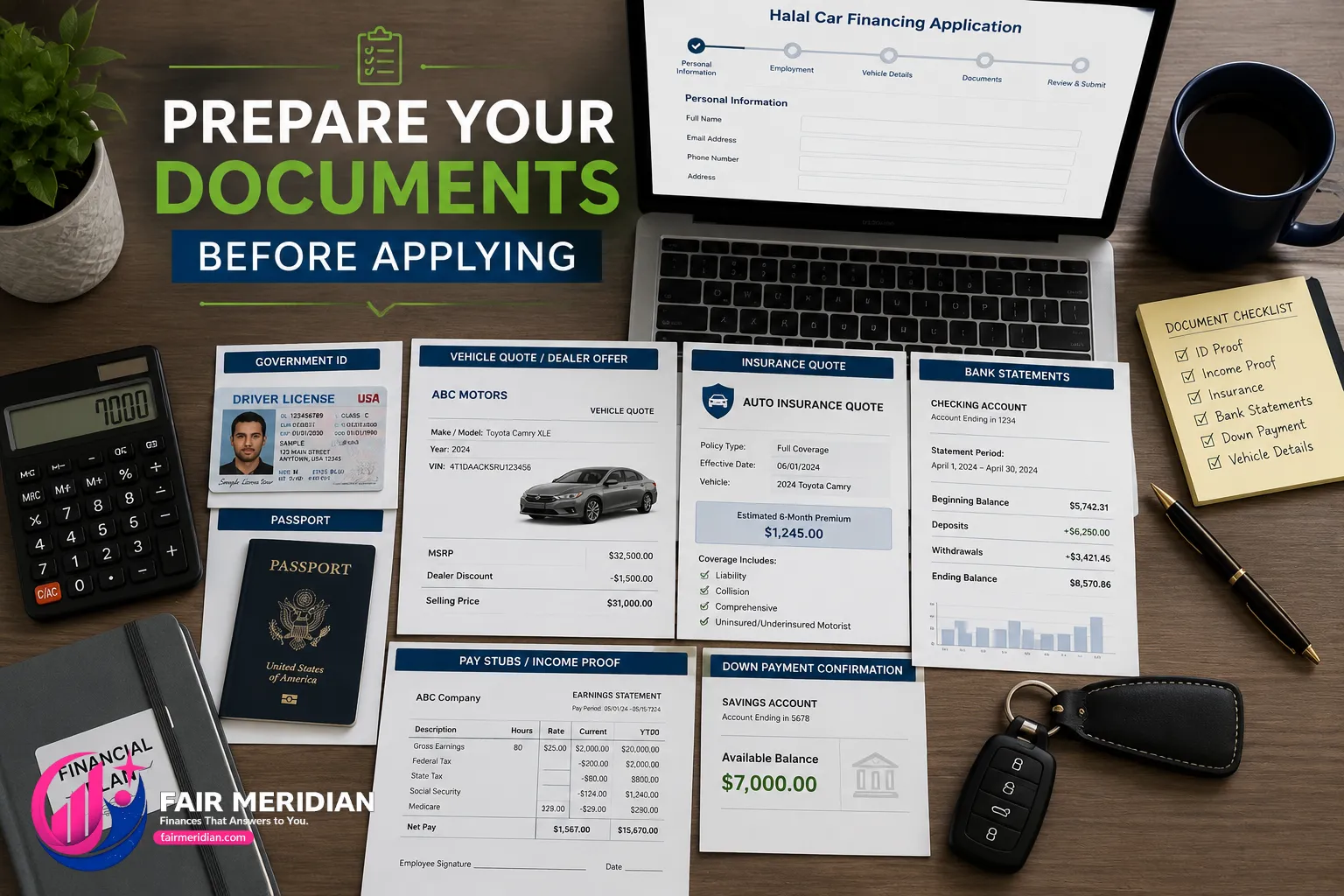
Have these ready before applying:
Government-issued photo ID (driver's license or passport)
Social Security Number
Two most recent pay stubs (W-2 employees) or 2 years of tax returns (self-employed)
Proof of auto insurance (or insurance quote — required before funding)
Down payment amount: plan for ~20% of the vehicle price
Three months of bank statements
Step 3: Apply with Lariba
Visit lariba.com and navigate to their auto financing application. Lariba serves customers nationwide — you do not need to be in California or near a physical office. Their process is primarily conducted online and by phone.
You can also reach Lariba by phone at their Arcadia, CA headquarters. Application processing typically takes 2–5 business days for a financing decision on complete applications.

Step 4: Review Your Contract
Before signing, confirm that your Lariba contract:
Does not use the word "interest" or "APR" in the traditional sense — Lariba uses a different calculation methodology based on rate of return on investment
States the total amount you will pay (principal + profit markup) clearly
Specifies the monthly payment amount and term
States that there is no prepayment penalty
What to Expect on Rates and Terms
Lariba's rates are benchmarked to market rates for auto financing — comparable to conventional auto loan rates (currently averaging 7–9% for new vehicles with good credit). The structure eliminates interest; the comparable cost is similar because conventional auto loans are simple interest amortized (not compound interest like a conventional mortgage). The halal advantage here is compliance, not dramatic cost savings.

Path 2: Devon Bank — Murabaha Auto Financing
Devon Bank (devonbank.com) is an FDIC-insured Chicago-based bank that offers murabaha-structured auto financing alongside its halal home financing programs. Devon serves customers nationwide.
Step 1: Contact Devon Bank's Commercial Lending Team
Devon Bank's auto financing is handled through their lending department rather than a standard consumer application portal. Call Devon Bank at their main number (available at devonbank.com) and ask to speak with someone about Islamic auto financing (murabaha). This is important — not all Devon Bank staff will be familiar with the Islamic product; ask specifically for their Islamic finance team.
Step 2: Get a Murabaha Quote
Devon Bank will quote you a total murabaha price for the vehicle — the original cost plus their markup, expressed as a fixed total. For example, on a $35,000 vehicle with 20% down ($7,000), Devon finances $28,000 and adds a fixed markup for the agreed term. The total price you pay is known at signing and does not change.
Why Choose Devon Over Lariba?
If you want FDIC-insured institution status: Devon Bank is a federally regulated bank with FDIC backing. Some buyers prefer this regulatory oversight over a non-bank Islamic finance company.
If you want the murabaha structure specifically: Lariba uses an ijara-based model; Devon uses pure murabaha. Some scholars prefer one over the other — follow your scholarly guidance if this matters to you.
If Lariba's terms don't work for your vehicle type: Devon may have different eligibility criteria for certain vehicle types, ages, or mileage limits.
Path 3: Pay Cash — The Best Halal Car Option
Cash purchase is the most Sharia-compliant approach to car ownership and, for many Muslim families, the most practical halal strategy. Here is why it works and how to execute it.
The Math That Makes Cash Smart
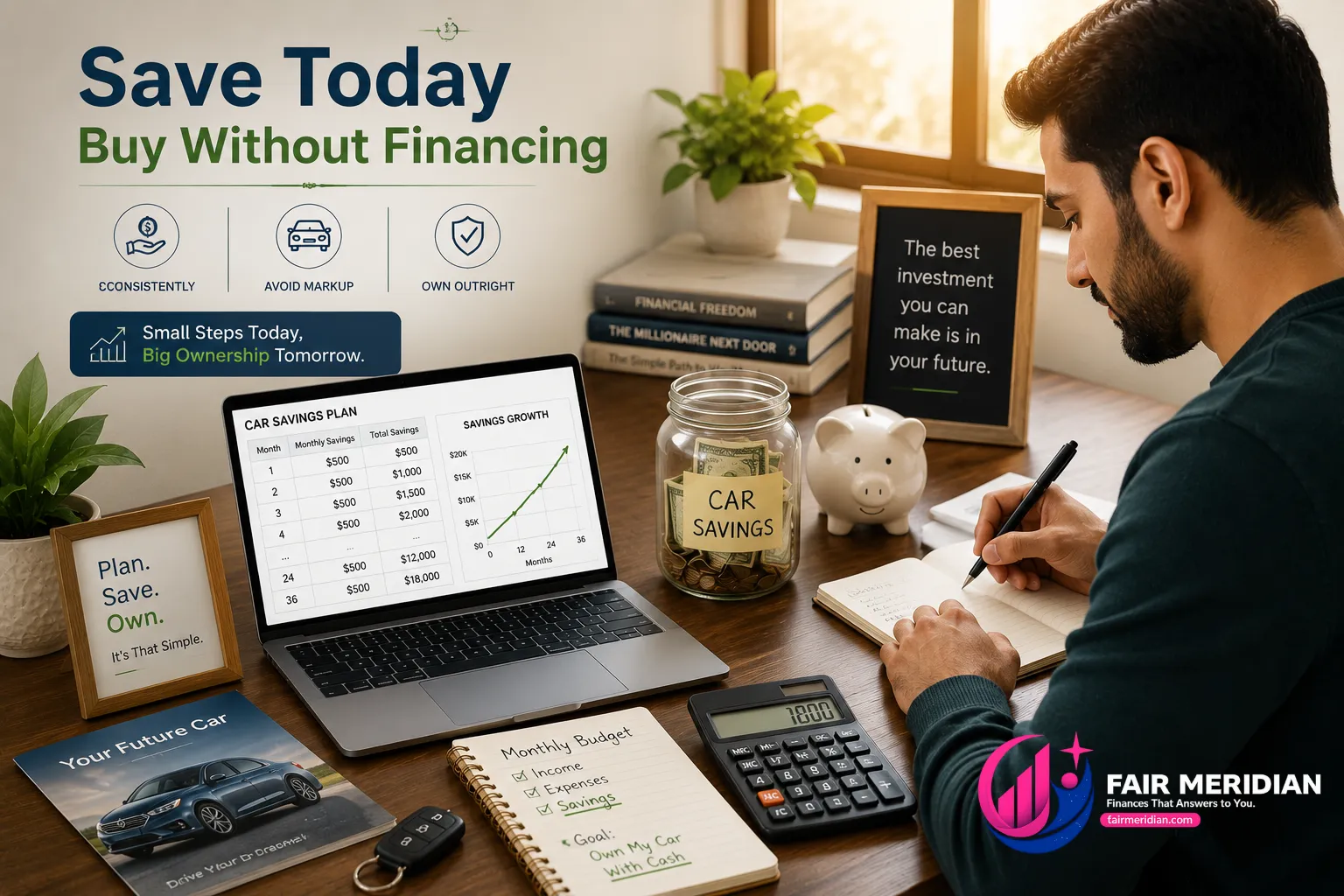
At current auto financing rates (7–8.5% markup over a 60-month term), halal auto financing on a $35,000 vehicle costs approximately $5,600–$7,300 in total markup over the term. If you can save the purchase price within 24–36 months, you eliminate this cost entirely — and own the vehicle outright from day one.
The Cash Savings Timeline
Monthly Savings | In 18 Months | In 24 Months | In 36 Months | Target Vehicle |
|---|---|---|---|---|
$300/month | $5,400 | $7,200 | $10,800 | Budget used vehicle |
$500/month | $9,000 | $12,000 | $18,000 | Reliable used vehicle |
$800/month | $14,400 | $19,200 | $28,800 | Newer used / base new |
$1,200/month | $21,600 | $28,800 | $43,200 | Most new vehicles |
Where to Keep Your Car Savings
Do not save for a car purchase in a conventional interest-bearing savings account. The interest earned creates a purification obligation and is riba. Instead:
Timeline under 12 months: Non-interest-bearing checking account at your bank (the account that earns 0% — yes, this exists; just don't link to their savings product)
Timeline 12–36 months: SPUS in a taxable Fidelity account. Accept some equity volatility in exchange for halal growth. Set an alert to shift to checking at 90 days before your target purchase date.
What to Do If Neither Lariba Nor Devon Can Help You
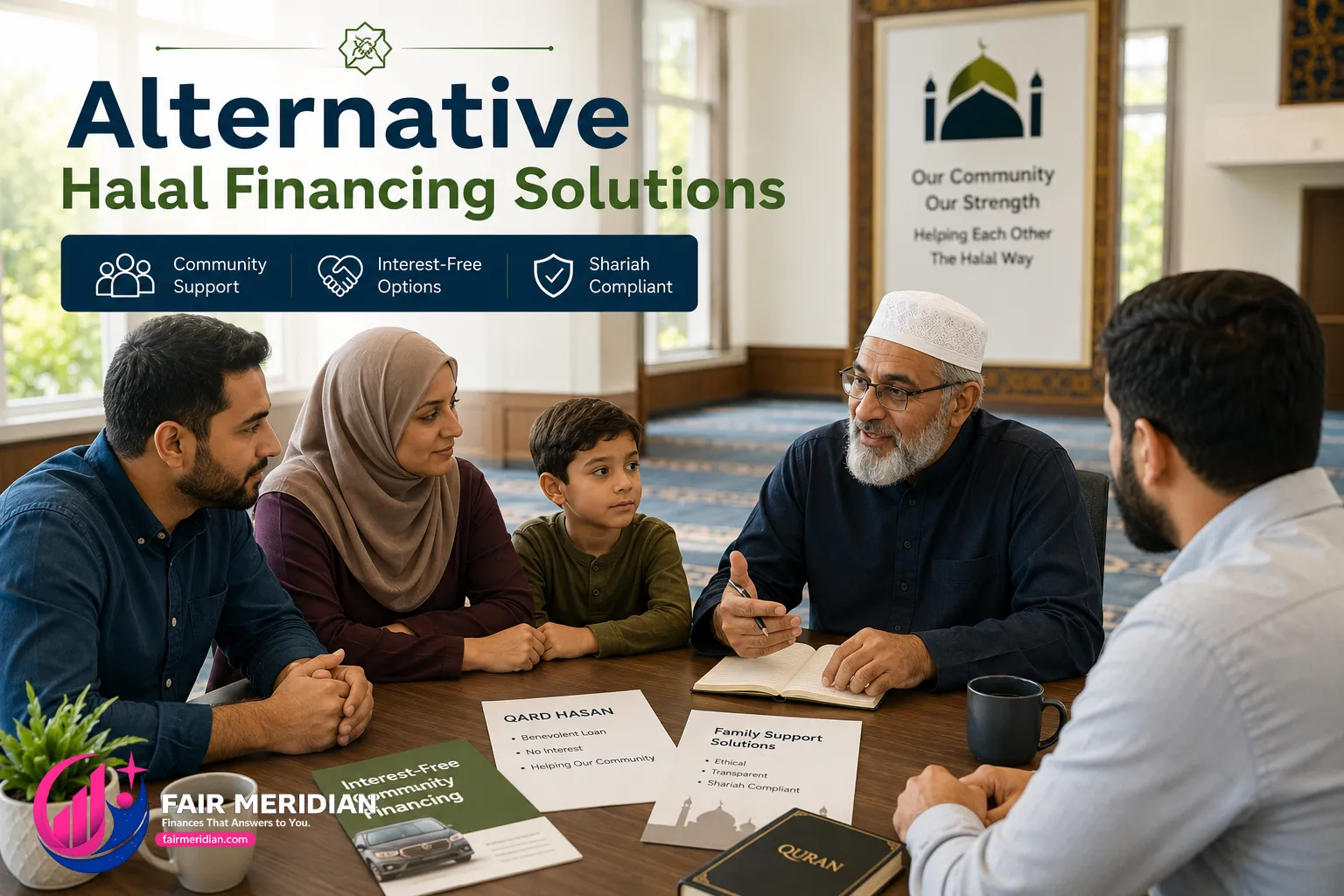
If Lariba and Devon both cannot serve your specific situation (unusual vehicle type, state licensing limitations, income documentation issues), these fallback options apply:
Contact your local mosque community: Ask if they have a qard hasan (interest-free benevolent loan) fund. Some established Muslim communities (particularly in Dearborn, Houston, Chicago, and Northern Virginia) have informal interest-free community loan funds that can help with vehicle purchases.
Family mudaraba arrangement: A family member with savings provides the full vehicle cost. You repay over time with no interest. Document it simply in writing: amount provided, repayment schedule, and confirmation that no interest is charged. This is a legitimate halal financing arrangement when structured correctly.
Extend the vehicle's life, save faster: If you have a working vehicle, extend its life 12–18 months through maintenance while building the cash purchase fund. A $2,500 repair investment that lets you avoid $7,000 in financing markup is strongly positive financially.

Frequently Asked Questions
Is car financing halal?
Conventional car financing from banks and dealerships charges interest — which is prohibited (riba) under Islamic law. Halal car financing uses murabaha (cost-plus sale) or ijara (lease-to-own) structures that eliminate interest. These structures are available in the US through Lariba Finance and Devon Bank. Cash purchase is always the most straightforward halal option when achievable.
Does Lariba Finance serve my state?
Lariba Finance is NMLS-licensed and operates nationwide — they are not limited to California despite being headquartered in Arcadia, CA. Contact them at lariba.com to confirm availability for your specific state and vehicle type before preparing documents.
What is the minimum down payment for halal car financing?
Both Lariba and Devon Bank typically require approximately 20% down payment for halal auto financing. On a $35,000 vehicle: $7,000 down. On a $25,000 used vehicle: $5,000 down. There is no equivalent of Guidance Residential's 5% down home financing program for halal auto loans — 20% is the standard minimum across providers.
Is it better to get halal car financing or pay cash?
Cash is better from both a Sharia and financial perspective: no markup, full ownership from day one, no documentation burden, no provider availability constraints. Halal car financing is better when you need the vehicle now, don't have the full purchase price saved, and cannot reasonably extend your current vehicle's life while saving. Use halal financing as a bridge to transportation — not as a permanent financial strategy.
For the complete educational guide on halal auto financing structures (murabaha vs ijara explained, true cost comparison, and the development economics of Islamic vehicle financing), read our Halal Car Financing USA Guide. For the halal mortgage equivalent — where the savings are far more dramatic — see our Halal Mortgage USA Guide.