

A Self-Directed IRA (SDIRA) is halal — but only if the real estate inside it is purchased with 100% cash. No conventional mortgage. This is the constraint most SDIRA guides never mention, and it is the most important sentence in this post. If you buy real estate inside an SDIRA using conventional financing, the interest is riba regardless of the IRA wrapper around it. Buy with cash, and you have one of the most tax-efficient halal wealth-building strategies available to any Muslim investor in America.
What an SDIRA Is — and What Makes It Halal
A standard IRA (Roth or Traditional) at Fidelity or Schwab can only hold publicly traded securities: stocks, ETFs, bonds, mutual funds. A Self-Directed IRA is the same legal structure — same tax advantages, same contribution limits, same rules — but held at a specialized custodian that allows alternative assets: direct real estate, private businesses, raw land, and more.
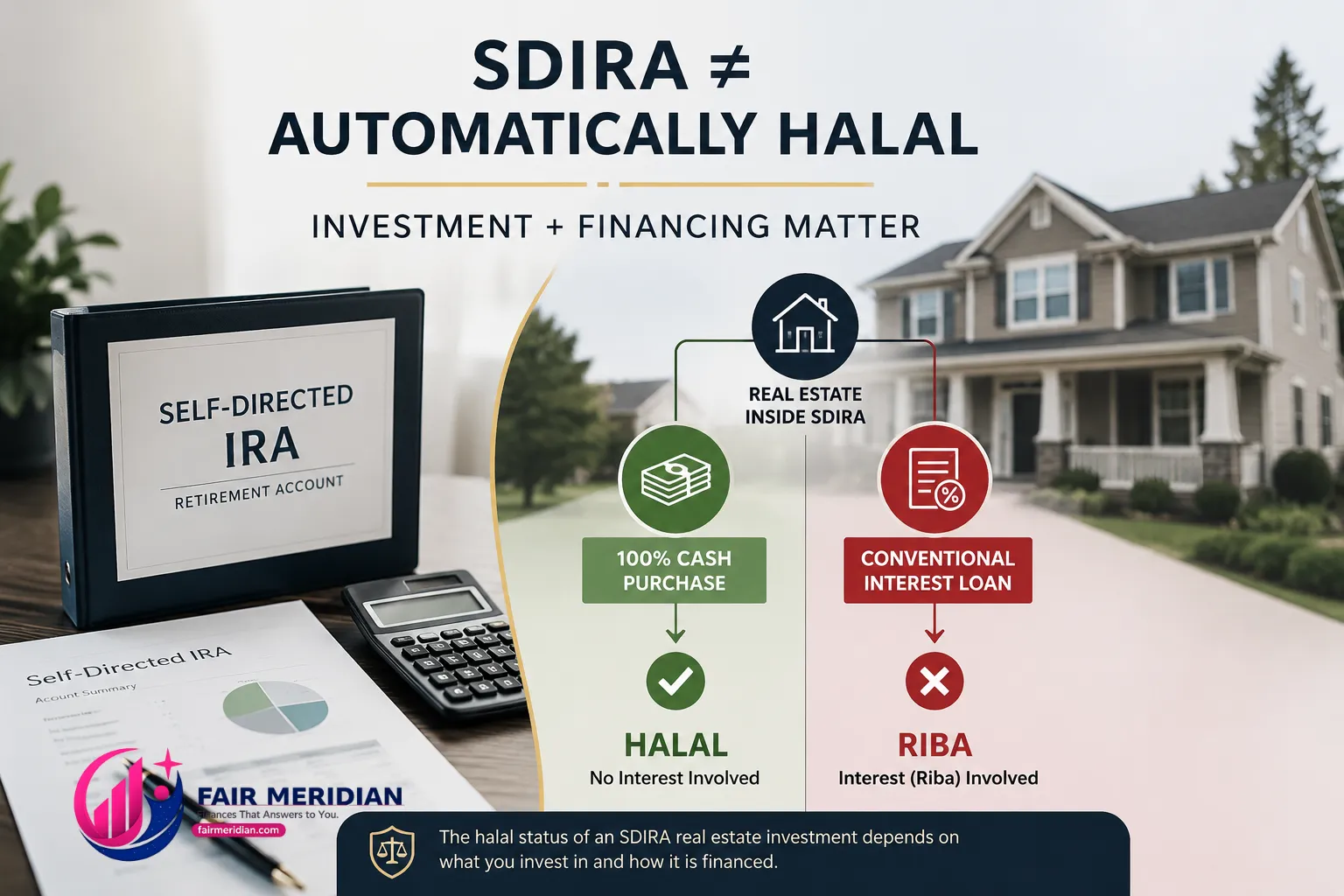
The SDIRA itself is a legal container. It has no inherent interest component and no Sharia compliance problem. What determines halal status is what goes inside it and how it's financed:
Investment Inside SDIRA | Financing | Halal Status |
|---|---|---|
Rental property | 100% cash (no mortgage) | ✅ Halal |
Rental property | Non-recourse conventional loan | ❌ Riba — not halal |
SPUS or SPRE ETF | N/A (publicly traded) | ✅ Halal (hold in standard Roth IRA — SDIRA unnecessary) |
Musharakah partnership share | Cash equity contribution | ✅ Halal if partnership is debt-free |
Conventional REIT | N/A (fund holds leveraged properties) | ❌ Most conventional REITs fail debt ratio screen |
The One Rule You Cannot Bend: 100% Cash Purchase

SDIRA non-recourse loans exist — lenders who provide financing specifically to IRAs, where the loan is secured only by the property (no personal guarantee from you). Many conventional SDIRA guides recommend them to amplify returns. For a Muslim investor, they are not an option. The interest on a non-recourse loan is riba regardless of who the borrower is (you personally vs your IRA). The IRA wrapper does not change the nature of the transaction.
The cash-purchase requirement shapes your entire SDIRA real estate strategy: the property must be cheap enough that your SDIRA balance can buy it outright. This is not a limitation — it is a filter that directs you toward markets with better fundamentals, lower risk, and often higher cap rates than expensive coastal cities. More on target markets below.
Why Roth SDIRA Is the Right Container
You can open an SDIRA as either a Traditional (pre-tax) or Roth (post-tax) account. For halal real estate specifically, the Roth SDIRA is significantly better — and the advantage compounds over time.
Traditional SDIRA | Roth SDIRA | |
|---|---|---|
Contributions | Pre-tax (deductible) | Post-tax (not deductible) |
Rental income inside account | Tax-deferred | Tax-free permanently |
Property appreciation inside account | Tax-deferred | Tax-free permanently |
Withdrawals (age 59½+) | Taxed as ordinary income | Zero tax |
Required Minimum Distributions | Yes — starting at age 73 | None — hold forever |
Pass to heirs | Heirs pay income tax on distributions | Heirs receive tax-free |
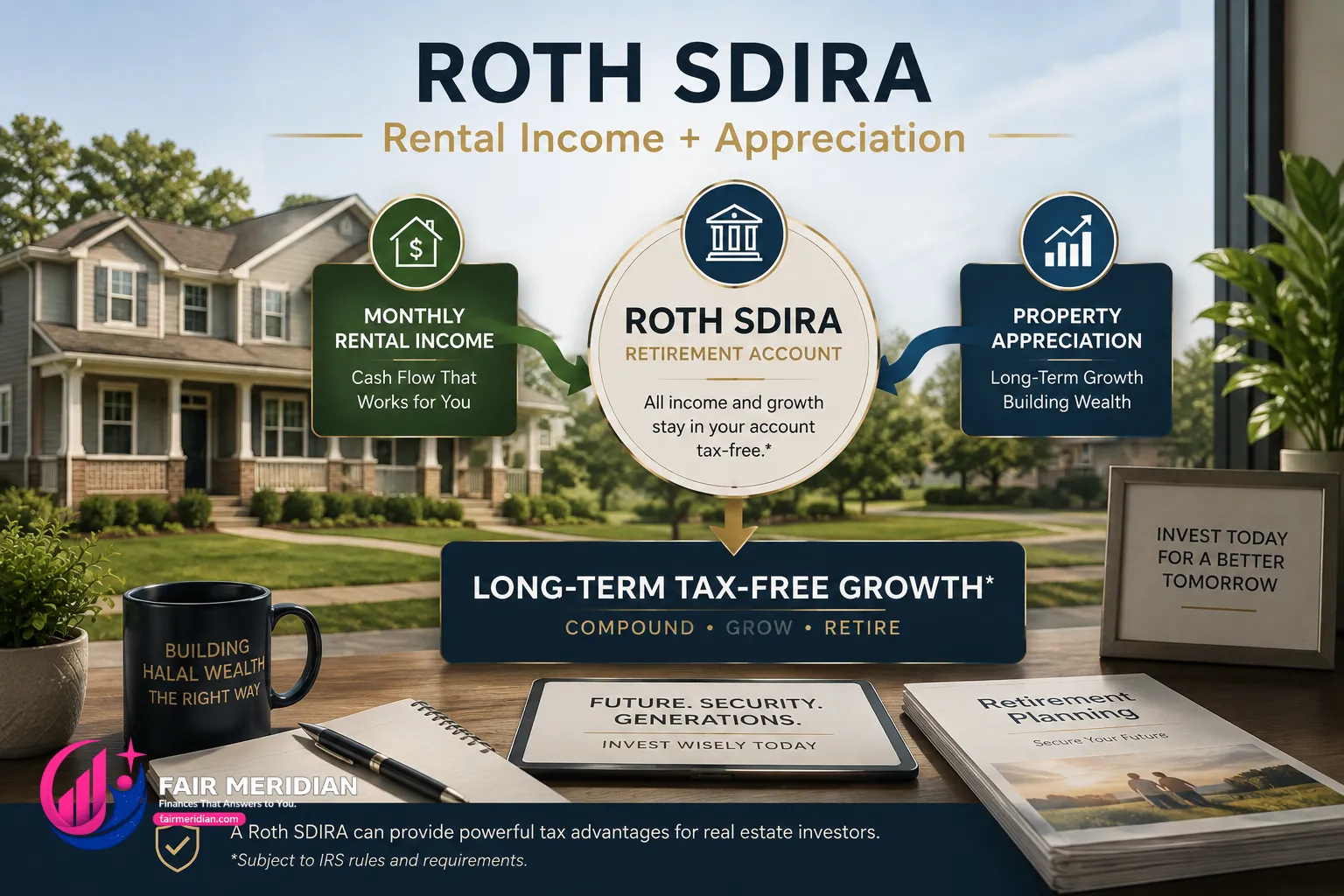
The Roth SDIRA advantage for real estate is specifically extraordinary because real estate generates two types of return — ongoing rental income and long-term appreciation — that conventional investors pay tax on continuously. Inside a Roth SDIRA, both compound permanently without any tax friction.
The Tax Math — What This Actually Worth
Here is a concrete example: a Muslim investor purchases a duplex in Hamtramck, Michigan for $140,000 cash inside a Roth SDIRA. Two units renting at $900/month each.
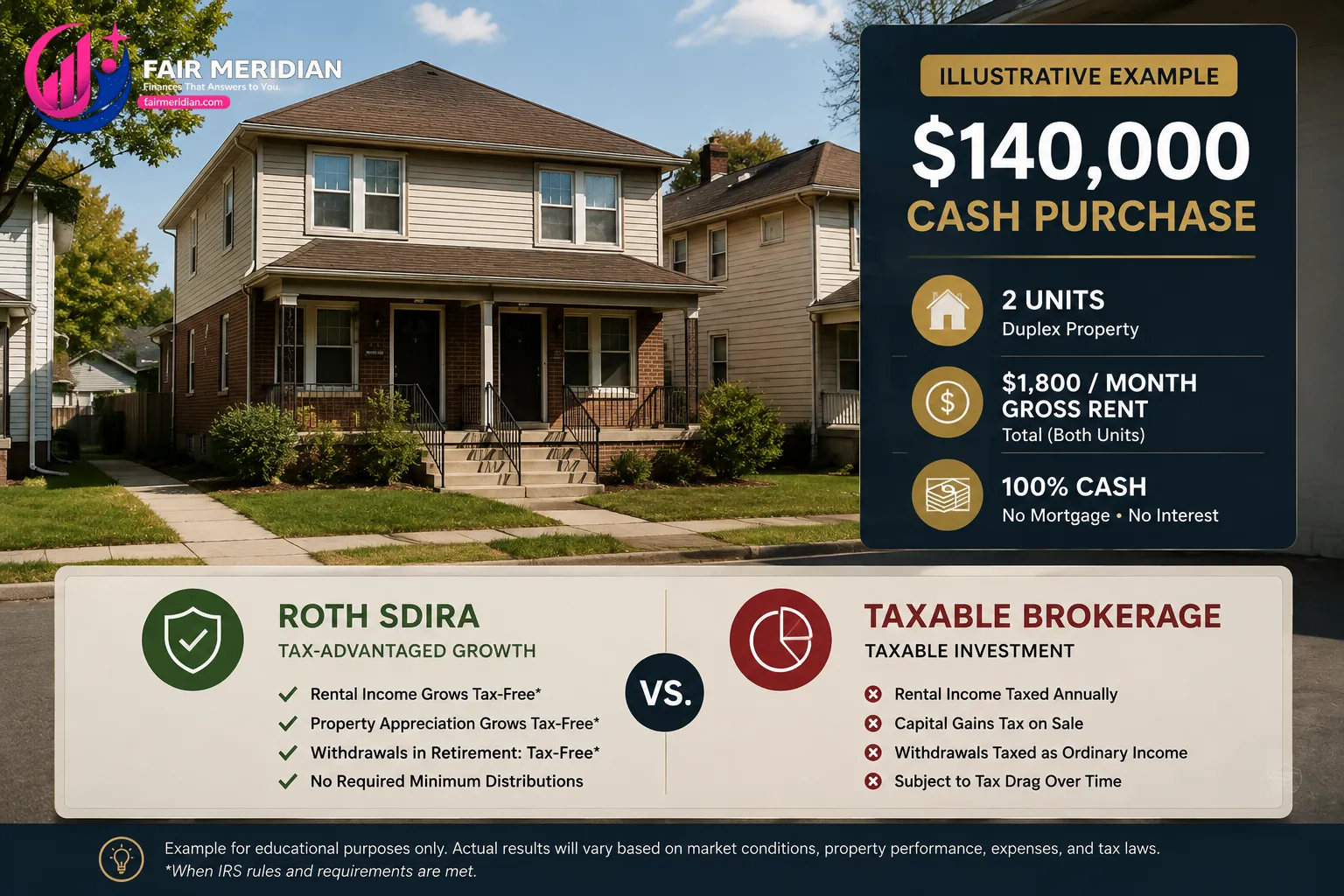
Metric | Roth SDIRA | Taxable Brokerage Account |
|---|---|---|
Purchase price | $140,000 cash | $140,000 cash |
Annual gross rent | $21,600 | $21,600 |
Annual expenses (40%) | $8,640 | $8,640 |
Annual net rental income | $12,960 | $12,960 |
Annual tax on rental income (30%) | $0 | $3,888 |
Annual after-tax cash flow | $12,960 | $9,072 |
Property value at year 20 (3%/yr) | $252,000 | $252,000 |
Capital gains tax on sale | $0 | ~$26,600 (23.8% on $112K gain) |
Cumulative rental income (20 years) | ~$310,000 | ~$217,000 (after annual tax) |
Total value at year 20 | ~$562,000 | ~$442,400 |
Roth SDIRA advantage | ~$119,600 more — from a $140,000 starting investment |
Assumes: 3% annual rent growth, 3% property appreciation, 40% expense ratio, 30% marginal tax rate on rental income (federal + state), 23.8% long-term capital gains rate. Simplified — actual results vary by market, management, and tax circumstances.
The Roth SDIRA generates approximately $119,600 more over 20 years on the same $140,000 investment — purely from eliminating the annual tax drag on rental income and capital gains tax on sale. That $119,600 is the dollar value of Roth SDIRA's tax-free compounding applied to halal rental income.
IRS Prohibited Transaction Rules — What You Cannot Do
These are IRS rules, not Sharia rules — but violating them causes the IRA to be treated as fully distributed (triggering income tax + a 10% early withdrawal penalty if you're under 59½). Know them cold before you buy.
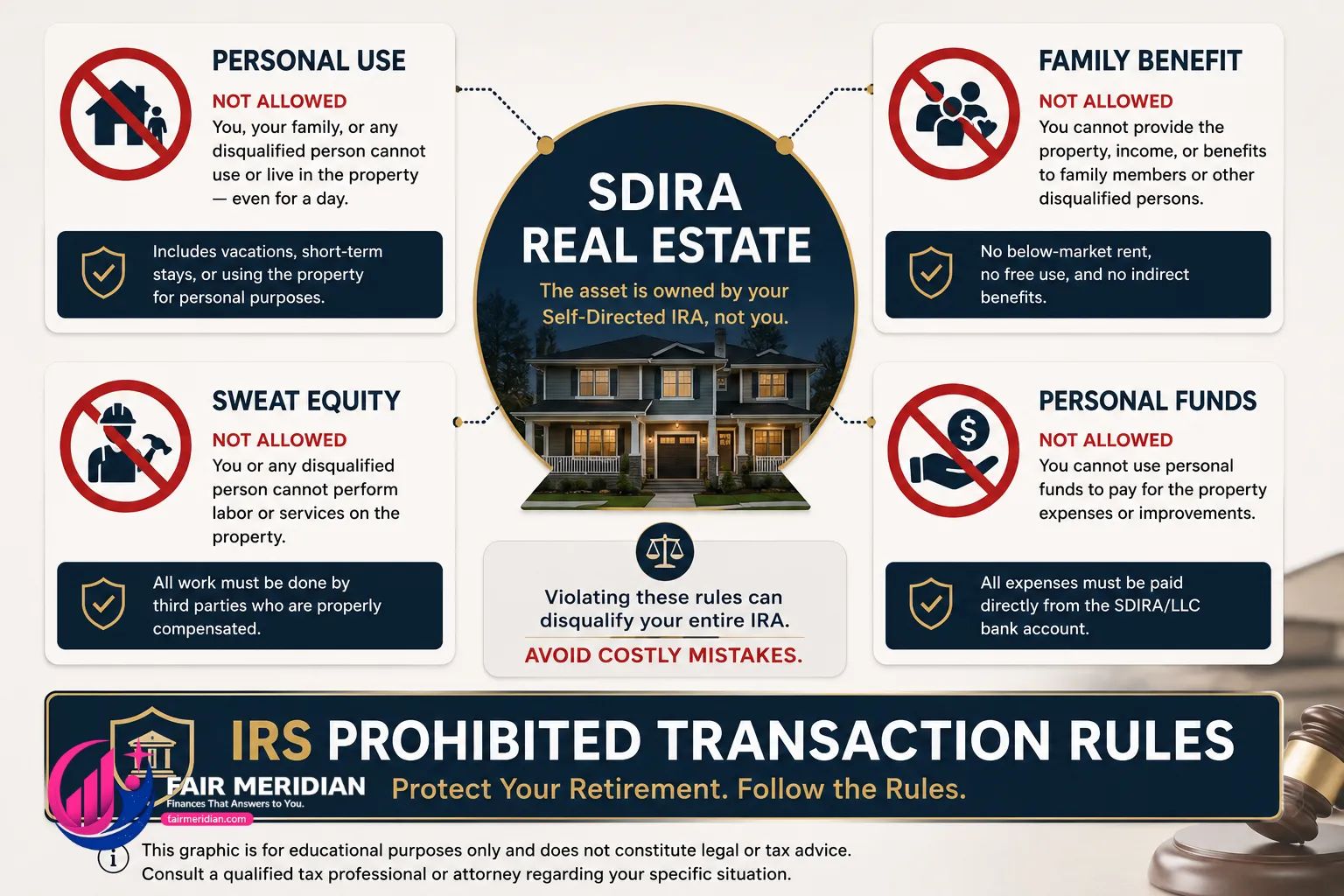
Rule 1: You Cannot Use the Property Personally
The property inside your SDIRA cannot provide any personal benefit to you. You cannot:
Sleep there — not for one night
Use it as an office or conduct business there
Store personal belongings there
Vacation there, ever
The property exists only as an investment asset of the IRA. You are a third-party investor relative to the property — even though you control the SDIRA.
Rule 2: "Disqualified Persons" Cannot Benefit
Your family members cannot use or benefit from the property either. Disqualified persons include: your spouse, your parents, your grandparents, your children, your grandchildren, and their spouses. None of them can rent the property, use it, or receive any personal benefit from it.
They CAN be paid for legitimate services (a daughter who is a licensed property manager can manage the property at fair market rates). But they cannot be tenants or users of the property.
Rule 3: No Sweat Equity
You cannot personally repair or maintain the property. Painting, fixing, landscaping — anything you do personally as labor is a prohibited transaction. All work must be done by third-party contractors paid from the SDIRA's cash balance at fair market rates.
Rule 4: All Income Into the IRA
Every dollar of rental income must go directly into the SDIRA account — not to your personal bank account. Give tenants a payment address that routes directly to the custodian's account or the SDIRA's dedicated bank account (if you use the checkbook LLC structure described below).
Rule 5: All Expenses From the IRA
Property taxes, insurance, maintenance, and management fees must be paid from the SDIRA's cash balance — not from your personal funds. Keep a minimum cash reserve of $5,000–$10,000 in the SDIRA to cover unexpected property expenses without triggering prohibited transactions.
The violation consequence: A prohibited transaction causes the ENTIRE IRA to be treated as distributed in the year of the violation — not just the property. If you have $200,000 in your Roth SDIRA and commit a prohibited transaction, you may owe income tax on the full $200,000 plus a 10% penalty. There are no exceptions and no do-overs.
The Checkbook LLC Structure — For Active Investors
The standard SDIRA structure requires custodian approval for every transaction — submitting an investment direction form, waiting for processing, and having the custodian issue funds directly. For a buy-and-hold rental property, this works fine. For an active investor making multiple acquisitions or needing to close quickly, the checkbook LLC structure is more practical.
How It Works
Your SDIRA owns a Limited Liability Company (LLC)
The LLC holds the real estate
You serve as manager of the LLC
The LLC has its own bank account — you can write checks directly from it
You control investment decisions within the LLC without getting custodian approval for each transaction
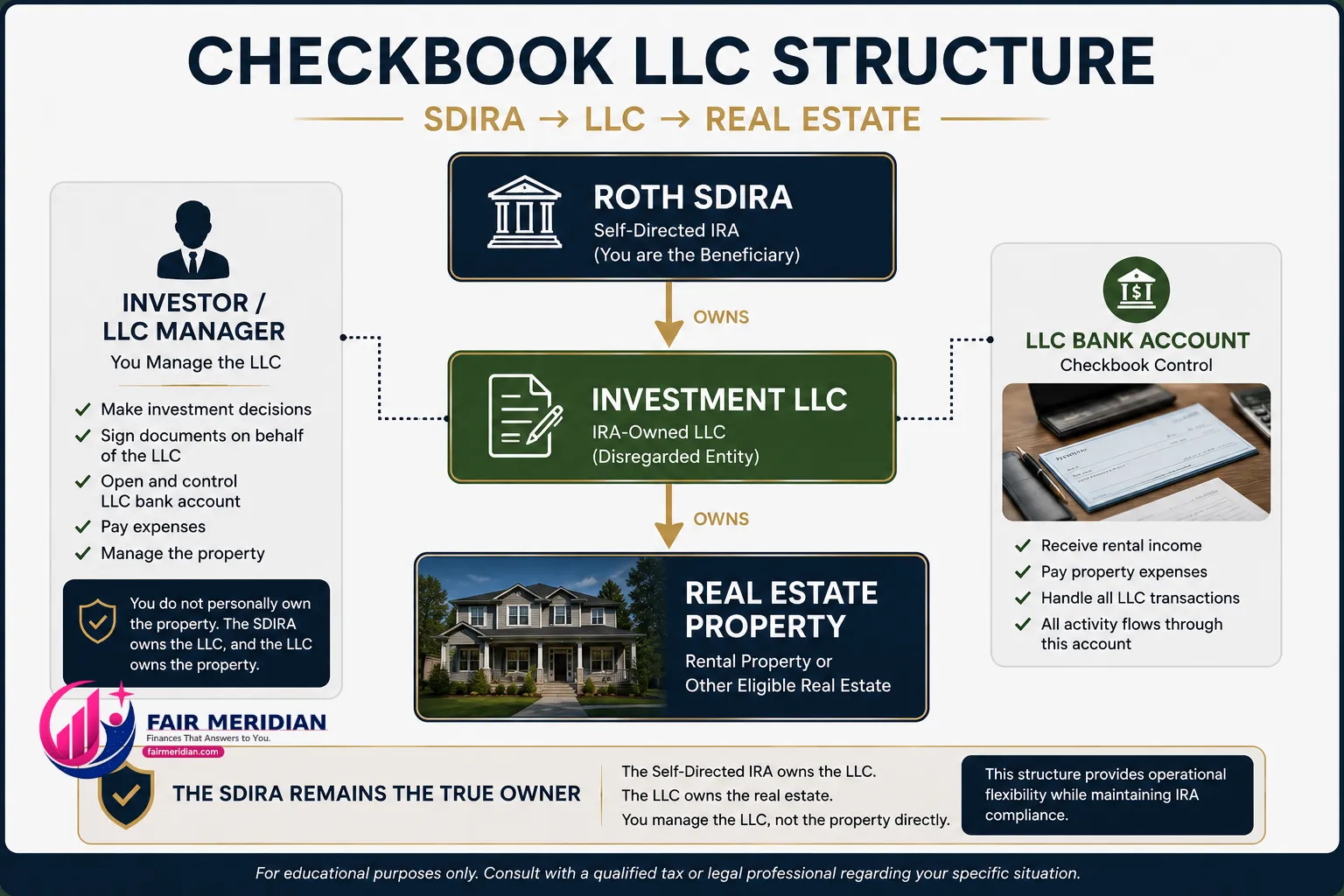
A checkbook LLC structure can give SDIRA investors greater operational control over eligible real estate investments while keeping the retirement account as the underlying owner.
Checkbook LLC Costs
Attorney to form the LLC and draft the operating agreement: $1,500–$3,000
Annual state LLC filing fee: $50–$500 depending on state
Custodian annual fee: varies (Rocket Dollar and IRA Financial are popular for checkbook LLCs)
The checkbook LLC makes sense if you're planning to purchase two or more properties over time — the operational flexibility justifies the setup cost. For a single buy-and-hold rental property, the standard SDIRA structure is sufficient.
Step-by-Step Setup
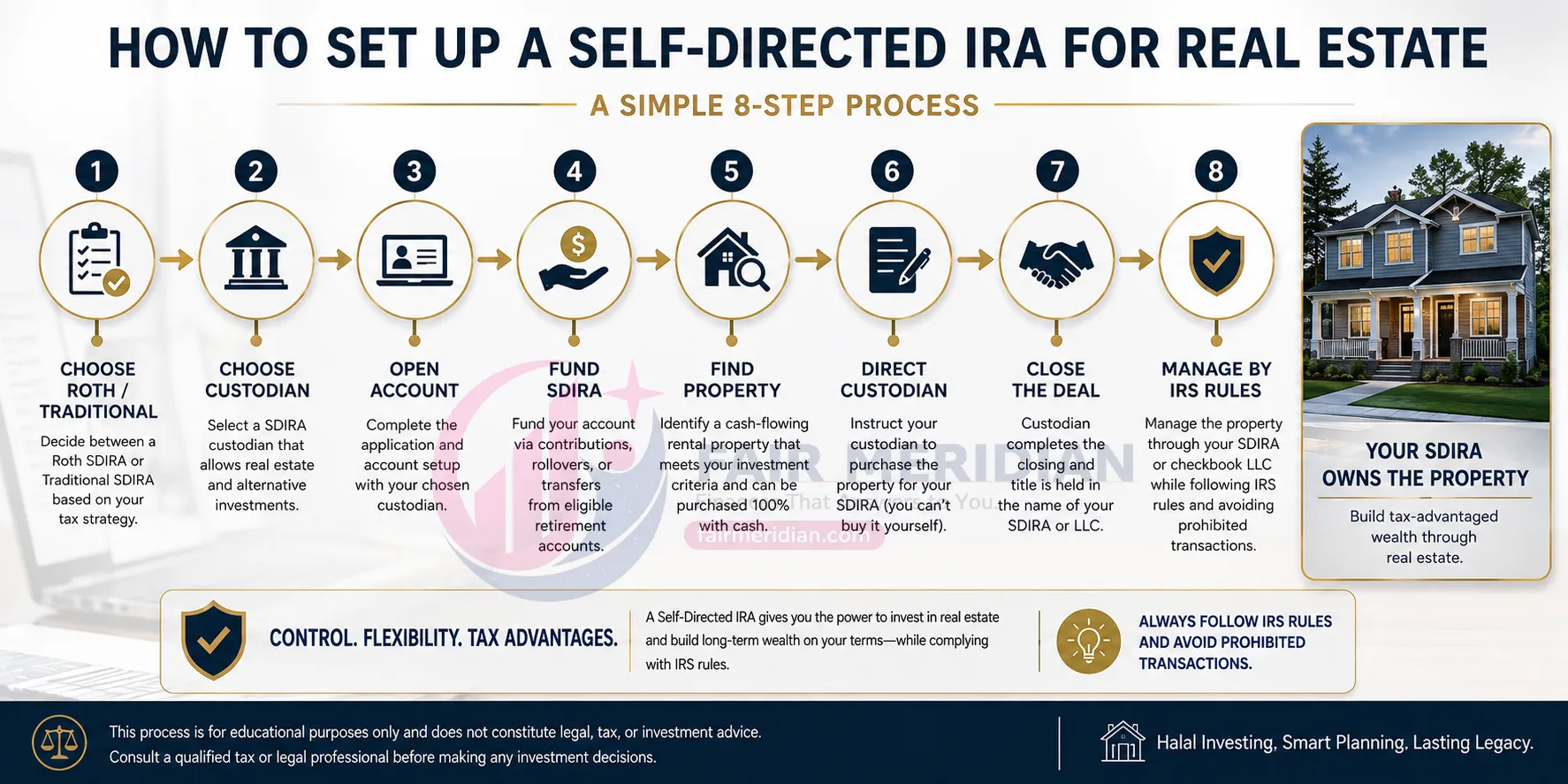
Step 1: Choose Traditional or Roth SDIRA
Choose Roth if your income qualifies: single filers under $150,000 MAGI (full contribution); $150K–$165K (phased); above $165K (not eligible for direct Roth IRA). Married filing jointly: under $236,000 full; $236K–$246K phased; above $246K not eligible.
If you earn too much for a direct Roth contribution: contribute to a Traditional SDIRA and convert to Roth (the "backdoor Roth" — legal and available to all income levels). A tax advisor familiar with this strategy can guide execution.
Step 2: Choose Your SDIRA Custodian
Custodian | Annual Fee | Best For | Checkbook LLC? |
|---|---|---|---|
Equity Trust | $225–$2,250 (asset-based) | First SDIRA real estate investors; most established | Yes (additional cost) |
Rocket Dollar | $360/yr flat | Flat-fee simplicity; includes checkbook LLC option | Yes (included) |
IRA Financial | $400/yr flat | Active investors; checkbook LLC built in | Yes (specialty) |
Alto IRA | $10/mo + $10/investment | Smaller starting balances; simple investments | Limited |
Entrust Group | $199–$1,999 (asset-based) | Wide alternative asset support; educational resources | Yes |
Recommendation for most Muslim investors starting their first SDIRA real estate investment: Equity Trust (most experience, best support for first-time SDIRA real estate transactions) or Rocket Dollar (flat fee, checkbook LLC included, clean interface).
Step 3: Open the Account
Apply online at your chosen custodian. You'll need: government-issued ID, Social Security Number, and basic personal information. Account opening typically takes 1–3 business days. Select "Roth SDIRA" as the account type.
Step 4: Fund the SDIRA
Three options:
Direct contribution: Up to $7,000/year (2026; $8,000 if age 50+). Takes time to accumulate enough for a cash property purchase — plan for a multi-year accumulation strategy.
Rollover from existing 401k: If you have a 401k from a current or former employer invested in conventional funds, you can roll it over to your SDIRA. Traditional 401k → Traditional SDIRA: no immediate tax. Traditional 401k → Roth SDIRA: you pay income tax on the converted amount in the year of conversion — meaningful cost but creates permanent tax-free compounding from that point.
IRA transfer: Transfer from an existing Traditional or Roth IRA at Fidelity/Schwab to your SDIRA. No tax consequence for same-type transfers.
Step 5: Identify Your Property
Target markets where SDIRA balances can buy properties outright with 100% cash. See the target market table below. Engage a local real estate agent, identify the property, negotiate the price. Do not sign a purchase agreement yet — the SDIRA must be the buyer.
Step 6: Direct the Custodian
Submit an "Investment Direction" form to your SDIRA custodian specifying: property address, purchase price, and directing them to issue funds at closing. The purchase contract must be signed by the custodian on behalf of your IRA — not by you personally. Title will read: "Equity Trust Company, Custodian FBO [Your Name] Roth IRA" (or equivalent for your custodian).
Step 7: Close on the Property
Standard closing process with a title company. Note: the closing attorney must be familiar with SDIRA closings — not all title companies have experience with this. Ask your custodian for a list of title companies experienced with SDIRA closings in your target market. Budget 2–3 additional weeks vs a conventional closing for custodian processing.
Step 8: Manage the Property by the Rules
All rental income to the SDIRA. All expenses from the SDIRA. All maintenance by third-party contractors. No personal use. Keep $5,000–$10,000 cash reserve in the SDIRA account at all times for property expenses. Use a third-party property management company if you want to minimize prohibited-transaction risk from your own involvement.
Target Markets — Where the Math Works
The cash-purchase requirement filters you toward markets with lower entry prices — which typically also have higher cap rates (net rent as percentage of price). This is financially advantageous, not a limitation.

Market | Median Entry Price | Est. Annual Net Yield | Muslim Community | SDIRA-Feasible With |
|---|---|---|---|---|
Hamtramck, MI | ~$140,000 | ~7–9% | Muslim majority city; Arab-American; Yemeni | $150K SDIRA balance |
Dearborn Heights, MI | ~$195,000 | ~6–7% | Large Arab-American Muslim community | $210K SDIRA balance |
Utica, NY | ~$160,000 | ~7–9% | Bosnian, Somali communities | $175K SDIRA balance |
Buffalo, NY | ~$200,000 | ~6–8% | Yemeni, Somali, South Asian | $220K SDIRA balance |
Cleveland, OH | ~$150,000 | ~7–10% | Growing Muslim community | $165K SDIRA balance |
Memphis, TN | ~$190,000 | ~7–9% | Growing; university markets | $210K SDIRA balance |
Pittsburgh, PA | ~$175,000 | ~6–8% | Small but established Muslim community | $195K SDIRA balance |
"SDIRA-Feasible With" includes ~$10K–$15K cash reserve for closing costs and property expense reserves inside the account. Net yield estimates are approximate — conduct your own due diligence on specific properties.
The Hamtramck opportunity specifically: At ~$140,000 median price, Hamtramck is uniquely positioned for Muslim SDIRA investors. It is the only Muslim-majority city in the United States, has stable rental demand from a multi-generational Arab-American community, and is accessible enough that a $150,000 SDIRA balance — achievable by rolling over a 401k from a decade of employment — can buy a property outright and begin generating halal rental income immediately.
How to Build Your SDIRA Balance Before Buying
If you don't yet have the SDIRA balance to purchase a target property in cash, here is the accumulation strategy:

Open the Roth SDIRA now and hold SPUS or SPRE ETF inside it while accumulating. Earn halal market returns on your balance until it's large enough to buy real estate. At $583/month in SPUS at 9%: $75,000 in approximately 8 years; $150,000 in approximately 13 years.
Roll over an existing 401k if you have one. Many Muslim professionals have $50,000–$200,000 sitting in a 401k from current or past employers invested in conventional funds. Rolling over to a Roth SDIRA (with tax on conversion) or Traditional SDIRA (no immediate tax) immediately gives you a meaningful starting balance for real estate.
Accelerate with a musharakah partnership: If your SDIRA balance isn't sufficient for a solo purchase, two Muslim investors can pool their SDIRAs into a co-owned property through a tenants-in-common structure. Each SDIRA owns a percentage share proportional to its contribution. This approach requires careful legal structuring — work with an attorney experienced in multi-IRA real estate ownership.
Frequently Asked Questions
Is an SDIRA halal?
The SDIRA is a legal container with no intrinsic halal or haram characteristics. It is halal when the investments inside it are halal. For real estate specifically: a property purchased with 100% cash (no conventional mortgage) inside a Roth SDIRA is halal — it generates permissible rental income that compounds permanently tax-free. The container is halal; the investments determine compliance.
Can I use non-recourse financing inside my SDIRA?
Not for a halal portfolio. Non-recourse SDIRA loans are conventional interest-bearing loans — riba — regardless of the IRA wrapper around them. The interest is charged to the IRA and reduces your return, but the transaction itself is not halal. Muslim SDIRA real estate investors must use 100% cash purchases. This is also operationally simpler — non-recourse loans trigger UDFI (Unrelated Debt-Financed Income) tax complications that partially offset the IRA's tax advantage even for conventional investors.
What is the minimum amount I need to start an SDIRA?
You can open most SDIRAs with no minimum balance. The practical minimum for SDIRA real estate investment in accessible markets is approximately $150,000–$165,000 (enough to purchase a property and maintain a $10,000–$15,000 cash reserve for expenses). While building toward that balance, hold SPUS or SPRE ETF inside the SDIRA and earn halal market returns on your accumulating balance.
Can my family rent a property inside my SDIRA?
No — not "disqualified persons." Your spouse, parents, grandparents, children, grandchildren, and their spouses cannot rent, use, or benefit from a property inside your SDIRA. Tenants must be unrelated third parties at fair market rent. This is an IRS rule with severe consequences for violation (the entire IRA is treated as distributed).
What happens to the SDIRA property when I reach retirement age?
After age 59½, you can take distributions from the SDIRA without penalty. Options: (1) the SDIRA sells the property and distributes cash to you; (2) the SDIRA distributes the property itself to you (in-kind distribution) — the property transfers to your personal ownership and you can then use it personally, including as a personal residence. In a Roth SDIRA: both options are tax-free after the 5-year holding period and age 59½ requirements are met.
For the complete halal real estate investing framework — including SPRE ETF, musharakah partnerships, and the capital-level comparison — read our Halal Real Estate Investing USA 2026 guide. For the waqf strategy that converts your SDIRA property into a permanent Islamic endowment, read our Waqf Property USA guide.