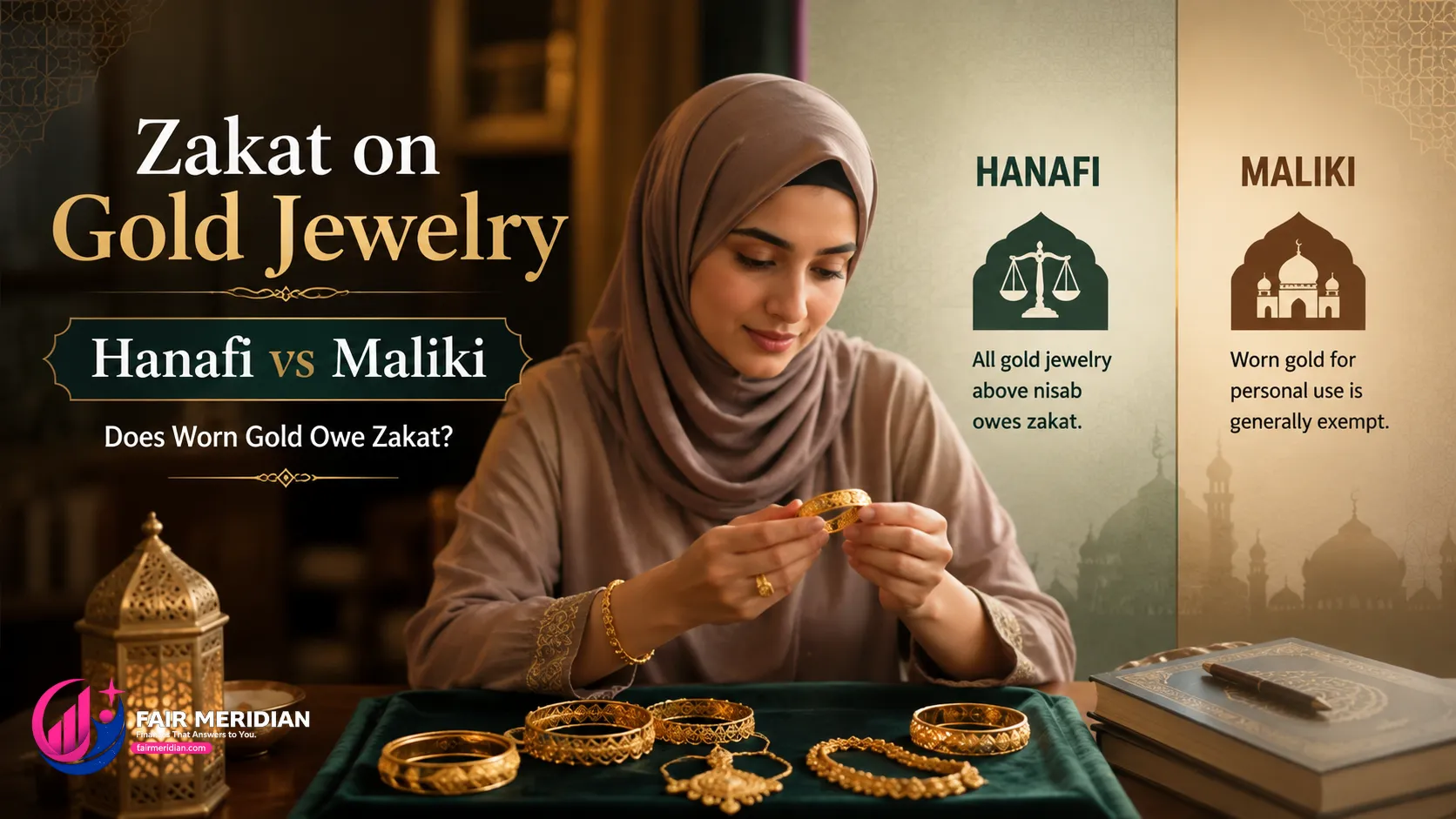
The question of zakat on gold jewelry produces genuinely different answers from equally qualified scholars — and the difference is not a matter of one side being right and the other wrong. It is a 1,400-year-old disagreement rooted in how classical scholars interpreted competing hadith and applied principles of Islamic property law to ornamental gold. The Hanafi madhab says all gold jewelry above the nisab owes zakat, without exception. The Maliki and Shafi'i madhabs say gold worn regularly for personal use is exempt. This post explains exactly why both positions exist, which applies to you based on your tradition, and how to calculate precisely what you owe if you do.
Which madhab am I? Quick reference: Most South Asian Muslims (Pakistan, India, Bangladesh) follow the Hanafi madhab. Most Arabs from North Africa and West Africa follow Maliki. Most Arabs from the Gulf, Levant, and Egypt, and most Southeast Asian Muslims (Indonesia, Malaysia), generally follow Shafi'i. Most Saudis and some Gulf Arabs follow Hanbali. If you're unsure, ask your local imam or follow what your family has always done — madhab consistency matters more than switching positions.
The Four Madhab Positions — Summary First
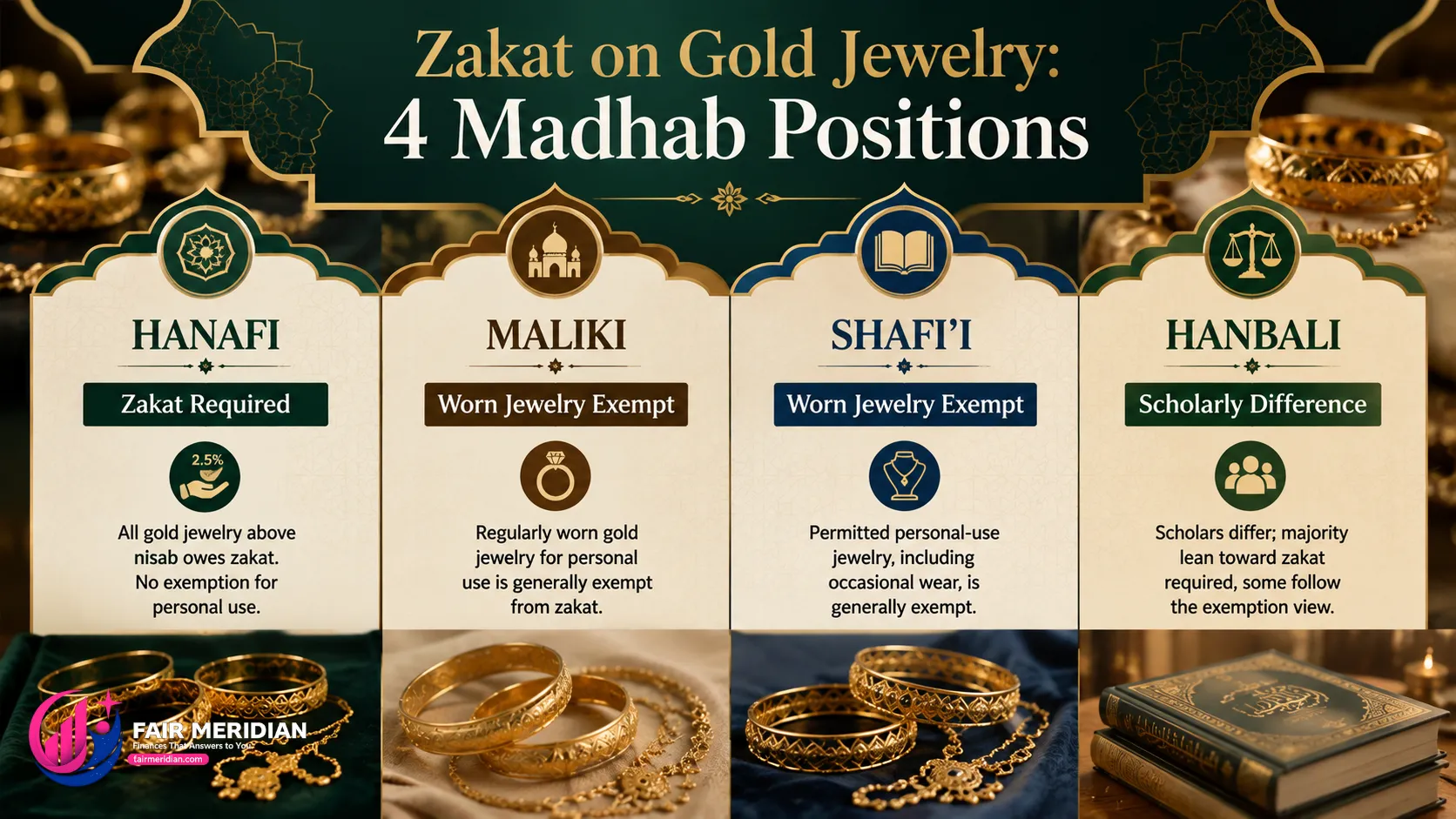
Madhab | Position on Worn Jewelry | Position on Stored Jewelry | Primary Scholarly Basis |
|---|---|---|---|
Hanafi | ✅ Zakat obligatory — no exemption for personal use | ✅ Zakat obligatory | Abu Dawud hadith (woman with gold bracelets); Umm Salamah hadith; gold is wealth (mal) regardless of form |
Maliki | ❌ Exempt if worn regularly for permitted personal use | ✅ Zakat obligatory | Muwatta narrations; companion reports (athar); jewelry for use is mal al-qunya, not investment capital |
Shafi'i | ❌ Exempt if worn for permitted personal use (including occasional wear) | ✅ Zakat obligatory | Al-Nawawi in Al-Majmu'; jewelry is utility good like clothing; companions' practice; same logic as Maliki |
Hanbali | ❌ Exempt according to the majority/relied-upon position; another view requires zakat | ✅ Zakat obligatory | Ibn Qudama discusses the differing views and supports the position that permissible jewelry prepared for personal adornment is not subject to zakat |
The Hadith Debate — Why Scholars Disagree
The disagreement is not arbitrary — it reflects genuine differences in how scholars evaluated competing evidence. Understanding the hadith on each side explains why both positions have been held by qualified scholars for centuries.

The Hadith Supporting Zakat on ALL Jewelry (Hanafi Position)
Hadith 1 — The Woman with Gold Bracelets (Abu Dawud 1563)
A woman came to the Prophet (ﷺ) with her daughter who was wearing two heavy gold bracelets. The Prophet said: "Do you pay the zakat on these?" She said: "No." He said: "Would it please you that Allah should put on you two bracelets of fire in place of these?" She then threw them off. (Abu Dawud 1563; al-Tirmidhi 637; al-Nasa'i)
Hanafi scholars say: This is a direct prophetic command to pay zakat on worn gold bracelets — the most straightforward possible evidence. The woman was wearing the bracelets, not storing them. The Prophet did not ask whether they were worn or stored; he asked whether zakat was paid on them. The exemption for "worn" jewelry has no prophetic basis.
Maliki/Shafi'i scholars respond: The chain of this hadith has been questioned — Imam Malik did not include it in the Muwatta. Many hadith scholars (including some who authenticated it) note the chain contains narrators whose reliability is disputed. Imam al-Nawawi (Shafi'i) graded it as having weakness. This doesn't make it fabricated — but it means it cannot be used to establish an obligation that overrides the extensive companion practice to the contrary.
Hadith 2 — Umm Salamah's Gold Anklets (Abu Dawud 1565)
Umm Salamah (RA), a wife of the Prophet (ﷺ), narrated: "I used to wear gold ornaments. I said: 'O Messenger of Allah, is this kanz (hoarded/buried wealth)?' He said: 'What reaches the nisab and on which zakat is paid is not kanz.'" (Abu Dawud 1565)
Hanafi scholars say: The Prophet's instruction — "pay zakat on it and it is not kanz" — implies that jewelry requires zakat payment to be exempted from being "hoarded wealth." The exemption from kanz status comes specifically from paying zakat on it. Without paying zakat, jewelry IS kanz.
Maliki/Shafi'i scholars say: The Prophet told her that if she pays zakat on it (when it applies to her situation), it is not kanz — but this doesn't establish that zakat always applies to worn jewelry. It establishes that paying zakat is the remedy for kanz; it presupposes that the jewelry in question has reached a level that warrants evaluation.
The Companion Reports Supporting Exemption (Maliki/Shafi'i Position)
The Maliki and Shafi'i positions rest heavily on the practice of the Prophet's companions (Sahabah), which classical scholars treat as authoritative legal evidence.
Report 1 — Aisha (RA): No Zakat on Worn Jewelry
Aisha (RA), the Prophet's wife, reportedly held and practiced that gold jewelry worn by women does not require zakat. This report is narrated through multiple chains and is accepted as reliable by Imam Malik. Crucially: Aisha lived with the Prophet and would have been aware of any general instruction he gave on jewelry zakat. Her practice of not paying zakat on worn jewelry despite this proximity to prophetic guidance is treated by Maliki scholars as strong evidence that the Prophet's instructions on jewelry zakat applied to stored/excessive jewelry, not all gold.
Report 2 — Abdullah ibn Umar (RA): Daughters' Jewelry
Abdullah ibn Umar (RA) reportedly dressed his daughters and female servants in gold jewelry and did not pay zakat on it. (Narrated in Imam Malik's Muwatta) Ibn Umar was one of the most scrupulous companions in following the Prophet's practice. His established habit of not paying zakat on his daughters' jewelry — despite having direct knowledge of all prophetic narrations — is treated by Maliki scholars as definitive evidence for the exemption of worn jewelry.
Report 3 — Jabir ibn Abdillah (RA)
Jabir ibn Abdillah is reported to have said: "There is no zakat on gold jewelry (women's ornaments)." Though the chain of this report has some weakness, it adds to the pattern of companion practice supporting the exemption.
The Scholarly Weight — Who Has the Stronger Evidence?
Both positions have genuine scholarly foundations. The honest assessment:
The hadith directly supporting zakat on all jewelry (Abu Dawud 1563) have been authenticated by some scholars (al-Hakim, Ibn Khuzaymah) and questioned by others (Imam Malik excluded them; al-Nawawi noted weakness)
The companion reports supporting the exemption of worn jewelry are accepted as reliable in Maliki and Shafi'i scholarship — and the companions include people who lived with the Prophet and had direct knowledge of his practice
This is why the difference persists across 1,400 years of Islamic jurisprudence — it is not one side being ignorant of the other's evidence; it is qualified scholars reaching different conclusions from the same body of evidence
The Islamic Property Law Principle — Why the Distinction Matters
Beyond the hadith debate, the Maliki and Shafi'i position rests on a principle of Islamic property law: the distinction between mal al-qunya (property for personal utility) and mal al-nama (wealth capable of growth/investment).
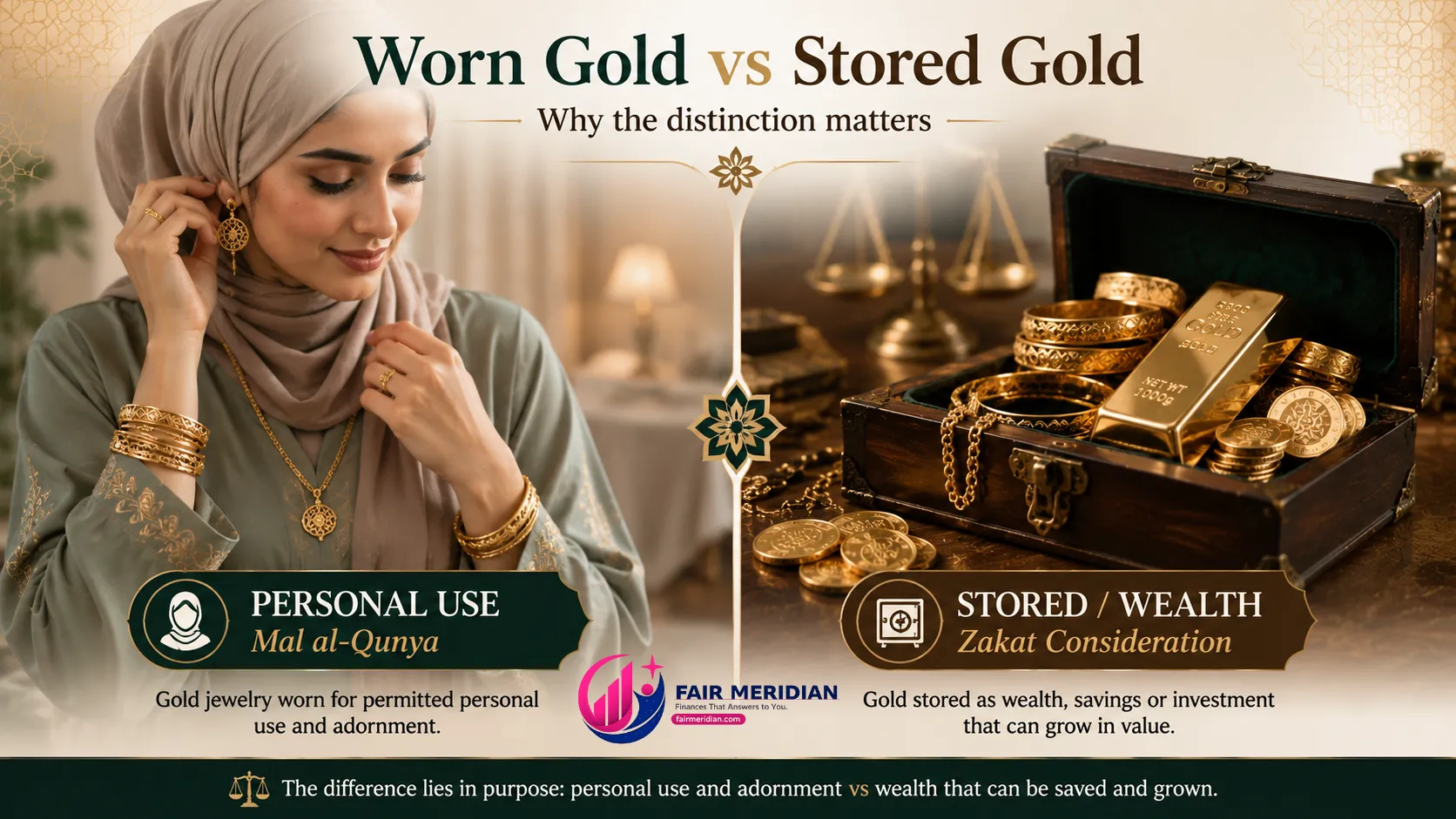
Zakat is an obligation on growing wealth — not on personal use goods. Your car, your furniture, your clothes, your kitchen appliances all have value but are not zakatable because they serve a utility function in your daily life. Maliki and Shafi'i scholars extend this principle to gold worn as personal adornment (al-tazayyun) — jewelry that is genuinely worn for its intended purpose has transitioned from capital asset to utility item, like clothing.
The Hanafi counter-argument: gold is inherently currency in Islamic legal theory (thaman) because it is the basis of Islamic monetary value. Unlike a car or furniture, gold retains its nature as a monetary commodity regardless of what shape it's made into. A gold bangle is still gold — the goldsmith's work doesn't change the underlying commodity's legal nature.
The Four Key Scenarios — Which Rule Applies
Scenario | Hanafi | Maliki | Shafi'i | Hanbali (majority) |
|---|---|---|---|---|
Gold jewelry worn daily (rings, bangles you always wear) | ✅ Zakat obligatory | ❌ Exempt | ❌ Exempt | ❌ Exempt according to the majority/relied-upon view; another view requires zakat |
Gold jewelry worn occasionally (Eid, weddings, special occasions) | ✅ Zakat obligatory | ⚠️ Disputed — some Maliki scholars require regular wear for exemption | ❌ Exempt (occasional use for permitted purposes) | ✅ Zakat obligatory |
Gold jewelry stored in a box, never or rarely worn | ✅ Zakat obligatory | ✅ Zakat obligatory — stored gold is not mal al-qunya | ✅ Zakat obligatory | ✅ Zakat obligatory — all agree |
Excessive luxury gold beyond customary adornment | ✅ Zakat obligatory | ✅ Zakat obligatory — Maliki exemption applies only to customary amounts | ✅ Zakat obligatory — excessive quantity loses utility exemption | ✅ Zakat obligatory |
Gold given as mahr (dowry) | ✅ Zakat obligatory once hawl passes | ❌ Exempt if worn; ✅ if stored | ❌ Exempt if worn; ✅ if stored | ✅ Zakat obligatory |
Gifted gold (wedding gifts, family gifts) | ✅ Zakat obligatory once hawl passes | ❌ Exempt if worn regularly | ❌ Exempt if worn for permitted use | ✅ Zakat obligatory |
Gold bought as investment (coins, bars, ETF) | ✅ Zakat obligatory | ✅ Zakat obligatory | ✅ Zakat obligatory | ✅ Zakat obligatory |
The Nisab for Gold — 2026
Regardless of which madhab you follow, zakat on gold only becomes obligatory when the gold (and/or total zakatable wealth) exceeds the nisab threshold and a full lunar year (hawl) has passed while above it.
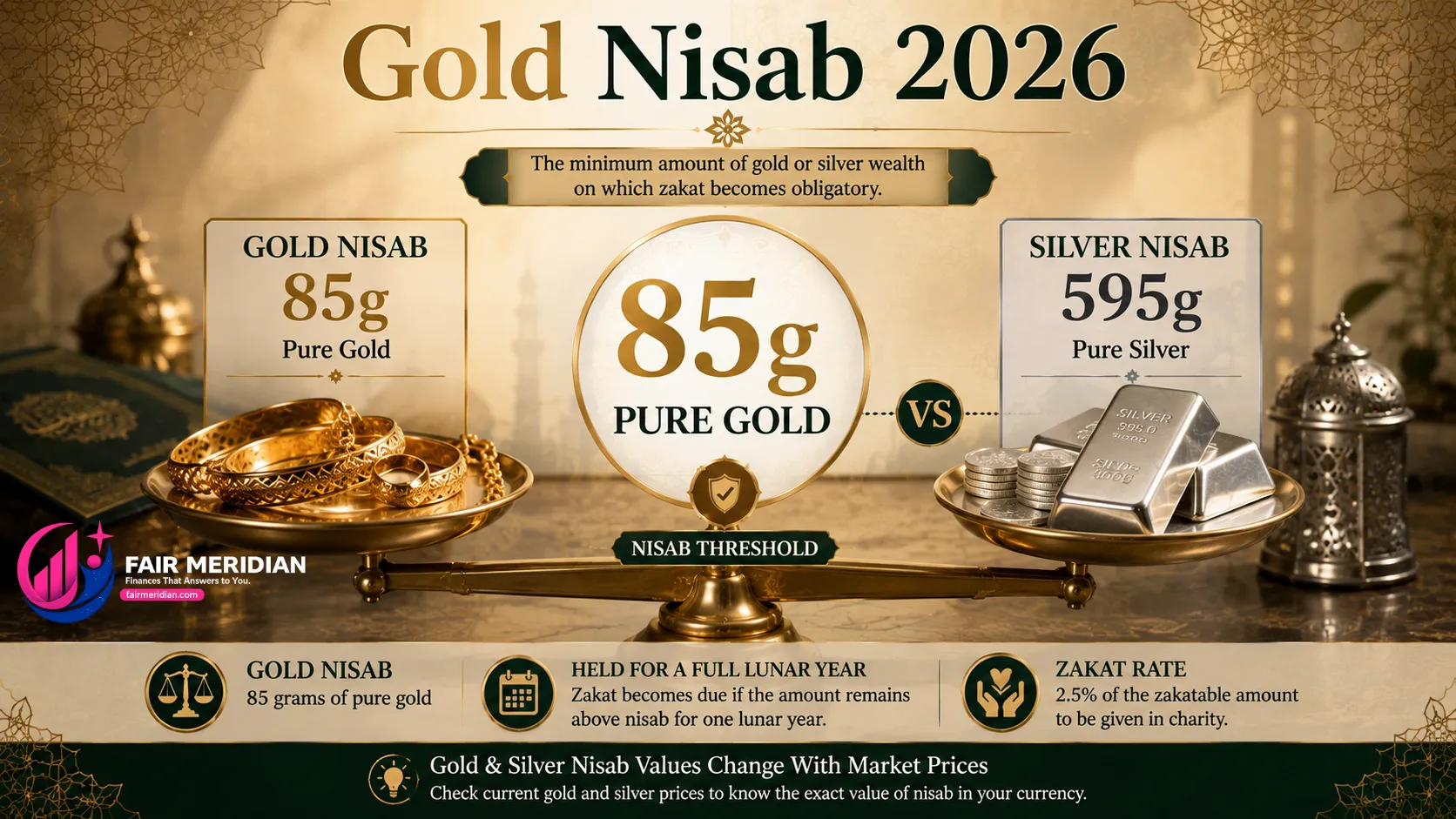
Nisab Standard | Weight | AUG 2026 Value | Which to Use |
|---|---|---|---|
Gold Nisab | 85 grams of pure (24K) gold | ~$11,909 | Most commonly cited; higher threshold |
Silver Nisab | 595 grams of silver | ~$1,235 | Lower threshold; used by most North American scholars to ensure more Muslims fulfill obligation |
Gold spot price August 14, 2026: ~$4,357.63/troy oz (1 troy oz = 31.1035 grams). Silver: ~$64.57/troy oz. Values are based on international bullion/spot prices.
Critical point most women miss: You do not evaluate your jewelry in isolation to determine if you owe zakat. You add ALL zakatable assets together — cash savings, gold (jewelry included for Hanafi, or stored-only for Maliki/Shafi'i), silver, stocks (at their zakatable assets ratio), business inventory. If the TOTAL exceeds the nisab and has for a full lunar year, zakat is owed on ALL of it — including the gold. A woman who has $500 in cash savings and 100 grams of gold jewelry may owe zakat on both under the silver nisab ($1,236), even though the cash alone would not trigger it.
The Calculation — Step by Step with 2026 Prices
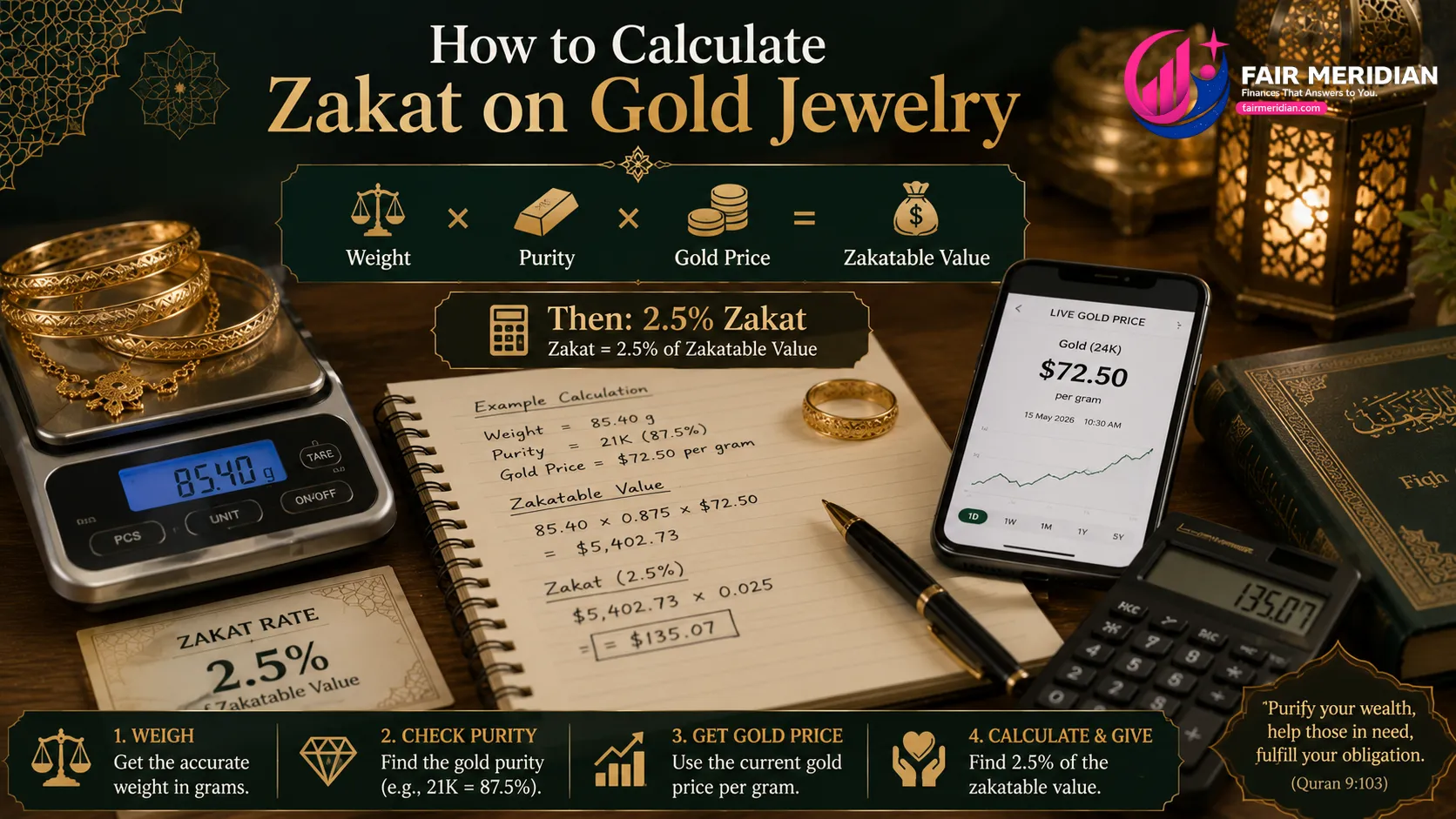
Step 1: Determine Your Gold's Purity and Weight
Gold jewelry is almost never pure 24K gold — it is alloyed for durability. Find the karat marking inside your ring, on the clasp of your necklace, or on the loop of your earrings. If you cannot find a marking, a jeweler can test the purity.
Karat Marking | Gold Purity % | Value per gram (AUG 2026) |
|---|---|---|
24K | 99.9% | ~$139.96 |
22K | 91.7% | ~$128.46 |
21K | 87.5% | ~$122.59 |
18K | 75.0% | ~$105.08 |
14K | 58.3% | ~$81.68 |
10K | 41.7% | ~$58.42 |
Per-gram values = ($4,357.63/31.1035) × purity %. Zakat is calculated on the gold content value only — not the jewelry's retail price (which includes craftsmanship markup).
Step 2: Weigh Your Jewelry
Use a digital kitchen scale accurate to 0.1 grams, or take your jewelry to a jeweler to be weighed. Weigh each piece separately and note its karat. Do not include the weight of gemstones (diamonds, rubies, emeralds) — only the gold setting. Most jewelers can provide the gold weight separately from stone weight.
Step 3: Calculate Each Piece's Zakatable Value
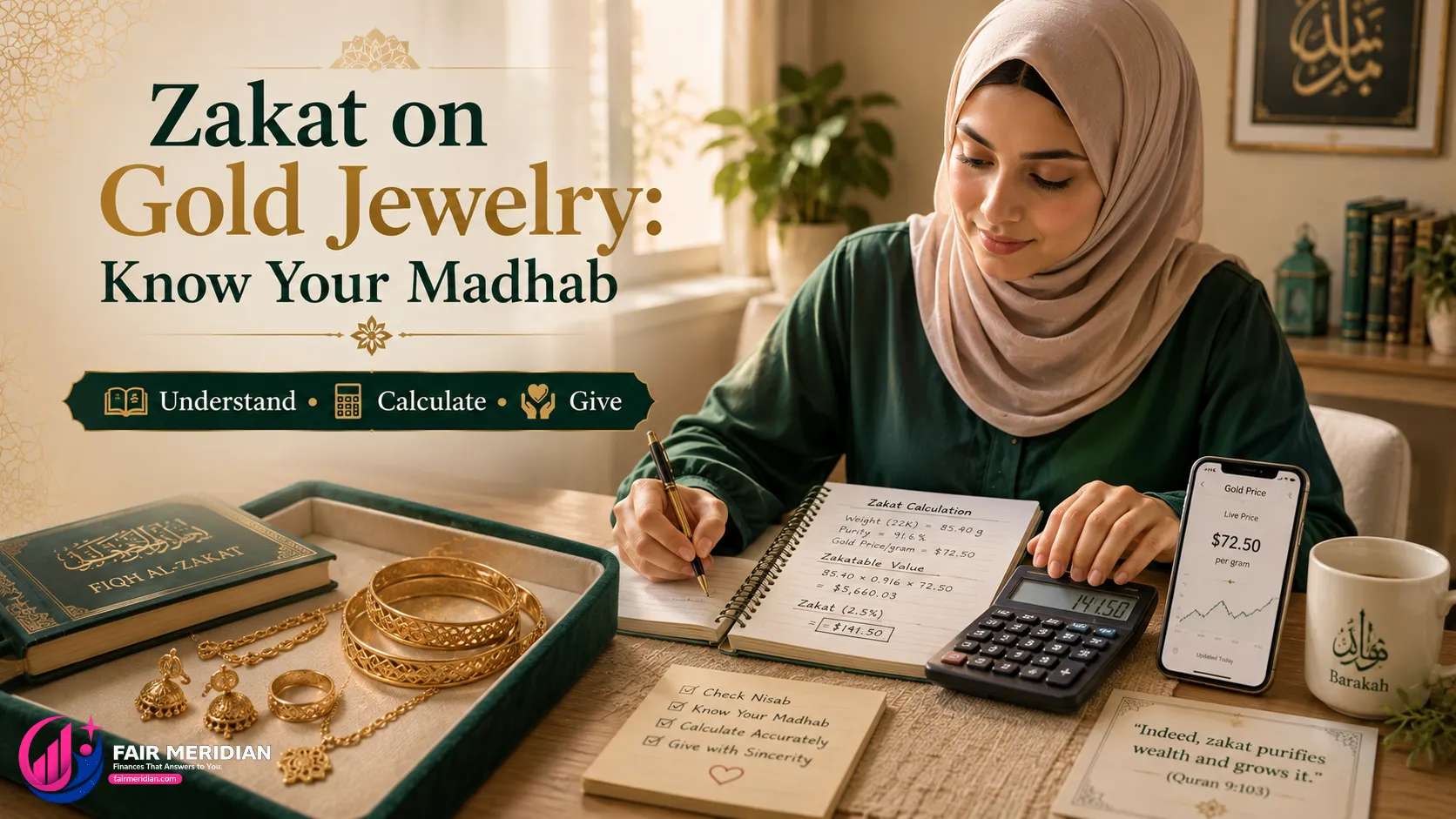
Formula: Weight (grams) × Purity % × Gold spot price per gram = Zakatable value
Example calculation:
Item | Weight | Karat | Gold Content | Value per gram | Zakatable Value |
|---|---|---|---|---|---|
Wedding bangles (set of 4) | 32g | 22K | 29.3g pure | ~$128.46 | $4,111 |
Gold necklace | 18g | 22K | 16.5g pure | ~$128.46 | $2,312 |
Gold earrings | 8g | 18K | 6g pure | ~$105.08 | $841 |
Gold ring (mahr) | 5g | 22K | 4.6g pure | ~$128.46 | $642 |
Total gold jewelry | 63g | 56.4g pure | $7,906 |
Step 4: Add All Zakatable Wealth and Check Nisab
Asset | Value |
|---|---|
Gold jewelry (from above) — Hanafi only; Maliki/Shafi'i: worn exempt | $7,906 |
Cash savings / current account | $3,200 |
Investment account (SPUS × 34.2% zakatable ratio) | $850 |
Silver (if any) | $0 |
Total zakatable wealth (Hanafi) | $11,956 |
Total zakatable wealth (Maliki/Shafi'i, worn jewelry exempt) | $4,050 |
Nisab check: Silver nisab is approximately $1,236 at August 14, 2026 silver prices. Both totals exceed this threshold.
Step 5: Calculate the Zakat Owed
Hanafi — zakat on full $11,956:
$11,956 × 2.5% = $298.90
Maliki/Shafi'i — zakat on $4,050 (jewelry exempt):
$4,050 × 2.5% = $101.25
The "She Doesn't Know the Weight" Problem
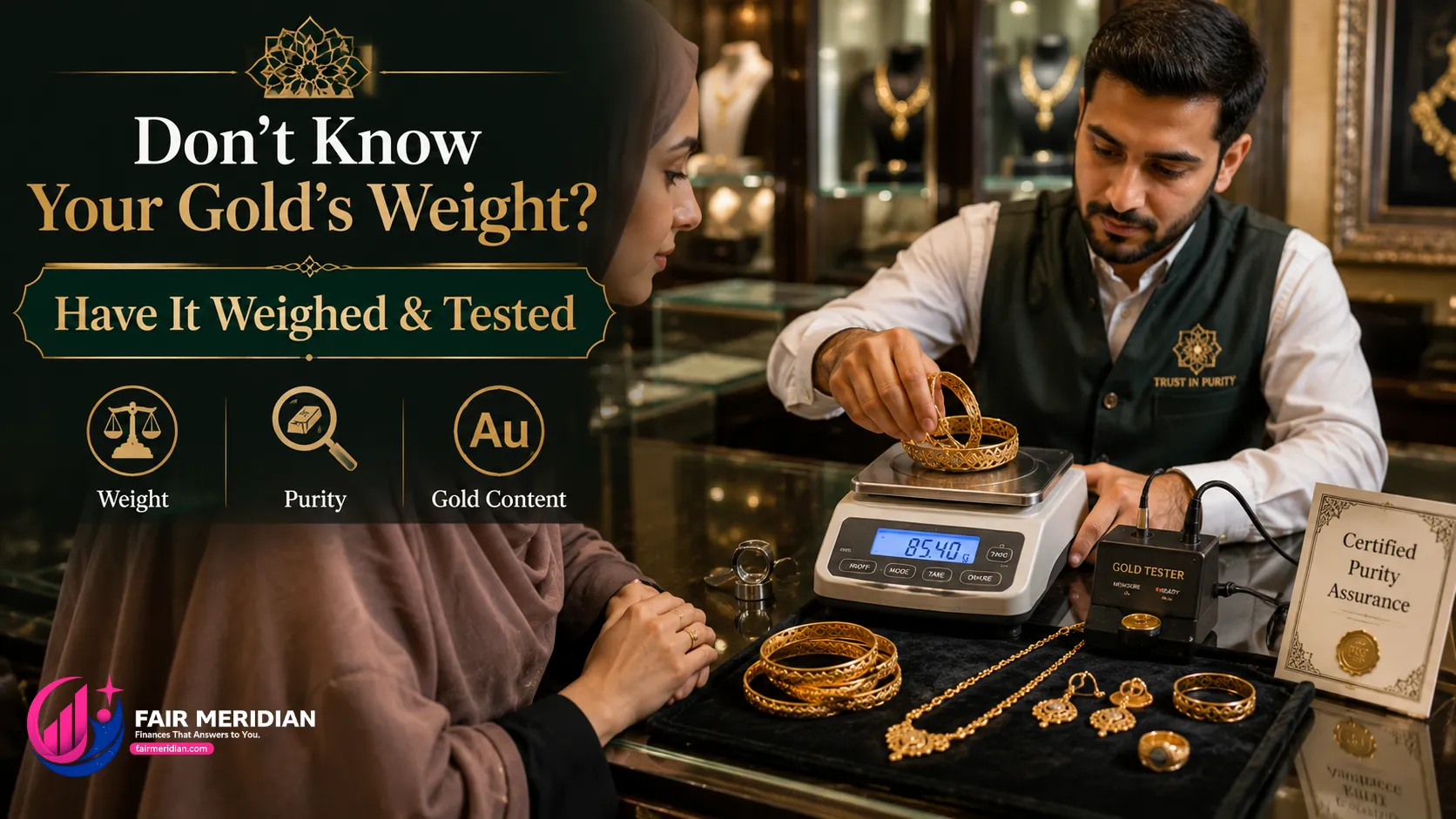
Many women — particularly those with inherited gold or gold received as wedding gifts over many years — genuinely don't know the weight or purity of each piece. This is common and there is a practical Islamic solution:
Take all your gold to a jeweler and ask for the total weight and an estimate of the average purity. Many jewelers will do this for free or for a small fee.
If you cannot determine purity: Use 18K (75%) as a conservative estimate for South Asian gold (typically 21K–22K) or 14K for Western-style jewelry. Using a lower purity estimate means you may slightly overpay zakat — which scholars treat as sadaqah rather than a problem.
For past years you missed: Scholars generally hold that if you did not know zakat was due on jewelry, you should pay for the current year and make an intention to make up missed years gradually. Paying zakat on all past years at once is encouraged but not mandatory for those who genuinely did not know.
The Mahr (Dowry Gold) Question
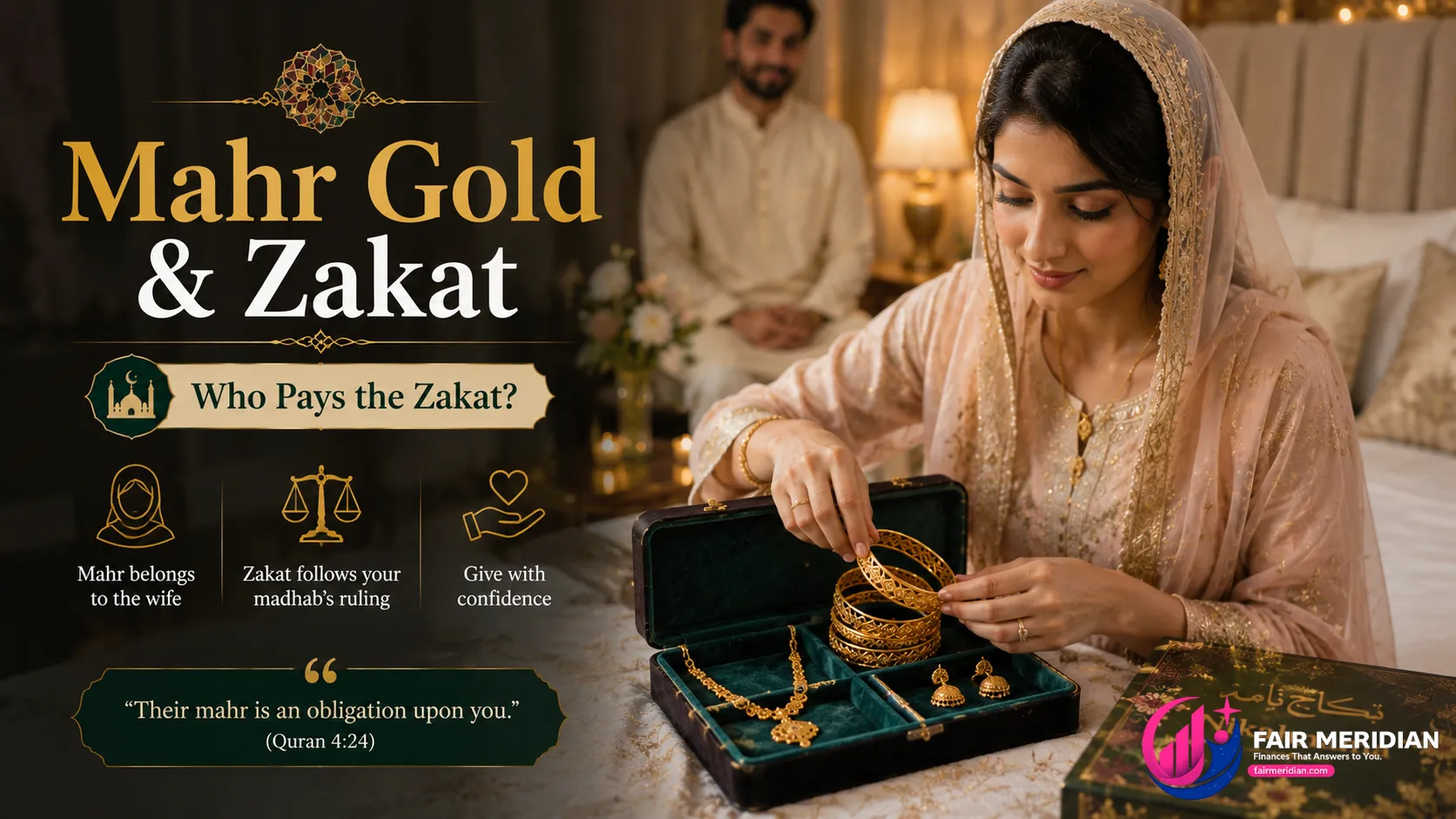
Many Muslim women received gold as mahr — the bridal gift that is their personal property. The zakat rules for mahr gold follow the same madhab-based framework:
Hanafi: Zakat is owed on mahr gold from the moment it comes into her possession and she has had it for a full hawl (lunar year) while total zakatable wealth exceeds nisab. The fact that it was given as mahr does not exempt it from zakat.
Maliki/Shafi'i: If she wears the mahr gold regularly, it is exempt under the worn-jewelry exemption. If she stores it, zakat applies.
Who pays — her or her husband? The mahr gold is the wife's personal property — zakat on it is her obligation, not her husband's. However, it is common in Muslim households for the husband to pay on behalf of the wife as a household practice. Either is valid; what matters is that the zakat is paid.
Gemstones in Gold Settings — Do Diamonds Owe Zakat?
Diamonds, rubies, emeralds, pearls, and other precious stones do not owe zakat under any madhab — with one exception: if they are bought specifically for trade (resale business). The zakat calculation covers only the gold component of jewelry, not the stones. When a jeweler weighs your jewelry for zakat purposes, they should provide the gold weight separately.
Item | Zakatable for Personal Use? | Zakatable for Trade Inventory? |
|---|---|---|
Gold in jewelry | Hanafi: Yes. Maliki/Shafi'i: If stored | Yes — all madhabs |
Diamond in ring | No — all madhabs | Yes — if held as trade inventory |
Ruby, emerald, sapphire | No — all madhabs | Yes — if held as trade inventory |
Pearl jewelry | No — all madhabs | Yes — if held as trade inventory |
Platinum and White Gold — Not Gold for Zakat
A common question: does white gold jewelry owe zakat?
White gold is yellow gold alloyed with white metals (palladium, nickel) and rhodium plated. It contains real gold — typically 14K (58.3%) or 18K (75%). Zakat applies to the gold content at the same rates above. The rhodium plating contains no gold and is ignored.
Platinum is a different metal entirely — not gold or silver. Classical Islamic jurisprudence does not identify platinum as a zakatable metal. Contemporary scholars generally hold that platinum jewelry does not owe zakat unless it is held for trading. This is one area where modern scholars have applied ijtihad — there is minority scholarly opinion that platinum, as a precious metal of high value, should be zakated by analogy, but the majority does not require it for personal jewelry.
Frequently Asked Questions
Is zakat obligatory on gold jewelry I wear every day?
It depends on your madhab. If you follow the Hanafi madhab (most South Asian Muslims), zakat is obligatory on all gold jewelry above the nisab — including pieces you wear daily. The Hanafi position makes no distinction between worn and stored gold. If you follow the Maliki or Shafi'i madhab (most Arab and Southeast Asian Muslims), gold jewelry worn regularly for permitted personal use is exempt from zakat. Stored gold jewelry owes zakat under all madhabs.
How do I calculate zakat on gold jewelry?
Weigh each piece (in grams). Identify its karat purity (24K = 99.9%, 22K = 91.7%, 18K = 75%, 14K = 58.3%). Multiply: weight × purity% × current gold spot price per gram. At August 14, 2026 prices (~$140.10/gram for 24K): a 20-gram 22K bangle = 20 × 0.917 × $140.10 = ~$2,569 zakatable value. Add all your gold's zakatable value to your other zakatable assets. If the total exceeds the nisab ($1,236 silver nisab; $11,909 gold nisab) and has for a full lunar year: pay 2.5% of the total.
What is the nisab for gold in 2026?
The gold nisab is 85 grams of pure (24K) gold — approximately $11,909 at August 14, 2026 gold prices of approximately $4,357.63/troy oz. However, most North American scholars recommend using the silver nisab (595 grams of silver, approximately $1,236 at Aug 2026 silver prices) because it is lower and ensures more Muslims fulfill the obligation. When total zakatable wealth (cash + gold value + investments at zakatable ratio) exceeds approximately $1,236 under the silver-nisab method and has for a full lunar year, zakat is owed on the applicable zakatable wealth at 2.5%.
Do I owe zakat on gold I received as a wedding gift or mahr?
Yes — if you follow the Hanafi madhab. Mahr gold and gifted gold are your personal property from the moment of receipt. Once a full lunar year (hawl) has passed while your total zakatable wealth exceeds the nisab, zakat is due on all of it — including mahr and gifted gold. Maliki and Shafi'i: if you wear the mahr/gifted gold, it is exempt; if stored, zakat applies.
I have not paid zakat on my jewelry for years. What should I do?
Consult a qualified scholar in your madhab for guidance on your specific situation. The general principle: pay this year's zakat immediately and make sincere tawbah (repentance) for the years you missed if the omission was due to not knowing the obligation. Scholars generally recommend paying back years' zakat as well — calculate the best estimate for each year and pay the total. If the amount is very large, scholars permit spreading it over time while paying current zakat consistently. Ignorance of an obligation does not eliminate the debt to those entitled to receive zakat.
For the complete zakat calculation guide — covering cash, stocks, silver, and business inventory alongside gold — read our Comprehensive Zakat Guide 2026. For the nisab amount updated monthly as gold and silver prices change, see our Zakat Calculator. For the SPUS zakatable assets ratio used in investment zakat calculations, see our Halal ETFs Guide.