

There is no single correct answer to the question of zakat on a 401k — and that's not a cop-out. Three genuinely different scholarly positions exist, held by qualified Islamic scholars with legitimate reasoning behind each one. The differences between them are not trivial. On a $180,000 401k balance, Position 1 means you owe zero zakat this year. Position 3 means you owe approximately $1,170. Position 2 lands somewhere in between. Understanding which position your own scholar or tradition follows — and why — is the only way to calculate your actual obligation correctly. This post lays out all three with full reasoning and real numbers.
Why Retirement Accounts Create a Genuine Zakat Problem
Zakat has clear rules for money you can access. Cash in your checking account, gold in your possession, stocks in your brokerage — these are straightforward. You own them, they exceed the nisab, a lunar year has passed, you pay 2.5%. The 401k complicates this in several ways that classical Islamic jurisprudence never had to address, because employer-sponsored defined contribution retirement accounts didn't exist in the 7th century.

The specific features that create scholarly disagreement: you cannot access your 401k funds without a 10% early withdrawal penalty plus income taxes if you're under 59½. The money is legally yours — it's in your name, it grows based on your investment elections, you can see the balance — but accessing it before retirement has real costs attached. Is that "ownership" in the Islamic legal sense that triggers zakat? Or is the inaccessibility meaningful enough to defer or reduce the obligation? Scholars have reached three different answers.
Position 1: No Zakat Until Withdrawal
The first position holds that you owe no zakat on your 401k while the funds remain in the account. Zakat requires what classical scholars call milkiyyah tammah — complete ownership with the ability to use and dispose of the asset freely. Because a 401k imposes genuine penalties and costs on early withdrawal, the argument is that you don't have complete beneficial ownership in the Islamic legal sense. You have contingent ownership — full ownership arrives at retirement age when the funds become freely accessible.
Under this position, the year you retire and begin withdrawing — or the year you reach 59½ and the penalty disappears — is when the hawl (lunar year) clock starts on that money. One full lunar year after the funds become fully accessible, zakat becomes due. Not before.
This is the position taken by some contemporary scholars who apply classical milk al-tam (complete ownership) doctrine strictly to modern financial instruments. It has particular appeal for the argument that a 401k more closely resembles a deferred right than present wealth — you have a claim on the money, but not the money itself in any practically meaningful sense until retirement.
Dollar example on $180,000 401k: Zakat owed this year = $0.
Position 2: Zakat Due Only on Accessible Portion After Withdrawal Costs
The second position is a middle path that tries to balance the ownership reality with the access limitation. It holds that you do own your 401k — the funds are in your name, they appear in your net worth, and you could theoretically access them if you chose to pay the penalty. But because accessing them costs you the 10% penalty plus income taxes, the zakatable amount should be calculated on what you'd actually receive after those costs, not the gross balance.
In practical terms: if your 401k balance is $180,000 and you're 45 years old, withdrawing now would cost you the 10% penalty ($18,000) plus income taxes on the full amount. Assuming a 25% effective combined federal and state tax rate, you'd net approximately $112,500 after penalty and taxes. Under Position 2, you calculate zakat on that accessible net amount — $112,500 × 2.5% = $2,813. Some scholars simplify this by suggesting you calculate zakat on the balance minus the expected tax burden only, without the penalty, on the reasoning that the tax would be due on any investment liquidation.
This position is popular among scholars who want to acknowledge that the 401k is genuinely your wealth — you can't pretend $180,000 in your 401k doesn't exist for zakat purposes — while also acknowledging that its present value is not $180,000 because of the access costs.
Dollar example on $180,000 401k (age 45, estimated 35% combined tax+penalty): Net accessible value ~$117,000. Zakat owed = ~$2,925.
Position 3: Full Zakat on the Balance — Pay 2.5% on the Total
The third position — and the one many imams communicate to their communities without explaining the underlying reasoning — holds that the full 401k balance is zakatable at 2.5% every year, without reduction for the withdrawal penalty or taxes.
The reasoning: the legal ownership of the funds is clear and unambiguous. The money is yours. It shows up in your name. You control the investment elections. The inaccessibility is partial and temporary — you can access the funds at any time by paying the penalty, and the penalty disappears entirely at 59½. This is meaningfully different from money you genuinely don't own, like an inheritance that hasn't been distributed or an employer pension you haven't yet earned. Classical Islamic jurisprudence held zakat due on held wealth even when it wasn't being actively used — the 401k is held wealth in this sense.
Some scholars holding this position also point to the broader maslaha (public interest) rationale: if Muslims systematically defer all zakat on retirement accounts until withdrawal, the zakat system loses access to a massive and growing pool of Muslim wealth for decades, impoverishing the communities that depend on zakat distribution.
Dollar example on $180,000 401k: Zakat owed = $180,000 × 2.5% = $4,500.
The Three Positions Side by Side
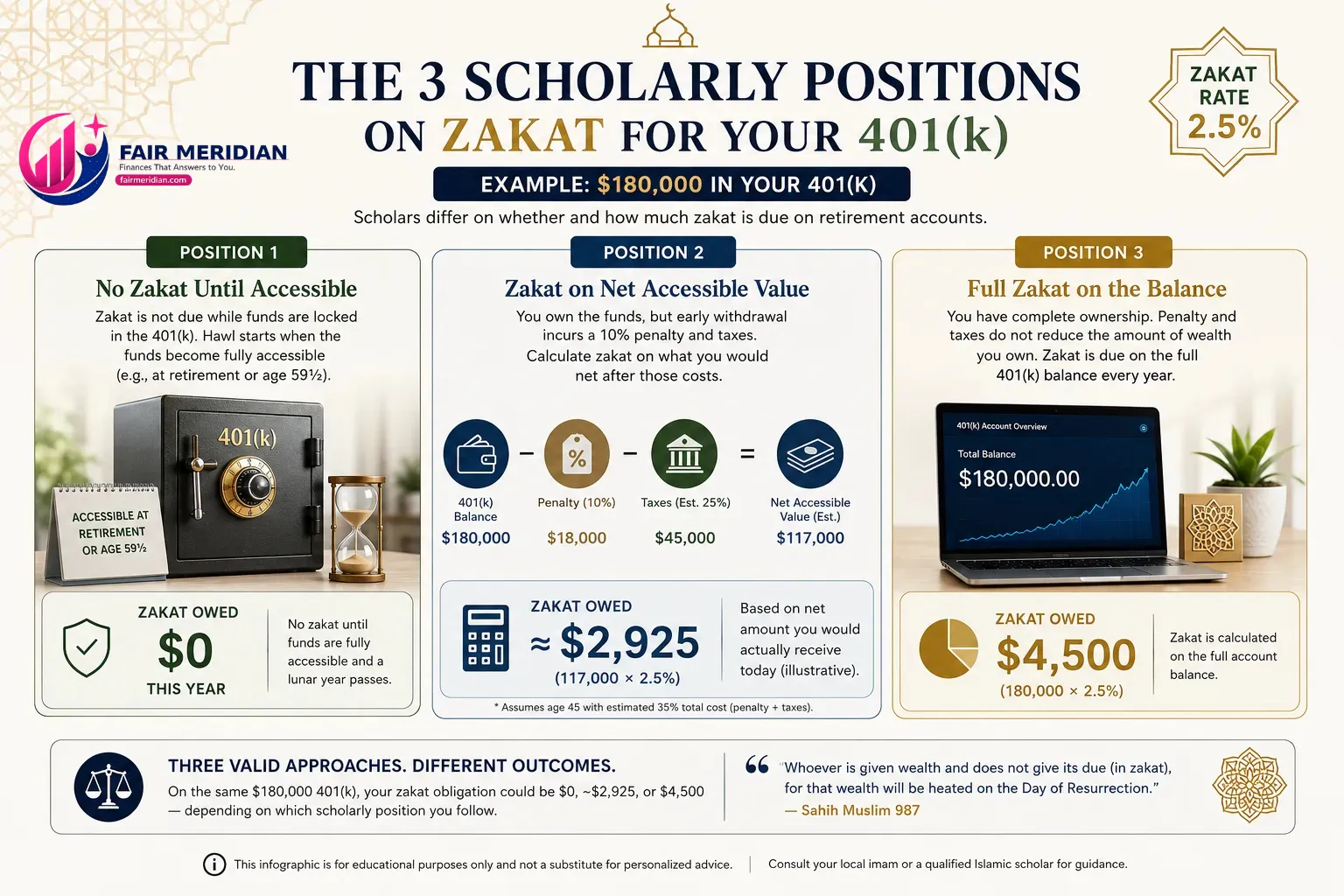
Position | Core Logic | Zakat on $180K 401k | When Hawl Starts |
|---|---|---|---|
1 — No zakat until accessible | Incomplete ownership (milkiyyah tammah) until funds freely accessible at 59½; no zakat before that milestone | $0 | At age 59½ or actual withdrawal |
2 — Zakat on net accessible value | You own it, but present value is reduced by access costs; pay on what you'd actually receive after penalty and taxes | ~$2,925 (estimated net ~$117K) | Now, on the net accessible amount |
3 — Full zakat on gross balance | You own it fully; inaccessibility is temporary and partial; 2.5% on the complete balance | $4,500 | Now, on the full balance |
What About the Roth IRA?
The Roth IRA introduces a slightly different analysis because contributions (not earnings) can be withdrawn penalty-free at any time. If you've contributed $50,000 to a Roth IRA and it's now worth $80,000, you can withdraw your $50,000 in contributions with no penalty and no tax at any time. The $30,000 in earnings remains locked until 59½.
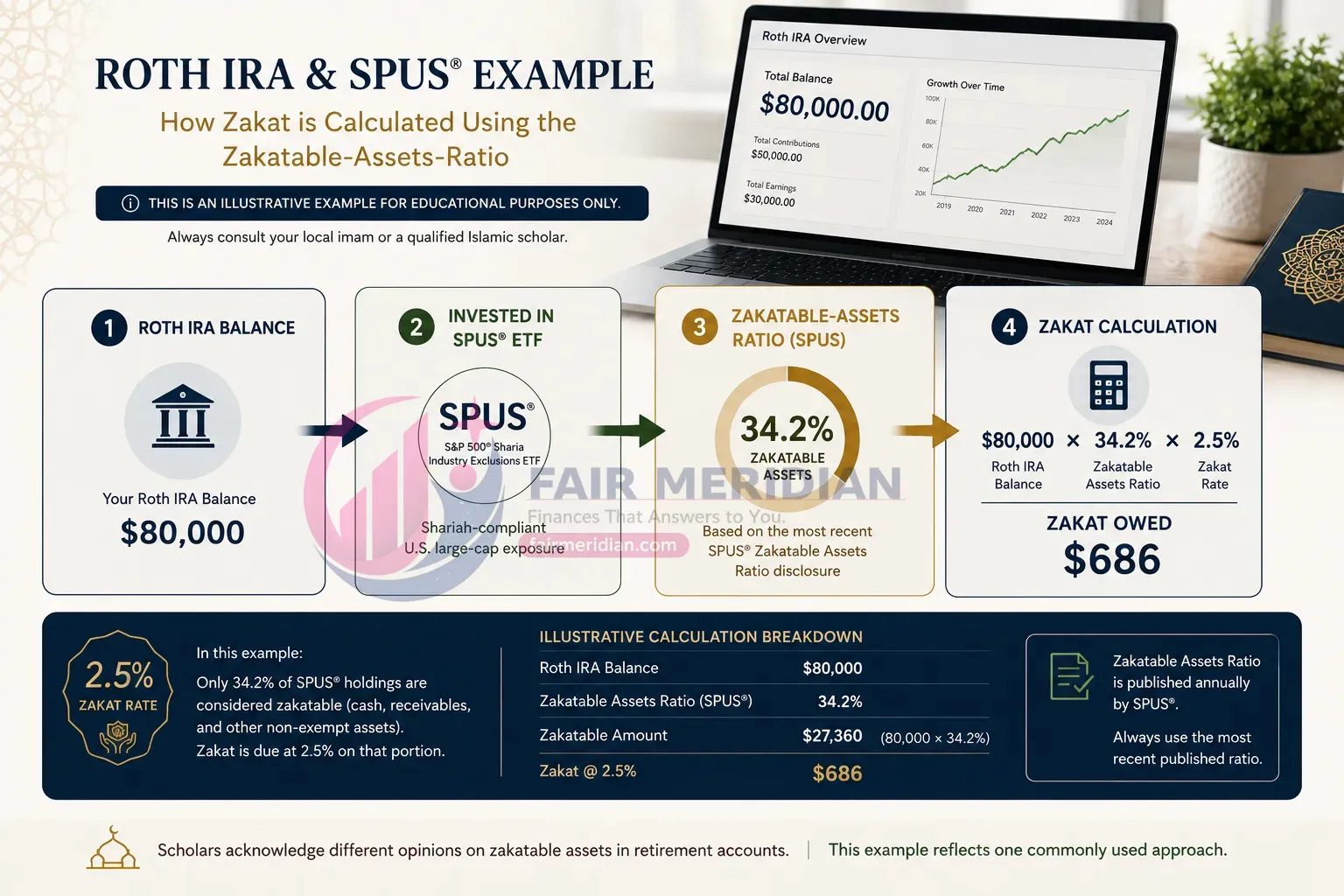
Under Position 1: the $50,000 in accessible contributions is zakatable now; the $30,000 in locked earnings is not until 59½.
Under Position 2: full balance minus expected taxes on the earnings portion only.
Under Position 3: 2.5% on the full $80,000 regardless of contribution vs earnings.
If you're using a Roth IRA with SPUS — which is the recommended halal retirement setup — there's an additional layer: SPUS has a published zakatable assets ratio of 34.2% (2025). Some scholars apply this ratio to the stock-based portion of the calculation — meaning if your Roth IRA holds $80,000 of SPUS, the zakatable amount under the assets-ratio method is $80,000 × 34.2% × 2.5% = $686, rather than 2.5% on the full $80,000 ($2,000). This is a separate scholarly debate within Position 3 — whether to apply 2.5% to the full investment value or to the underlying zakatable assets ratio of the holdings.
The Employer Match Question
Many Muslims don't think about their employer match separately, but it raises its own question. If your employer matches your 401k contributions — essentially giving you additional compensation that immediately vests into your 401k — is that money zakatable from the moment of the match, or is it treated the same as your own contributions?
Most scholars treat employer-matched funds the same as your own 401k contributions once they vest. If your employer matches $5,000 this year and it's immediately vested (in your name, under your control), it joins your 401k balance for zakat purposes under whichever position you follow. Unvested employer matches — money promised but not yet legally yours because you haven't met the vesting schedule — are not zakatable under any position, because they don't yet constitute your property.
What to Actually Do This Year
If you've never paid zakat on your 401k and this is the first year you're thinking about it seriously, here is an honest framework.
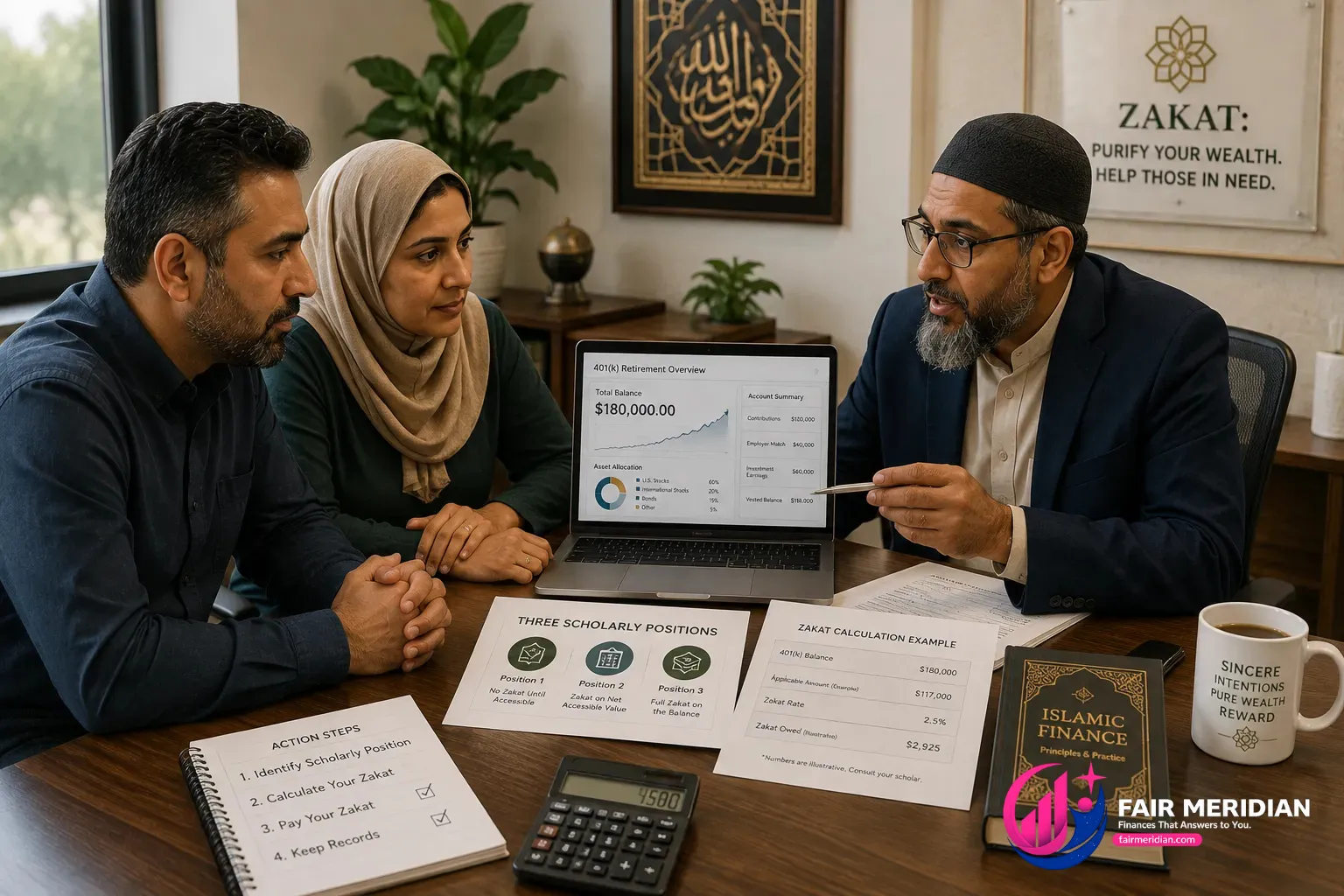
First, identify which scholarly tradition you follow and ask your local imam or scholar which of these three positions they hold. Don't default to the internet's answer or this article's summary. Islamic law is meant to be practiced within a tradition of ongoing scholarly guidance, and the 401k question specifically benefits from a scholar who knows your full financial situation.
If you genuinely cannot access qualified scholarly guidance and need to make a decision, Position 2 is the most defensible middle path — it acknowledges that you own the money while honestly accounting for the real cost of accessing it. Calculate the net amount you'd receive after the 10% penalty and an estimated tax rate, and pay 2.5% on that.
For past years you didn't pay zakat on retirement accounts: consult your scholar about making up missed years. The general principle in Islamic jurisprudence is that genuinely missed obligations due to ignorance — not deliberate avoidance — are handled with sincere repentance and reasonable effort to make them right. Paying this year's zakat and making a plan to gradually cover previous years is better than doing nothing because the accumulated amount feels overwhelming.
A Note on 403b, TSP, and Pension Accounts
Everything above applies equally to 403b accounts (the nonprofit sector equivalent of a 401k), the federal Thrift Savings Plan (TSP), and any employer-sponsored defined contribution retirement account. The zakat analysis is the same — the three positions apply identically.
Defined benefit pensions (the kind that promise a specific monthly payment at retirement rather than accumulating a balance you control) are a separate question. Most scholars hold that a defined benefit pension is not zakatable until you actually receive the payments — because you don't have a balance in your name, you have a future income right that you haven't yet received and may never receive if you die before retirement. When pension payments arrive, they're treated as income and zakatable under the normal income rules if they push your total wealth above the nisab.
Frequently Asked Questions
Do I owe zakat on my 401k?
It depends on which scholarly position you follow. Position 1 (held by scholars who apply strict milkiyyah tammah doctrine): no zakat until the funds become freely accessible at age 59½. Position 2 (middle path): zakat on the net amount you'd receive after the 10% early withdrawal penalty and income taxes. Position 3 (most common in community practice): 2.5% on the full 401k balance each year. Ask your scholar which position they hold before calculating.
How do I calculate zakat on my 401k?
Under Position 3 (full balance): multiply your 401k balance by 2.5%. On $180,000: $4,500. Under Position 2 (net accessible value): estimate what you'd receive after 10% penalty plus income taxes, then multiply by 2.5%. On $180,000 with 35% combined tax rate and 10% penalty: approximately $117,000 net × 2.5% = $2,925. Under Position 1: $0 until age 59½.
Is a Roth IRA zakatable?
Yes, under most scholarly positions — but with an important distinction. Roth IRA contributions can be withdrawn penalty-free at any time, making them more clearly zakatable even under Position 1. Earnings on the Roth IRA are locked until 59½ and follow the same three-position debate as a 401k. If your Roth IRA holds SPUS, the 2025 zakatable assets ratio for SPUS is 34.2% — some scholars apply this ratio rather than calculating 2.5% on the full investment value.
Is employer-matched 401k money zakatable?
Vested employer-matched funds are treated as part of your 401k balance for zakat purposes under all three positions — once the money vests, it's legally yours and follows the same analysis as your own contributions. Unvested employer matches (money promised but not yet legally yours under your vesting schedule) are not zakatable because they don't yet constitute your property.
What if I haven't paid zakat on my 401k for past years?
Consult your scholar about making up missed years. The Islamic jurisprudential approach to obligations missed through genuine ignorance — not deliberate avoidance — involves sincere repentance and reasonable effort to make it right. Don't let the size of the accumulated obligation paralyze you. Pay this year's zakat correctly, then make a plan with your scholar to address previous years gradually. Doing something is better than doing nothing because the full amount feels impossible.
Does the nisab apply separately to my 401k or to my total wealth?
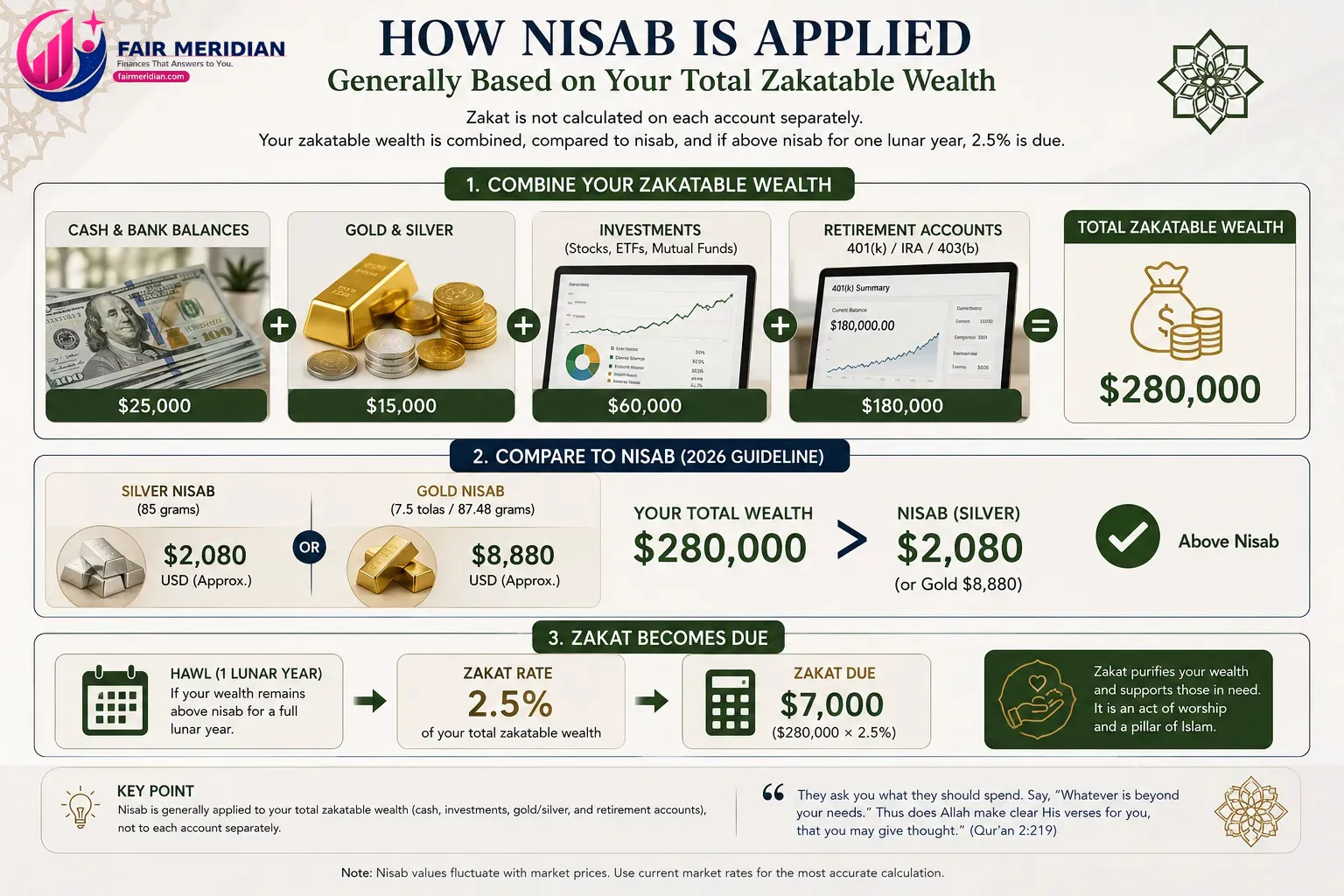
The nisab applies to your total zakatable wealth combined — not to each asset category separately. Add your zakatable cash, gold, investments, business inventory, and 401k amount (under whichever position you follow) together. If the total exceeds the nisab ($612 at the silver standard or $9,009 at the gold standard as of May 2026) and has for a full lunar year, you pay 2.5% on the combined total. A 401k balance alone that exceeds the nisab doesn't trigger zakat in isolation — it's part of the aggregate calculation.
For the complete zakat calculation covering all asset types — gold jewelry, investment portfolios, business inventory, and cash — see our Comprehensive Zakat Calculation Guide 2026. For the madhab-by-madhab breakdown of zakat on gold jewelry including the Hanafi vs Maliki difference, read our Zakat on Gold Jewelry Guide. For the SPUS zakatable assets ratio used in investment portfolio zakat, see our Halal ETFs Guide.