
The question of whether cryptocurrency is halal is one of the most actively debated in contemporary Islamic jurisprudence — and any content that gives you a single clean verdict without acknowledging the genuine scholarly disagreement is misleading you. The reality: some of the world's most qualified Islamic finance scholars say haram. Some say conditionally permissible. The debate turns on four unresolved questions of Islamic commercial law applied to a genuinely novel financial instrument. This post maps every major global position, explains the reasoning behind each, and then breaks down the most common crypto types separately — because Bitcoin, stablecoins, DeFi, and NFTs are not the same question.
Important note: This post maps scholarly opinions as an educational resource — it does not itself issue a fatwa or religious ruling. For a ruling that applies to your specific situation, consult a qualified scholar in your madhab and tradition. The purpose here is to help you understand the debate well enough to have an informed conversation with that scholar.

The Four Core Scholarly Disputes
Before mapping who says what, understanding the four underlying questions scholars disagree on clarifies why the debate exists at all.
Question | Those Who Answer YES | Those Who Answer NO | Impact |
|---|---|---|---|
1. Does crypto constitute mal (property)? | It has real-world utility, widespread acceptance, and economic value — that is sufficient for mal | Mal requires tangible or conventionally recognized value; speculative belief does not qualify | If not mal: cannot be sold, traded, or owned in any halal transaction |
2. Does its volatility constitute major gharar? | Volatility ≠ gharar; all investments carry risk; price uncertainty at time of purchase ≠ contractual uncertainty | 80%+ price swings in a year exceed tolerated minor gharar and constitute major fahish gharar | If major gharar: all crypto contracts are invalid regardless of purpose |
3. Does trading constitute maysir? | Long-term holding and genuine use differ from speculative trading; the asset itself is not maysir even if some trading is | The dominant use case is speculative zero-sum trading where gains come from other traders' losses — that is maysir by definition | If maysir: speculative crypto trading is prohibited even if the asset itself is permitted |
4. Does valid currency require state/institutional backing? | Classical Islamic currency scholars required usability and acceptability, not state backing; Bitcoin is accepted globally | Islamic monetary theory requires legitimate authority recognition; a decentralized private currency without issuing authority does not qualify | Affects whether crypto can serve as halal medium of exchange, not just whether it can be owned |
The Global Scholarly Map — Who Says What and Why
Position 1: Haram — The Case Against
Mufti Taqi Usmani (Pakistan / AAOIFI) — Haram
Mufti Taqi Usmani is Chairman of AAOIFI's Sharia Board and arguably the most influential living Islamic finance scholar globally. His position on cryptocurrency has been consistently clear, and he has reaffirmed it in recent statements: Bitcoin and most cryptocurrencies are not permissible.
His reasoning rests on four arguments:
Absence of intrinsic value or real asset backing: Classical Islamic monetary theory, as articulated in the Hanafi school's concept of thamaniyyah (monetary status), requires that currency either be a commodity with intrinsic value (gold, silver) or carry formal recognition by a legitimate authority (as with modern fiat currency, which the state declares legal tender). Bitcoin has neither. Its "value" is based entirely on collective speculation — what someone else will pay for it — which Mufti Taqi Usmani considers insufficient for thamaniyyah.
Extreme volatility = major gharar: He considers the price swings of cryptocurrencies (Bitcoin has fallen 80%+ multiple times) to constitute major gharar (fahish) — uncertainty that would cause a reasonable party to reconsider the transaction if they knew the likely range of outcomes. This is not the minor gharar inherent in all commerce; it is structural instability that makes contract enforcement effectively meaningless.
Dominant use is speculation (maysir): The overwhelming majority of cryptocurrency transactions — by volume and by intent — are speculative trading, not productive commerce. When an instrument's primary real-world use is for one party to gain from another's loss in a market dominated by information asymmetry and price manipulation, it exhibits the characteristics of maysir.
Facilitation of prohibited activities: Cryptocurrency's pseudonymity has historically facilitated illegal transactions — drug markets, ransomware payments, sanctions evasion. Muslim participation in a system primarily serving these purposes raises collective responsibility (i'anah 'ala al-ma'siyah) concerns beyond the individual investor's intention.
Weight of this position: Mufti Taqi Usmani's ruling carries significant authority particularly in Pakistan, the Gulf, and among scholars trained in the Deoband/Hanafi tradition. His chairmanship of AAOIFI means his position effectively represents the international Islamic finance institution's working stance.
Dar al-Ifta al-Misriyyah (Egypt) — Haram
Egypt's House of Religious Edicts, Dar al-Ifta, issued a formal ruling against Bitcoin in 2018 and has maintained and reaffirmed this position. Their primary arguments:
Cryptocurrency disrupts national monetary order — issuing unregulated private currency undermines the monetary sovereignty that Islamic political jurisprudence grants to legitimate governments
The opacity and anonymity of crypto transactions is incompatible with the Islamic emphasis on transparency (wudhuh) in commercial transactions
The speculative ecosystem facilitates harm (darar) to individuals and communities — many Muslims have lost savings in crypto crashes
Al-Azhar University, Egypt's preeminent Islamic institution, has not issued a unified binding fatwa but its senior scholars have predominantly aligned with Dar al-Ifta's cautious-to-prohibitive stance.
Turkey's Diyanet (Directorate of Religious Affairs) — Haram
Turkey's official religious authority declared Bitcoin and other cryptocurrencies haram in 2021. Key reasoning: cryptocurrencies are "open to speculation" and "not subject to government supervision." The Diyanet's ruling reflected both theological concerns (gharar, maysir) and economic policy concerns (capital flight, monetary stability).
Saudi Arabia's Religious Establishment — Effectively Haram
Saudi Arabia's Council of Senior Scholars (Hay'at Kibar al-'Ulama) has not issued a specific named fatwa on Bitcoin, but the Saudi government has prohibited crypto trading, and senior Saudi scholars have aligned with Mufti Taqi Usmani's position. The Saudi central bank (SAMA) prohibits crypto trading. Scholars in the Hanbali tradition dominant in Saudi Arabia have generally viewed crypto as lacking the monetary legitimacy required for halal financial instruments.
Position 2: Conditionally Permissible — The Case For
Malaysia's Shariah Advisory Council (SAC) — Conditionally Permissible
Malaysia has the world's most developed Islamic finance regulatory system — the Securities Commission Malaysia's Shariah Advisory Council (SC-SAC) has provided the most comprehensive institutional engagement with cryptocurrency of any global Islamic body. Their position: digital assets can be permissible when properly regulated and used appropriately.
Malaysia's framework:
Regulated exchanges are permissible: Crypto traded on registered exchanges licensed by the Securities Commission (Luno Malaysia, MX Global, Tokenize) is permissible — the regulatory oversight addresses the anonymity and transparency concerns
Utility tokens are treated like equity: Crypto representing genuine utility or ownership is analogous to permissible securities
Pure speculation remains problematic: Day-trading for speculative gain is still discouraged — the concern is maysir, not the technology itself
Digital assets are mal: The SAC has accepted that digital assets with economic utility and market acceptance constitute mal for purposes of Islamic commercial law
Weight of this position: Malaysia's SC-SAC is the most institutionally rigorous body to have engaged comprehensively with crypto. Their opinion carries authority in Southeast Asia and among scholars who take a more contextual approach to novel financial instruments.
UAE — Regulated Framework, Divided Scholars
The UAE has built the most comprehensive crypto regulatory framework in the Muslim world through Dubai's Virtual Assets Regulatory Authority (VARA) and Abu Dhabi Global Market (ADGM). This regulatory clarity has influenced the scholarly environment.
Dubai's Fatwa Centre has not issued a comprehensive prohibition — regulated digital assets in VARA's framework occupy a different position from unregulated anonymous trading
Individual UAE scholars remain divided — some align with Mufti Taqi Usmani; others accept VARA-regulated crypto as permissible
The Dubai Islamic Economy Development Center has been working on Sharia standards for digital assets — published frameworks suggest regulated crypto is being treated as legitimately tradeable
Mufti Faraz Adam (UK, Amanah Finance / Dar al-Sharia) — Nuanced Permissibility
Mufti Faraz Adam is one of the most prolific contemporary scholars on Islamic fintech and has published the most detailed English-language ijtihad on cryptocurrency. His position, developed through multiple papers and scholarly engagements:
Bitcoin as mal: He accepts that Bitcoin and similar established cryptocurrencies constitute mal (property) under Islamic law — their widespread acceptance, economic utility as a medium of exchange, and market value establish them as property even without commodity backing
Ownership is permissible: Buying and holding Bitcoin for legitimate purposes is permissible — the asset itself is not inherently prohibited
Speculative trading requires caution: Day-trading primarily for speculative gain activates maysir concerns — particularly leveraged crypto trading and derivatives
Not all crypto is equal: He distinguishes between established cryptocurrencies (Bitcoin, Ethereum) and meme coins or highly speculative new tokens — the latter have much weaker mal credentials
Weight of this position: Mufti Faraz Adam's detailed written scholarship is widely cited among English-speaking Muslims globally. His work represents the most developed "conditionally permissible" scholarly framework.
Mufti Muhammad Abu Bakar — Permissible
Mufti Muhammad Abu Bakar (formerly of Blossom Finance) published early detailed Islamic analysis of Bitcoin in 2017 and has maintained that Bitcoin is permissible as a currency and asset. His primary argument: the classical Islamic definition of currency requires only acceptance by a community as a medium of exchange — which Bitcoin clearly meets in its user community. State backing was never a classical Islamic requirement; it is a modern addition that cannot be read back into classical fiqh.
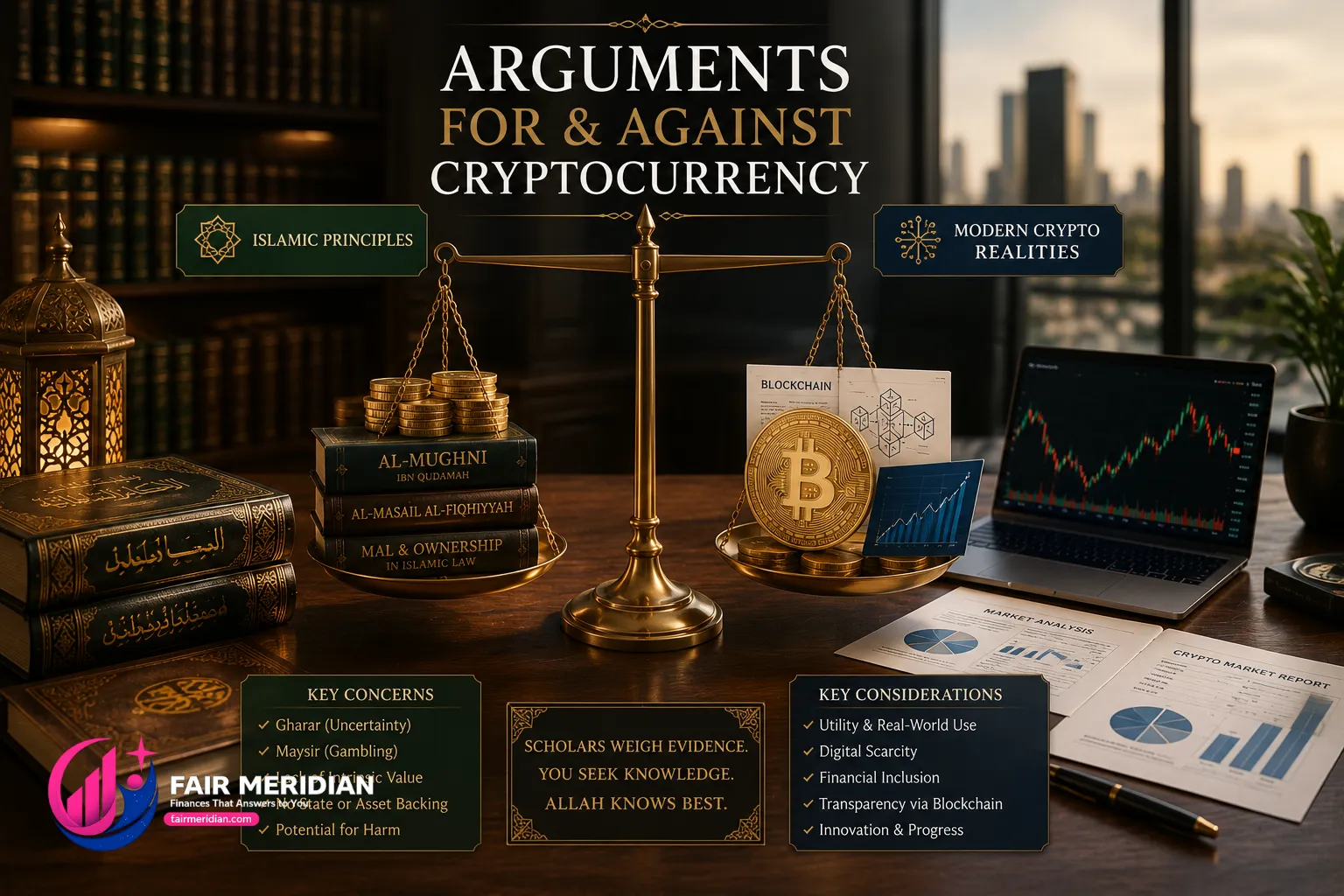
The Strongest Arguments on Each Side
Argument | Strongest Form | Best Counter |
|---|---|---|
FOR HARAM: No intrinsic value | Classical Islamic currencies (gold, silver, then accepted fiat) derived value from physical properties or state authority. Bitcoin's value is pure collective belief — a house of cards with no floor. | Gold's original value was also "collective belief" before monetary systems formalized it. Fiat currency has no intrinsic value either — only state decree. If we accept fiat as mal, the bar for crypto acceptance is the same: widespread use and acceptance. |
FOR HARAM: Extreme gharar | Bitcoin fell from $69,000 to $16,000 (77%) in 2022. A contract for deferred delivery of an asset that could be worth 77% less at delivery date is the definition of major gharar that scholars prohibited in forward contracts. | Gharar in Islamic law refers to uncertainty in the CONTRACT (what you're buying, whether it exists, what terms apply) — not price risk post-purchase. Buying a volatile stock is not gharar; it's investment risk (khatar). The scholarly disagreement here is genuine and unresolved. |
FOR HARAM: Maysir | Over 70% of crypto trading volume is short-term speculation. Most small retail traders lose money. The gains of some come entirely from the losses of others. This is a near-perfect description of maysir. | This argument applies to speculative trading, not to cryptocurrency ownership or long-term holding. It also applies equally to speculative stock trading, which is not categorically prohibited — only the speculative activity, not the underlying asset. |
FOR PERMISSIBLE: Mal by acceptance | Bitcoin is accepted by millions of people, regulated businesses, and governments as a medium of exchange and store of value. Classical scholars required "tawatur" (widespread acceptance) for currency — Bitcoin has it. | Tawatur requires legitimate authority and general social acceptance — a minority of the global population using a volatile speculative instrument does not constitute the kind of settled social consensus classical scholars meant. |
FOR PERMISSIBLE: Utility value | Ethereum is a computational platform. Bitcoin is censorship-resistant money. These are genuine utilities with real economic value that goes beyond speculation — like owning a factory or a communications network. | The utility exists but it doesn't explain why Bitcoin needs to trade at $100,000 vs $5,000. Most of the "value" above utility cost is speculative premium — and it's the speculative premium that Muslim investors are actually buying. |

Country-by-Country Ruling Summary
Country / Region | Leading Scholarly Body | Position | Status |
|---|---|---|---|
Pakistan | Mufti Taqi Usmani; Wifaq ul Madaris | Haram | Dominant view; government crypto regulation evolving but scholarly consensus tilts prohibitive |
Egypt | Dar al-Ifta al-Misriyyah; Al-Azhar | Haram | Official fatwa issued and maintained |
Turkey | Diyanet | Haram | Official 2021 ruling; consistent |
Saudi Arabia | Senior scholars; government ban | Effectively Haram | No formal named fatwa but scholarly and regulatory alignment toward prohibition |
Malaysia | Securities Commission SAC | Conditionally Permissible | Most developed positive framework; regulated exchanges permissible |
UAE / Dubai | Dubai Fatwa Centre; VARA framework | Divided (leaning permissible for regulated assets) | World's most crypto-friendly Islamic regulatory environment; no blanket prohibition |
UK | No unified body; Mufti Faraz Adam prominent | Nuanced / Conditionally Permissible | Most active ijtihad space; regulated ownership generally accepted; speculation cautioned |
United States | FCNA (no ruling); individual scholars | No unified position | Fiqh Council of North America has not issued a comprehensive ruling; US Muslims follow varied scholarly traditions |
Indonesia | Majelis Ulama Indonesia (MUI) | Permissible as commodity, not currency | MUI ruled crypto permissible as a tradeable commodity asset (not as a currency medium of exchange) — 2021 |

Each Major Crypto Type — Analyzed Separately
"Is cryptocurrency halal" is not one question. Bitcoin, stablecoins, DeFi tokens, and NFTs involve different structures, different use cases, and different scholarly analyses.
Bitcoin (BTC) — The Most Contested
Analysis Dimension | Detail |
|---|---|
Business activity | No prohibited underlying business (no alcohol, riba, gambling) — Bitcoin is a protocol |
Mal status | Disputed — see above. Scholars who accept it as mal permit ownership; those who reject mal status prohibit all transactions |
Gharar concern | Real — 50–80% drawdowns. Whether this is contract gharar or market risk is the scholarly dispute |
Maysir concern | For long-term holders: lower concern. For active traders: high maysir concern. The holding strategy is different from the trading strategy |
Scholarly verdict | Genuinely divided — haram (Mufti Taqi Usmani, Egypt, Turkey, Saudi) vs conditionally permissible (Malaysia, UAE framework, UK scholars) |
Ethereum (ETH) — The Smart Contract Platform
Ethereum adds genuine utility dimensions that Bitcoin lacks — it is a programmable blockchain platform on which applications, contracts, and services run.
Utility case: Ethereum is not purely speculative — it is computing infrastructure with real demand from developers and users. Owning ETH is closer to owning equity in a technology platform than to holding a purely speculative currency.
Staking: ETH staking (where validators earn ETH for confirming transactions) generates returns. Most scholars treat this as fee income for network services — permissible — not as interest on deposited funds. This is the strongest "conditionally halal" case for ETH.
DeFi applications built on Ethereum: This is where the analysis becomes complex — see the DeFi section below. Owning ETH as a platform asset is a different question from participating in DeFi lending protocols.

Stablecoins (USDC, USDT, DAI, PYUSD) — Most Accepted
Stablecoins are the most broadly accepted category among scholars because they function as digital representations of fiat currency with minimal price volatility — eliminating the gharar concern that is central to Bitcoin prohibition arguments.
Stablecoin | Backing | Halal Status | Key Concern |
|---|---|---|---|
USDC | US dollar reserves (cash + short-term T-bills) | Generally Accepted | Reserves include interest-generating T-bills — minor concern; most scholars accept for transactional use |
USDT (Tether) | Mixed reserves (cash, T-bills, commercial paper) | Generally Accepted for transactions | Reserve transparency concerns; riba from reserve investments — minor purification concern |
DAI | Over-collateralized by ETH and other crypto | Acceptable for transactional use | Backed by volatile assets — more stable than BTC but carries collateral risk; no direct riba mechanism |
The stablecoin consensus: Most scholars who prohibit Bitcoin permit stablecoins for transactional purposes (sending money, payments, cross-border transfers). The objections to Bitcoin (volatility = gharar; speculation = maysir) don't apply to stablecoins whose value is fixed to fiat currency.
DeFi (Decentralized Finance) — Mostly Problematic
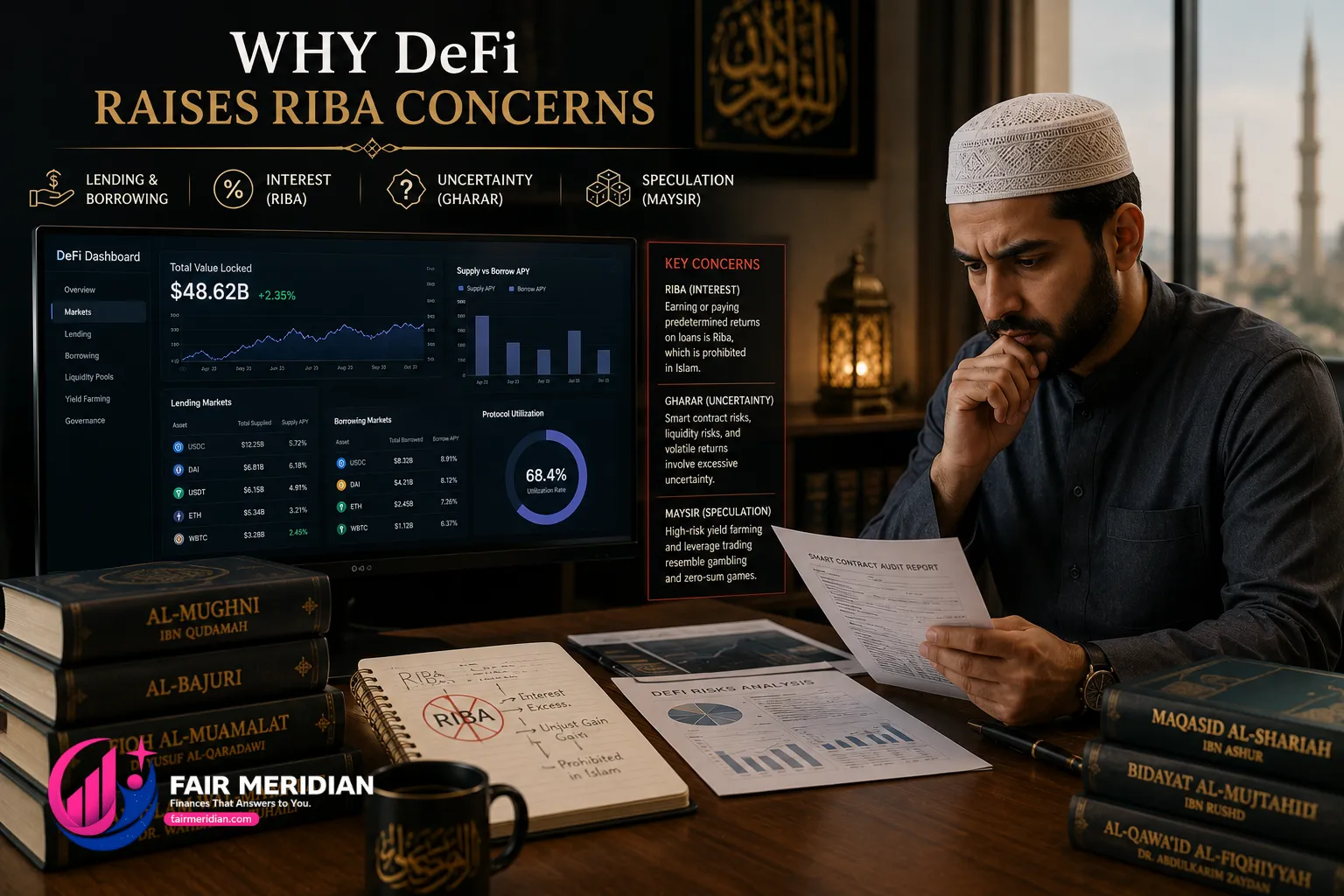
DeFi is where Islamic finance scholars' concerns are most clearly validated. Most DeFi protocols involve lending and borrowing with explicit interest rates — riba in its most direct form, just executed by smart contract rather than by a conventional bank.
DeFi Activity | Structure | Halal Status |
|---|---|---|
Lending protocols (Aave, Compound) | Deposit crypto → earn interest; borrow crypto → pay interest | ❌ Riba — deposit interest is prohibited regardless of the technology delivering it |
Yield farming | Complex strategies to maximize interest/fee income across protocols | ❌ Primarily riba-based; the optimization of prohibited income is itself prohibited |
Liquidity pools (Uniswap, etc.) | Provide liquidity to exchange pool; earn a share of trading fees | ⚠️ Disputed — fees from providing a service may be permissible; impermanent loss and specific structure require scrutiny |
Staking (PoS networks) | Lock tokens to validate transactions; earn newly minted tokens as reward | ⚠️ Majority of scholars accept staking as fee income for network services, not as interest on deposited funds |
Crypto derivatives (futures, options, leveraged trading) | Trade contracts on future crypto prices; leverage amplifies gains/losses | ❌ Combines crypto's gharar with options/futures' additional gharar and maysir — prohibited by virtually all scholars |
NFTs (Non-Fungible Tokens) — Depends on the Asset
NFTs as a technology are neutral — they are digital certificates of ownership. What matters is what they represent:
NFTs representing genuine digital property rights (actual ownership of digital art, exclusive access rights, digital real estate in a specific platform) — scholars who accept digital mal generally accept these, provided the underlying content is permissible
NFTs as pure speculation (buying a JPEG to sell to someone else at a higher price with no underlying utility) — maysir concerns apply strongly; this is the category that produced the most losses and the most complaints
NFTs with prohibited content (digital art with inappropriate imagery) — prohibited regardless of the technology
Meme Coins and New Token Launches — Strongest Case for Haram
Meme coins (Dogecoin, Shiba Inu, etc.) and new ICO/IDO token launches present the weakest halal case of any crypto category:
No genuine utility backing the price
Value derived almost entirely from collective speculation and social media momentum
Price collapse to zero is common — classic maysir where gains come entirely from later buyers losing their money
Even scholars who are most open to Bitcoin and Ethereum permissibility generally reject meme coins
The Bitcoin ETF Question (January 2024)
The SEC's approval of spot Bitcoin ETFs in January 2024 (BlackRock iShares Bitcoin Trust, Fidelity Wise Origin Bitcoin Fund, and others) changed the investment landscape for US Muslims in a meaningful way — and scholars have had different responses.
Those who argue the ETF changes nothing: Mufti Taqi Usmani and those aligned with his position hold that regulatory approval of an investment vehicle does not change the Sharia status of the underlying asset. If Bitcoin lacks thamaniyyah and is subject to major gharar, a BlackRock wrapper around it doesn't resolve those issues.
Those who argue the ETF is relevant: Regulated ETF structures address some transparency concerns (you're buying through a regulated, reporting entity rather than anonymously on an exchange). Some scholars who were cautious about direct crypto ownership have been more open to Bitcoin ETF exposure as a regulated investment vehicle with institutional oversight.
Neither group has shifted their fundamental position on whether Bitcoin itself is halal — the ETF question is primarily relevant to how those who accept Bitcoin's permissibility choose to access it.

If You Already Own Cryptocurrency
A common practical question: what do I do with crypto I already own, given the scholarly disagreement?
If you own established cryptocurrencies (Bitcoin, ETH) for long-term purposes: You are in an area of genuine scholarly dispute. Continue holding while seeking qualified scholarly guidance from a scholar in your tradition. The "immediately sell" instruction requires the same certainty that it's haram that the "definitely keep" instruction requires certainty that it's halal — and that certainty doesn't exist.
If you have profits from speculative trading: The maysir concern applies most strongly here. Consult a scholar about what to do with profits from activity that may have been prohibited.
If you are in DeFi lending protocols: The riba concern is the clearest of all crypto categories. Most scholars across the spectrum — including those who accept Bitcoin — agree that DeFi lending interest is prohibited. Exiting is the most defensible course.
If you have unrealized losses: Selling at a loss to exit an impermissible investment is not required — the losses are already suffered. Seek scholarly guidance on whether continued holding is preferable to crystallizing the loss.
The Practical Framework for Muslim Investors
Activity | Majority Position | Minority Position | Practical Guidance |
|---|---|---|---|
Buying and holding Bitcoin long-term | Haram (Usmani, Egypt, Turkey) | Permissible (Malaysia, UK scholars) | Genuine scholarly dispute — follow your qualified scholar in your tradition |
Active speculative crypto trading | Haram (almost all scholars) | Discouraged even by those who permit holding | Avoid — maysir concern is broadly held across permissibility positions |
Using stablecoins for payments/transfers | Permissible (broadly) | — | Generally acceptable for transactional use |
DeFi lending/borrowing | Haram (virtually all scholars) | — | Avoid — riba is explicit in the protocol |
ETH staking | Disputed but trending permissible | — | Most scholars accept as service fee, not interest — reasonable to proceed while monitoring scholarly development |
Crypto derivatives/leveraged trading | Haram (all scholars) | — | Avoid — gharar + maysir + often riba |
Meme coins | Haram or strongly discouraged | — | Even scholars open to BTC/ETH reject these |
Bitcoin ETF (IBIT, FBTC) | Follows Bitcoin ruling | — | If Bitcoin is halal in your tradition, regulated ETF is an acceptable vehicle |

Frequently Asked Questions
Is Bitcoin halal or haram?
There is genuine, serious scholarly disagreement. Mufti Taqi Usmani — the chairman of AAOIFI's Sharia Board and the most prominent Islamic finance scholar globally — considers Bitcoin haram: it lacks the requirements of valid currency (thamaniyyah), its extreme volatility constitutes major gharar, and the speculative trading ecosystem constitutes maysir. Egypt's Dar al-Ifta, Turkey's Diyanet, and the Saudi religious establishment align with this position. Malaysia's Securities Commission Shariah Advisory Council, UK scholars including Mufti Faraz Adam, and Indonesia's MUI (for commodity use) consider it conditionally permissible. You must consult a qualified scholar in your tradition and madhab to determine which framework governs your practice.
What does Mufti Taqi Usmani say about cryptocurrency?
Mufti Taqi Usmani has consistently maintained that Bitcoin and most cryptocurrencies are impermissible under Islamic law. His position rests on four arguments: cryptocurrencies lack the thamaniyyah (monetary legitimacy) required for valid Islamic currency; their extreme volatility constitutes major gharar; the dominant trading ecosystem constitutes maysir; and their historical facilitation of illegal activity raises collective responsibility concerns. He has reaffirmed this position in multiple contexts and has not modified it in response to institutional developments like the Bitcoin ETF approvals.
Is crypto trading halal?
Active speculative crypto trading — buying and selling for short-term price gains — is the category with the broadest scholarly consensus toward prohibition. Even scholars who accept that Bitcoin is permissible to own as an asset (Malaysia, UK scholars) distinguish between holding as an asset and speculative trading. The maysir concern applies most strongly to trading: short-term crypto gains come largely from other traders' losses, which is the defining characteristic of maysir. Leveraged crypto trading (using borrowed money to amplify positions) is prohibited by virtually every scholar across all positions on the underlying crypto permissibility question.
Are stablecoins halal?
Stablecoins are the most broadly accepted category among Islamic scholars. Their fixed value (pegged to USD) eliminates the gharar and maysir concerns that are central to the Bitcoin debate. Most scholars who prohibit Bitcoin accept stablecoins for transactional purposes — sending money internationally, making payments, or holding savings in a digital format. The minor concern: USDC and USDT reserve pools include interest-bearing T-bills; some scholars suggest a minor purification donation to address this indirect riba exposure.
Is Ethereum (ETH) halal?
ETH follows the general Bitcoin debate with additional considerations. Scholars who prohibit Bitcoin generally prohibit ETH. Scholars who accept Bitcoin's permissibility generally extend it to ETH, often with stronger justification due to ETH's genuine utility as a computational platform. ETH staking — earning rewards for validating transactions — is specifically accepted by most scholars who engage with it, classifying it as fee income for network services rather than interest on deposited funds. DeFi protocols built on Ethereum (lending, yield farming) are a separate question and generally problematic due to explicit riba mechanisms.
For the full Islamic finance framework — including the riba and gharar prohibitions that underlie this debate — read our Riba Explained and Gharar Explained guides. For Sharia-compliant investment alternatives with full scholarly consensus, see our Halal Investing USA 2026 Guide and our Halal Roth IRA Setup Guide.