Key takeaways:
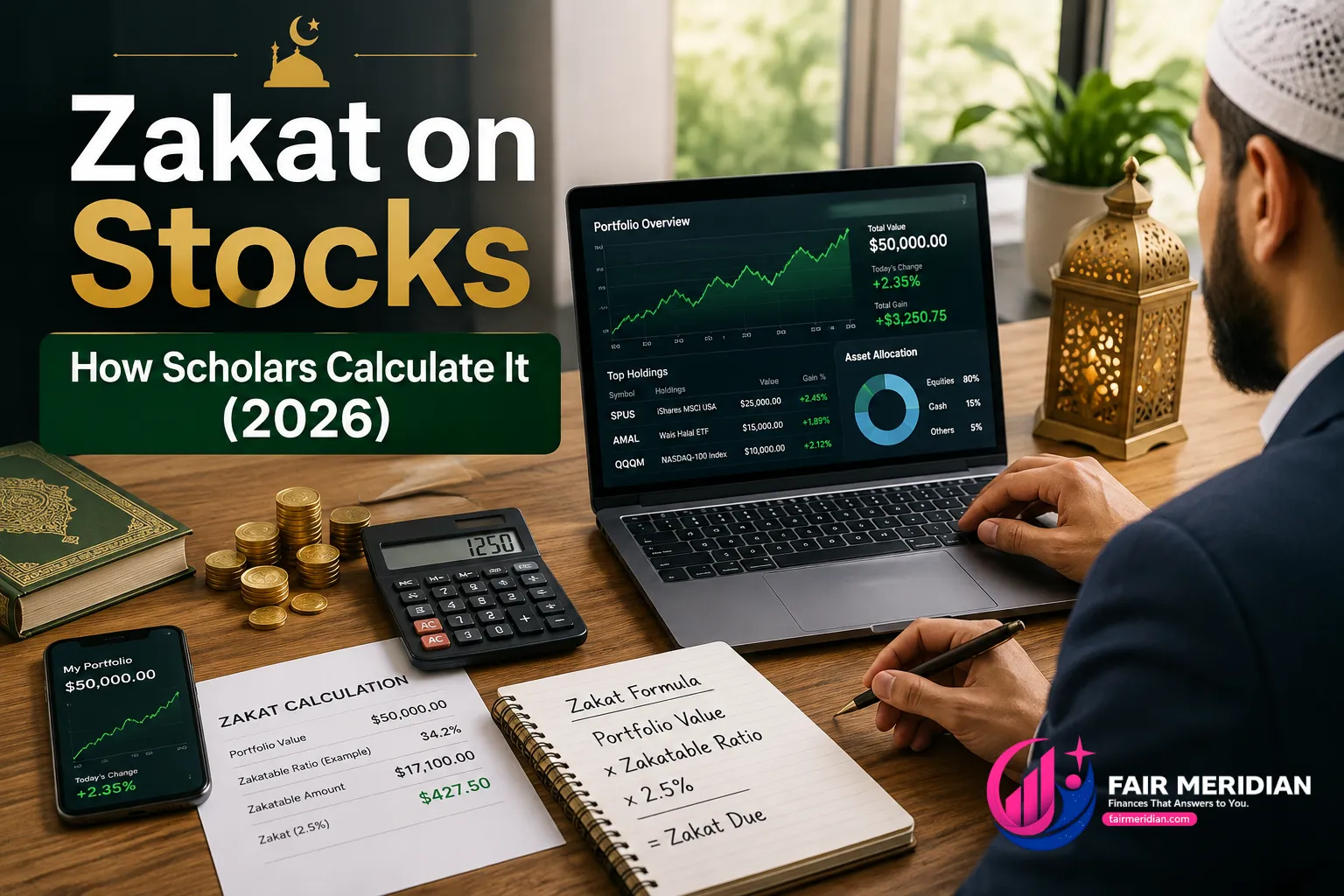
Zakat on stocks: 2.5% of zakatable assets (cash, receivables, inventory) — not full market value — for long-term investors
2026 silver nisab: ~$1,110 | Gold nisab: ~$11,200 (verify live at kitco.com)
SPUS zakatable ratio (2025): 34.2% → a $50,000 SPUS portfolio owes ~$427.50 in zakat
401k: most scholars recommend zakat on net accessible value after estimated tax/penalty
Last updated: August 5, 2026 | Reviewed by Tufail Ahmed, Hafiz-e-Quran, Islamic Scholar (Ashrafia Islamic University)
Step 1: Do You Owe Zakat on Your Investments? The Nisab Check
Zakat is only obligatory when your total zakatable wealth exceeds the nisab threshold — and only on wealth you have held for a complete lunar year (hawl).

Nisab in US Dollars — August 2026
Standard | Quantity | Price (Aug 2026) | Nisab in USD | Scholarly Preference |
|---|---|---|---|---|
Gold Nisab | 85 grams (2.73 troy oz) | ~$4,100/troy oz | ~$11,200 | Used by some scholars as higher threshold |
Silver Nisab | 595 grams (19.13 troy oz) | ~$58/troy oz | ~$1,110 | Majority North American scholars — ensures more fulfill obligation |
Gold and silver prices fluctuate daily and can move 10–20% in weeks during volatile periods (as of August 2026, both metals are near multi-year highs). Always verify current spot prices at kitco.com on the day you calculate — do not rely on this table beyond a few weeks old.
The majority position among North American scholars (ISNA, FCNA) is to use the silver nisab (~$1,110) — because using the lower threshold ensures more Muslims fulfill their obligation. At ~$1,110, most Muslim investors with a brokerage account exceed the nisab and owe zakat on their investment portfolio.
The Hawl Requirement
You owe zakat only on wealth that has remained at or above nisab for a complete lunar year — 354 days. For an investment portfolio: if you had more than ~$1,110 invested on your zakat due date last year, and your portfolio still exceeds ~$1,110 today, the hawl condition is met. You do not need to have held the exact same stocks — just maintained at least nisab value throughout.
The Two Scholarly Methods for Stocks
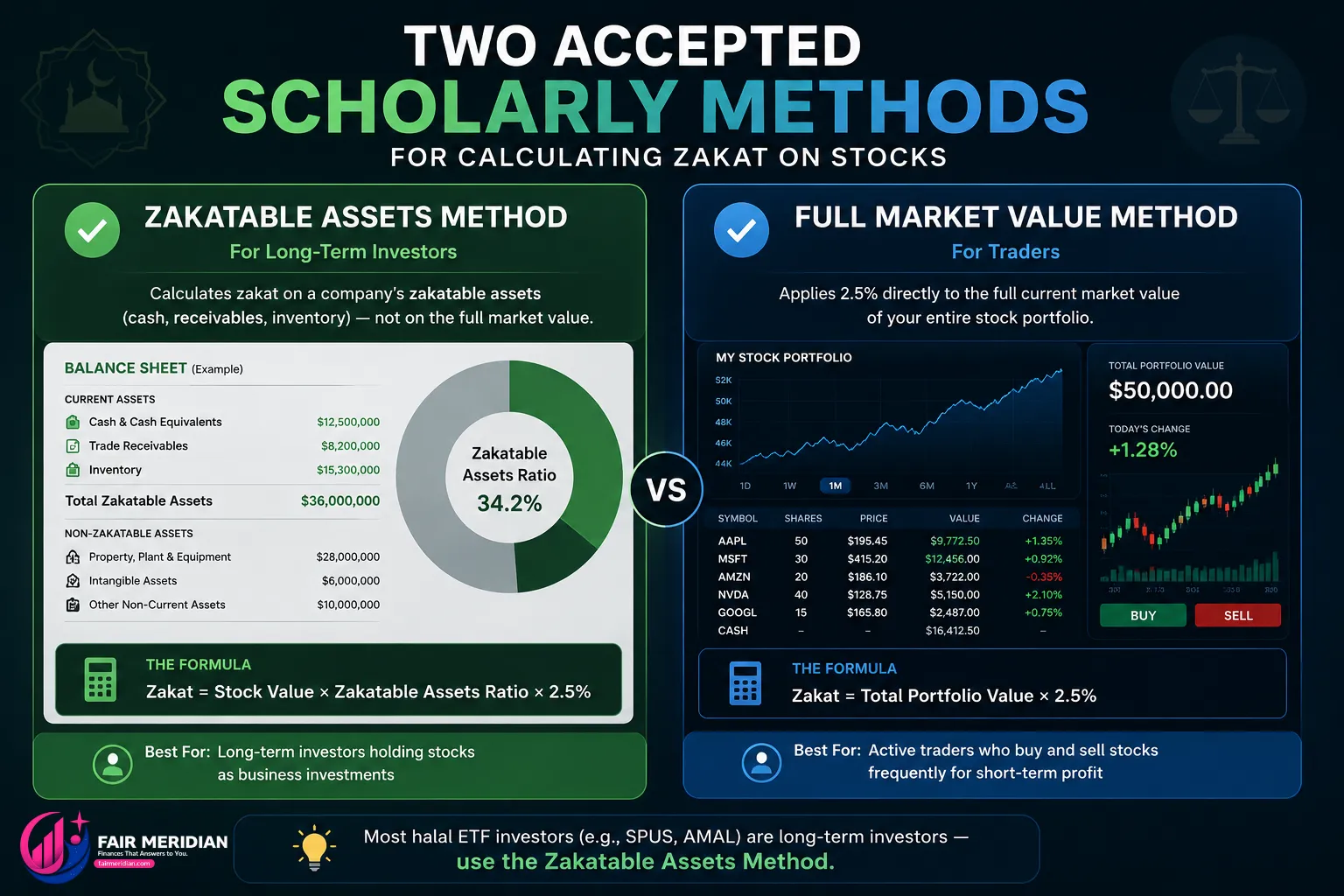
Method 1: Zakatable Assets Method (Recommended for Long-Term Investors)
This method "looks through" your stock holdings to the company's balance sheet and calculates zakat only on the zakatable portion of the company's assets — its cash, trade receivables, and inventory.
The logic: when you own a share of stock, you own a proportional share of the company's assets. Zakat is due on productive financial assets (cash, receivables, inventory) — not on fixed physical assets like factories or equipment. This method calculates your share of the company's zakatable assets and applies 2.5% to that amount only.
The formula:
Zakat = Stock Value × Zakatable Assets Ratio × 2.5%
Who should use it: Long-term investors holding stocks as business investments — not as items for resale. If you buy SPUS and hold it for years as a retirement investment, use Method 1.
Method 2: Full Market Value Method (For Traders)
This method applies 2.5% directly to the full current market value of your entire stock portfolio.
The logic: if you treat stocks as trading inventory — assets held for resale at a profit — then the full value (like business inventory) is zakatable. Traders who buy and sell frequently are in the business of trading shares as their "merchandise," and the full inventory value is subject to zakat.
The formula:
Zakat = Total Portfolio Value × 2.5%
Who should use it: Active traders who frequently buy and sell stocks for short-term profit. If you trade with intent to capture short-term price movements, use Method 2.
Practical guidance: Most Muslim investors with halal ETF portfolios (SPUS, AMAL) are long-term investors — use Method 1. The difference is significant: on a $50,000 SPUS portfolio, Method 1 yields approximately $425 in zakat; Method 2 yields $1,250. Using the correct method matters.
Worked Example: Calculating Zakat on SPUS
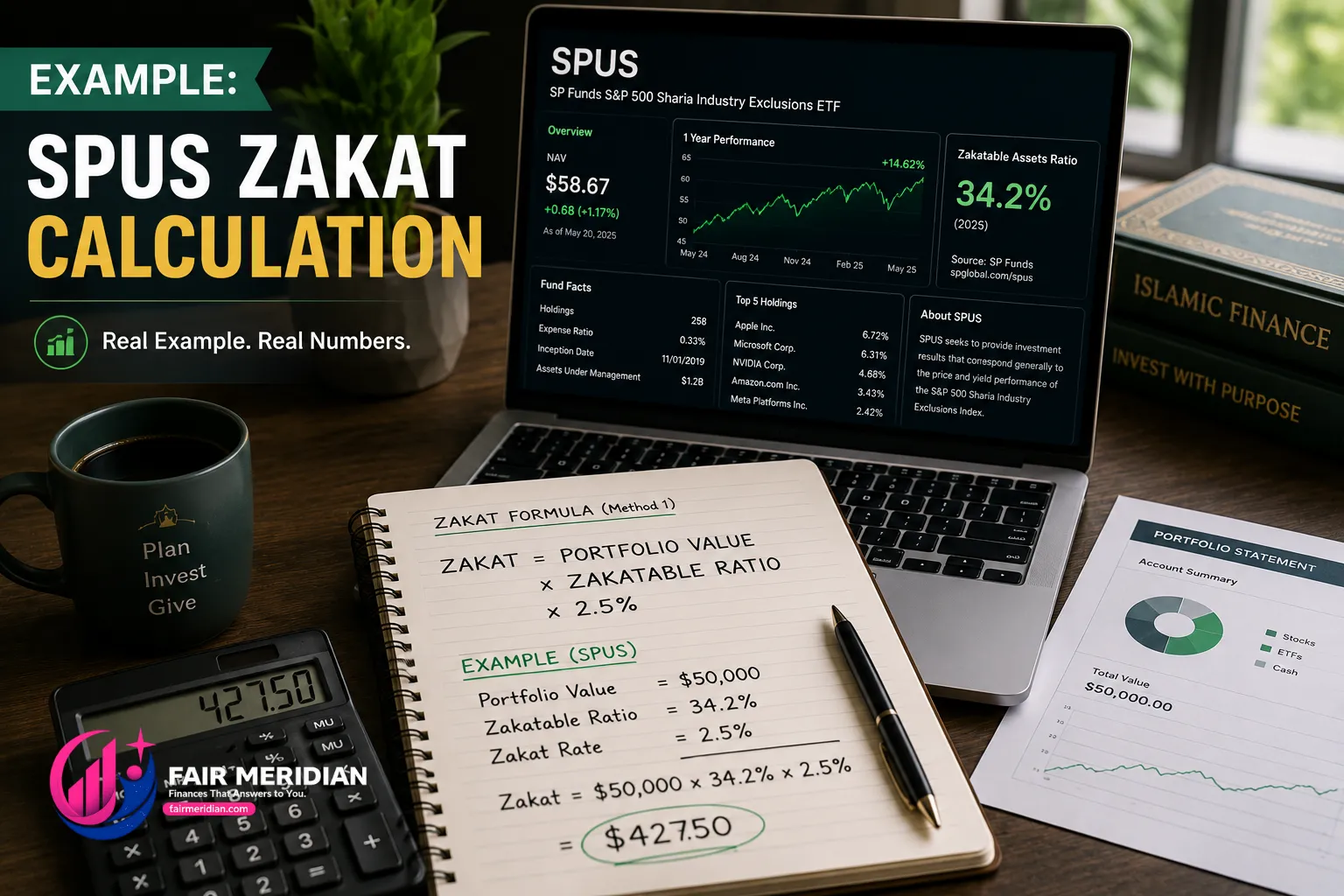
SP Funds publishes an annual zakatable assets ratio for SPUS — they do the company look-through calculation across all 258 holdings and express the result as a percentage of NAV. For 2025, SPUS published a zakatable assets ratio of 34.2%.
This means 34.2% of SPUS's NAV represents zakatable assets (cash, receivables, and inventory proportional to each holding). This single number makes zakat calculation on SPUS straightforward.
SPUS Portfolio Value | Zakatable Ratio | Zakatable Amount | Zakat (2.5%) |
|---|---|---|---|
$5,000 | 34.2% | $1,710 | $42.75 |
$10,000 | 34.2% | $3,420 | $85.50 |
$25,000 | 34.2% | $8,550 | $213.75 |
$50,000 | 34.2% | $17,100 | $427.50 |
$100,000 | 34.2% | $34,200 | $855.00 |
Based on SPUS's 2025 zakatable assets ratio of 34.2%. Verify the current year's ratio at spfunds.com — it is updated annually after fiscal year close. Use your portfolio value on your zakat due date, not today's value if different.
For HLAL (Wahed FTSE USA Shariah ETF) and other halal ETFs: check each fund's annual zakat report on their website (see AMAL's zakat page). Most publish a zakatable assets ratio annually. If a fund does not publish one, default to Method 2 (full market value) as the conservative fallback.
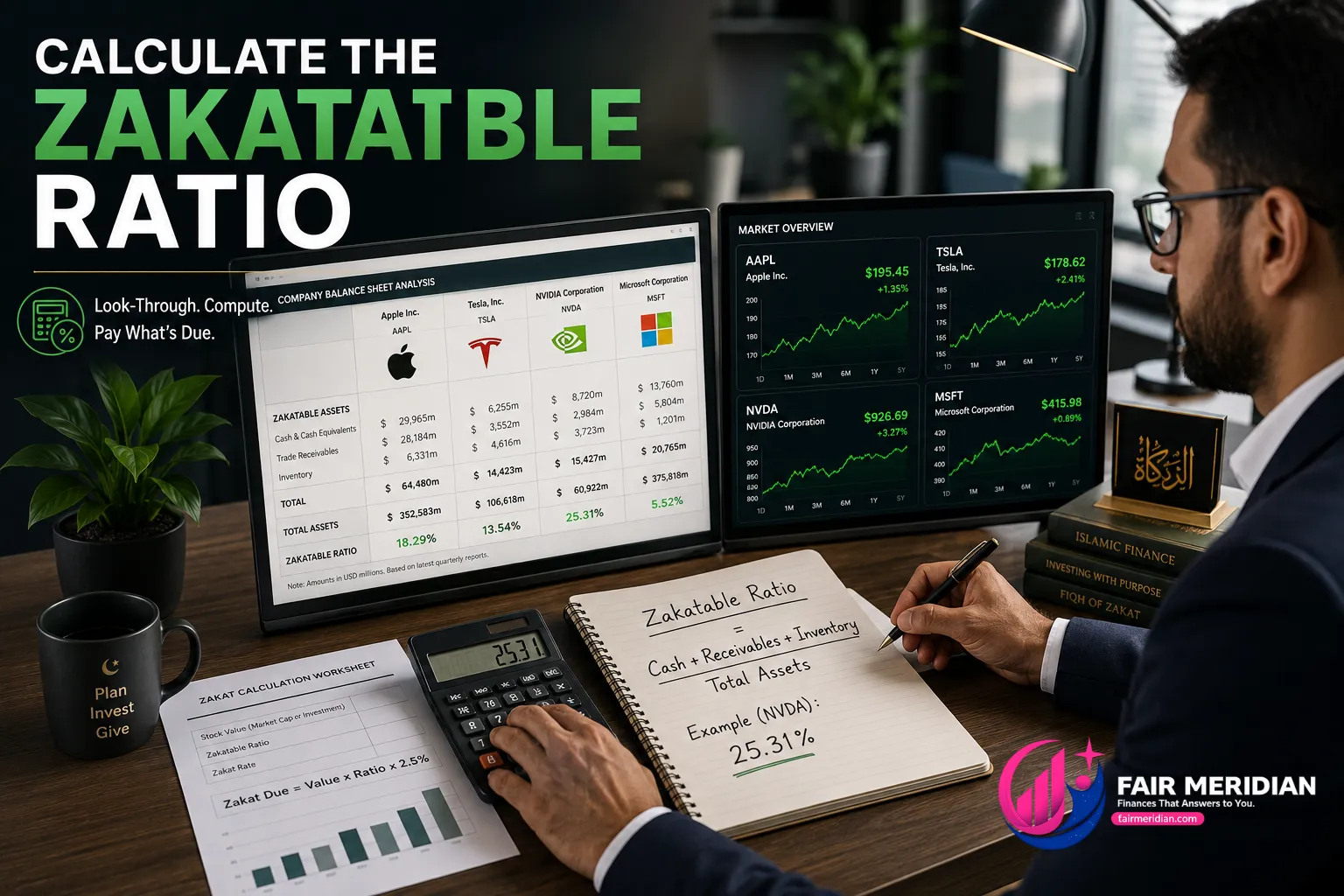
Individual Stocks — Calculating the Zakatable Ratio
For individual stocks (Apple, Tesla, Nvidia, etc.), you calculate the zakatable assets ratio yourself from the company's balance sheet — or use Zoya's zakat calculation (available in the app for each screened stock).
Quick Ratio Calculation
Company | Cash + Receivables + Inventory (Est.) | Total Assets (Est.) | Zakatable Ratio | Zakat on $10K Position |
|---|---|---|---|---|
Apple (AAPL) | ~$106B | ~$365B | ~29% | $10,000 × 29% × 2.5% = $72.50 |
Tesla (TSLA) | ~$45B | ~$120B | ~37.5% | $10,000 × 37.5% × 2.5% = $93.75 |
Nvidia (NVDA) | ~$48B | ~$98B | ~49% | $10,000 × 49% × 2.5% = $122.50 |
Microsoft (MSFT) | ~$80B | ~$520B | ~15.4% | $10,000 × 15.4% × 2.5% = $38.50 |
Figures are estimates based on FY2025 balance sheet data. Calculate using the company's most recent annual report (10-K). Zoya's app provides these calculations for all screened stocks — the most convenient way to calculate zakat on individual holdings.
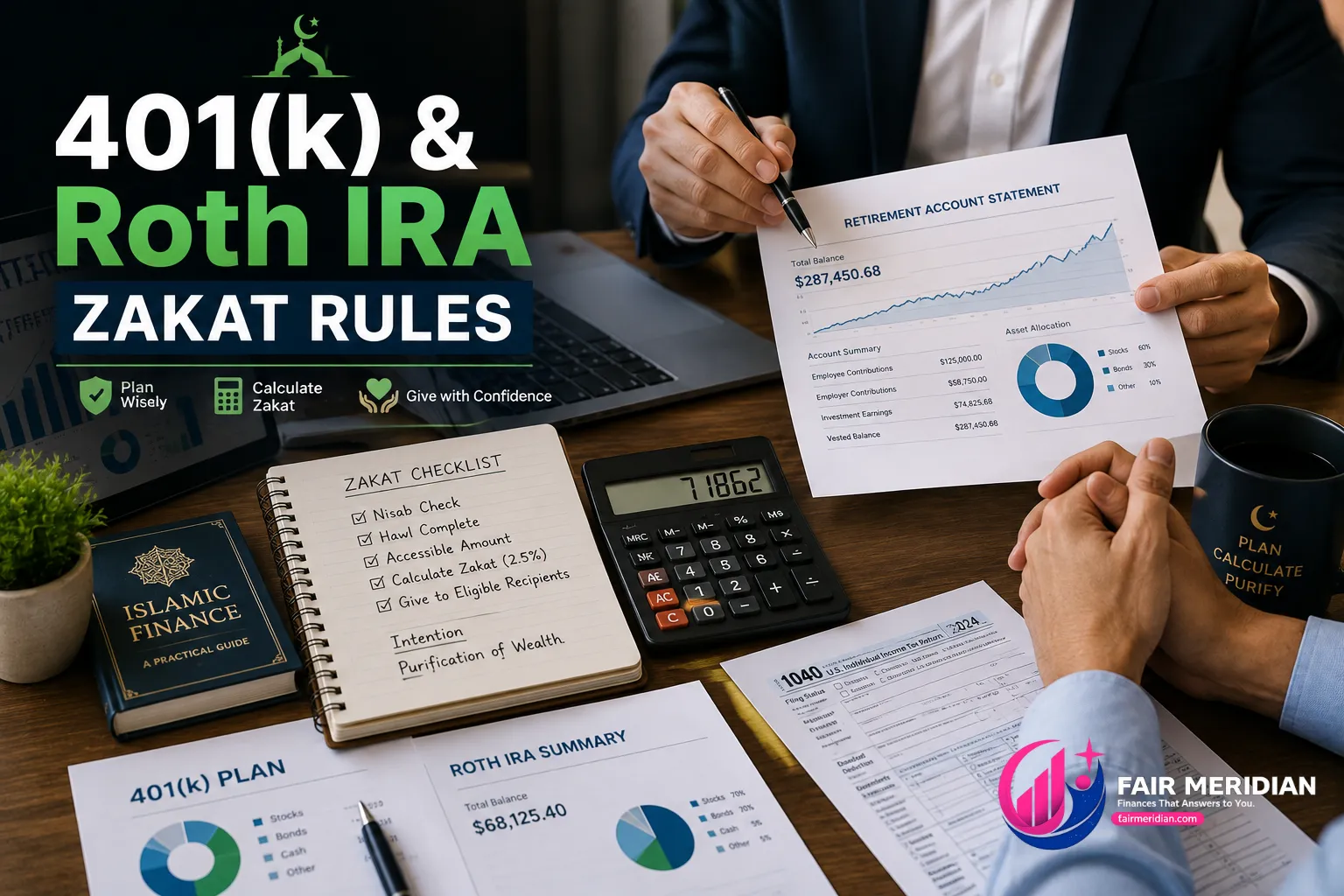
The 401k and Roth IRA Question
This is the question most zakat calculators skip entirely — and the one Muslim investors ask most urgently. The scholarly positions differ meaningfully.
Three Scholarly Positions on Retirement Account Zakat
Position | Rule | Basis | Scholars |
|---|---|---|---|
Position 1 (Stricter) | Full zakat due annually on the total account value | You own the assets even if access is restricted; ownership triggers zakat | Some AAOIFI scholars; strict traditional position |
Position 2 (Moderate) | Zakat due on net accessible value — account value minus estimated tax/penalty on withdrawal | Zakat is due on wealth you can actually use; early withdrawal penalties reduce net wealth | FCNA mainstream position; Sh. Yasir Qadhi |
Position 3 (Lenient) | No zakat until funds are withdrawn; pay at time of withdrawal | Inaccessible deferred compensation is not fully owned wealth in a zakatable sense | Some North American scholars; lenient position |
What This Means Practically
For a traditional 401k (pre-tax): Position 2 is the most widely recommended North American position. Subtract estimated income tax plus early withdrawal penalty (together often ~30–40% of the balance before age 59½) to arrive at the net accessible value — then apply the zakatable assets ratio and 2.5%.
Example: $80,000 traditional 401k invested in SPUS. Estimated tax + penalty on early withdrawal: ~$28,000 (35%). Net accessible value: $52,000. Zakatable base: $52,000 × 34.2% = $17,784. Zakat: $17,784 × 2.5% = $444.60.
For a Roth IRA: Your contributions can be withdrawn penalty-free at any time (only earnings are restricted). Most scholars treat Roth IRA contributions as accessible wealth — calculate zakat on the contribution portion using the full zakatable assets method with no deduction for penalty. The earnings portion follows Position 2 or 3.
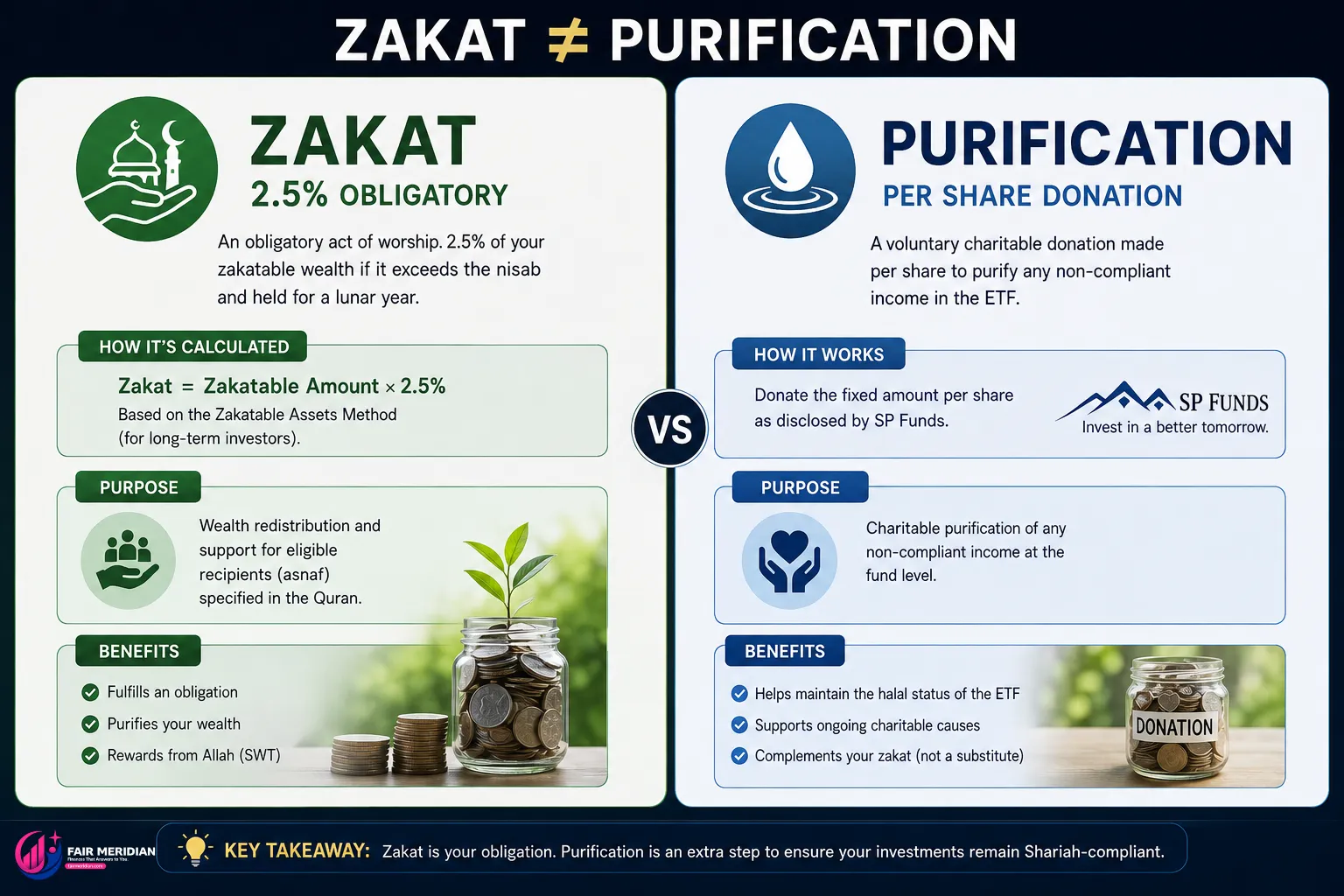
Zakat vs SPUS Purification — Critical Distinction
Many Muslim SPUS investors confuse zakat and purification. They are completely different obligations.
Zakat on SPUS | SPUS Purification | |
|---|---|---|
What it is | 2.5% of your zakatable SPUS assets — your personal zakat obligation | Small per-share donation to cleanse residual prohibited income from fund holdings |
Amount (2025) | $10,000 SPUS × 34.2% × 2.5% = $85.50 | $0.18 per share × your share count |
Who receives it | Zakat-eligible recipients (eight Quran 9:60 categories) | Any charity (not specifically zakat-eligible) |
Counts as zakat? | Yes — this is zakat | No — purification is separate from zakat |
Frequency | Annually on your zakat due date | Annually, after SPUS publishes purification amount |
You owe both, separately. Paying the purification does not satisfy your zakat. Paying your zakat on SPUS does not eliminate the purification obligation. They serve different religious functions.
Your Complete Zakat Worksheet — Investments
Asset | Current Value | Zakatable Ratio | Zakatable Base | Zakat (2.5%) |
|---|---|---|---|---|
SPUS (Roth IRA) | $________ | 34.2% | $________ | $________ |
AMAL | $________ | Check amal.fund | $________ | $________ |
Individual stocks | $________ | Check Zoya app | $________ | $________ |
401k (net of penalty) | $________ | 34.2% (if SPUS) | $________ | $________ |
Total Zakat on Investments | $________ |
Add investment zakat to your zakat on cash savings, gold, and business assets for your total annual zakat obligation. The Zoya app calculates per-stock zakat automatically for all screened holdings — the most time-efficient tool for Muslim investors with diversified portfolios.

Frequently Asked Questions
Do I pay zakat on stocks I haven't sold?
Yes — unrealized gains are included in the market value used to calculate zakat. You calculate zakat on the current market value of your portfolio on your zakat due date, regardless of whether you have sold any positions. Zakat is on wealth, not on realized income. If your SPUS is worth $30,000 today and you haven't sold a single share, you still calculate zakat on the $30,000 current value using the 34.2% zakatable ratio.
What is the nisab for stocks in 2026?
Nisab for stocks uses the same gold or silver threshold as all other wealth. At August 2026 prices: gold nisab ~$11,200; silver nisab ~$1,110. Most North American scholars use the silver nisab (~$1,110) as the minimum threshold. If your total zakatable wealth (cash + investments + gold + business assets) exceeds ~$1,110 and has for a full lunar year, you owe zakat on it.
Is zakat due on SPUS in a Roth IRA?
Yes — most scholars consider Roth IRA contributions zakatable because they can be withdrawn penalty-free at any time. For the full value in your Roth IRA including both contributions and earnings: apply the SPUS zakatable ratio (34.2%) and 2.5%. Some scholars apply Position 2 to Roth IRA earnings that cannot yet be withdrawn without penalty — consult your local scholar for your specific situation.
How do I calculate zakat on HLAL or UMMA?
Check each fund's website for their annual zakatable assets ratio. HLAL (Wahed) and UMMA (Saturna) both publish zakat-related disclosures. If no ratio is published, use Method 2 (full market value × 2.5%) as the conservative default. You can also check Zoya's app — they calculate zakatable assets ratios for major halal ETFs based on the underlying holdings.
For your complete zakat calculation including cash, gold, and business assets, use our Zakat Guide with the Nisab Live Widget. For a quick estimate of your total zakat, use the Fair Meridian Zakat Calculator.
This guide is for educational purposes and reflects general scholarly positions. It is not a fatwa. For your individual situation, consult a qualified local scholar or Islamic finance advisor.