
Five beliefs about Islamic finance are actively costing American Muslims money — either keeping them in rental apartments when they could be building halal equity, leaving savings in cash when SPUS is compounding tax-free in a Roth IRA, or paying riba unnecessarily because they assumed no halal alternative existed. Each myth below is followed by data that directly contradicts it.
Myth 1: "Halal Mortgages Cost More Than Conventional Mortgages"
The myth: Islamic mortgages charge higher rates to cover the extra complexity of the halal structure — so buyers pay a premium for religious compliance.
The data:
Product | Rate (May 2026) | Total Cost on $320K Financed (30yr) |
|---|---|---|
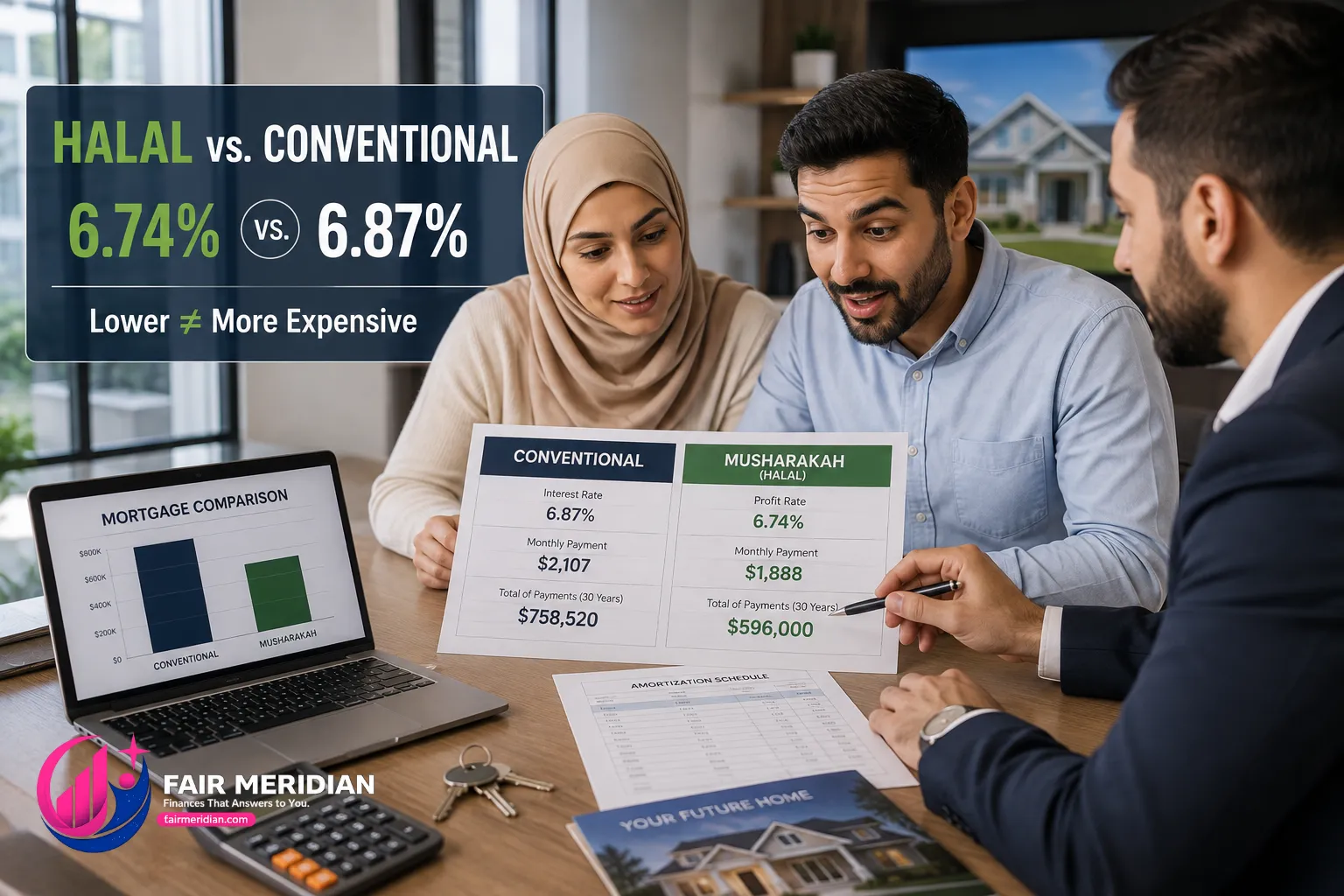
Conventional 30yr (Freddie Mac) | 6.87% | ~$758,520 |
Guidance Residential (Musharakah) | 6.74% | ~$596,000 |
Guidance Residential's musharakah rate (6.74%) is currently 13 basis points below the conventional 30-year average. The cheapest home financing in America right now — halal or conventional — is Guidance Residential.
The total cost difference is even more striking: $596,000 vs $758,520 — the halal buyer saves approximately $162,000 over 30 years. The savings come from two sources: the lower rate AND the musharakah's declining-balance structure, which means profit is charged on a shrinking bank stake each month rather than on a full principal balance compounding over 30 years.
What this myth costs: A Muslim family that avoids halal financing because they assume it's more expensive, and instead takes a conventional mortgage at 6.87%, is paying $162,000 more than they would with Guidance. On a $400,000 home, that's the cost of a second down payment — given back to a bank in compound interest.
Myth 2: "It's Just Conventional Finance With Different Names"
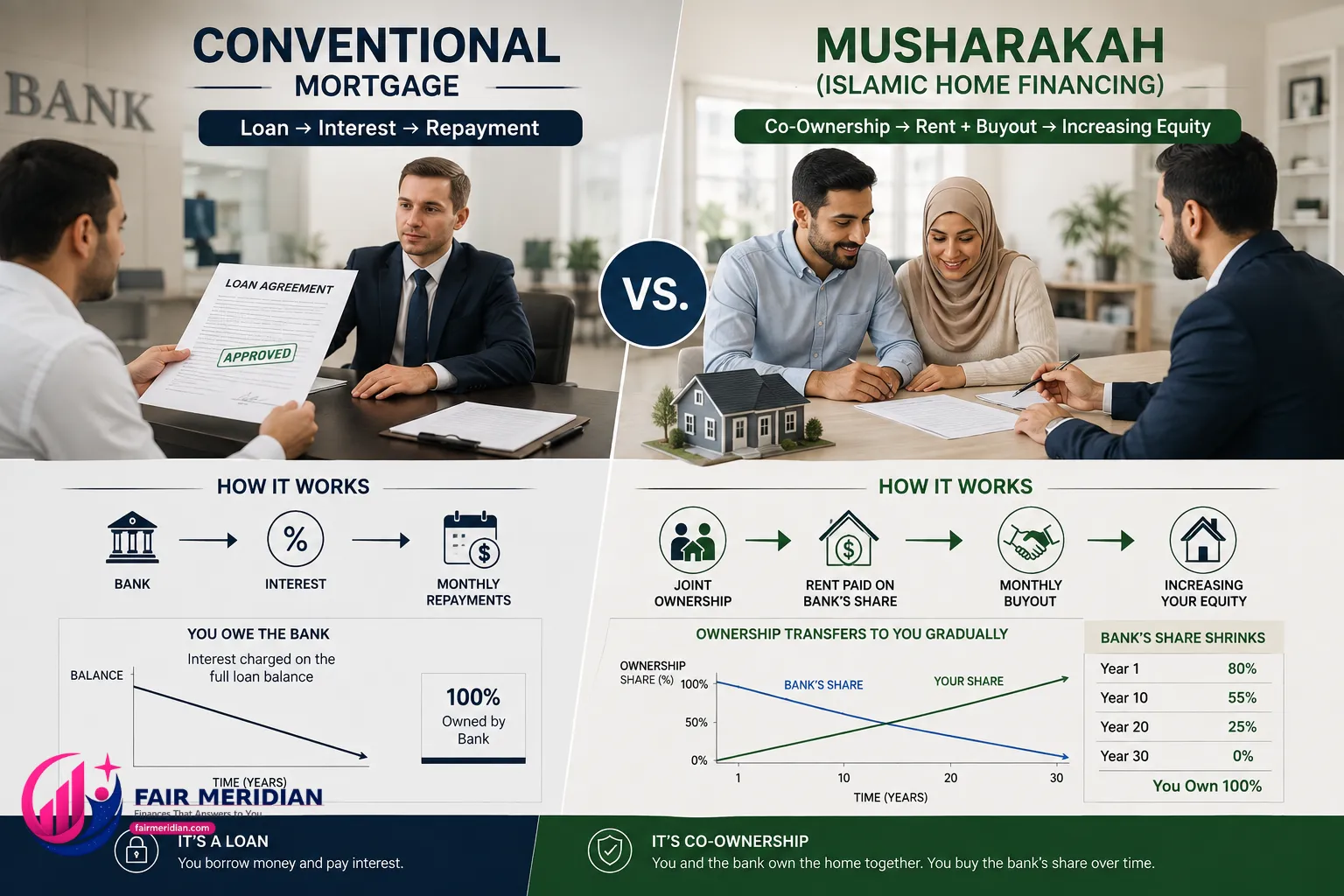
The myth: Islamic mortgages and conventional mortgages are economically identical — the bank just swaps "interest" for "profit" and charges the same amount.
The data — look at month 1:
Month 1 — $320,000 Financed | Conventional (6.87%) | Guidance Musharakah (6.74%) |
|---|---|---|
Payment to bank | $1,832 interest | Rent on bank's 80% stake |
Equity building | $275 (principal reduction) | $889 (fixed monthly buyout) |
What happens next month | Interest recalculates on ~$319,725 | Rent recalculates on bank's smaller stake |
Year 30 payment | Same $2,107 (constant) | Approximately $896 (declining) |
The legal structure is genuinely different. In a conventional mortgage: you borrowed $320,000 and owe interest on that balance. In musharakah: there is no loan. You and the bank co-own the property. You pay rent on the bank's ownership stake — which shrinks each month as you buy it out. These are different contracts, different legal relationships, and different mathematics.
The institutional proof: Freddie Mac and Fannie Mae — US government-sponsored enterprises that purchase and securitize mortgages — independently reviewed Guidance Residential's musharakah contracts and approved them for purchase in the secondary market. Two federal agencies with no Islamic finance mandate certified that the structure is legally different from a conventional mortgage. Window dressing doesn't get GSE approval.

Myth 3: "Halal Investing (SPUS) Underperforms the Stock Market"
The myth: Excluding conventional banks, alcohol, and tobacco companies means missing out on returns — halal investing is a sacrifice for your faith.
The data (YTD May 2026):
Fund | YTD Return (May 2026) | What It Holds |
|---|---|---|
SPUS (halal S&P 500) | +12.4% | S&P 500 minus banks, alcohol, tobacco, gambling |
SPY (conventional S&P 500) | +10.9% | Full S&P 500 |
HLAL (halal global) | +11.8% | FTSE Shariah screened |
SPUS has outperformed the S&P 500 by 1.5 percentage points YTD in 2026. This is not anomalous — SPUS regularly outperforms SPY in years when conventional banks and financial sector stocks underperform, and tracks closely in years when banks do well.
The historical logic: the companies excluded from SPUS (conventional banks, alcohol producers, tobacco companies) have been among the worst performers during financial crises. Excluding JPMorgan and Citigroup in 2008–2009 would have dramatically improved any portfolio's performance. The "halal investing sacrifices return" narrative assumes the excluded sectors consistently outperform — the data doesn't support this.
What this myth costs: A Muslim investor who keeps $50,000 in cash because they believe SPUS underperforms — instead of investing it — loses approximately $6,200/year in expected returns (at SPUS's YTD 2026 rate). Over 10 years at 9% average return: they forgo approximately $720,000 in tax-free Roth IRA wealth from a $50,000 starting position.

Myth 4: "There's No Viable Halal Path to Retirement Savings"
The myth: Retirement accounts involve interest-bearing bonds and conventional investments — Muslim retirement savings require complexity and sacrifice.
The reality: The halal retirement path is four steps and takes 20 minutes to set up.
Go to fidelity.com
Open a Roth IRA (10 minutes, free)
Buy SPUS
Set up $583/month automatic investment
That's it. At $583/month in SPUS at 9% average annual return over 30 years: $1,348,000 — completely tax-free. No capital gains tax. No income tax on withdrawal. 100% Sharia-compliant. 100% legally available to any US Muslim with earned income.
The SPUS Roth IRA is not a compromise or a second-best option — it is literally one of the highest-return, lowest-tax retirement vehicles available to any American investor, halal or conventional.
What this myth costs: A Muslim professional who delays starting their Roth IRA by 5 years because of this myth loses approximately $250,000–$400,000 in final Roth IRA value at retirement, depending on starting balance and return assumptions. The five years of compounding from age 25 to 30 is worth more than the next fifteen years of contributions.

Myth 5: "My Imam Said I Can Use a Conventional Mortgage, So It's Fine"
The myth: The darurah (necessity) framework generally permits conventional mortgages for Muslim homebuyers, so there's no reason to seek out halal alternatives.
The nuance: Darurah is a genuine and important scholarly framework — and the scholars who invoke it are not wrong about the principle. The problem is its application. Darurah applies when no halal alternative is genuinely available after real effort to find one. It is a last resort, not a default assumption.
State | Halal Lenders Available | Darurah Applies? |
|---|---|---|
Virginia, Maryland, New York, New Jersey | Guidance (5% down, 6.74%) + 4 others | No — halal option clearly available |
Texas, Illinois, Michigan | Guidance + UIF + Devon Bank + others | No — halal option clearly available |
California | Guidance + Ameen Coop + 4 others | No — halal option clearly available |
All 50 states | Devon Bank (nationwide), Lariba (nationwide) | Darurah is extremely hard to justify in the US |
Five major halal lenders serve the United States. Guidance serves 22 states + DC. UIF serves 30+. Devon Bank and Lariba serve all 50 states. It is very difficult to make a genuine darurah case for conventional mortgage financing in the United States when nationwide halal options exist at rates currently below the conventional average.
The scholars who issued darurah rulings on mortgages largely did so in an era when Guidance Residential didn't exist (pre-1999) or when its coverage was limited. The landscape has changed dramatically. The correct application of darurah requires checking today's halal availability — not applying a ruling from a different era to a fundamentally changed market.
What this myth costs: A Muslim family that takes a conventional mortgage at 6.87% when Guidance would have served their state at 6.74% pays $162,000 more over 30 years. The darurah exception doesn't make that riba less expensive — it just resolves the religious question of permissibility. When a halal option is available and cheaper, darurah doesn't apply and the conventional loan costs $162,000 more than necessary.

Frequently Asked Questions
Is halal finance just a marketing label for the same products?
No — for home financing specifically, the legal and mathematical structure is genuinely different. Guidance Residential's musharakah involves joint property ownership, not a loan. Freddie Mac and Fannie Mae independently reviewed and approved these contracts — they would not have done so for a simple relabeling of a conventional mortgage. The declining-balance structure also produces different total costs (lower) than conventional amortization, confirming the mathematical difference.
Does SPUS consistently outperform SPY?
Not consistently in every period — but it does not systematically underperform over full market cycles. SPUS typically outperforms in bear markets and financial crises (when excluded financial sector stocks crash) and performs slightly below SPY in strong bank stock bull markets. Over long holding periods, the performance difference has been minimal — with SPUS showing slight outperformance in recent years due to the strong performance of AI and tech stocks that are well-represented after excluding conventional banks.
Can I get a halal mortgage in any US state?
Devon Bank (murabaha) and Lariba Finance (ijara-based) both serve all 50 US states. Guidance Residential serves 22 states + DC. UIF Corporation serves 30+ states. For virtually every US Muslim homebuyer, a halal mortgage is available. The question is which provider serves your state and which product best fits your situation — not whether a halal option exists at all.
Use our Halal Mortgage Calculator to see the exact cost comparison at your home price. To start your SPUS Roth IRA in 20 minutes, read our step-by-step Roth IRA setup guide. For current halal mortgage rates from all five providers, see our Halal Mortgage Rates USA guide.