"Is day trading halal?" is one of the most searched Islamic finance questions in the United States — and one of the most poorly answered. Most content gives you either a blanket prohibition without scholarly reference, or a vague "it depends" that explains nothing. Neither helps a Muslim investor who actually wants to understand the ruling.
This post gives you the complete scholarly analysis: what Islamic law actually says about short-term trading, which specific trading activities are clearly prohibited, which are disputed, which are permitted, and the named scholars whose positions form the basis for each ruling.
It is 14 minutes long because the honest answer requires that length. If you want a one-line answer, it is: most forms of day trading as practiced in the US involve one or more prohibited elements. But the analysis behind that answer — and the specific distinctions that matter — are what make this post worth reading.
Day Trading Is Not One Thing
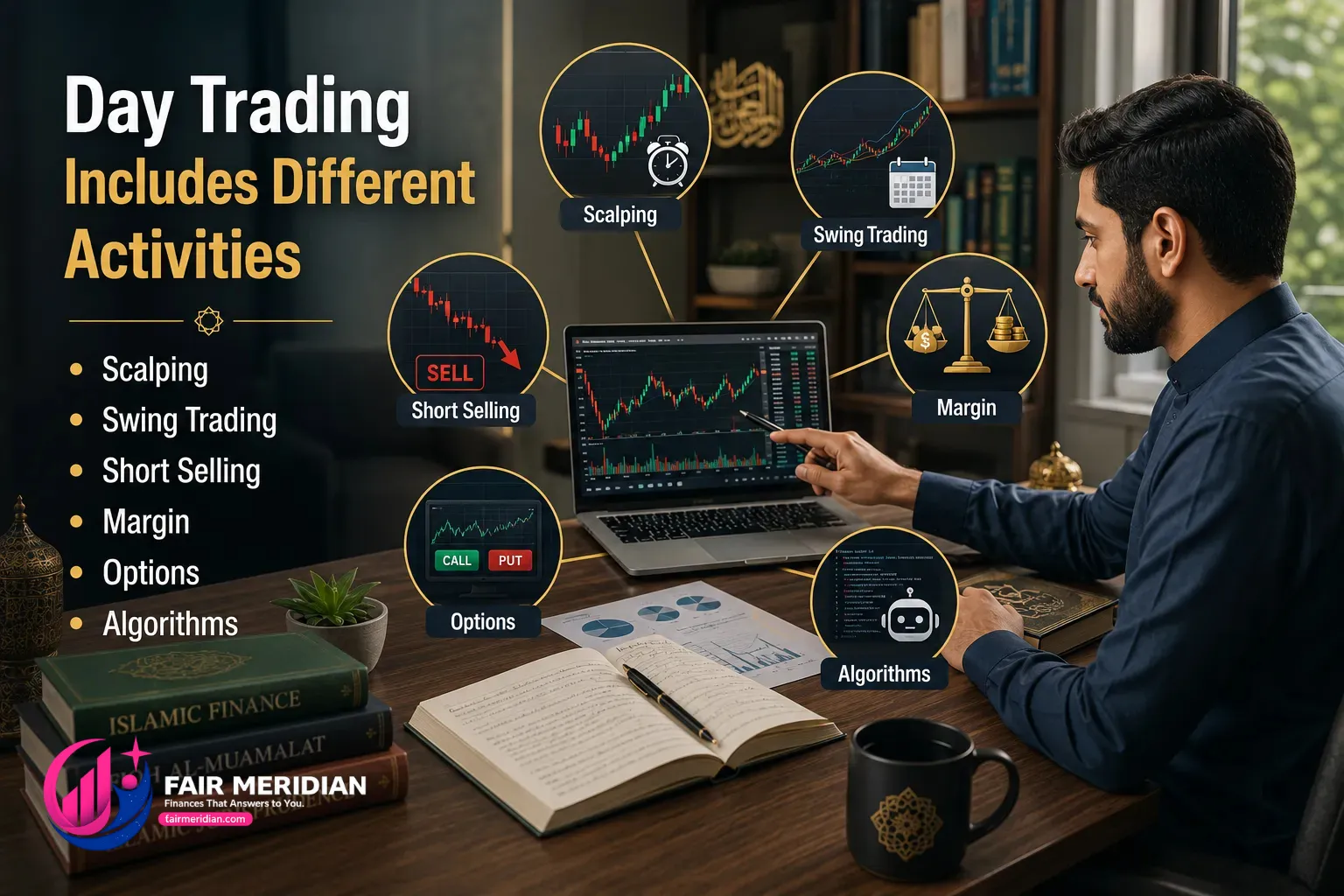
The reason most answers to this question are unsatisfying is that "day trading" describes at least six distinct trading activities, each with a separate Islamic legal analysis:
Intraday equity scalping (buying and selling stocks within hours)
Swing trading (holding stocks for days to weeks)
Short selling (selling stocks you do not own)
Margin trading (buying stocks with borrowed money)
Options trading (buying/selling contracts on stocks)
Algorithm and bot trading (automated short-term strategies)
Each of these has a different ruling. This post analyzes each one separately.
The Core Islamic Finance Principles That Apply
Before analyzing specific trading types, you need to understand the three Islamic finance principles that are most relevant to trading:
Riba — The Prohibition of Interest
Riba (the Arabic word for interest) is prohibited in Islamic law across four Quranic revelations, the most explicit being Surah Al-Baqarah 2:275–281: "Allah has permitted trade and forbidden riba." Any trading activity that involves borrowing money at interest (margin), or instruments that function as interest-bearing debt instruments, involves riba and is categorically prohibited.
Gharar — Excessive Uncertainty
Gharar (Arabic for "hazard" or "deception") refers to excessive ambiguity or uncertainty in a contract that makes it unjust. It includes situations where one party possesses information the other lacks, where the subject matter of a contract is fundamentally uncertain, or where a transaction is structured around pure uncertainty rather than productive activity. The AAOIFI defines gharar as "uncertainty about the subject matter or price in a contract, or uncertainty about whether the contract will actually materialize." (AAOIFI Sharia Standard No. 1 on Trading in Currencies)
Maysir — Gambling and Speculation
Maysir refers to games of chance, gambling, and transactions where one party's gain is necessarily another's loss without any real economic value being created. The Quran prohibits maysir explicitly in 5:90–91 alongside alcohol and idols — one of the strongest levels of prohibition in the Quran. Islamic scholars have extended the maysir prohibition to financial speculation where the primary motivation is gain from price movement rather than productive investment.
Genuine Ownership (Tamalluk)
Islamic law requires that you genuinely own an asset before selling it. The Prophet Muhammad (peace be upon him) said: "Do not sell what you do not possess." (Tirmidhi, Abu Dawud) This hadith, considered sound (hasan sahih) by the scholars of hadith, is one of the most frequently cited texts in Islamic commercial law discussions about trading. It forms the basis for the prohibition of short selling.

Activity 1: Intraday Equity Scalping
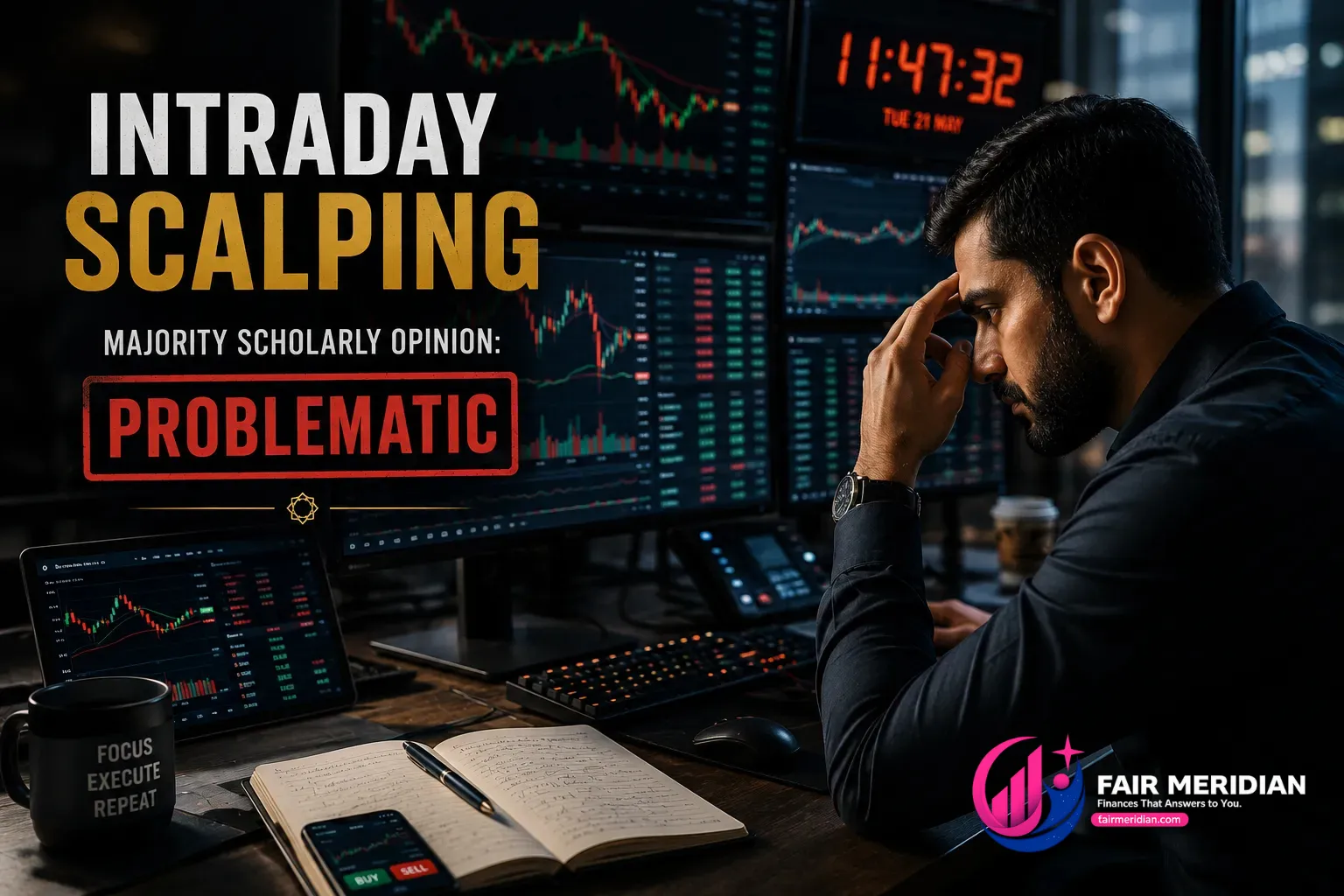
Scholarly Verdict: PROBLEMATIC — majority position considers it impermissible
Intraday scalping means buying a stock in the morning and selling it within hours (or minutes) to capture small price movements, with no intention of holding for investment purposes.
Why Most Scholars Consider This Problematic
Sheikh Muhammad Taqi Usmani, in his seminal work An Introduction to Islamic Finance (Kluwer Law International, 2002), addresses the question of speculative trading in stocks. He writes that buying shares with genuine investment intent — owning the underlying business, receiving its dividends, participating in its growth — is permissible. He distinguishes this sharply from "buying and selling shares for the sake of gain from price fluctuations" without any real ownership intent, which "partakes of gharar and maysir."
Dr. Muhammad Obaidullah, in Islamic Financial Services (Islamic Economics Research Centre, King Abdulaziz University, 2005), provides the most systematic academic treatment of this distinction. He identifies three conditions for permissible stock trading:
The stocks must be in Sharia-compliant companies
The transaction must involve genuine ownership transfer with real settlement (not a paper gain)
The intent must be investment (ownership of the business) rather than pure speculation on price movement
Intraday scalping fails the third condition. When a trader buys a stock at 9:35 AM and sells it at 11:48 AM having performed no fundamental analysis and with no intention of holding for business participation, the transaction is functionally a bet on short-term price movement — structurally similar to a zero-sum game where the scalper's gain comes directly from someone else's loss.
The Strongest Counter-Argument
Some contemporary scholars — including a minority position among Hanafi jurists — argue that any genuine buying and selling of a permissible asset involves permissible trade regardless of the holding period, citing the Quranic principle that "Allah has permitted trade." Under this view, if you genuinely owned the shares (settlement occurred), sold at a profit, and the company is halal, the transaction is a form of trade even if brief.
However, the majority scholarly position in contemporary Islamic finance academia — including the OIC Islamic Fiqh Academy (Resolution 63/1/7, 1992 on financial markets) — distinguishes between genuine trade and speculative contracts, and categorizes pure scalping without ownership intent in the speculative category.
Activity 2: Swing Trading
Scholarly Verdict: GENERALLY PERMISSIBLE with conditions
Swing trading means holding positions for days to several weeks based on technical or fundamental analysis, with genuine ownership during the holding period and genuine settlement of the transaction.
Why Swing Trading Is More Defensible
The OIC Islamic Fiqh Academy's 1992 resolution on stock market investment distinguishes between: (a) investment based on research and analysis of the underlying business, and (b) pure speculation based on rumor or technical patterns divorced from business fundamentals. Swing trading based on fundamental analysis — buying a halal-screened company because you believe its earnings will improve in the coming weeks — falls closer to legitimate investment than intraday scalping.
Sheikh Nizam Yaqoobi, in a widely cited 2007 fatwa on stock market investment (published in the Journal of Islamic Financial Services), holds that short-to-medium-term trading based on genuine analysis of company fundamentals is permissible provided: the company passes Sharia screening, the investor genuinely takes ownership risk during the holding period, and the transaction is not leveraged.

The Conditions That Must Be Met
Sharia screening: The stocks held must pass a recognized Sharia screening methodology (Zoya, Musaffa, Dow Jones Islamic Market Index criteria, or equivalent)
Genuine ownership: Standard brokerage settlement (T+2 for equities in the US) must occur — you must actually own the shares, not merely hold a contract or CFD
No margin: No borrowed capital. Cash account only.
Research basis: The holding should be based on analysis of some kind — not pure momentum or rumor trading
Activity 3: Short Selling
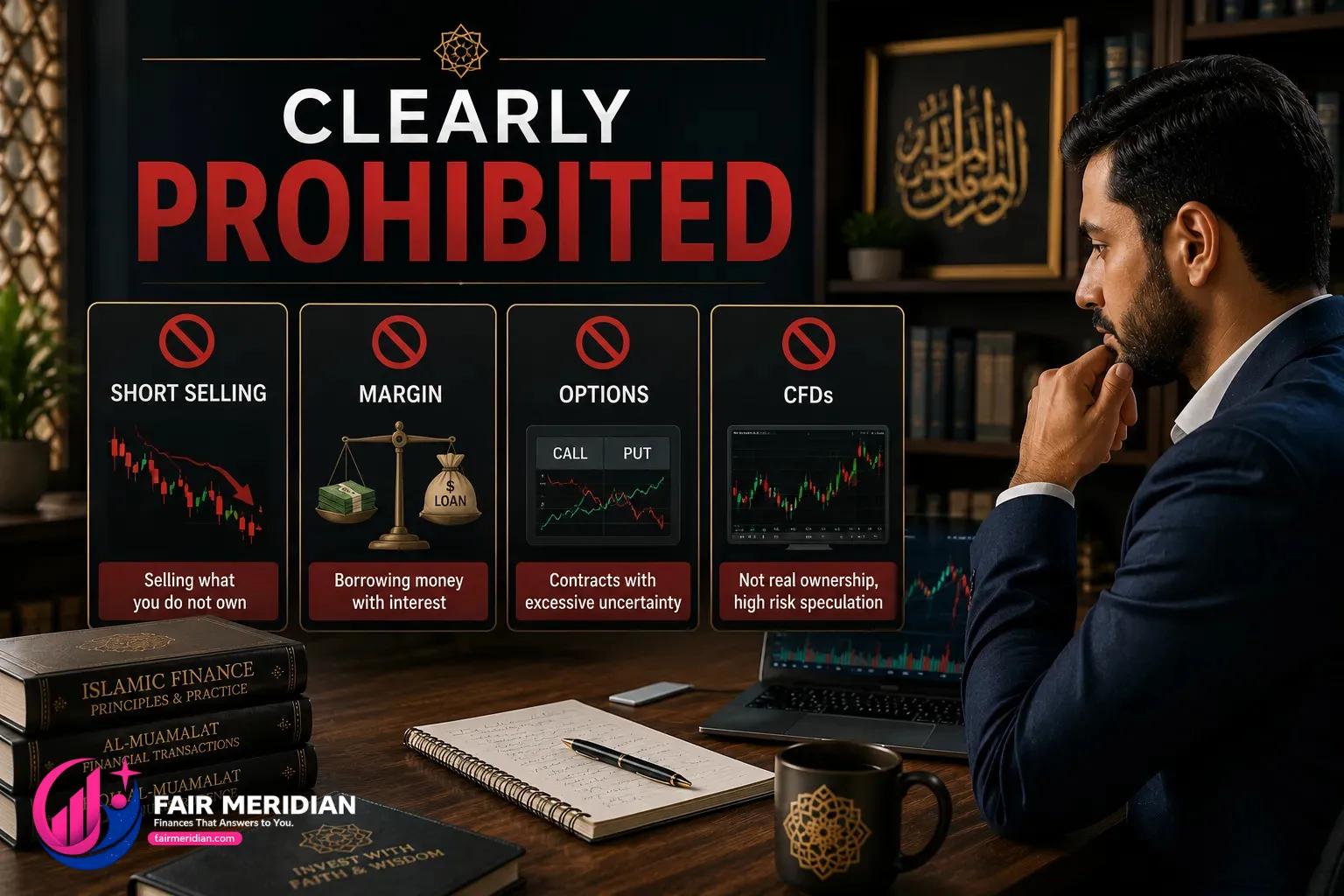
Scholarly Verdict: PROHIBITED — virtually unanimous
Short selling means selling shares you do not currently own, hoping to buy them back at a lower price later and profit from the difference. To do this, you borrow shares from a broker, sell them, and later buy them back to return.
Why Short Selling Is Prohibited
The prohibition is unambiguous and comes directly from the most reliable hadith sources. The Prophet Muhammad (peace be upon him) said: "Do not sell what you do not possess." (Tirmidhi 1232, Abu Dawud 3503 — graded hasan sahih by multiple hadith scholars including Ibn Hajar al-Asqalani)
Short selling violates this principle categorically: you sell shares you borrowed (and therefore do not own) at the time of the sale. The AAOIFI Sharia Standard on Shares (No. 21, paragraph 3/1/2) explicitly prohibits short selling as a form of bay' al-ma'dum (selling what one does not own). The OIC Islamic Fiqh Academy similarly prohibited it in Resolution 65/1/7 (1992).
Additionally, conventional short selling requires borrowing shares and paying interest on the borrowing arrangement — adding riba to an already prohibited transaction structure.
There is no significant scholarly disagreement on this point. Short selling is prohibited under virtually all scholarly opinions, across all four madhabs, for the same reason.
Activity 4: Margin Trading
Scholarly Verdict: PROHIBITED — clear riba
Margin trading means borrowing money from your broker at interest to buy more securities than you have cash for. As of May 2026, US brokers charge 6.0–8.5% annually on margin balances. Robinhood Gold charges 6.5%. Interactive Brokers charges from 5.33% depending on balance.
Why Margin Trading Is Prohibited
This requires no complex scholarly analysis. You are borrowing money at a predetermined interest rate. This is riba al-nasi'ah — the core prohibited form of interest — directly and unambiguously. Sheikh Muhammad Taqi Usmani, Sheikh Yusuf al-Qaradawi, and virtually every Islamic finance authority who has addressed this question reach the same conclusion without exception.
The fact that you are using the borrowed money to buy stocks rather than consumer goods does not change the analysis. The prohibition is on the interest-bearing loan structure, not on what the loan proceeds are used for.
Practical implication: Never activate a margin account. Use cash accounts only. Do not subscribe to Robinhood Gold. If your brokerage asks whether you want a "margin account" or "cash account" during setup, always choose cash.
Activity 5: Options Trading
Scholarly Verdict: PROHIBITED — majority position; gharar and maysir
Options are contracts giving you the right (but not the obligation) to buy or sell a stock at a predetermined price before a specified date. Buying a call option means paying a premium for the right to buy a stock at $100 by a certain date. Buying a put option means paying a premium for the right to sell.
Why Options Are Problematic Under Islamic Law
The OIC Islamic Fiqh Academy addressed financial options directly in Resolution 63/1/7 (7th Session, 1992) and concluded that conventional options contracts are not permissible under Islamic law for several reasons:
Gharar: The subject matter of an options contract is an uncertain future event — whether the underlying asset will be above or below the strike price at expiry. Paying a premium for this uncertainty is the definition of bay' al-gharar (uncertain sale).
Bay' al-ma'dum (selling what does not exist): When you sell a call option, you may be selling the right to buy shares you do not currently own. This violates the same "do not sell what you do not possess" principle that prohibits short selling.
Maysir resemblance: When options expire worthless — which happens to the majority of options positions — the premium paid is a complete loss with no underlying asset acquired. The payout structure (large gain or total loss) structurally resembles gambling.
Zero-sum nature: Options are zero-sum — for every dollar gained by the option buyer, a dollar is lost by the option seller. No real economic value is created. Islamic finance requires returns to come from genuine economic productivity, not zero-sum speculation.
Dr. Sami Al-Suwailem, in his paper "Towards an Objective Measure of Gharar in Exchange" (Islamic Economic Studies, Vol. 7, Nos. 1 & 2, 1999–2000), provides the most rigorous academic treatment of why options contracts constitute gharar. His quantitative analysis of payoff structures demonstrates that conventional options are structurally equivalent to zero-sum games.
The practical implication: do not activate options trading at any brokerage account. This includes covered calls (even though some scholars might view these differently, the dominant position prohibits all conventional options contracts).
Activity 6: Algorithm and Bot Trading
Scholarly Verdict: DEPENDS on underlying strategy
Algorithmic trading simply automates a trading strategy. The permissibility of an algorithm depends entirely on what strategy it implements:
Algorithm that buys and holds halal-screened ETFs based on rebalancing signals: Permissible — the algorithm is implementing a permissible strategy
Algorithm that scalps intraday: Subject to the same analysis as manual intraday scalping — most scholars would consider it problematic
Algorithm that short sells: Prohibited — automation does not change the underlying prohibition
Algorithm that trades options: Prohibited — automation does not change the underlying prohibition
The automation itself is not the issue. The issue is what the algorithm does. Use automation tools (robo-advisors, automatic rebalancing at Fidelity) only for strategies that are themselves permissible.
The Complete Verdict Table
Activity | Islamic Verdict | Primary Basis | Key Scholarly Reference |
|---|---|---|---|
Intraday scalping (stocks) | ⚠️ Majority: Not Permissible | Gharar + maysir; lacks genuine ownership intent | Usmani, Islamic Finance; OIC Res. 63/1/7 |
Swing trading (days to weeks, fundamental basis, halal stocks) | ✅ Permissible with conditions | Genuine ownership + Sharia-screened stocks + no margin | Yaqoobi fatwa 2007; FCNA position |
Long-term investing (months to years, halal stocks) | ✅ Permissible and recommended | Genuine ownership; participation in business growth | Unanimous scholarly consensus |
Short selling | ❌ Prohibited | Bay' ma'dum — selling what you don't own + riba on borrowing | Hadith of Prophet (Tirmidhi 1232); AAOIFI SS No. 21; OIC Res. 65/1/7 |
Margin trading | ❌ Prohibited | Riba — borrowing at interest to invest | Usmani; al-Qaradawi; unanimous |
Options trading (all types) | ❌ Prohibited (majority) | Gharar + maysir + bay' ma'dum | OIC Res. 63/1/7; Al-Suwailem, Islamic Economic Studies 1999 |
Forex / currency speculation | ❌ Majority: Not Permissible | Gharar; riba al-fadl on currency exchange; no real value creation | AAOIFI Sharia Standard No. 1 on Currencies |
CFDs (Contracts for Difference) | ❌ Prohibited | Gharar + no genuine ownership transfer + typically margined | Broadly prohibited across Sharia boards globally |
Crypto day trading | ⚠️ Disputed | Cryptocurrency's permissibility itself is disputed; speculative trading compounds concerns | No consensus; individual scholar positions vary widely |
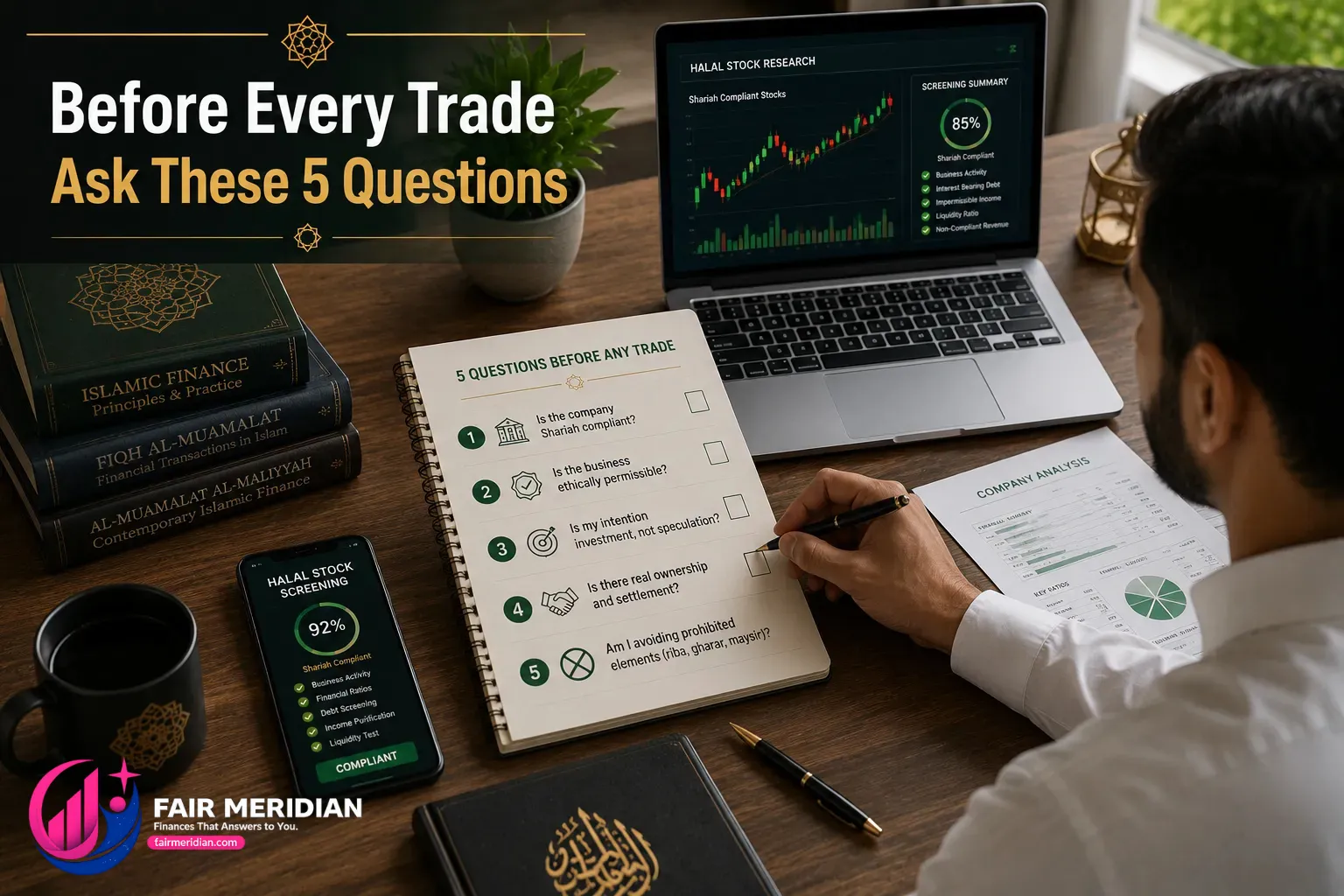
A Practical Framework: 5 Questions Before Any Trade
For any Muslim investor who wants to trade stocks or ETFs, these five questions determine whether a specific transaction is permissible:
Question 1: Is the company Sharia-screened?
Check the ticker in Zoya (zoya.finance) or Musaffa (musaffa.com) before buying. If it fails the screen — conventional bank, alcohol, tobacco, gambling — do not buy it regardless of how attractive the trade looks. This check takes 30 seconds.
Question 2: Am I using a cash account (not margin)?
Confirm you are using a cash account, not a margin account. At Fidelity, Schwab, or Vanguard, you can specify "cash account" when opening. At Robinhood, do not activate Gold. If you are unsure whether your account has margin enabled, check your account settings — look for "margin balance" or "buying power beyond settled cash." If those figures exceed your deposited cash, you have margin enabled.
Question 3: Am I selling what I actually own?
Are you selling shares you bought and hold in your account? If yes — permissible to sell. Are you entering a short position (selling borrowed shares), trading options (selling rights to buy/sell), or using CFDs? If yes — stop.
Question 4: What is my genuine reason for buying?
This question requires honest self-examination. Are you buying this stock because you have a view about the underlying business — its earnings, its competitive position, its products — even if that view covers only a few weeks? Or are you buying because the price went up yesterday and you think it will go up again today?
The scholars who permit short-to-medium-term trading consistently draw this distinction. A swing trade based on genuine analysis of company fundamentals is different from scalping based on price momentum. The difference is not always crisp, but honesty with yourself about your motivation matters.
Question 5: Will I genuinely own this stock between purchase and sale?
Standard US equity settlement is T+2 — you own the shares two business days after purchase. For intraday trades, this means you technically own shares on purchase (the ownership risk is yours from the moment of execution) but you sell before settlement. Whether this constitutes genuine ownership during the trade is one of the scholarly debates around intraday trading — which is another reason intraday scalping is more problematic than holding for multiple days through a complete settlement cycle.
The Broader Principle: Investment vs Speculation

The most consistent theme across all scholarly analysis of trading is the distinction between investment (genuine participation in business through ownership) and speculation (betting on price movements with no genuine business connection).
Sheikh Muhammad Taqi Usmani, who is perhaps the most authoritative contemporary voice on Islamic commercial law, writes in An Introduction to Islamic Finance: "Dealing in shares is permissible with certain conditions: (1) The main business of the company is not violative of Sharia; (2) The company does not undertake any activities prohibited by Sharia... The purchaser of shares acquires a proportionate ownership in the assets of the company and is entitled to a proportionate share in profits and subject to proportionate losses."
The key insight in Usmani's formulation is what stock ownership actually means: acquiring a proportionate ownership in the assets of a real business, sharing in its genuine profits and losses. A scalper who holds for 47 minutes has a fundamentally different relationship to the underlying business than a long-term investor — this difference in relationship to the underlying asset is what most scholars find ethically significant.
What Muslims Can Do Instead of Day Trading
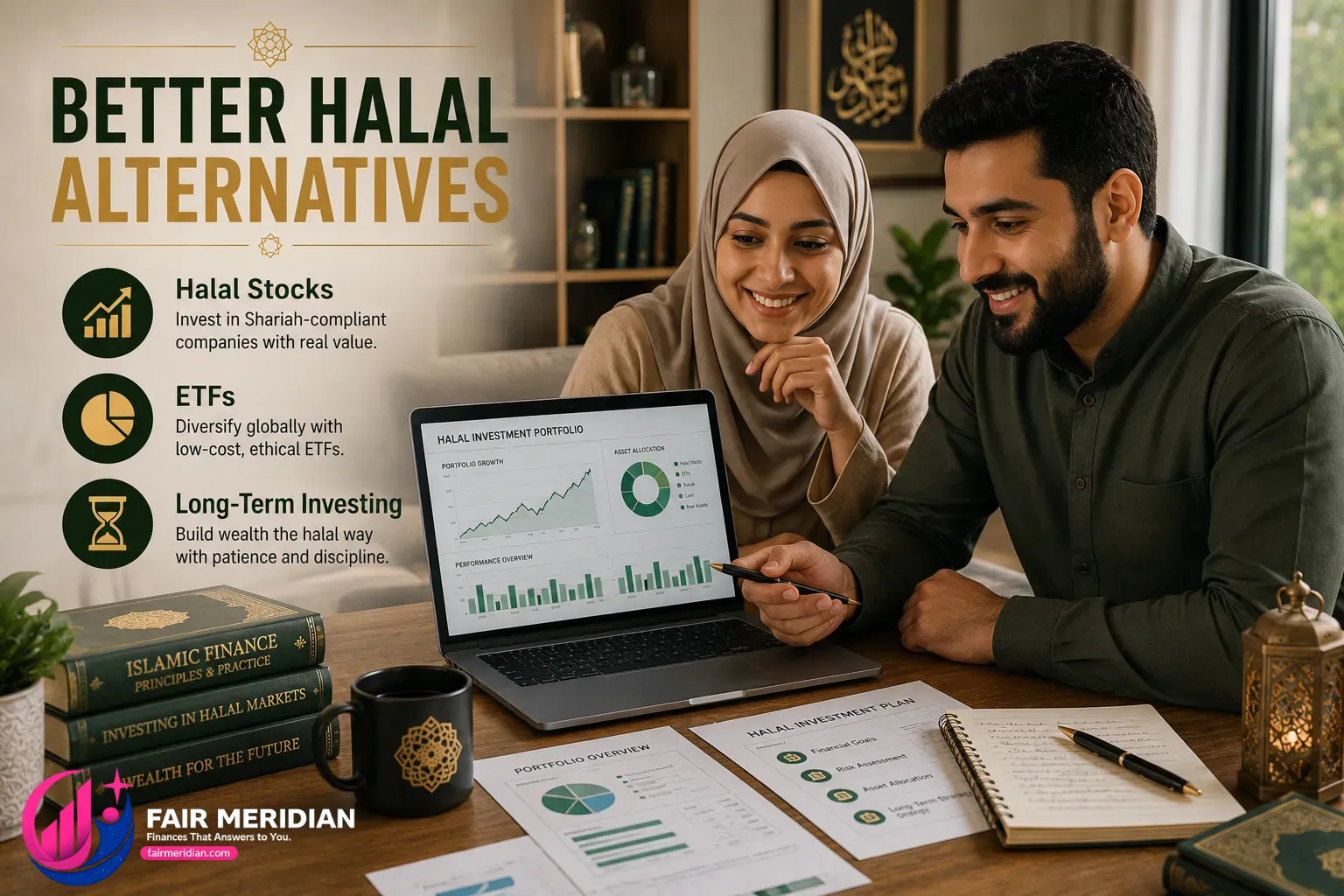
If you are interested in active participation in financial markets as a Muslim investor, here are the permissible alternatives that provide engagement without the prohibited elements:
Research-based swing trading of halal stocks (days to weeks, cash account): Permissible under the majority position. Use Zoya to screen stocks. Use Fidelity or Schwab on a cash account. Research fundamentals before buying.
Core halal ETF portfolio with regular contributions: SPUS at Fidelity in a Roth IRA, contributed monthly. No active trading required. Returns have outperformed the S&P 500 YTD 2026.
Halal stock selection based on fundamental analysis: Building a concentrated portfolio of 10–20 Sharia-screened stocks based on your research into specific companies, held for months to years.
Real estate via SDIRA: If you enjoy active engagement with investments, a Self-Directed IRA invested in Sharia-structured real estate provides active investment management within a halal framework.
Frequently Asked Questions
Is day trading halal in Islam?
The scholarly consensus leans toward "no" for most forms of day trading as practiced in the United States. Pure intraday scalping — buying and selling within hours for price movement profits with no fundamental analysis — is considered problematic by most Islamic finance scholars due to gharar (excessive uncertainty) and its structural resemblance to maysir (gambling). However, research-based swing trading of halal-screened stocks in a cash account over days to weeks is generally considered permissible. The prohibited elements that cause the most clear prohibitions are: short selling, margin borrowing, and options trading — all of which should be avoided by Muslim investors regardless of holding period.
Is forex trading halal?
Forex (foreign exchange) speculation is prohibited under the majority scholarly position for multiple reasons. The AAOIFI's Sharia Standard No. 1 on Trading in Currencies permits genuine currency exchange (buying one currency with another for actual use) but not speculative forex trading designed to profit from exchange rate movements. The reasons: speculative forex trading typically involves riba al-fadl (unequal exchange of currencies), gharar (the exchange rate is the source of uncertainty, not a byproduct), and in practice almost always involves leverage (margin) — which adds riba al-nasi'ah. The OIC Islamic Fiqh Academy has addressed currency transactions in multiple resolutions (most recently in 2004) and distinguishes between permitted genuine exchange and prohibited speculation.
Is crypto trading halal?
Cryptocurrency itself — particularly Bitcoin — has no scholarly consensus regarding its permissibility, with positions ranging from permitted (treated as a commodity) to prohibited (treated as having no intrinsic value or legitimate use). Given the unresolved status of cryptocurrency itself, day trading in crypto adds additional gharar and maysir concerns to an already unresolved foundational question. The most cautious position — recommended in the absence of clear scholarly consensus — is to avoid crypto trading until a qualified scholar whose opinion you respect has issued a clear ruling on the specific activity.
Is technical analysis halal?
Using technical analysis as a tool — studying price charts, moving averages, support and resistance levels — is not itself prohibited. Technical analysis is a methodology for making trading decisions, not an activity that is halal or haram in itself. What matters is: (1) what you trade (halal-screened stocks in a cash account), and (2) what your genuine purpose is (genuine investment/ownership vs pure speculation). Technical analysis used to time entry and exit on halal stock positions held for days to weeks is a different activity from pure momentum scalping, even if both use charts.
What about paper trading (simulation) — is that halal?
Yes. Paper trading — simulated trading without real money — is permissible regardless of what is being simulated. You are not entering into any actual contract or transaction. Paper trading is a useful tool for learning trading mechanics before deploying real capital. Some scholars have analogized it to a training exercise that in itself does not create any real financial obligation or prohibited transaction.
Can I use Robinhood for halal trading?
Robinhood's basic cash account can be used to buy halal-screened stocks and ETFs (like SPUS) permissibly. Do not activate Robinhood Gold (margin — riba), do not trade options, and screen every stock through Zoya before buying. However, for a Muslim investor focused on halal compliance, Fidelity or Schwab may be better platforms: both offer SPUS commission-free, Roth IRA accounts, and have no equivalent to Robinhood Gold's prohibited margin feature prominently displayed.

The complete answer to "is day trading halal" requires specifying which kind of day trading. Short selling: clearly prohibited. Margin trading: clearly prohibited. Options: clearly prohibited. Intraday scalping: problematic under the majority scholarly position. Swing trading of halal stocks on a cash account with a research basis: generally permissible.
For Muslim investors who want market participation without navigating these distinctions on every trade, the simplest approach remains the best one: open a Roth IRA at Fidelity, buy SPUS monthly, hold long-term. SPUS has returned +12.4% YTD through May 2026 — outperforming the conventional S&P 500 without a single active trade required.
Use our Halal Investment Screener to verify any stock's Sharia status before buying. For the complete halal investing framework — ETFs, stock screening, 401k strategies, and Roth IRA setup — read our Halal Investing USA 2026 Guide.