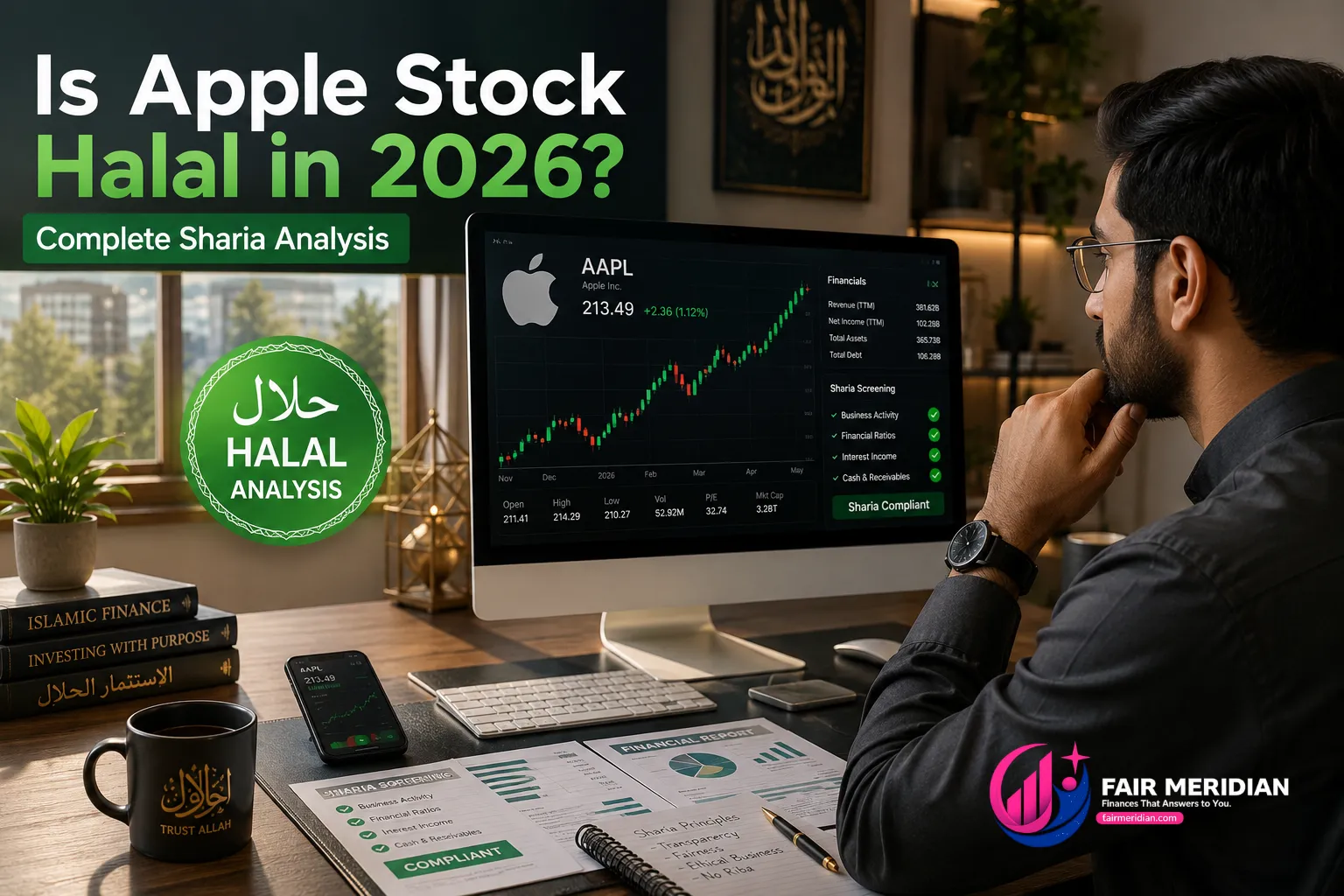
Apple (AAPL) is the most widely held individual stock by US retail investors and the largest holding in SPUS — the most popular halal ETF in America. That alone tells you something. But the question deserves a complete answer, not just "SPUS holds it so it must be fine."
This post walks through the full Sharia screening methodology applied to Apple: the business activity screen, all three financial ratio tests with actual numbers, the Apple Pay and Apple Card question most analyses skip, Zoya's current verdict, and the purification amount you owe if you hold AAPL.
Step 1: Business Activity Screen
The business activity screen asks one question: is the company's primary business prohibited under Islamic law? The prohibited categories are conventional banking, alcohol, tobacco, gambling, weapons manufacturing, pork, and adult entertainment. A 5% revenue tolerance applies — a company earning less than 5% of revenues from prohibited activities passes.
Apple's Primary Business
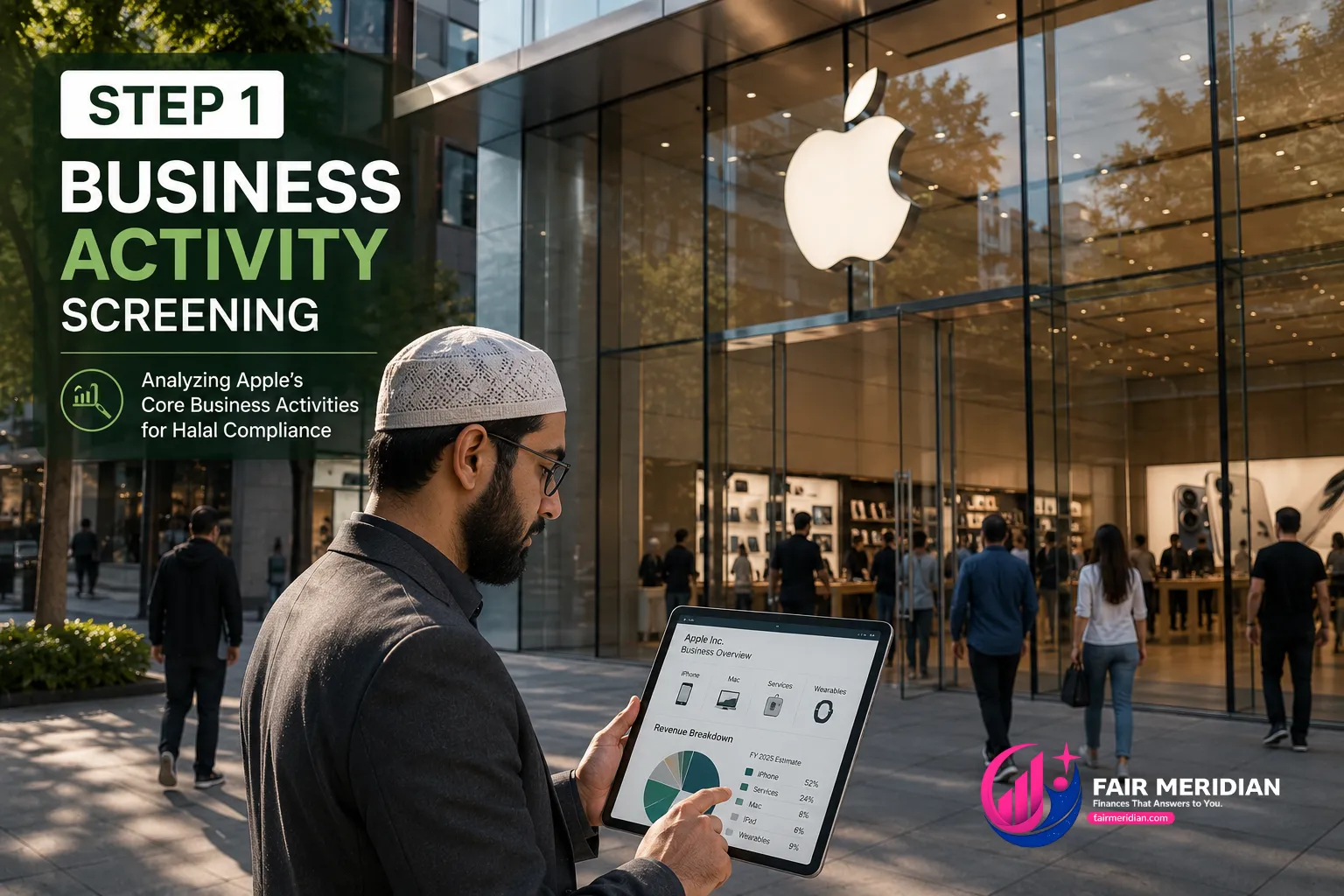
Apple's revenue breaks down as follows (FY2025 estimate):
Revenue Segment | FY2025 Estimate | % of Total | Halal? |
|---|---|---|---|
iPhone | ~$212B | ~52% | ✅ Permissible |
Services (App Store, iCloud, Apple Music, Apple TV+) | ~$96B | ~24% | ✅ Permissible |
Mac | ~$31B | ~8% | ✅ Permissible |
iPad | ~$26B | ~6% | ✅ Permissible |
Wearables, Home & Accessories | ~$37B | ~9% | ✅ Permissible |
Business activity verdict: PASS ✅
Apple's primary businesses — consumer electronics, software, and digital services — have no connection to the five prohibited industry categories. Apple does not manufacture alcohol, tobacco, or weapons. It is not a bank or gambling company. The 5% revenue tolerance does not even come into play — prohibited revenue rounds to 0%.
Step 2: The Three Financial Ratio Tests
This is where most "is Apple halal" content stops being useful — it either skips the financial screens entirely or says "run it through Zoya" without explaining what Zoya is actually checking.
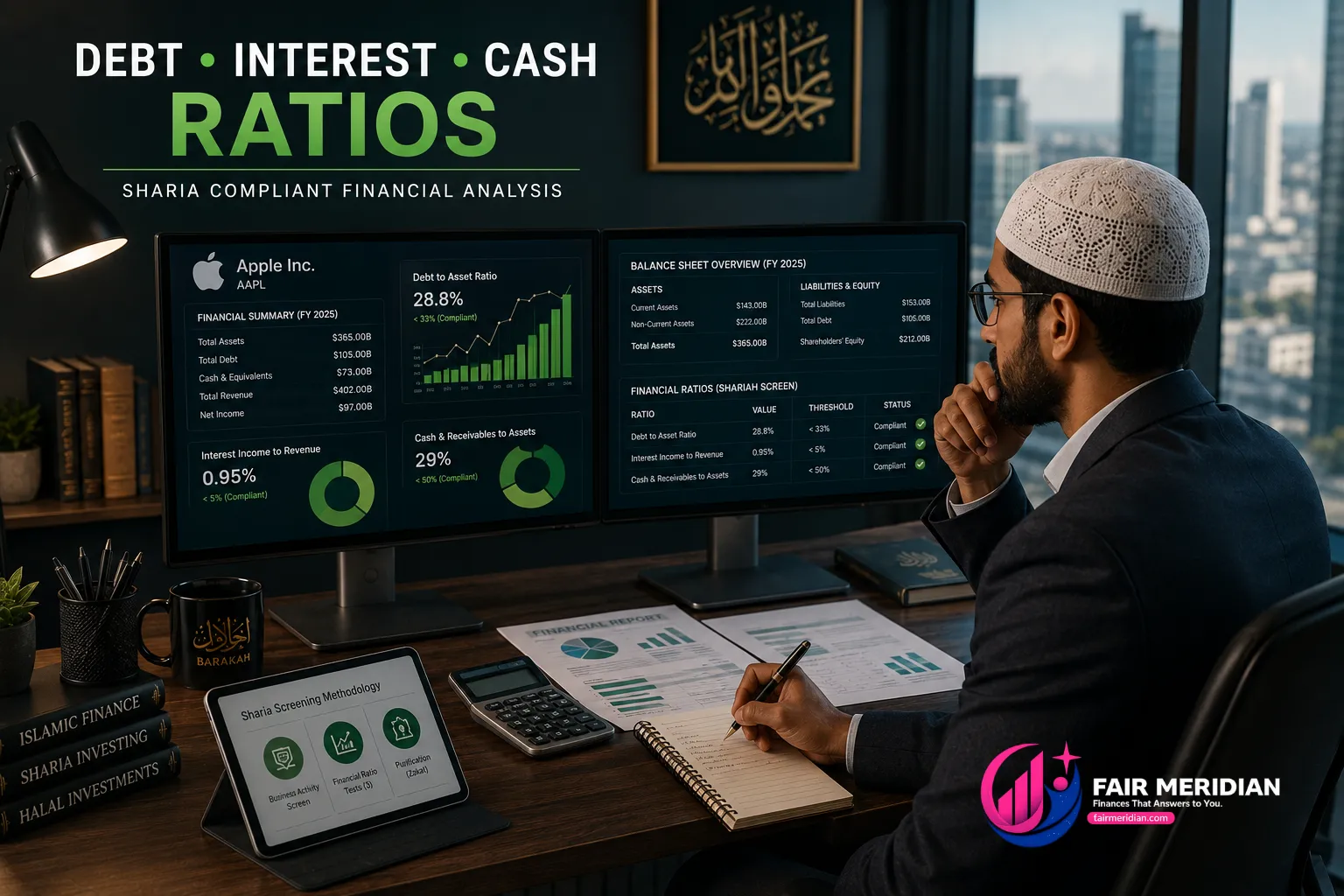
The AAOIFI Sharia Standard 21 requires three financial ratio tests. All three must be passed simultaneously:
Test 1: Debt-to-Asset Ratio — Must Be Under 33%
This test screens out companies that are so heavily leveraged with interest-bearing debt that they cannot be considered operating independently of riba.
Apple's numbers (approximate, FY2025):
Total interest-bearing debt: ~$105 billion
Total assets: ~$365 billion
Debt-to-assets ratio: ~28.8%
Result: PASS ✅ — 28.8% is below the 33% threshold. Apple carries significant absolute debt (~$105B) but at its scale this is a modest leverage ratio. Apple's cash flow generation (over $100B annually) makes this debt structurally manageable and well within the Sharia threshold.
Test 2: Interest Income — Must Be Under 5% of Revenue
This is the test that requires the most attention for Apple specifically. Apple holds approximately $165 billion in cash, cash equivalents, and marketable securities on its balance sheet. A significant portion of this cash earns interest income. The question is whether that interest income exceeds 5% of Apple's revenues.
Apple's interest/investment income (FY2025 estimate):
Interest and investment income: ~$3.8 billion
Total revenues: ~$402 billion
Interest income as % of revenue: ~0.95%
Result: PASS ✅ — Apple's interest income of ~$3.8 billion sounds large in absolute terms, but relative to $402 billion in revenues it represents less than 1% — far below the 5% threshold. Apple's core business is so large that even its enormous cash reserve generates interest income that is negligible as a percentage of the whole.
This is the key insight: the 5% test is designed to catch companies whose primary economic activity has shifted toward interest-earning. Apple is not a financial institution — it is a consumer electronics and services company that happens to have substantial cash. The ratio test correctly classifies it as permissible.
Test 3: Cash and Receivables — Must Be Under 50% of Assets
This test prevents investing in companies that are essentially holding companies for liquid assets (cash and receivables) rather than real productive businesses.
Apple's numbers (approximate, FY2025):
Cash and short-term investments: ~$73 billion
Accounts receivable: ~$33 billion
Total cash + receivables: ~$106 billion
Total assets: ~$365 billion
Ratio: ~29%
Result: PASS ✅ — 29% is well below the 50% threshold. Despite Apple's famous cash pile, its total assets are dominated by property, plant, equipment, and intangible assets (brands, intellectual property) that are genuinely productive real assets.
Step 3: The Apple Pay and Apple Card Question
Most halal screening analyses of Apple stop after the three financial ratio tests. But a thorough analysis needs to address Apple's financial services products specifically, because some Muslim investors have raised concerns.
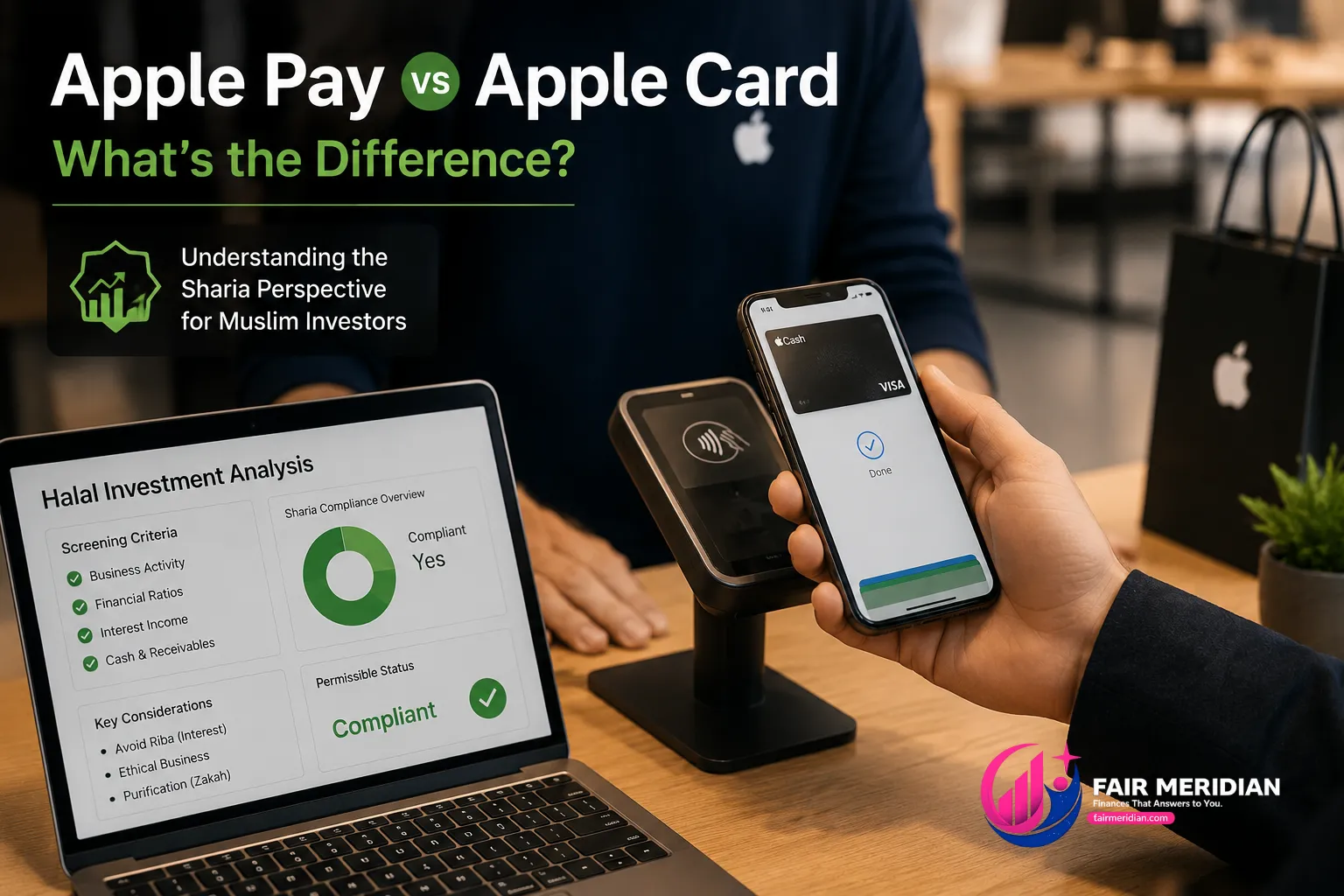
Apple Pay
Apple Pay is a payment processing system — it facilitates transactions between a buyer's card and a merchant's terminal. Apple earns a small fee (approximately 0.15% of each transaction) from the card issuer for processing the transaction. Apple does not lend money, charge interest, or issue credit through Apple Pay.
Verdict: Not a concern. Payment processing is a fee-based service. Apple's income from Apple Pay is transaction fees, not interest. This is no different from Visa's business model — and Visa passes Sharia screening as well.
Apple Card
The Apple Card is a credit card issued by Goldman Sachs, not by Apple. Apple designed the product, provides the interface, and earns a revenue share from Goldman Sachs for referring users and providing the technology platform. Goldman Sachs is the lender — Goldman charges interest on unpaid balances, Goldman issues the credit, Goldman holds the receivables.
Apple's income from the Apple Card arrangement is a platform/referral fee from Goldman Sachs — not interest income. This fee income flows into Apple's Services revenue line and is already captured in the interest income test above (where Apple's interest income is ~0.95% of revenues).
Verdict: A scholarly concern worth noting, but not disqualifying under mainstream screening methodology. Some scholars take a stricter view that facilitating any interest-bearing product — even through a referral arrangement — creates complicity concerns. The majority scholarly position in Islamic finance academia, and the position reflected in Zoya's and SPUS's screening methodology, is that Apple's fee income from the Apple Card arrangement is not itself interest income and does not disqualify the stock.
If you follow a stricter scholarly position on facilitation of prohibited activities, you may choose to avoid AAPL specifically — while still being able to hold SPUS, which takes the mainstream position. This is a legitimate individual judgment call.
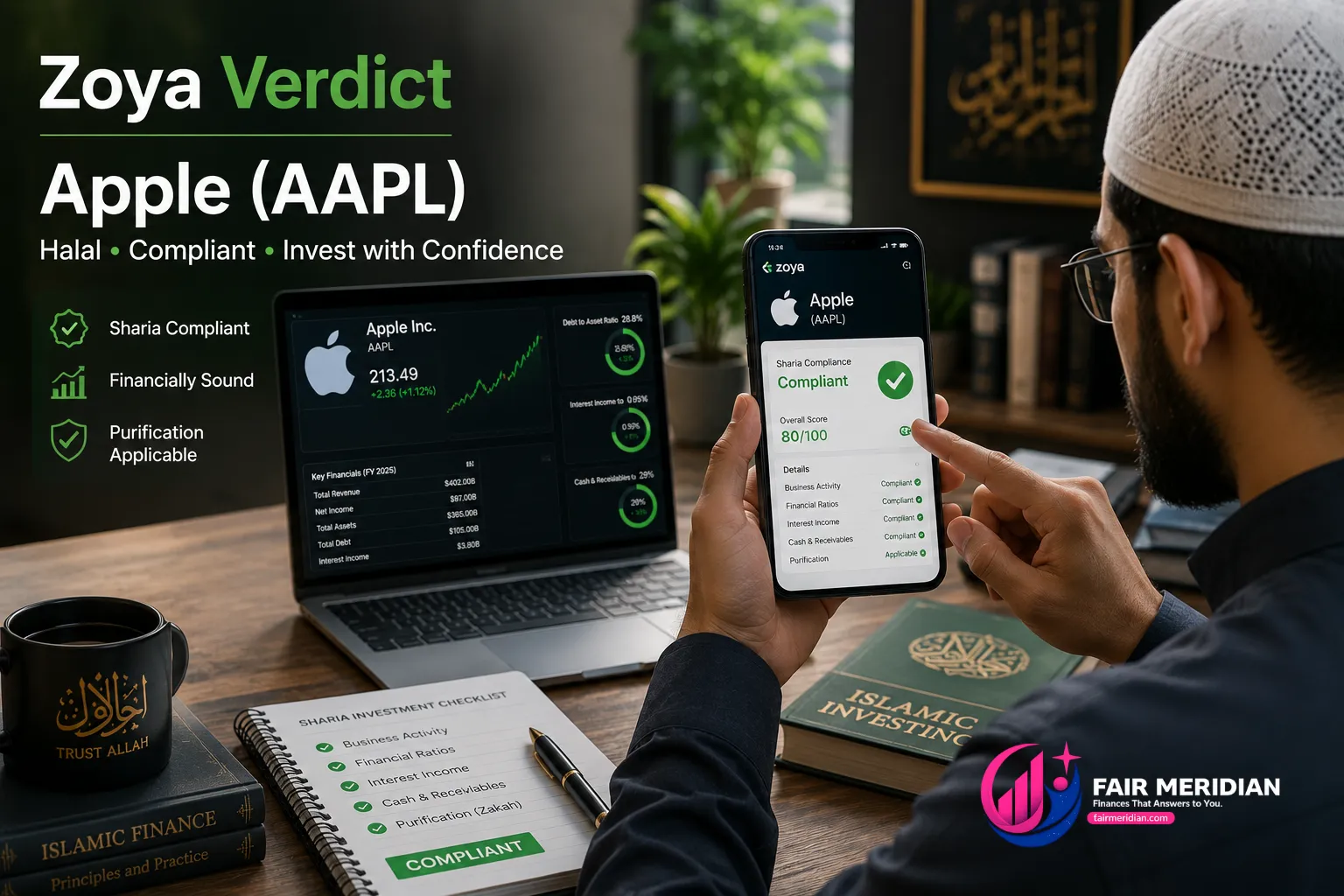
Zoya's Current Verdict (May 2026)
Screen | Zoya Result | Detail |
|---|---|---|
Business Activity | ✅ Pass | No prohibited industry revenue |
Debt-to-Asset Ratio | ✅ Pass | ~28.8% — below 33% threshold |
Interest Income | ✅ Pass | ~0.95% of revenues — below 5% threshold |
Cash + Receivables | ✅ Pass | ~29% of assets — below 50% threshold |
Overall Verdict | ✅ HALAL | Purification required (small amount) |
Zoya rates Apple as Halal as of May 2026. This is consistent with Apple's inclusion in SPUS (where it is the top holding at approximately 9.8% of the fund) and HLAL. Both Sharia boards — Ratings Intelligence Partners (SPUS) and Amanie Advisors (HLAL) — have reviewed Apple and certified it as permissible.
Purification: What You Owe If You Hold AAPL
Owning a halal stock does not mean zero purification obligation. Because Apple earns some interest income on its cash (even at <1% of revenues), a small purification amount is required annually.
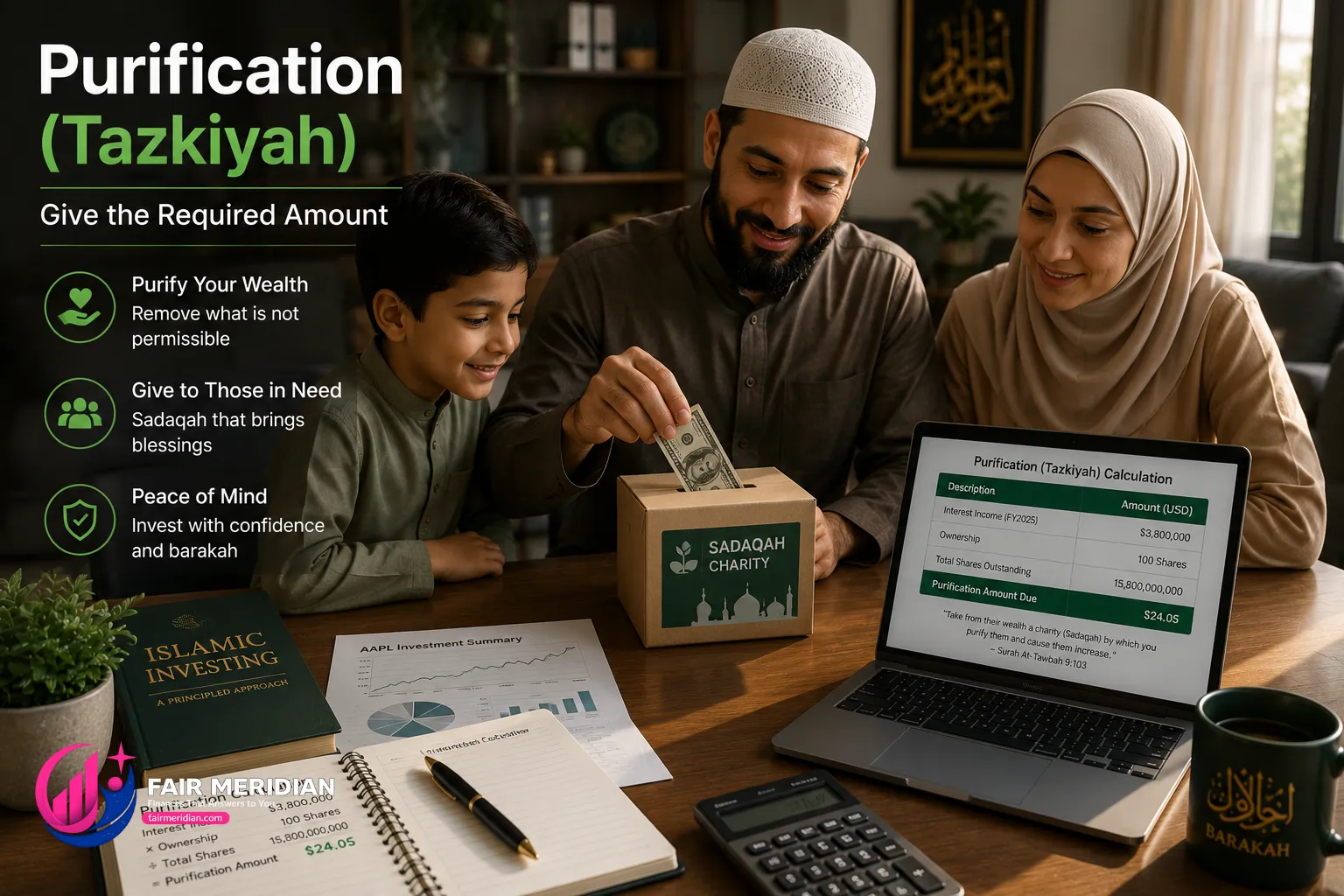
Zoya calculates purification amounts per share annually. For FY2025, Zoya's published purification amount for Apple is approximately $0.08–$0.12 per share (final figure published after fiscal year close — check Zoya directly for the exact current amount).
On a typical retail holding:
Shares Held | Approx. Purification (FY2025) |
|---|---|
10 shares | ~$1.00 |
50 shares | ~$5.00 |
100 shares | ~$10.00 |
500 shares | ~$50.00 |
The purification amount is small — Apple's interest income is a tiny fraction of its revenues, which means the purification per share is correspondingly small. Donate the total to any charity. Include it with your annual zakat calculation if convenient.
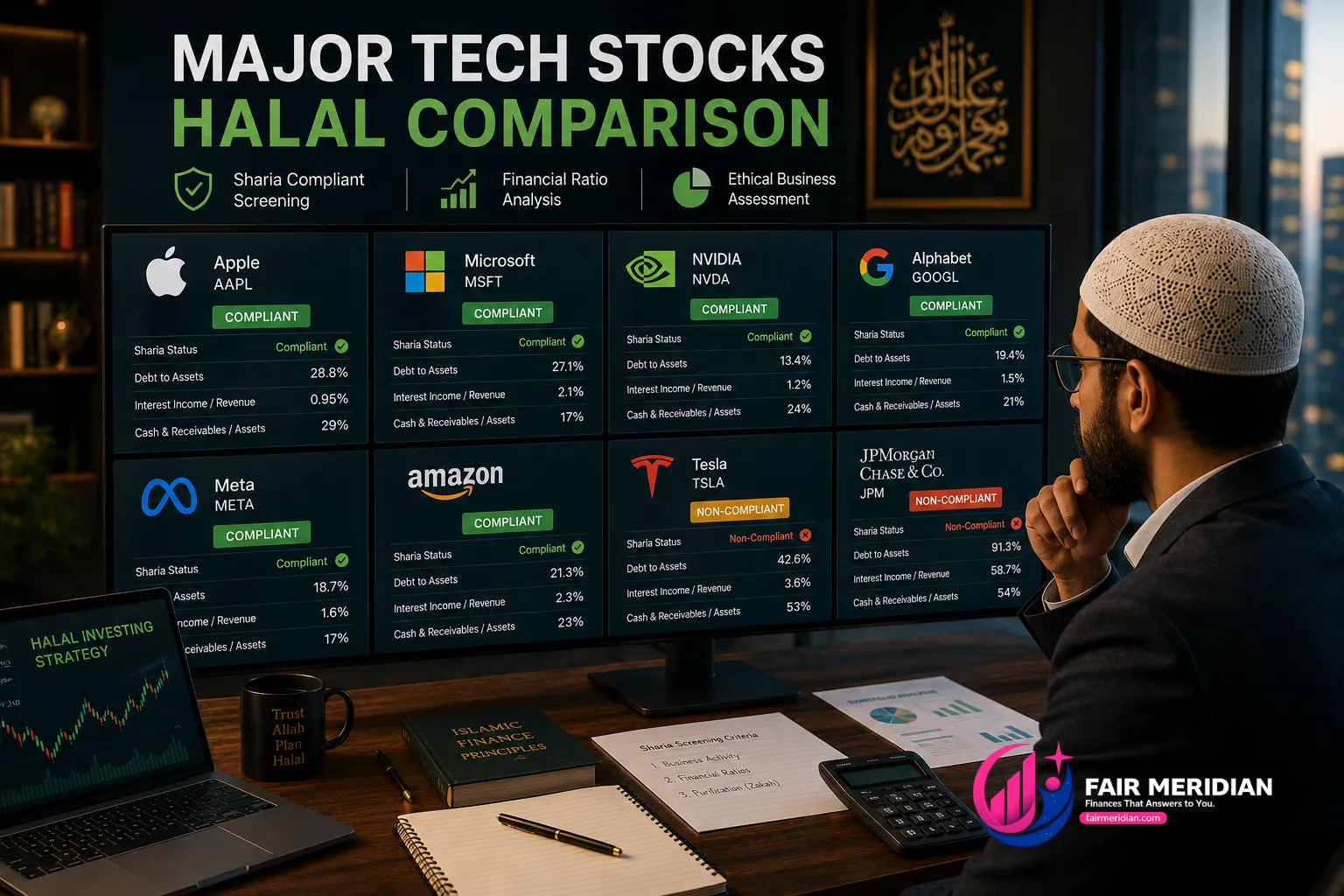
Apple vs Other Major Tech Stocks — Halal Status at a Glance
Company | Ticker | 2026 Halal Status | Primary Concern |
|---|---|---|---|
Apple | AAPL | ✅ Halal | Minor interest income on cash (passes screen) |
Microsoft | MSFT | ✅ Halal | Minor interest income on cash (passes screen) |
Nvidia | NVDA | ✅ Halal | None significant |
Alphabet (Google) | GOOGL | ✅ Halal | Minor interest income (passes screen) |
Meta | META | ✅ Halal | Advertising to prohibited products (monitored) |
Amazon | AMZN | ⚠️ Scholarly debate | AWS + entertainment revenue mix; check Zoya |
Tesla | TSLA | ✅ Halal | None significant at current ratios |
JPMorgan Chase | JPM | ❌ Not Halal | Primary business is interest-based lending |
Halal status as of May 2026 based on Zoya screening and SPUS/HLAL holdings. Status changes at quarterly rebalancings. Always verify in Zoya before buying.
Our Final Position
Apple (AAPL) is halal under mainstream Sharia screening methodology. All three financial ratio tests pass with significant margin. The business activity screen passes easily. The Apple Pay and Apple Card concerns, while worth understanding, do not disqualify the stock under the scholarly positions reflected in SPUS's and HLAL's Sharia boards.

If you hold Apple individually or through SPUS or HLAL, calculate your annual purification amount (~$0.08–$0.12 per share) and donate it to charity. That is the complete obligation.
For a stricter position on the Apple Card facilitation concern — if that matters to your personal ruling — you can avoid individual AAPL while still holding SPUS, and let the Sharia board's collective judgment cover your ETF position.
Use our Halal Investment Screener to check any stock before buying. For the complete halal investing framework, read our Halal Investing USA 2026 Guide. To verify Apple's current status or get the exact purification amount, check Zoya directly — their data updates with each quarterly rebalancing.