Amazon (AMZN) is the question Muslim investors ask most after Apple — and unlike Apple, which passes Sharia screening with minimal controversy, Amazon has three specific concerns that require actual analysis rather than a quick lookup. Most "is Amazon halal" content either skips these concerns entirely or dismisses them with vague language. This post addresses each one with real numbers.
The concerns, in order of importance:
Amazon Lending — interest-based loans to marketplace sellers
Prime Video — adult content within the streaming platform
Amazon Advertising — serving ads for alcohol, gambling, and other prohibited products
The short answer before the full analysis: Amazon is generally considered halal by mainstream Sharia screening services, including Zoya (May 2026) and SPUS's Sharia board (Ratings Intelligence Partners), with a purification amount required. It is a more borderline case than Apple, Microsoft, or Nvidia — and some scholars take a stricter view. This post gives you everything you need to make an informed decision for your own situation.
Amazon's Revenue — Understanding What Amazon Actually Is
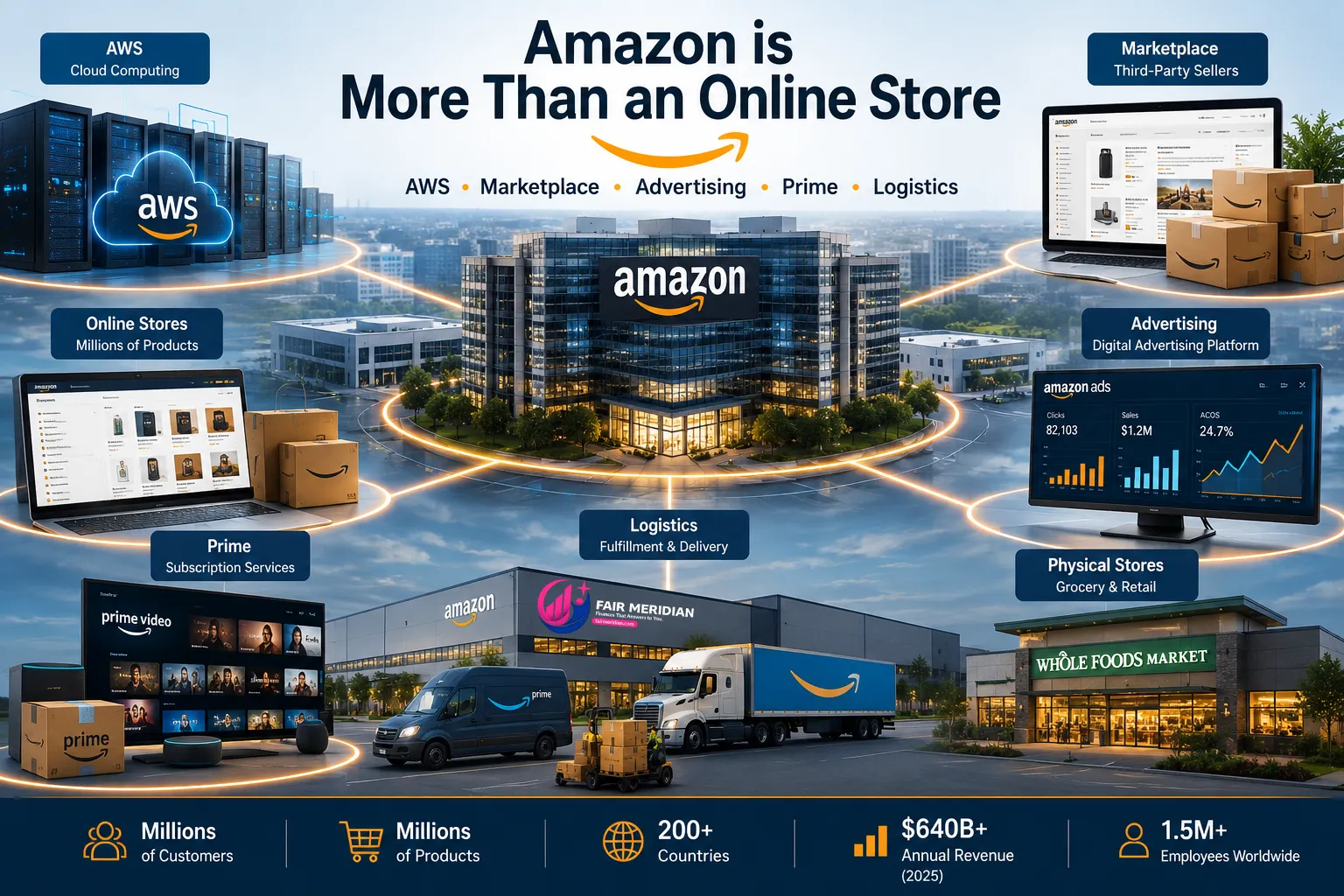
Amazon is not primarily a retailer in 2026, despite what most people assume. Understanding its actual revenue breakdown is essential to the Sharia analysis.
Revenue Segment | FY2025 Estimate | % of Total | Primary Activity |
|---|---|---|---|
Amazon Web Services (AWS) | ~$115B | ~18% | Cloud computing infrastructure |
Third-Party Seller Services | ~$158B | ~25% | Marketplace fees, fulfillment, logistics |
Online Stores (first-party retail) | ~$130B | ~20% | Direct product sales |
Advertising Services | ~$60B | ~9% | Sponsored products, display advertising |
Subscription Services (Prime) | ~$45B | ~7% | Prime membership (shipping, video, music) |
Physical Stores (Whole Foods, etc.) | ~$22B | ~3% | Grocery retail |
Other (including Amazon Lending) | ~$30B | ~5% | Various financial and other services |
Total Revenue | ~$640B | 100% |
Revenue figures are estimates for FY2025 based on Amazon's reported segments. Individual sub-segment breakdowns (including Amazon Lending) are not separately disclosed by Amazon; estimates are based on analyst research and industry reporting.
Step 1: Business Activity Screen
The business activity screen asks whether any of Amazon's revenue comes from prohibited industries — conventional banking, alcohol, tobacco, gambling, weapons, pork, or adult entertainment — and whether that revenue exceeds 5% of total revenues.
Concern 1: Amazon Lending — Interest to Marketplace Sellers
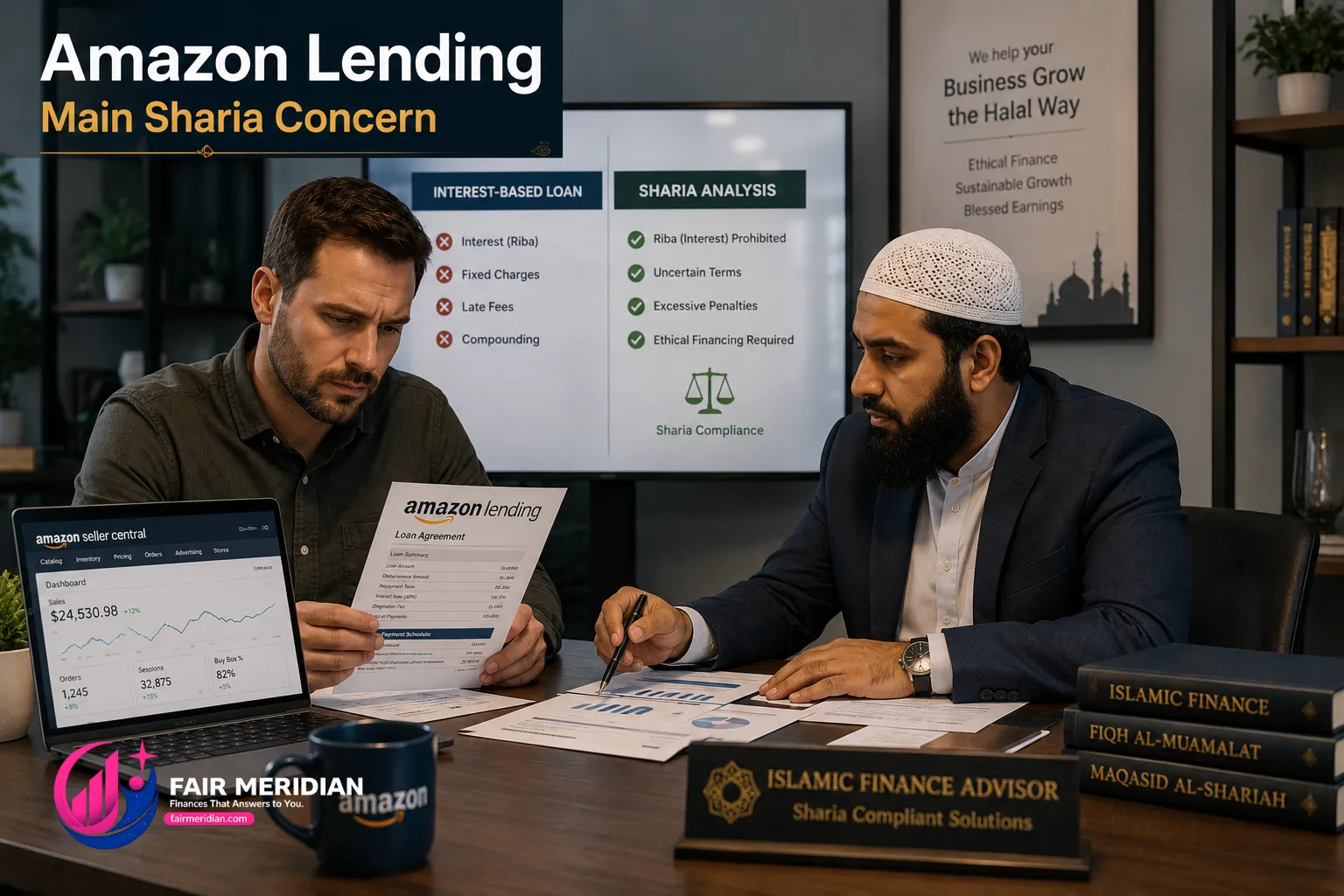
Amazon Lending provides short-term working capital loans to third-party marketplace sellers on Amazon's platform. These are interest-bearing loans — a direct riba-generating business. Amazon Lending has been operating since 2011 and has provided billions in cumulative loans to sellers.
The critical question: how much revenue does Amazon Lending generate?
Amazon does not separately disclose Amazon Lending revenue. Based on analyst estimates and Amazon's "Other" revenue segment disclosures, Amazon Lending is estimated to generate approximately $1.5–$2.0 billion in annual interest income from seller loans.
Against $640 billion in total revenues:
Amazon Lending Revenue (Est.) | Total Amazon Revenue | % of Total Revenue | 5% Threshold | Result |
|---|---|---|---|---|
~$1.75B | ~$640B | ~0.27% | 5.0% | PASS ✅ |
Amazon Lending's interest income, while absolutely large ($1.75 billion is more than many companies' total revenue), is 0.27% of Amazon's total revenues. The 5% AAOIFI threshold is not approached. Amazon could increase its lending business by 18x before the threshold would be crossed.
Important nuance: Some scholars apply a stricter view — any deliberate interest-earning business is problematic regardless of its revenue percentage, because the 5% tolerance is intended for incidental interest (cash deposits, minor financial activities) rather than a dedicated interest-bearing loan business. Under this stricter view, Amazon Lending as a structured product raises more concern than a company that simply earns interest on its cash reserves. This is a legitimate scholarly position that explains why some Sharia boards may take different views on Amazon vs other tech companies with comparable interest income ratios.
Concern 2: Prime Video — Adult Content
Amazon Prime Video's library includes some adult-oriented content. The relevant AAOIFI question is whether Amazon earns more than 5% of its revenues from adult entertainment specifically.
Amazon's video streaming revenue is bundled within the Prime subscription business (~$45 billion annually). Adult content is a very small fraction of Prime Video's overall library and viewing hours. Most content on Prime Video is mainstream film and television. Adult content specifically — in the sense meant by Islamic screening (sexually explicit adult entertainment) — represents a marginal portion of Prime Video, which itself is a sub-component of the $45B subscription business.
Conservative estimate of adult content revenue within Prime: less than 1% of the $45B subscription business = less than $450 million = less than 0.07% of total Amazon revenue.
Prohibited Content Revenue (Est.) | Total Amazon Revenue | % of Total | 5% Threshold | Result |
|---|---|---|---|---|
~$350–$450M | ~$640B | ~0.06% | 5.0% | PASS ✅ |
Concern 3: Amazon Advertising — Prohibited Product Ads
Amazon's advertising platform generates approximately $60 billion annually by allowing brands to advertise their products on Amazon.com. Advertisers include alcohol brands, gambling companies (in jurisdictions where legal), and other prohibited product categories.
This is the most nuanced concern. Advertising revenue from prohibited product advertisers is generally treated differently from revenue earned by selling or producing prohibited products directly. The mainstream Sharia screening position (AAOIFI Standard 21 and Dow Jones Islamic Market methodology) does not apply the 5% business activity screen to advertising revenue from prohibited product advertisers — because the advertising platform itself is neutral, and the prohibited activity (selling alcohol) is conducted by the advertiser, not by Amazon.
The minority stricter scholarly view holds that facilitating the promotion of prohibited products creates complicity. Under this view, Amazon Advertising serving alcohol and gambling advertisers is a concern.
Mainstream screening verdict: Advertising platform revenue from prohibited product advertisers does not trigger the 5% business activity screen — the screen applies to Amazon's own primary revenue from prohibited activities, not to advertisers who use its platform.

Step 2: Financial Ratio Screen — All Three Tests
Test 1: Debt-to-Asset Ratio — Must Be Under 33%
Interest-Bearing Debt | Total Assets | Ratio | Threshold | Result |
|---|---|---|---|---|
~$155B | ~$525B | ~29.5% | 33% | PASS ✅ |
Amazon carries significant debt in absolute terms (~$155 billion), primarily from AWS infrastructure financing and corporate bonds. However, against its $525 billion asset base, the ratio of 29.5% is below the 33% threshold. Amazon's cash generation ($50B+ annually) makes this debt level manageable and the ratio structurally stable.
Test 2: Interest Income — Must Be Under 5% of Revenue
Interest Income (on cash) | Total Revenue | Ratio | Threshold | Result |
|---|---|---|---|---|
~$4.5B | ~$640B | ~0.70% | 5% | PASS ✅ |
Amazon holds substantial cash and investments (~$85 billion), generating approximately $4.5 billion in interest income annually. Against $640 billion in total revenues, this is 0.70% — well below the 5% threshold.
Test 3: Cash + Receivables — Must Be Under 50% of Assets
Cash + Receivables | Total Assets | Ratio | Threshold | Result |
|---|---|---|---|---|
~$120B | ~$525B | ~22.9% | 50% | PASS ✅ |
Amazon's asset base is dominated by real productive assets — AWS data centers, fulfillment center infrastructure, and capitalized technology development. Cash and receivables at ~$120 billion represent 22.9% of total assets — well below the 50% threshold.

Is Amazon in SPUS? The Definitive Confirmation
The single most important external validation of Amazon's Sharia status: Amazon (AMZN) is included in SPUS — the SP Funds S&P 500 Sharia ETF — and represents approximately 2.8% of the fund's holdings as of May 2026.
SPUS's Sharia board — Ratings Intelligence Partners, one of the most established Islamic finance advisory firms globally — has reviewed Amazon's financial ratios and business activities and certified it as permissible within their AAOIFI-aligned screening methodology. Ratings Intelligence Partners' certification is based on AAOIFI Sharia Standard 21, the same standard used by the Dow Jones Islamic Market Index.
HLAL (Wahed FTSE USA Shariah ETF, certified by Amanie Advisors) also includes Amazon in its holdings.
When two independent Sharia boards using different methodologies both certify a company, that represents the mainstream scholarly consensus on permissibility.
Amazon vs Apple vs Microsoft — Complexity Comparison
Company | Business Activity Concerns | Complexity Level | In SPUS? | Zoya Verdict (May 2026) |
|---|---|---|---|---|
Apple (AAPL) | Apple Card facilitation (minor) | Low — clear pass | ✅ ~9.8% (top holding) | ✅ Halal |
Microsoft (MSFT) | Minor interest income on cash; LinkedIn gambling ads (marginal) | Low — clear pass | ✅ ~8.9% | ✅ Halal |
Nvidia (NVDA) | None significant | Very low — cleanest major tech | ✅ ~7.4% | ✅ Halal |
Amazon (AMZN) | Amazon Lending (interest); Prime Video content; ad platform | Moderate — passes screens; stricter view possible | ✅ ~2.8% | ✅ Halal (with conditions) |
Meta (META) | Ad platform serves prohibited products | Moderate — similar to Amazon | ✅ ~3.8% | ✅ Halal (with conditions) |
Alphabet (GOOGL) | YouTube content; ad platform; minor financial services | Moderate — passes; content concern monitored | ✅ ~4.6% | ✅ Halal |
JPMorgan (JPM) | Primary business is interest-based lending | Clear fail — excluded | ❌ Excluded | ❌ Not Halal |
The Purification Amount
If you hold Amazon individually or through SPUS/HLAL, you owe an annual purification amount for the interest income and other residual prohibited revenue in Amazon's operations. For individual Amazon stock holders, Zoya calculates this amount per share annually.
Based on Amazon's interest income and other prohibited revenue ratios (~0.97% combined as a percentage of total revenue), the approximate purification amount per share is $2.00–$3.50 per share annually (higher per-share than Apple because Amazon's share price is much higher). Verify the current amount directly in Zoya after fiscal year close.
Shares Held | Approx. Annual Purification |
|---|---|
1 share (~$210) | ~$2.00–$3.50 |
5 shares (~$1,050) | ~$10–$18 |
10 shares (~$2,100) | ~$20–$35 |
50 shares (~$10,500) | ~$100–$175 |
The Stricter Scholarly View — When Amazon Might Not Qualify
Intellectual honesty requires presenting the minority position. Some scholars and screening approaches take a stricter view of Amazon that would make it impermissible under their methodology:
Amazon Lending as a structured riba business: Some scholars distinguish between a company that incidentally earns interest on cash deposits (clearly incidental) and a company that has built a dedicated interest-based lending product with a specific team, marketing, and growth strategy. Amazon Lending is the latter. Under a stricter view, operating a dedicated interest-based lending product is more problematic than the 0.27% revenue ratio suggests.
Prime Video content facilitation: Some scholars hold that hosting and profiting from adult content — even if it is a small fraction of the library — creates a facilitation concern that the 5% revenue test does not fully address, because the company is actively providing the platform for prohibited content.
If you are inclined toward a stricter scholarly position on either of these points, you can hold SPUS without individual Amazon exposure — SPUS's overall portfolio includes Amazon but at 2.8%, your individual exposure to Amazon through SPUS is small and covered by the fund's purification mechanism.
The Final Scorecard
Screen | Result | Key Number |
|---|---|---|
Business Activity — Primary business | ✅ Pass | E-commerce, cloud computing, logistics — all permissible |
Business Activity — Amazon Lending | ✅ Pass (mainstream) / ⚠️ Concern (stricter) | ~0.27% of revenues — below 5% threshold |
Business Activity — Prime Video content | ✅ Pass | ~0.06% of revenues — far below 5% |
Debt-to-Asset Ratio | ✅ Pass | ~29.5% — below 33% threshold |
Interest Income Ratio | ✅ Pass | ~0.70% of revenues — below 5% |
Cash + Receivables Ratio | ✅ Pass | ~22.9% of assets — below 50% |
Included in SPUS (Ratings Intelligence) | ✅ Yes (~2.8% weight) | Mainstream Sharia board certification |
Zoya Verdict (May 2026) | ✅ Halal | Purification required (~$2.00–$3.50/share) |
Overall Verdict | ✅ Generally Halal | More complex than Apple; stricter view possible on Lending |
Frequently Asked Questions
Is it haram to invest in Amazon?
Under mainstream Sharia screening methodology — including Zoya (May 2026), SPUS's Sharia board (Ratings Intelligence Partners), and HLAL's Sharia board (Amanie Advisors) — Amazon is rated halal with a required purification amount. All three financial ratio tests pass with significant margin. The business activity concerns (Amazon Lending, Prime Video, ad platform) all represent less than 0.3% of revenues each — far below the 5% tolerance threshold. Under a stricter scholarly view regarding Amazon Lending specifically, some may choose to avoid it. Under mainstream screening, it is permissible with annual purification.
Is buying on Amazon halal (the shopping platform)?
Buying products on Amazon's marketplace is an entirely separate question from investing in Amazon stock, and the answer is straightforwardly yes — using Amazon as a retail platform is permissible, provided you are not purchasing prohibited products (alcohol, pork, gambling services, etc.) through it. The platform itself is a neutral commerce intermediary.
Is Amazon Prime halal?
Amazon Prime membership — providing free shipping, Prime Video, Prime Music, and other services — is permissible to subscribe to. The fact that Prime Video includes some adult content does not make the Prime subscription itself haram, provided you do not access or consume that prohibited content. The subscription is for the full bundle of permissible services; avoiding the impermissible content within it is your personal obligation.
Should I buy Amazon stock or just hold SPUS?
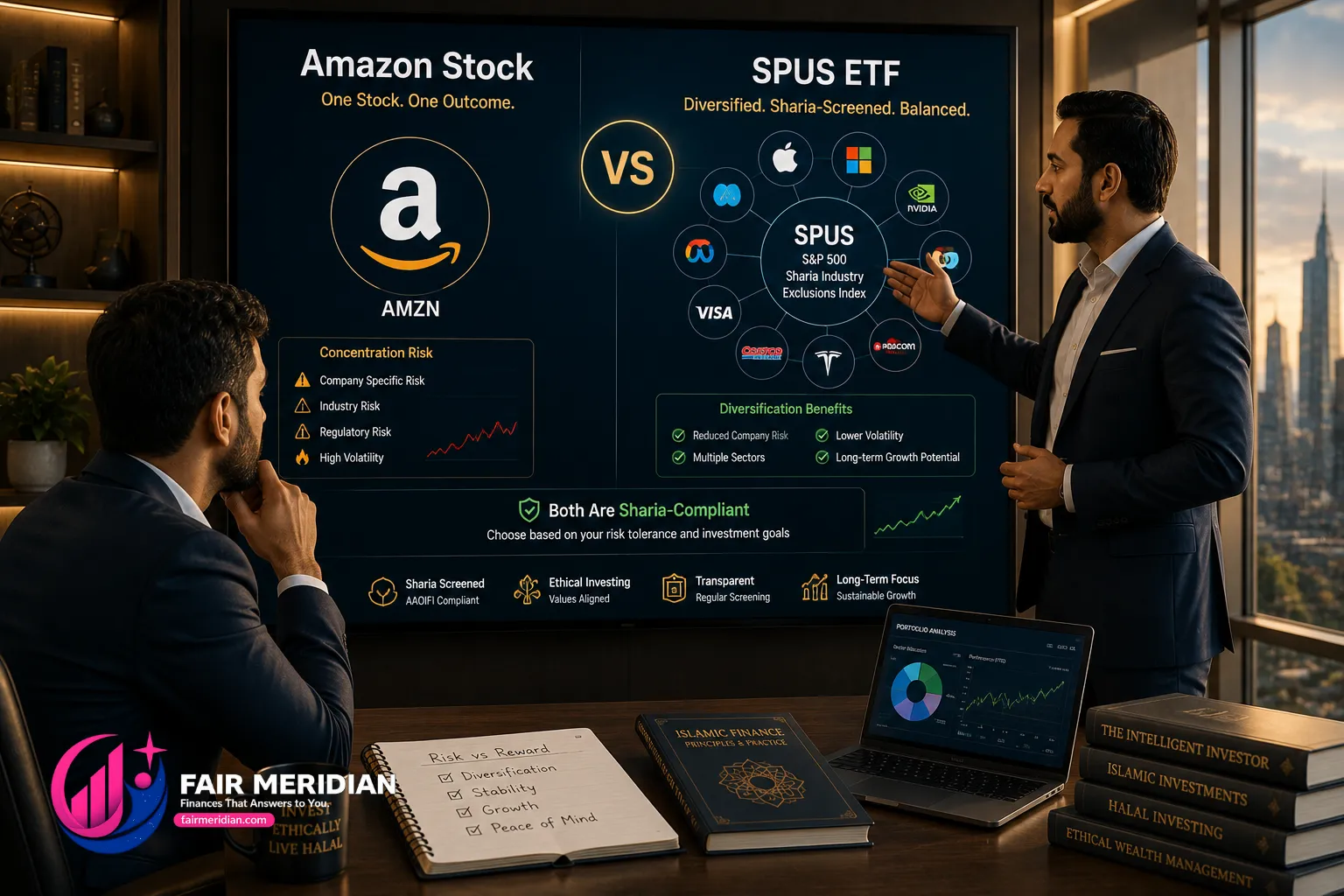
Both are permissible under mainstream Sharia screening. For most Muslim investors, SPUS is the better vehicle: it provides exposure to Amazon (at 2.8% weight) alongside 289 other Sharia-screened companies, the Sharia board handles the annual purification calculation, and the diversification eliminates the company-specific risk of holding individual Amazon. Buying individual Amazon stock adds concentration risk without adding Sharia compliance benefit relative to SPUS. The case for individual Amazon: if you have a specific investment thesis about Amazon's AI/AWS growth that you want more concentrated exposure to. In that case, buy it — but track your purification obligation in Zoya.

Amazon is halal under mainstream Sharia screening — but it is genuinely more complex than Apple and is where "it depends on which methodology" starts to matter. If you follow a stricter position on Amazon Lending, use SPUS for diversified exposure without individual AMZN. If you follow the mainstream position, buy it or hold it through SPUS and donate the purification amount ($2–$3.50/share annually) to charity.
Use our Halal Investment Screener to check any stock's current status. For the complete framework on stock screening methodology and how the financial ratio tests work, read our Halal Investing USA 2026 Guide.