
Most Muslim Americans with a 401k have never looked at exactly what they own inside it. You signed up during onboarding, checked a box for a target-date fund, and moved on. That target-date fund is almost certainly investing in things that are haram — not as a technicality, but structurally and significantly.
This post names exactly what those things are, how much of your 401k is in each one, and what you can do about it — starting today.
What Makes a 401k Investment Haram?
Two categories of prohibition apply to 401k investments under Islamic finance principles:
Business activity prohibition: Companies whose primary business involves alcohol, tobacco, conventional banking (interest), gambling, weapons manufacturing, or adult entertainment are prohibited — regardless of how small a percentage they are of your fund.
Riba prohibition: Any investment in interest-bearing instruments — bonds, bond funds, money market funds, stable value funds — generates riba income. These are prohibited regardless of the interest rate.
A typical employer 401k default — a target-date fund — violates both categories simultaneously. Here are the five specific problems you almost certainly have right now.
Problem 1: Bond Funds — The Biggest Issue Nobody Talks About
If you are in a target-date fund — which most workers are by default — a significant portion of your account is in interest-bearing bonds. This is pure riba. There is no Sharia compliance path for it.
Here is exactly how much:
Target-Date Fund | Bond Allocation | Example Fund (Fidelity) | Example Fund (Vanguard) |
|---|---|---|---|
2055 Fund (age ~30) | ~10% | Fidelity Freedom 2055 | Vanguard Target 2055 |
2045 Fund (age ~40) | ~20% | Fidelity Freedom 2045 | Vanguard Target 2045 |
2035 Fund (age ~50) | ~35% | Fidelity Freedom 2035 | Vanguard Target 2035 |
2025 Fund (near retirement) | ~50% | Fidelity Freedom 2025 | Vanguard Target 2025 |
On a $100,000 401k balance in a 2045 target-date fund, approximately $20,000 of your money is in interest-bearing bonds right now, generating riba income every year. As you get older and the fund automatically shifts allocation, this problem gets worse — not better.
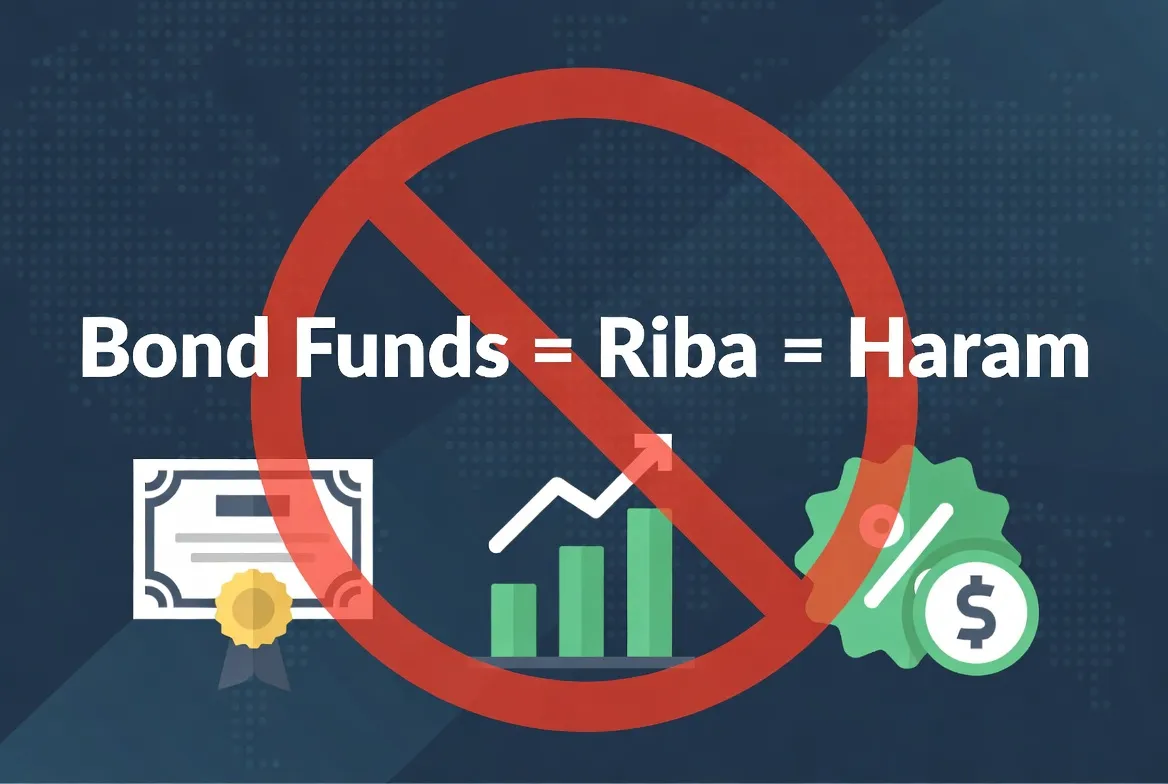
The fix: Move your 401k allocation out of all bond, fixed income, stable value, and money market funds immediately. Reallocate to the equity fund with the least prohibited company exposure in your plan's menu.
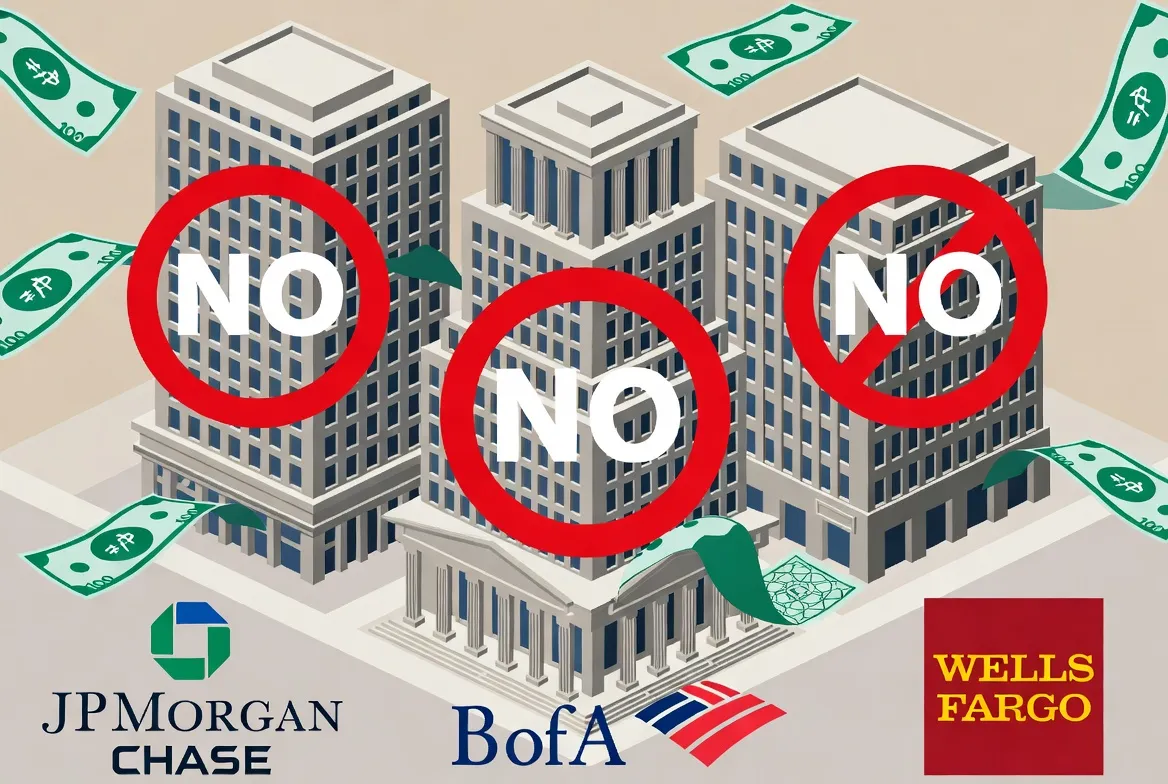
Problem 2: JPMorgan, Bank of America, Wells Fargo — In Your S&P 500 Fund
The stock portion of your 401k is almost certainly in an S&P 500 index fund or total market fund. These funds hold every large US company — including the largest conventional banks in America.
Here is what the financial sector allocation looks like in a standard S&P 500 fund as of 2026:
Company | S&P 500 Weight | Why It's Haram | Est. Amount in $100K 401k |
|---|---|---|---|
JPMorgan Chase | ~2.1% | Primary income is interest — largest US bank | ~$2,100 |
Berkshire Hathaway | ~1.8% | Significant insurance and financial holdings | ~$1,800 |
Bank of America | ~0.95% | Conventional bank — interest-based | ~$950 |
Wells Fargo | ~0.68% | Conventional bank — interest-based | ~$680 |
Goldman Sachs | ~0.55% | Investment bank — interest and derivatives | ~$550 |
Total Financial Sector | ~13–15% | Conventional banking and insurance | ~$13,000–$15,000 |
In a $100,000 401k invested in a standard S&P 500 fund, approximately $13,000–$15,000 is in conventional financial companies whose primary income is interest. This is the single largest Sharia compliance problem in the equity portion of a standard 401k.
The fix: Look for ESG or socially responsible funds in your 401k menu that exclude conventional financial companies — Parnassus Core Equity (PRBLX) has only ~4% in financials. Better: check if your plan has a self-directed brokerage window (see below) where you can hold SPUS directly.
Problem 3: Tobacco Companies Generating Returns in Your Name
Standard S&P 500 and total market index funds hold tobacco companies. These are prohibited under Islamic finance regardless of their financial ratios — the business itself is haram.
Company | S&P 500 Weight | Business | Est. in $100K S&P 500 401k |
|---|---|---|---|
Philip Morris International | ~0.42% | Tobacco manufacturing | ~$420 |
Altria Group | ~0.27% | Philip Morris USA, tobacco | ~$270 |

Tobacco is a small percentage — but the prohibition is not about percentage. It is about participating in a business whose primary product causes harm and death. Most ESG funds already exclude these companies, which is why switching to an ESG option in your 401k menu (if available) helps on this dimension.
Problem 4: Alcohol Companies — Constellation Brands, Molson Coors
Alcohol producers are explicitly prohibited under Islamic investment screening — not because of a small revenue percentage from a prohibited activity, but because alcohol production and distribution is their core business.
Company | S&P 500 Weight | Business | Est. in $100K S&P 500 401k |
|---|---|---|---|
Constellation Brands | ~0.15% | Beer, wine, spirits (Corona, Robert Mondavi) | ~$150 |
Molson Coors | ~0.06% | Beer manufacturing | ~$60 |
Brown-Forman | ~0.05% | Jack Daniel's, spirits | ~$50 |

These are small dollar amounts on a $100,000 balance — but they represent your ownership stake in businesses you are not permitted to own under Islamic principles. The solution is the same: either an ESG fund that excludes these companies, or a self-directed brokerage window with SPUS (which screens them out automatically).
Problem 5: Gambling Companies — DraftKings, MGM, Caesars
Online gambling has grown significantly since the 2018 Supreme Court decision legalizing sports betting, and gambling companies now sit inside many total market index funds. All are prohibited under Islamic investment screening.
Company | Status | Business |
|---|---|---|
DraftKings | Mid-cap; in many total market funds | Online sports betting |
MGM Resorts International | S&P 500 member | Casino, hotel, gaming |
Caesars Entertainment | S&P 500 member | Casino, gaming |
Penn Entertainment | Mid-cap; in total market funds | Casino, Barstool Sports betting |

Gambling stocks are a small percentage of most funds but their inclusion in total market index funds (like Vanguard Total Stock Market or Fidelity Total Market) is one reason these broad funds are not suitable for Sharia-compliant investors.
What to Do About It — Your 4-Step Action Plan
Step 1: Log in and find out exactly what you own (do this today)
Log into your 401k portal — Fidelity NetBenefits, Vanguard, Empower, Transamerica, or whichever platform your employer uses. Find your current allocation. Write down every fund you hold and its percentage.
Step 2: Check if your plan has a self-directed brokerage window
This is the best possible solution. Search your plan portal for "brokerage window," "self-directed brokerage account," or "BrokerageLink" (Fidelity) / "PCRA" (Schwab). If your plan has this feature, you can invest directly in SPUS — the S&P 500 Sharia ETF — inside your existing 401k and capture your full employer match with halal investments. Ask HR if you cannot find it.
Step 3: If no brokerage window, switch to the best available ESG fund
Look at your fund menu for options labeled ESG, sustainable, responsible, or socially responsible. Compare the financials sector allocation — under 5% is good, under 8% is acceptable. Move out of all bond and fixed income funds immediately. Choose the equity fund with the lowest financial sector and prohibited company exposure.
Priority order for fund switching:
Move all bond / fixed income / stable value → to equity
Switch S&P 500 fund → ESG equity fund if available
Contribute to employer match only (not beyond)
Put all additional retirement savings into Roth IRA with SPUS
Step 4: Maximize your Roth IRA with SPUS
Your Roth IRA is where you have complete control. Open one at Fidelity (free, takes 10 minutes), buy SPUS, and contribute the maximum ($7,000 under 50 / $8,000 age 50+ for 2026). SPUS screens out all five categories above — no bonds, no banks, no tobacco, no alcohol, no gambling. This is your primary halal retirement vehicle regardless of what your 401k options look like.
The Employer Match Question
Here is the question everyone has: should I even contribute to a haram 401k for the employer match?
The majority position among North American Islamic scholars — including the Fiqh Council of North America — permits participating in an employer-matched 401k under the principle of darurah (necessity), with conditions: contribute only enough to capture the full match, avoid bond funds, choose the least problematic equity option available, and calculate and donate an annual purification amount.
The free money from an employer match (typically 3–6% of your salary) represents a significant economic benefit that, in the scholarly majority view, justifies participation when no fully halal option exists. But it does not justify contributing beyond the match into a non-compliant fund when a Roth IRA with halal ETFs is available as an alternative.
Frequently Asked Questions
Is it haram to have a 401k at all?
Not categorically — but the default investments in most 401k plans are haram. The account structure itself is neutral; the problem is what it is invested in. A 401k invested through a self-directed brokerage window in SPUS and HLAL is fully Sharia-compliant. A 401k defaulted into a target-date fund with 30% bonds and 13% bank stocks is significantly non-compliant. The work is changing the investments, not closing the account.
Can I roll my existing 401k into a halal IRA?
Yes — when you leave an employer, you can roll your entire 401k balance into an IRA without taxes or penalties. A self-directed Roth IRA at Fidelity or Schwab gives you complete control to invest in SPUS, HLAL, AMAL, and any halal ETF. If your previous 401k was a Roth 401k, it rolls into a Roth IRA. If it was a traditional 401k, it rolls into a Traditional IRA — you can convert to Roth but will owe income tax on the converted amount.
What is the purification amount I owe on a non-compliant 401k?
Calculate the percentage of your fund's annual returns attributable to prohibited activities and donate that amount to charity. For a target-date fund with 20% bonds and 13% bank stocks, roughly 33% of returns come from prohibited sources. If your 401k earned $8,000 last year, you would donate approximately $2,640 to charity. This is not optional — it is required alongside participation in a non-compliant fund under the darurah framework.
Does my employer have to offer a halal 401k option?
They are not legally required to, but you can formally request it. Email your HR benefits manager requesting the addition of SPUS to the plan's fund menu — name the fund specifically. Or ask whether your plan has a self-directed brokerage window. A group request from multiple Muslim employees is significantly more effective than an individual request. Read our complete Halal Retirement Planning guide for the full employer negotiation strategy, including a word-for-word email template.
The most important action you can take after reading this post is opening your 401k portal and looking at your actual fund allocation. Most people have never done it. Knowing exactly what you own is the first step to fixing it.
For the complete strategy — every halal retirement option, the self-directed IRA structure, the Roth IRA portfolio build, and the employer negotiation playbook — read our full Halal Retirement Planning guide.