Florida is one of the better-served halal mortgage states in the United States — all four major halal lenders operate here, Guidance Residential's 5% down musharakah is available statewide, and Florida's zero income tax means Muslim families keep more of what they earn than peers paying 5–10% state income tax in New York, New Jersey, or Illinois. The Florida-specific things most halal mortgage guides don't tell you: documentary stamp taxes add a buyer-paid closing cost unique to this state, the homestead exemption you must file by March 1 saves hundreds of dollars a year, and the Muslim communities here span price points from $280,000 in Jacksonville to $650,000 in Boca Raton. This guide covers all of it honestly.
Which Halal Mortgage Lenders Serve Florida
Four halal mortgage providers operate in Florida. The differences between them matter more in Florida than in some states because the Muslim community here is large, economically diverse, and spread across communities with very different property prices — meaning the right lender depends heavily on your specific situation.
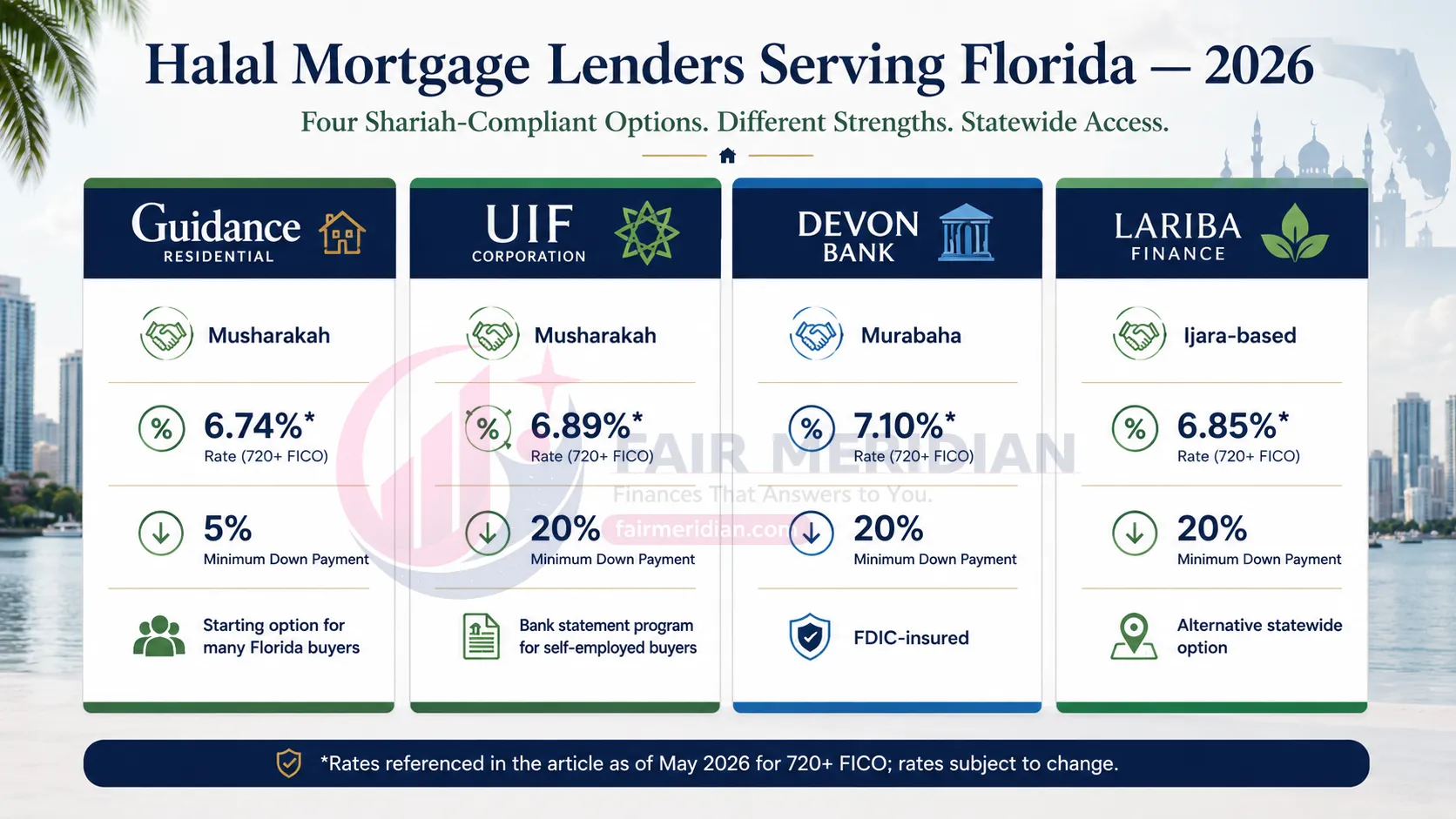
Guidance Residential is the starting point for most Florida buyers. Their 6.74% musharakah rate (720+ FICO, May 2026) is the lowest available in the halal market, and their 5% minimum down payment is the only below-20% halal option in Florida. On a $420,000 Kissimmee townhome, that's $21,000 down instead of $84,000. For a family that has been building savings but can't hit the full 20% yet, Guidance is often the difference between buying now and waiting another three years.
UIF Corporation serves Florida at 6.89% (720+ FICO) and carries something Guidance doesn't: a bank statement income program for self-employed buyers. South Florida's Muslim business owner community — Yemeni restaurant operators, Pakistani medical professionals, Moroccan real estate investors — often has strong cash flow that doesn't show up clearly on tax returns after legitimate deductions. UIF qualifies those buyers on 12 or 24 months of business bank deposits rather than Schedule C net income. If Guidance has turned you down because your tax return doesn't show enough income, UIF is your next call.
Devon Bank (7.10%, FDIC-insured, murabaha structure) and Lariba Finance (6.85%, ijara-based) both serve Florida statewide. Devon's commercial murabaha program is worth knowing about for Florida's Muslim business owners who want to purchase their commercial space halally — a rare institutional option. Lariba is a solid alternative if Guidance's capacity is constrained during Florida's intense spring homebuying season.
Florida's Muslim Communities — What Homes Cost Where You're Looking
Florida's Muslim population is genuinely one of the most diverse in the country — Arab-American families in South Florida, Palestinian and Jordanian communities in Orlando, Somali families in Tampa, South Asian professionals in Broward and Palm Beach. Each community has a different price reality.
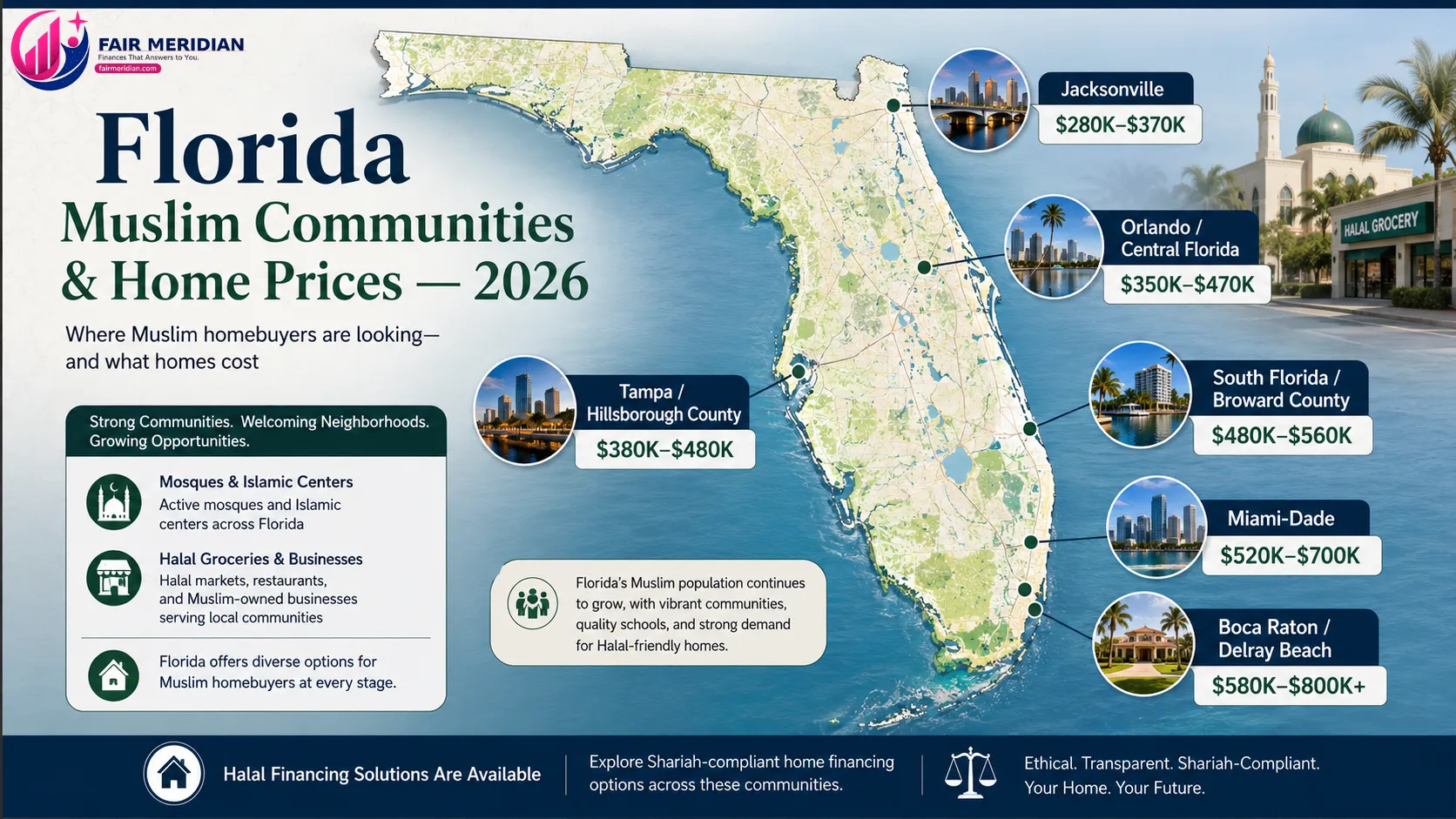
South Florida (Broward County): Pembroke Pines, Miramar, and Hollywood are the heart of Florida's South Asian Muslim community. Median single-family home prices run $480,000–$560,000 in these suburbs. At Guidance's 5% down: $24,000–$28,000. The mosques, halal grocery stores, and Pakistani/Indian community infrastructure in this corridor are among the most developed of any Florida Muslim community. Coconut Creek and Margate offer slightly lower prices ($420,000–$480,000) with access to the same community.
Miami-Dade: The Arab-American and Lebanese Muslim community is concentrated in Doral and parts of Hialeah and Kendall. Prices in Doral ($520,000–$700,000 for SFH) reflect Miami's broader affordability challenges. Homestead and Florida City in South Miami-Dade offer more accessible entry points ($320,000–$380,000) for families who can manage a longer commute.
Orlando / Central Florida: The Palestinian and Jordanian Muslim community in Greater Orlando is anchored in Kissimmee, Hunter's Creek, and Oviedo. Home prices here ($350,000–$470,000) are meaningfully lower than South Florida — and Central Florida's job market in healthcare, tourism infrastructure, and tech has grown significantly. Kissimmee specifically has seen substantial Muslim community investment in mosques and halal businesses over the past decade.
Tampa / Hillsborough County: Tampa's Muslim community includes a significant Somali presence alongside South Asian and Arab-American families. Median prices in Tampa proper ($380,000–$480,000) are competitive with Orlando, and the Carrollwood and Wesley Chapel suburbs north of Tampa are attracting Muslim professional families priced out of South Florida. Wesley Chapel's newer construction townhomes ($380,000–$440,000) represent good value for the Tampa market.
Jacksonville: The most affordable major Florida city for halal homebuyers. Median prices in Jacksonville's Muslim-community-adjacent neighborhoods run $280,000–$370,000. At Guidance's 5% down: $14,000–$18,500. A Muslim professional family relocating from New York or New Jersey will find Jacksonville's price points — combined with Florida's zero income tax — a dramatic quality-of-life upgrade.
Boca Raton / Delray Beach: Palm Beach County's South Asian Muslim professional community (physicians, engineers, finance professionals) lives in an expensive market. Median prices in Boca Raton ($580,000–$800,000+ for SFH) require either substantial savings or Guidance's 5% down at the higher loan amounts. The community infrastructure — multiple mosques, a growing network of halal restaurants and grocers — reflects the area's established Muslim presence.
Florida's Doc Stamp Tax — The Closing Cost Nobody Warns You About
Florida has a documentary stamp tax — "doc stamps" — that applies to both the deed and the mortgage note at closing. Most halal mortgage guides don't mention this because it's Florida-specific, but it adds real money to your closing costs and you need to budget for it explicitly.
The deed doc stamps (typically paid by the seller) run $0.70 per $100 of purchase price statewide — except Miami-Dade County, which charges $0.60 per $100. On a $420,000 purchase: $2,940 statewide, $2,520 in Miami-Dade. This is usually negotiated as a seller cost, but in competitive markets where sellers have leverage, buyers sometimes agree to contribute.
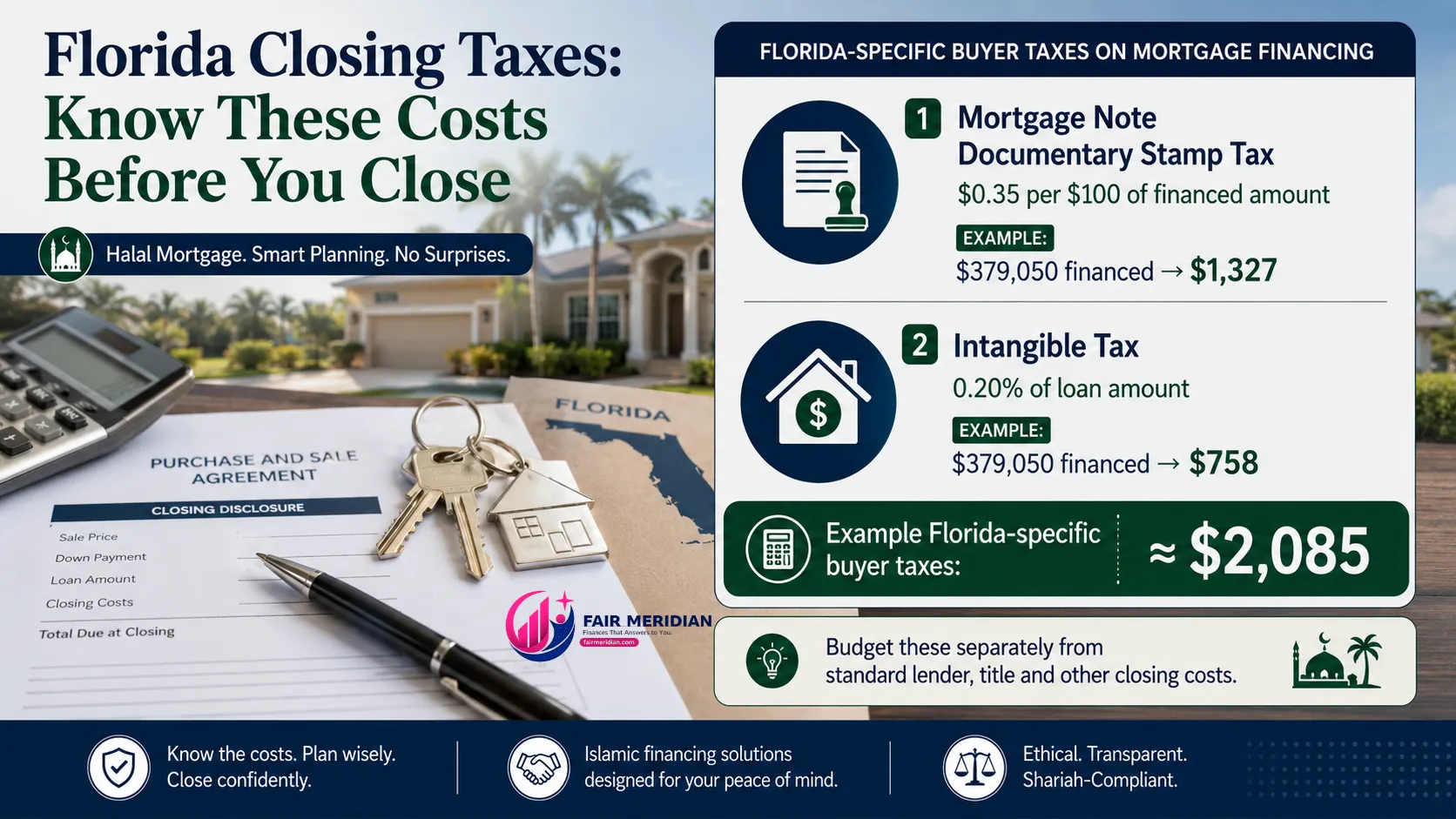
The mortgage note doc stamps are buyer-paid — $0.35 per $100 of the financed amount. Florida also charges an intangible tax on the mortgage at $0.002 per dollar of loan amount (0.20%). Together, these two buyer-paid Florida taxes add up:
On a $399,000 home at 5% down ($379,050 financed): note doc stamps of $1,327 plus intangible tax of $758 — $2,085 in Florida-specific buyer taxes beyond standard closing costs. On a $500,000 home at 20% down ($400,000 financed): $1,400 plus $800 — $2,200. Budget these separately when your loan officer provides an initial closing cost estimate — they should appear on your Loan Estimate, but confirm they're included before you finalize your cash-at-closing number.
The Homestead Exemption — File This Before March 1
Florida's homestead exemption is one of the most valuable property tax benefits in any US state, and new homebuyers consistently miss the filing deadline. Here is what it does and what you need to do.
Florida law exempts $50,000 of your home's assessed value from property taxes when it's your primary residence. The first $25,000 applies to all property taxes. The second $25,000 applies to non-school taxes only. On a $420,000 home in Broward County with an effective property tax rate of approximately 1.1%, the homestead exemption saves you roughly $400–$500 per year in property taxes — every year you own the home.
More importantly: once you have homestead status, Florida's "Save Our Homes" law caps increases in your assessed value at 3% per year (or the rate of inflation, whichever is lower). In a market where Florida home values have been appreciating at 5–10% annually, this cap means your property tax bill grows much more slowly than your home's actual value. Longtime Florida homeowners with homestead status pay dramatically less in property taxes than new buyers purchasing equivalent homes. You want to get into that protected status as early as possible.
File your homestead exemption application with your county property appraiser's office by March 1 of the year following your purchase. Miss this deadline and you wait another full year. Your closing attorney should remind you, but set your own calendar reminder the day you close. Most Florida county property appraisers accept homestead applications online.
Property Tax and Total Monthly Cost by Florida Market
Florida's effective property tax rates are moderate — lower than Texas and Illinois, higher than Virginia — and combined with zero state income tax, the total cost of homeownership in Florida is more manageable than the headline prices suggest for families moving from high-tax states.
Here is what the full monthly payment looks like across Florida's main Muslim markets, using Guidance Residential's 6.74% rate and 5% down:
Market | Median Price | P&I (6.74%, 5% down) | Est. Monthly Tax | Total Monthly |
|---|---|---|---|---|
Pembroke Pines / Miramar | $510,000 | $3,162 | ~$468 | $3,630 |
Doral (Miami-Dade) | $590,000 | $3,658 | ~$590 | $4,248 |
Kissimmee / Orlando area | $390,000 | $2,418 | ~$341 | $2,759 |
Wesley Chapel / Tampa north | $420,000 | $2,604 | ~$378 | $2,982 |
Boca Raton (Palm Beach) | $640,000 | $3,968 | ~$608 | $4,576 |
Jacksonville | $320,000 | $1,985 | ~$267 | $2,252 |
P&I calculated at 6.74% on 95% of median price. Property tax at approximately 1.0–1.1% effective rate (pre-homestead exemption). Add homeowners insurance ($150–$300/month in Florida — notably higher than most states due to hurricane risk) for full monthly cost. Homestead exemption reduces tax by $400–$600/year after filing.
One thing Florida buyers moving from the Northeast need to factor: Florida homeowners insurance is meaningfully more expensive than most of the country because of hurricane exposure. Budget $150–$300/month for insurance depending on the home's age, construction type, and distance from the coast. A coastal Broward County home will be at the high end; an inland Orlando home significantly lower. This insurance premium narrows the total cost advantage Florida has over high-tax states like New Jersey, but doesn't eliminate it.
Provider Selection for Florida Buyers
For most W-2 buyers with strong credit and less than 20% down: Guidance Residential is the clear starting point. 6.74%, 5% minimum, Freddie Mac and Fannie Mae approved. Call or apply online at guidanceresidential.com.
For self-employed business owners — South Florida restaurant operators, physicians with private practices, contractors and IT consultants: UIF Corporation and their bank statement income program. You need 20% down and 12–24 months of business bank statements. Call UIF at uif.com and specifically ask for their self-employed program.
For buyers who want a murabaha structure rather than musharakah — either for scholarly preference or because their advisor recommends it — Devon Bank serves Florida statewide at 7.10% with 20% down.
For buyers whose Guidance application hits a snag, or who need an alternative quote to compare: Lariba Finance at 6.85% with 20% down is the backup option worth keeping in your back pocket.
Step-by-Step: Getting a Halal Mortgage in Florida
Start with your down payment reality. If you have 5–19%: Guidance Residential is your only halal option in Florida. If you have 20%+: compare Guidance, Lariba, and Devon rates side by side — the rate difference matters over 30 years. If you're self-employed: begin with UIF, not Guidance.
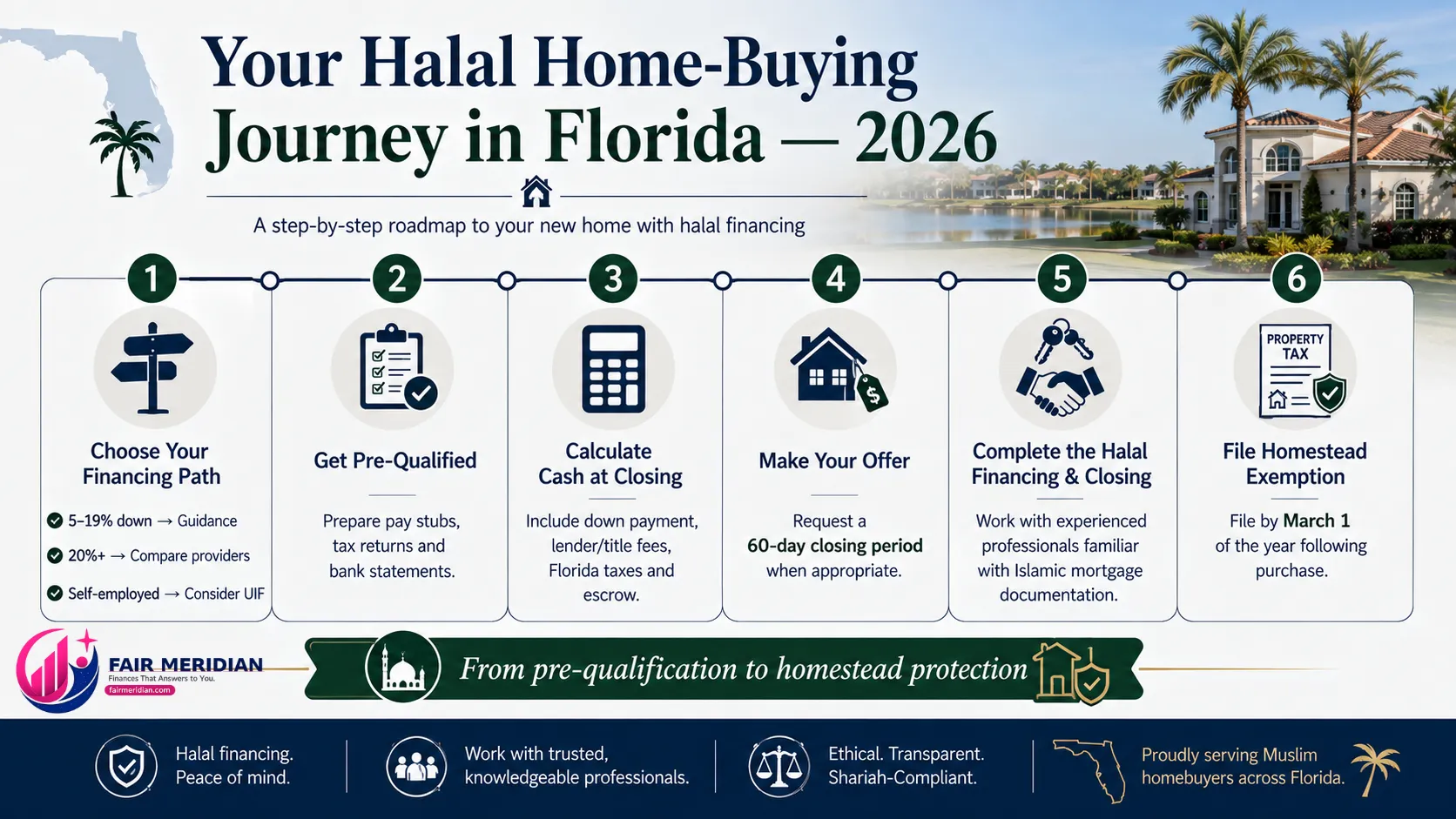
Pre-qualify online at whichever lender fits your situation. The application takes 15–20 minutes. Have your pay stubs, tax returns, and bank statements ready. For the self-employed bank statement path, gather 24 months of complete business statements before you apply — incomplete statements add weeks to processing.
Budget your complete cash at closing — not just the down payment. On a $420,000 Florida home at 5% down through Guidance: down payment $21,000, lender and title fees approximately $10,000–$14,000, Florida doc stamps and intangible tax approximately $2,100, property tax escrow approximately $1,000. Total cash needed at closing: approximately $34,000–$38,000.
Request a 60-day closing period in your purchase offer. Florida real estate agents in Broward County, Orlando, and Tampa are increasingly familiar with halal mortgage timelines — particularly in Muslim community corridors. In competitive Miami-Dade, you may face pressure for faster closings. Explain the Islamic mortgage documentation requirement clearly; most experienced sellers' agents have seen it before.
After closing, file your homestead exemption application immediately — don't wait. The March 1 deadline passes faster than new homeowners expect, and missing it costs you a year's worth of exemption and the Save Our Homes cap protection.
Frequently Asked Questions
Is halal mortgage available in Florida?
Yes. Four halal mortgage lenders serve Florida statewide: Guidance Residential (musharakah, 6.74%, 5% down minimum — the best rate and lowest down payment), UIF Corporation (musharakah, 6.89%, bank statement program for self-employed buyers), Devon Bank (murabaha, 7.10%, FDIC-insured), and Lariba Finance (ijara-based, 6.85%). Florida is well-covered by the halal mortgage market.
Does Guidance Residential serve Florida?
Yes — Guidance Residential is licensed and active in Florida. Their musharakah home financing product with a 5% minimum down payment is available to qualifying buyers throughout Florida. Guidance is Freddie Mac and Fannie Mae approved, making them the largest and most institutionally validated halal mortgage provider in the US market.
What is the minimum down payment for a halal mortgage in Florida?
5% through Guidance Residential — the only halal lender in Florida with a below-20% down payment option. On a $400,000 home: $20,000. On a $500,000 home: $25,000. All other halal lenders in Florida (UIF, Devon Bank, Lariba) require 20% down. Total cash at closing at 5% down on a $400,000 Florida home is approximately $32,000–$36,000 after including closing costs and Florida's documentary stamp taxes.
What is Florida's documentary stamp tax on a halal mortgage?
Florida charges two buyer-paid taxes related to the mortgage note: documentary stamp tax on the note at $0.35 per $100 of loan amount, and an intangible tax at $0.002 per dollar of loan amount (0.20%). On a $380,000 loan: $1,330 in note doc stamps plus $760 intangible tax — approximately $2,090 in Florida-specific buyer taxes at closing. These apply equally to halal and conventional mortgages and should be budgeted separately from lender fees and title costs.
Is it better to buy in Orlando or South Florida for a Muslim family?
Orlando (Kissimmee corridor) offers significantly lower home prices — $350,000–$450,000 versus $480,000–$600,000 in Broward County — and comparable Muslim community infrastructure for Palestinian, Jordanian, and diverse Muslim families. South Florida's Broward County has the more established South Asian Muslim community with deeper halal grocery and mosque infrastructure. The financial case strongly favors Central Florida for buyers who can work remotely or whose employment is in the Orlando area. For families with strong employment ties to South Florida, the community premium in Broward is real and worth the higher price — but the monthly cost difference is approximately $700–$900 in total housing costs.
For current halal mortgage rates from all four Florida providers updated monthly, see our Halal Mortgage Rates USA Guide. For the Guidance Residential full review including the 5% down application process, read our Guidance Residential 2026 Review. For UIF Corporation's bank statement program serving Florida's self-employed Muslim buyers, read our UIF Corporation 2026 Review.