
There are exactly five Sharia-compliant ETFs available to US retail investors in 2026. No more, no fewer. This post ranks all five by their function, performance, and fit for different investor needs — with current AUM, YTD returns, expense ratios, and a clear recommendation for each category.
If you want the single fastest answer: buy SPUS as your core equity holding in a Roth IRA at Fidelity. Everything else in this post explains why, and tells you when the other four ETFs belong in your portfolio.
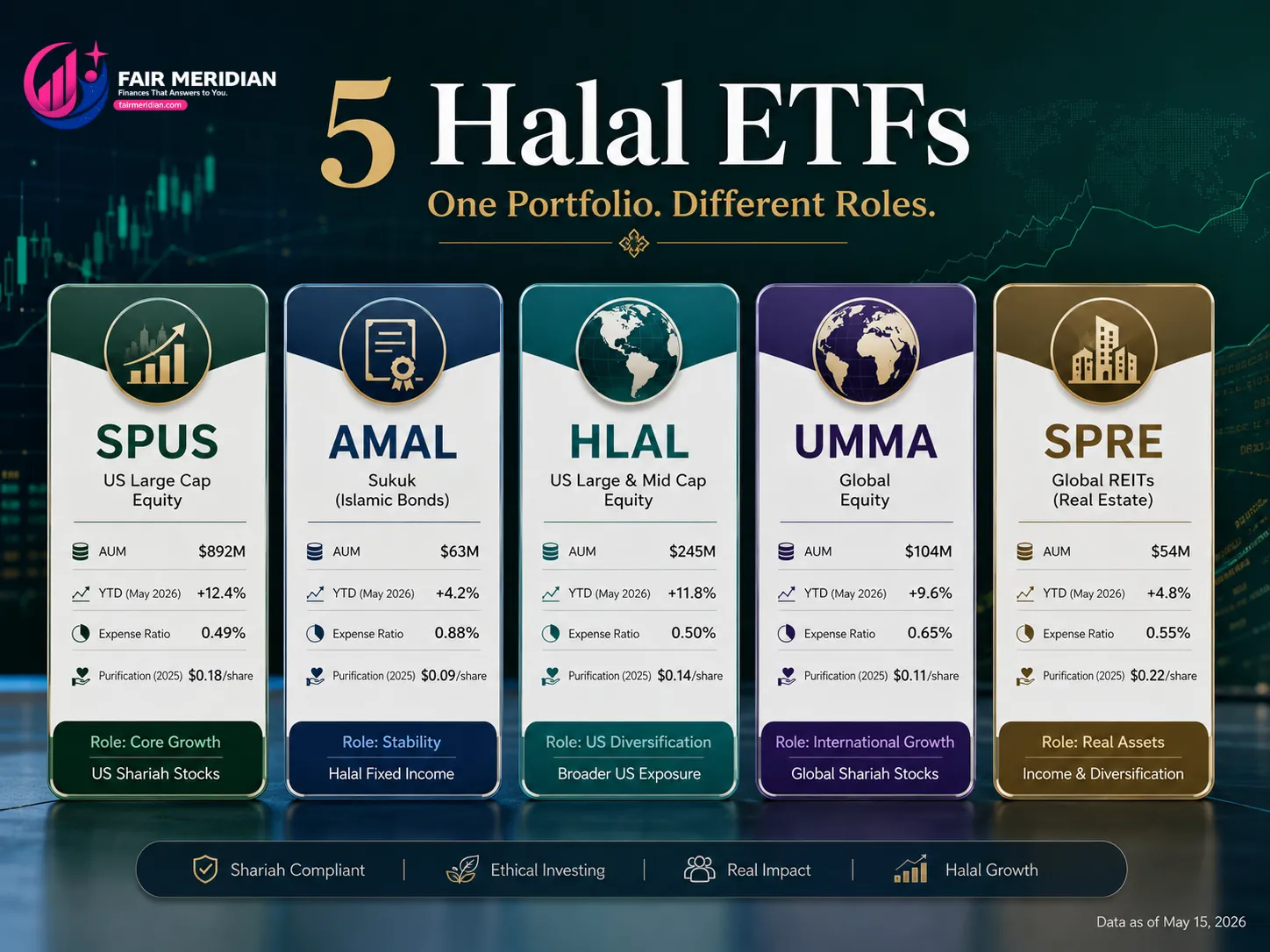
The Five Halal ETFs — At a Glance (May 2026)
Rank | ETF | Ticker | Type | AUM | Expense Ratio | YTD May 2026 | 2025 Purification |
|---|---|---|---|---|---|---|---|
#1 | SP Funds S&P 500 Sharia ETF | SPUS | US Large Cap Equity | $892M | 0.49% | +12.4% | $0.18/share |
#2 | Saturna Al-Kawthar Participation | AMAL | Sukuk (Islamic Bonds) | $63M | 0.88% | +4.2% | $0.09/share |
#3 | Wahed FTSE USA Shariah ETF | HLAL | US Large+Mid Cap Equity | $245M | 0.50% | +11.8% | $0.14/share |
#4 | Saturna Al-Kawthar Global Equity | UMMA | Global Active Equity | $104M | 0.65% | +9.6% | $0.11/share |
#5 | SP Funds S&P Global REIT Sharia | SPRE | Global REITs | $54M | 0.55% | +4.8% | $0.22/share |
Data as of May 15, 2026. YTD returns are approximate based on reported performance. Past performance does not guarantee future results. AUM figures rounded.
1 — SPUS: The Best Halal ETF for Most Investors
SP Funds S&P 500 Sharia Industry Exclusions ETF (SPUS)
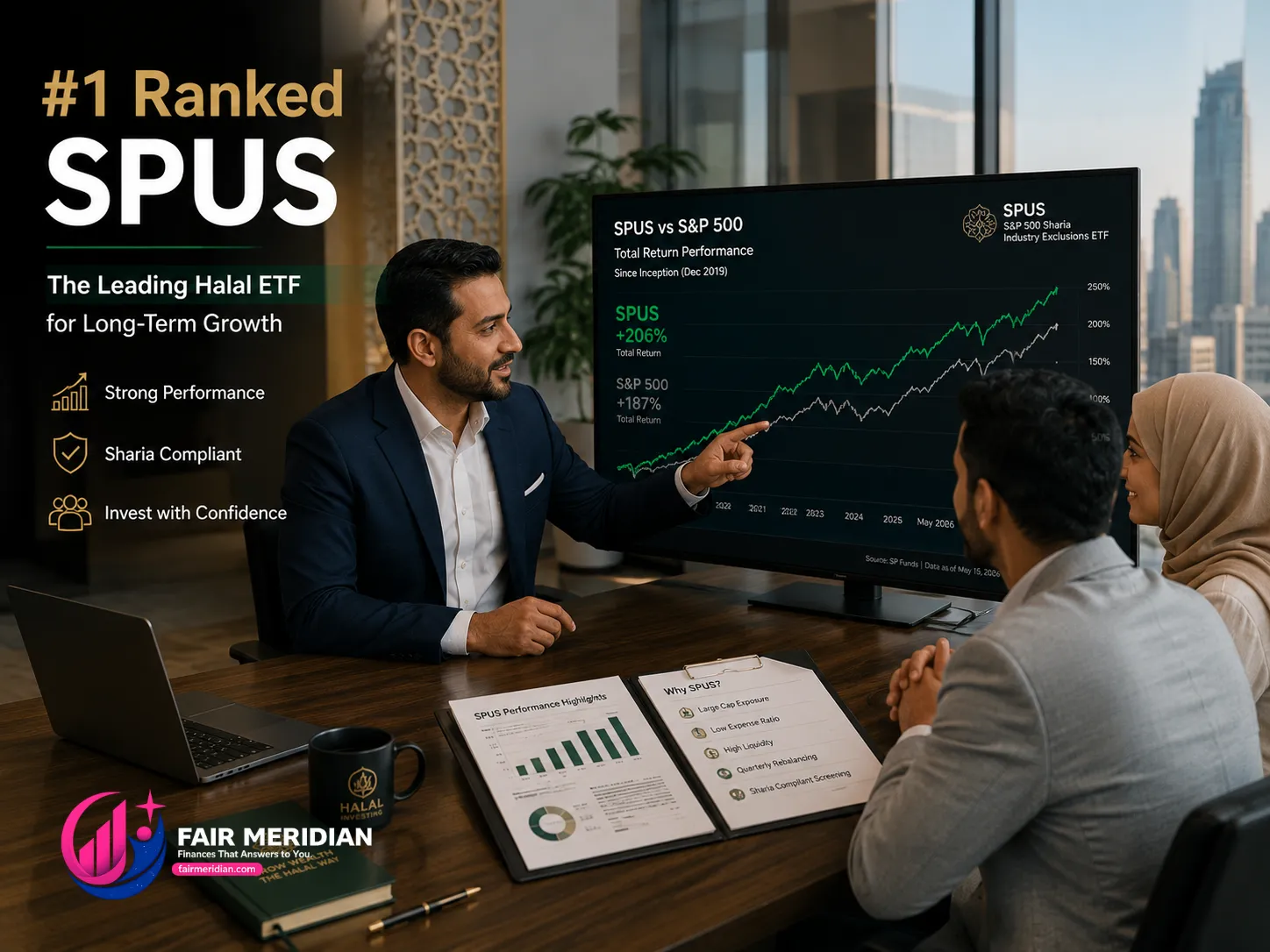
SPUS is the default core halal ETF for the overwhelming majority of US Muslim investors — and the data backs it up. At $892 million in AUM, it is the largest halal ETF in the United States by a factor of 3.6x over its nearest equity competitor. It has returned +12.4% YTD through May 2026, outperforming both the conventional S&P 500 (+10.9%) and every ESG ETF in its category.
What SPUS Does
SPUS tracks the S&P 500 Sharia Industry Exclusions Index — the S&P 500 universe after removing companies that fail AAOIFI-aligned Sharia screening. In practice, this means removing: all conventional banks and financial companies (JPMorgan, BofA, Goldman — the largest exclusions), alcohol producers, tobacco companies, gambling businesses, and any company with interest-bearing debt above 33% of assets or interest income above 5% of revenues.
The result is approximately 290 companies — vs the S&P 500's 503. The fund is heavily concentrated in technology (approximately 38% vs S&P 500's 29%), which has been the primary driver of its outperformance in recent years.
SPUS Key Facts (May 2026)
Metric | Value |
|---|---|
Issuer | SP Funds (Saturna Capital affiliate) |
AUM | $892 million |
Expense Ratio | 0.49% ($49/year per $10,000) |
Sharia Board | Ratings Intelligence Partners |
Rebalancing | Quarterly |
Holdings | ~290 companies |
Top Sector | Information Technology (~38%) |
Financial Sector Weight | ~1.1% (vs S&P 500's ~13.5%) |
YTD May 2026 | +12.4% |
Q1 2026 | +8.2% |
2024 Full Year | +24.4% |
Since Inception (Dec 2019) | ~+206% |
S&P 500 since same date | ~+187% |
2025 Purification Amount | $0.18 per share |
Available At | Fidelity, Schwab, Vanguard, Robinhood — commission-free |
Top Holdings (May 2026)
Apple (~9.8%), Microsoft (~8.9%), Nvidia (~7.4%), Alphabet (~4.6%), Meta (~3.8%), Tesla (~2.9%), Broadcom (~2.7%), Visa (~1.8%), Eli Lilly (~1.7%). No conventional banks. No tobacco. No gambling.
Who Should Buy SPUS
Everyone building a halal portfolio should start here. SPUS is appropriate as a core equity holding for any Muslim investor regardless of age, portfolio size, or investment sophistication. It is the halal equivalent of buying an S&P 500 index fund — the foundational position that everything else builds around.
The One Weakness
SPUS does not provide international exposure, real estate income, or fixed income. It is a US equity fund. A complete halal portfolio needs the other ETFs below to fill those roles.
2 — AMAL: The Best Fixed-Income Alternative
Saturna Al-Kawthar Participation ETF (AMAL)
Every investment portfolio needs both growth assets and stability assets. For conventional investors, the stability component is bonds — interest-bearing debt that generates regular income and cushions equity volatility. For Muslim investors, bonds are prohibited. AMAL is the solution.
AMAL invests in a diversified portfolio of global sukuk — Islamic bonds backed by real assets (infrastructure, corporate assets, real estate). The return comes from rental income on those real assets, not from interest on debt. The fund currently yields approximately 4.2% annually — competitive with conventional short-to-medium term bond funds without a single dollar of interest income.
AMAL Key Facts (May 2026)
Metric | Value |
|---|---|
Issuer | Saturna Capital |
AUM | $63 million |
Expense Ratio | 0.88% ($88/year per $10,000) |
Sharia Board | Saturna Sharia Supervisory Board |
Type | Actively managed sukuk (global) |
Annual Yield | ~4.2% |
YTD May 2026 | +4.2% |
Duration (May 2026) | Moderate — extended slightly in Q1 toward 5-year sukuk |
Rate Sensitivity | Positive for potential Fed cuts in H2 2026 |
2025 Purification Amount | $0.09 per share |
Who Should Buy AMAL
Any Muslim investor who wants a fixed-income component in their portfolio needs AMAL. Start adding AMAL when you are in your 30s (10–15% of portfolio) and increase to 40–55% as you approach retirement. AMAL replaces the role that a conventional bond ETF (BND, AGG, LQD) plays for conventional investors — but with rental income from real assets rather than interest from debt.
The 0.88% Expense Ratio
AMAL's expense ratio is meaningfully higher than the other ETFs in this list. This is the cost of active management of a global sukuk portfolio — sourcing, analyzing, and managing individual sukuk instruments is significantly more resource-intensive than index tracking. For a fixed-income allocation, most investors consider this a necessary cost for the only genuinely halal bond-equivalent available in the US market.
3 — HLAL: The Second US Equity Option
Wahed FTSE USA Shariah ETF (HLAL)
HLAL is SPUS's closest competitor — also a US equity ETF, also Sharia-certified, also holds approximately 300 companies. The differences are methodological: HLAL tracks the FTSE USA Shariah Index (vs SPUS's S&P 500 Sharia Index) and uses total assets rather than market cap as the denominator in its financial ratio tests (making inclusion decisions more stable but potentially less responsive to improving company fundamentals).
HLAL Key Facts (May 2026)
Metric | Value |
|---|---|
Issuer | Wahed Invest |
AUM | $245 million |
Expense Ratio | 0.50% |
Sharia Board | Amanie Advisors |
Holdings | ~318 companies (slightly broader than SPUS) |
Financial Ratio Denominator | Total assets (vs SPUS's market cap) |
YTD May 2026 | +11.8% |
Holdings overlap with SPUS | ~85% |
2025 Purification Amount | $0.14 per share |
SPUS vs HLAL: The One-Sentence Verdict
SPUS as your core holding; HLAL as a secondary position if your portfolio exceeds $25,000 and you want methodology diversification. Never necessary to hold both below that threshold — just own SPUS.
4 — UMMA: International Diversification
Saturna Al-Kawthar Global Focused Equity ETF (UMMA)
SPUS and HLAL are both US-only funds. UMMA provides what neither can: exposure to Sharia-compliant companies outside the United States — Europe, Asia, emerging markets — in a concentrated 25–40 stock actively managed portfolio.
UMMA Key Facts (May 2026)
Metric | Value |
|---|---|
Issuer | Saturna Capital |
AUM | $104 million |
Expense Ratio | 0.65% |
Management | Actively managed (global focused) |
Holdings | 25–40 concentrated global positions |
YTD May 2026 | +9.6% |
2025 Purification Amount | $0.11 per share |
Why UMMA Underperformed in 2026 — And Why That Is Expected
UMMA's +9.6% YTD trails SPUS's +12.4% — but this is an unfair comparison. UMMA is a global fund being compared to a US-only fund during a period when US markets have outperformed international markets. The right benchmark for UMMA is a global equity index, not the S&P 500. Hold UMMA for international diversification, not US equity performance.
Who Should Buy UMMA
Add UMMA when your halal portfolio exceeds $15,000 and you want international exposure. A 10–15% allocation to UMMA alongside 60–70% SPUS provides meaningful geographic diversification without sacrificing the Sharia-screened equity focus.
5 — SPRE: Real Estate Income
SP Funds S&P Global REIT Sharia ETF (SPRE)
SPRE provides exposure to Sharia-screened global real estate investment trusts — companies that own and operate income-producing real estate (warehouses, offices, data centers, industrial facilities). Returns come from rental income distributions (approximately 3.8% annual yield) plus property value appreciation.
SPRE is ranked fifth not because it is poor quality but because most investors should build the other four positions before adding SPRE. Its role — real estate income and inflation protection — is valuable but secondary to core equity (SPUS/HLAL), stability (AMAL), and international exposure (UMMA).
SPRE Key Facts (May 2026)
Metric | Value |
|---|---|
Issuer | SP Funds |
AUM | $54 million |
Expense Ratio | 0.55% |
Type | Global Sharia-screened equity REITs |
Annual Distribution Yield | ~3.8% |
YTD May 2026 | +4.8% |
Key Exclusion | Mortgage REITs — excluded (interest income) |
2025 Purification Amount | $0.22 per share (highest — REITs have more income) |
Q1 2026 Rebalancing | Increased industrial REIT weight; reduced retail |
Why SPRE Excludes Mortgage REITs
Standard REIT ETFs (like VNQ) include mortgage REITs — companies that earn their income from interest on mortgage loans, not from owning real property. SPRE's Sharia screen removes all mortgage REITs because their income is riba. This means SPRE holds only equity REITs — companies that actually own and operate physical properties — making it genuinely Sharia-compliant in a way that conventional REIT funds are not.

The Complete Portfolio: All Five ETFs Together
Here is how all five halal ETFs work together in a complete, age-appropriate portfolio:
Age / Stage | SPUS | AMAL | HLAL | UMMA | SPRE |
|---|---|---|---|---|---|
20s (Aggressive) | 75% | 0% | 15% | 10% | 0% |
30s (Growth) | 60% | 10% | 10% | 10% | 10% |
40s (Balanced) | 50% | 20% | 5% | 10% | 15% |
50s (Conservative) | 35% | 35% | 0% | 5% | 25% |
60s+ (Income) | 20% | 50% | 0% | 0% | 30% |

Where to Buy All Five ETFs
All five halal ETFs are available commission-free at every major US brokerage. The best platform for a Muslim investor building a Roth IRA:
Brokerage | All 5 ETFs? | Fractional Shares? | Roth IRA? | Auto-Invest? |
|---|---|---|---|---|
Fidelity | ✅ Yes | ✅ Yes ($1 minimum) | ✅ Yes | ✅ Yes |
Schwab | ✅ Yes | ✅ Yes | ✅ Yes | ✅ Yes |
Vanguard | ✅ Yes | ✅ Yes (ETF fractional) | ✅ Yes | ⚠️ Limited auto-invest |
Robinhood | ✅ Yes | ✅ Yes ($1 minimum) | ✅ Yes | ⚠️ Limited |
Wahed Invest | HLAL primary + others | Via managed account | ✅ Yes | ✅ Yes (fully managed) |
Our recommendation: Open your Roth IRA at Fidelity. Buy SPUS as your primary holding. Add AMAL once you cross $15,000. Add UMMA and SPRE as your portfolio grows. Fidelity's fractional share feature means you can start with any dollar amount — even $50 — and build up over time.
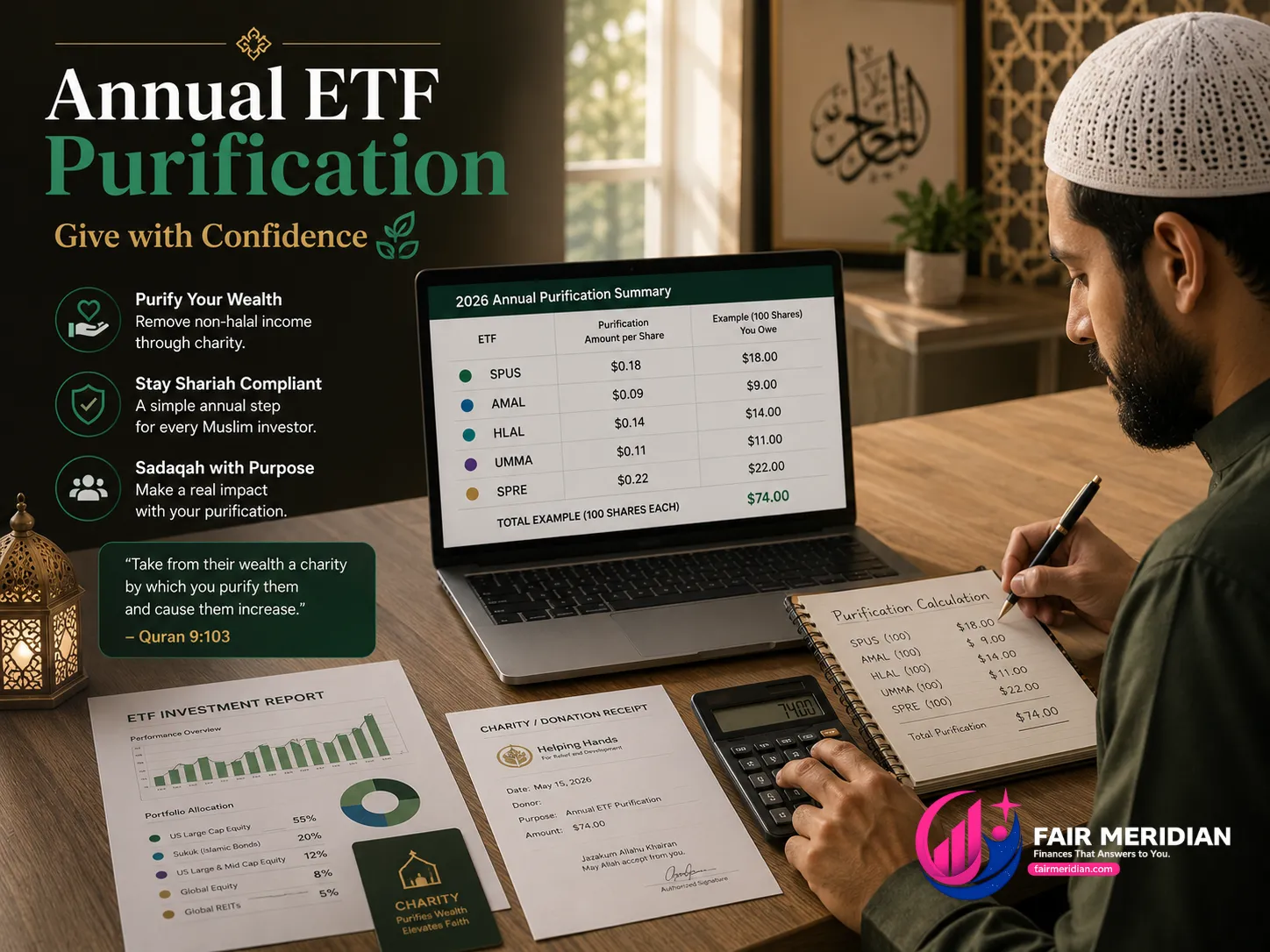
Annual Purification: What You Owe on Each ETF
Every halal ETF investor must calculate and donate an annual purification amount — the portion of investment returns from any residual prohibited income in the underlying holdings. Here are the 2025 published amounts:
ETF | 2025 Purification Per Share | On 100 Shares | On 500 Shares | Source |
|---|---|---|---|---|
SPUS | $0.18 | $18 | $90 | spfunds.com (annual report) |
HLAL | $0.14 | $14 | $70 | |
UMMA | $0.11 | $11 | $55 | |
SPRE | $0.22 | $22 | $110 | spfunds.com (annual report) |
AMAL | $0.09 | $9 | $45 |
Donate the total to any charity. Include it with your annual zakat if convenient. This is not optional — purification is required alongside Sharia-screened investing. Use our Zakat Calculator to track both zakat and purification together.
Frequently Asked Questions
Which halal ETF has the best performance in 2026?
SPUS leads all halal ETFs YTD through May 2026 at +12.4%, followed by HLAL at +11.8%. Both have outperformed the conventional S&P 500 (+10.9%) and all major ESG ETFs. UMMA returned +9.6% (global scope — different benchmark). AMAL and SPRE both returned approximately +4.2–4.8%, reflecting their role as income/stability assets rather than growth assets.
Can I hold multiple halal ETFs in the same account?
Yes — and for a complete halal portfolio, you should. SPUS handles US equity, AMAL handles the fixed-income equivalent, UMMA handles international equity, SPRE handles real estate income, and HLAL provides alternative US equity methodology. All five can be held simultaneously in any brokerage account or Roth IRA. There are no restrictions on holding multiple ETFs together.
Should I buy SPUS or just let Wahed manage my portfolio?
Self-directed at Fidelity with SPUS costs 0.49% annually (fund expense only). Wahed charges 0.29% advisory fee on top of fund expenses — bringing total cost to approximately 0.60–0.75% annually. The self-directed approach is cheaper and gives you more control. Wahed is better if you want everything managed automatically with no decisions required. Both are genuinely Sharia-compliant — the choice is between cost and convenience.
Are there any new halal ETFs launching in 2026?
As of May 2026, no new halal ETFs have launched in the US this year. The five listed above remain the complete universe. Watch the Fair Meridian Halal Market Watch newsletter for any new launches — we will cover them immediately when they occur.

The halal ETF universe is small but more than sufficient to build a complete, diversified, Sharia-compliant portfolio. Start with SPUS in a Roth IRA at Fidelity. Add AMAL for stability as you age. Add UMMA and SPRE as your portfolio grows. That is a complete, halal, tax-efficient retirement strategy that outperformed the conventional S&P 500 in 2026.
For the complete halal investing framework — stock screening, 401k strategies, robo-advisor comparison, and purification guidance — read our full Halal Investing USA 2026 Guide. For a detailed comparison of SPUS and HLAL specifically, read our Halal ETFs Guide.